


Most landscaping owners don't have a marketing problem. They have a timing problem. Leads come in waves—phones ring off the hook in April, go quiet in July, spike again when leaves fall, then die in December. The result is feast-or-famine scheduling, crews standing around in shoulder seasons, and panic-spending on ads right when everyone else is bidding up the same keywords.
This playbook is built to flatten that curve. Not with vague advice like "post more on social," but with actual budgets, ad copy you can paste in, a 12-week calendar, scripts, and a one-page dashboard. If you run between one and twenty-five trucks, this is designed to be implemented by you or your office manager in a few hours a week.
Start With the Math, Not the Tactics
Before you spend a dollar, you need three numbers. Almost nobody running a small fleet actually knows these, which is why ad spend feels like gambling.
-
Average job value (AJV) — your typical one-time job or the annual value of a maintenance account. Say a maintenance account is worth about $2,400/year and a one-time install averages $3,500.
-
Close rate — of the leads you quote, how many become paying customers. For most small landscapers this sits somewhere between 30% and 50%.
-
Target cost per lead (CPL) — what you can afford to pay for a lead and still profit.
Here's the quick way to back into your allowable CPL. If a maintenance customer is worth $2,400/year and stays roughly three years, that's around $7,200 in lifetime value. If you're willing to spend 8–10% of first-year revenue to acquire them, you can afford roughly $200–$240 per booked customer. At a 40% close rate, that means you can spend about $80–$96 per lead and stay healthy.
Write those numbers down. Every channel decision below gets measured against them. A channel that delivers leads under your target CPL stays. One that runs over it gets cut or fixed.
Local SEO & Google Business Profile: The Foundation That Costs Almost Nothing
Paid ads are rented attention. Your Google Business Profile (GBP) and local search presence are owned—they keep working after you stop paying. For small fleets, this is almost always the highest-ROI channel, and it's where you should start.
Never miss a job detail again.
Yardyly helps you plan, confirm, and manage every landscaping project seamlessly.
- Centralized project scheduling
- Automated client updates
- Crew and resource management
No credit card required
Here's a working checklist worth handing to a new office manager on day one:
-
Claim and fully complete your GBP — every field, not just name and phone. Service areas, hours, services list, attributes.
-
Primary category set to "Landscaper" with secondary categories added (Lawn care service, Snow removal service, Tree service) only if you actually offer them.
-
Service area matches reality — list the actual towns/zip codes you serve, not a 50-mile fantasy radius.
-
Add 15–25 real photos — before/after shots, crew working, equipment, completed installs. Refresh monthly.
-
Write detailed service descriptions for each service with the town names worked in naturally.
-
Turn on messaging and assign someone to answer within an hour during business hours.
-
Post weekly — a completed job, a seasonal tip, a promo. Google rewards active profiles.
-
Build review velocity — a steady trickle of reviews beats 40 reviews from one month two years ago.
-
Respond to every review, good or bad, within 48 hours.
-
Consistent NAP (name, address, phone) across your website, Facebook, Yelp, Angi, and local directories.
The landscapers who win local pack rankings aren't the ones with the slickest websites. They're the ones with the most recent reviews and the most consistent GBP activity. A competitor with 60 reviews averaging one new review every two weeks will usually outrank someone sitting on 200 reviews that stopped coming in last summer.
When you ask for reviews, gently prompt customers to mention what you did and where.
One thing most owners miss—reviews that mention the service and the town ("great fall cleanup in Naperville") carry more local relevance weight than a generic five stars. When you ask for reviews, gently prompt customers to mention what you did and where.
Paid Media: The Decision Matrix
Once your GBP foundation is solid, paid media fills the gaps—especially in shoulder seasons when organic leads thin out. The mistake small fleets make is spreading a tiny budget across four platforms and learning nothing from any of them. Pick one or two, fund them properly, measure, then expand.
Here's how the main channels actually compare for a small landscaping fleet:
| Channel | Best For | Typical CPL | Starter Budget | Lead Quality | Effort |
|---|---|---|---|---|---|
| Google Local Services Ads (LSA) | Maintenance + high-intent local jobs | $25–$60 | $800–$1,500/mo | High (ready to book) | Low |
| Google Search Ads | Installs, big-ticket project searches | $40–$90 | $1,000–$2,000/mo | High | Medium–High |
| Meta (Facebook/Instagram) | Seasonal promos, before/after, neighborhoods | $15–$45 | $500–$1,200/mo | Medium (needs nurture) | Medium |
| Nextdoor | Trust-driven, hyperlocal recommendations | $20–$50 | $300–$800/mo | Medium–High | Low–Medium |
Local Services Ads are where most small fleets should start. You pay per lead, not per click, you get the Google Guaranteed badge, and the leads are people who clicked to call or message right now. The catch is you have to pass a background/license check and keep your response time fast—miss calls and Google quietly throttles your lead flow.
Google Search Ads make sense when you're chasing higher-ticket work. Someone typing "paver patio installation near me" is worth real money. But Search requires tighter management—negative keywords, landing pages, bid control—or you'll burn cash on "landscaping jobs hiring" clicks.
Meta is where seasonal promos shine. It's not great for "I need someone today" intent, but it's excellent for planting a seed before spring and for retargeting people who visited your site.
Nextdoor punches above its weight for trust. In tight suburban neighborhoods, a recommendation thread can drive a cluster of jobs on the same street—which also cuts your drive time.
Sample Ad Copy You Can Steal
> Reliable Lawn Care in [Town] — Free Quote in 24 Hrs > Licensed & insured local crew. Weekly mowing, cleanups & more. Trusted by 200+ neighbors. Call or book online today.
> Spring's coming fast. Lock in your 2025 mowing schedule now and save 10% on your first month. Local crew, same team every visit, no contracts to cancel. Tap to grab a spot before routes fill up. 🌱
> Hi neighbors! We're [Company], a local family-run crew already working a few streets over. Booking spring cleanups and weekly mowing now—happy to give free quotes to anyone nearby. Just message us.
The LSA/Search copy leads with intent and proof. The Meta copy leads with urgency and scarcity. The Nextdoor copy leads with proximity and neighborliness. Selling the same thing differently on each platform is the whole game.
The 12-Week Seasonal Campaign Calendar
This is the part most owners never build, and it's why their marketing feels reactive. A simple rolling calendar means you're always promoting the next season before it arrives—when demand is forming, not after competitors have scooped the work.
Weeks 1–3: Spring Pre-Season (run in late winter)
-
Promo "Lock your 2025 schedule" early-bird maintenance discount.
-
Channels Email to past customers, Meta to local neighborhoods, GBP posts.
-
Goal Fill your route density before April chaos.
Sample email:
> Subject: Your spot on our spring route is open (for now) > Hey [Name], our 2025 schedule is filling up and we wanted to give past customers first pick. Reply "spring" and we'll hold your weekly slot—plus take 10% off your first month if you book by March 1. Same crew, same quality, zero hassle.
Weeks 4–6: Spring Peak
-
Promo Cleanup + mulch bundle. Upsell add-ons.
-
Channels LSA and Search cranked to full budget (highest intent window of the year).
-
Goal Max booked jobs; this is where you make your year.
Weeks 7–9: Summer Steady
-
Promo Irrigation checks, flower bed refreshes, referral push.
-
Channels Nextdoor, referral program, light Meta.
-
Goal Keep crews full through the mid-season dip and generate word-of-mouth.
> Hi [Name], it's [Company]. Lawn looking good this summer? If you know a neighbor who could use us, send them our way—you'll both get $25 off next service. Just have them mention your name. 🙌
Weeks 10–12: Fall Transition
-
Promo Fall cleanup, aeration/overseeding, "book snow removal now."
-
Channels LSA, email, GBP posts, Meta before/after of cleanups.
-
Goal Capture the second demand spike and pre-sell winter.
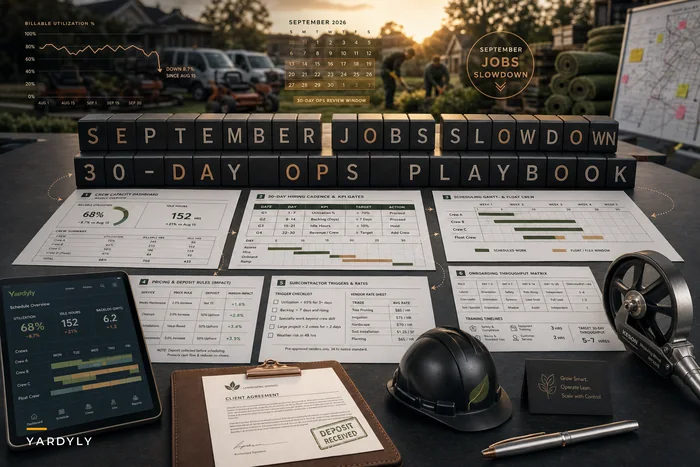
The quieter stretch between fall and spring is also when a lot of owners get blindsided by the seasonal slowdown. If that's hitting you hard, the hiring and scheduling moves in our guide to the September jobs slowdown pair directly with this calendar.
Landing Page Checklist (every campaign points here)
-
Headline matches the ad promise exactly (no bait-and-switch)
-
One clear call to action above the fold ("Get My Free Quote")
-
Phone number clickable on mobile
-
Short form — name, phone, zip, service needed. That's it.
-
3–4 real before/after photos
-
Trust signals
reviews, "licensed & insured," years in business
-
Loads in under 3 seconds on a phone
Conversion targets: A decent landscaping landing page converts visitors to leads at 8–15%. Below 5%, something's broken—usually a slow page, a long form, or a headline that doesn't match the ad.
A useful way to think about the full campaign flow, from ad click to booked job, is as a straight line with no unnecessary steps: ad → landing page → form or call → same-day follow-up → quote → close. Every extra step or delay in that chain costs you jobs.
Referral & Partnership Scripts That Actually Get Used
Paid media buys leads. Partnerships compound them. The highest-margin leads a small fleet gets rarely come from ads—they come from people who send you work repeatedly. Most owners never actually ask, or they ask once and never follow up.
Two partnership types are worth your time: real estate agents (they need yards fixed fast before listings) and HOAs/property managers (recurring volume on one route).
Real estate agent script:
> "Hi [Name], I run [Company], a local landscaping crew. I work with a few agents who need yards cleaned up fast before a listing goes live—curb appeal stuff that helps homes show better. I can usually turn a cleanup around in 2–3 days. If you ever have a listing that needs help, send it my way and I'll make you look good. Can I drop off a couple cards?"
HOA / property manager script:
> "Hi [Name], I'm [Your Name] with [Company]. We handle grounds maintenance for a few communities nearby and I'd love to be on your bid list for the next renewal. We're licensed, insured, and we keep the same crew on your property so nothing slips. Even if you're happy now, having a reliable backup bid never hurts. Could I send over a quick capabilities sheet?"
A note on HOA and property manager work: the volume is great but the pricing discipline has to be tight, because these contracts lock you in for a year. Before you chase them, it's worth reviewing the common pricing governance mistakes that quietly kill renewals—especially around annual escalators and account-level rules.
Suppliers are the third, underused partnership. Your mulch yard, nursery, or irrigation supplier talks to homeowners and contractors all day. A simple reciprocal arrangement—you refer clients to them, they hand your cards to walk-ins—costs nothing and runs on trust.
Low-Cost Offline Tactics (Don't Skip These)
Digital gets the attention, but offline tactics still produce for landscapers because the work is so visibly local. Your trucks and your job sites are advertising you're already paying for—you might as well make them work.
| Tactic | Rough Cost | Expected Return | Notes |
|---|---|---|---|
| Vehicle wraps | $2,500–$4,000/truck | ~$0.50 CPM equivalent | Cheapest long-term ad you'll ever run. Lasts 5+ years. |
| Yard signs | $4–$8/sign | 1 call per 15–30 signs posted | Post at completed jobs with permission. |
| Local paper inserts | $300–$700/run | Low but hyperlocal | Works in older suburban markets; dead in young urban ones. |
| Door hangers | $0.15–$0.40 each | ~0.5–2% response | Hit the streets right around a job you just completed. |
The single best offline move for route density is the yard-sign-plus-door-hanger combo on a street where you just finished a job. Neighbors already saw your crew working. A sign in the yard and hangers on the five closest houses turns one job into a cluster. A single well-placed cleanup can generate two or three neighbor calls within a week, and it tightens your routing at the same time.
Lead Nurture SOP: Where Most Small Fleets Quietly Bleed Money
Most landscaping owners don't have a lead generation problem. They have a lead follow-up problem. Leads come in, someone's on a mower, nobody calls back for two days, and the lead already hired the guy who answered. Industry-wide, the business that responds first wins the job more often than the business with the better price.
The fix is a boring, written cadence that doesn't depend on anyone remembering.
The follow-up cadence:
-
Within 5 minutes — call or text the new lead. (First responder wins.)
-
If no answer, same day — send a text
"Hi [Name], it's [Company]—got your request for a quote. When's a good time to swing by?"
-
Day 1 — second call attempt + email with a photo of similar work.
-
Day 3 — "Still want that quote?" text.
-
Day 7 — final nudge with a small incentive ("Book this week, save 10%").
-
Day 30 — move to monthly nurture list for seasonal promos.
Phone script for the first call:
> "Hi [Name], this is [Your Name] from [Company], thanks for reaching out! I saw you're looking for [service]. I've got a crew in your area this week—want me to swing by and get you a quick quote? Takes about ten minutes and there's no obligation."
Benchmarks to hold yourself to:
-
Speed to first contact
under 5 minutes for 80%+ of leads
-
Lead-to-quote rate
70%+ (you quote most leads who respond)
-
Quote-to-close rate
35–50%
-
Leads touched the full cadence
100% (no lead falls through)
This is also where a shared, tracked pipeline matters more than any clever ad. When leads live in one place—who called, who got quoted, who's due for follow-up—with reminders firing automatically, nobody has to remember to chase them. A lot of small fleets run this inside their field management or scheduling software so follow-up tasks show up next to the day's jobs instead of on a sticky note that dies in a truck cupholder. The point isn't the tool; it's that the cadence runs whether or not anyone's thinking about it.
When your pipeline and your dispatch live in the same system, you also stop the classic collision where a lead gets booked but no crew's actually free. If that sounds familiar, the manual-override and surge logic in our dispatch policies breakdown keeps bookings from outrunning capacity.
Here's a quick visual of the follow-up workflow.
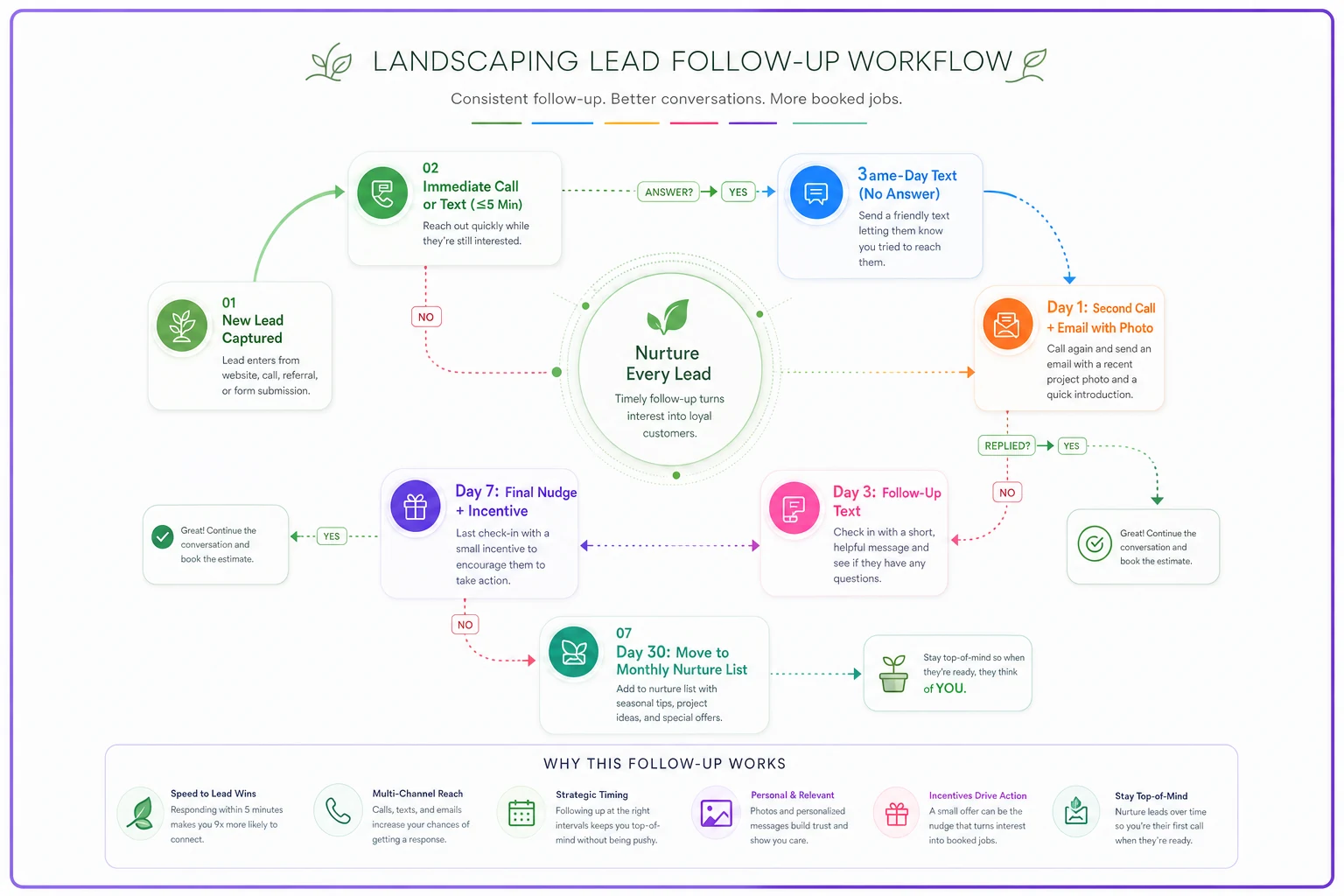
The point isn't the tool; it's that the cadence runs whether or not anyone's thinking about it.
The One-Page Measurement Dashboard
If you can't see it, you can't fix it. The owners who run marketing profitably all track roughly the same handful of numbers—weekly during season, monthly off-season. You don't need software for this; a spreadsheet works. What matters is that the numbers get looked at.
| KPI | Target Range | Red Flag |
|---|---|---|
| Cost per lead (CPL) | At or under your allowable (~$80 maintenance) | 25%+ over target |
| Cost per booked job | $150–$250 | Climbing 2 months straight |
| Lead-to-quote rate | 70%+ | Under 50% |
| Quote-to-close rate | 35–50% | Under 30% |
| Speed to first contact | Under 5 min | Over 1 hour |
| Review velocity | 4–10 new/month | Zero for 30 days |
| Marketing % of revenue | 5–10% | Over 12% with flat bookings |
| Return/referral rate | 20%+ of new jobs | Under 10% |
Review this on the same day each week. The goal isn't a pretty report—it's catching a channel going sideways before it eats a month of budget. If your Meta CPL doubles for two weeks running, pause and diagnose instead of finding out at month-end that you burned $900.
A Real Scenario: Flattening the Feast-or-Famine Curve
A five-truck operation outside a mid-sized metro ran maybe 60% of their year on April and October panic-marketing—blasting Google Ads only when the phone went quiet, then turning everything off when busy. Summer had crews idling two or three days a week.
They changed three things. First, they built the GBP foundation properly and set an office rule: every finished job gets a review request by text the same evening. Reviews went from a trickle to roughly 6–8 a month, and they started showing up in the local pack for their key towns. Second, they moved their main ad spend to Local Services Ads and ran it year-round at a steady ~$1,000/month instead of bursting it. CPL settled around $40–$55. Third—and this did the most—they put the lead cadence in writing and tied follow-up reminders to their scheduling board, so no lead sat more than an hour without a touch. Their close rate on quoted jobs climbed from somewhere in the low 30s to the mid-40s.
Net effect over a season: summer idle days dropped sharply, the fall and spring spikes got pre-sold instead of panic-sold, and their cost per booked job came down because organic and referral work carried more of the load. Nothing exotic—just a foundation, a steady channel, and a follow-up system that actually ran.
Where to Start This Week
Don't try to do all of this at once—that's how good plans die in a truck cupholder. The honest order of operations for a small fleet:
-
Nail your GBP and turn on the same-day review request. (Free, highest ROI.)
-
Write down your lead follow-up cadence and make one person own it.
-
Launch one paid channel—LSA for most of you—funded properly, measured weekly.
-
Build the 12-week calendar so you're always selling the next season.
The landscapers who generate predictable leads year-round aren't spending more than everyone else. They're just doing the unglamorous parts consistently—answering fast, asking for reviews, promoting the next season early, and watching a handful of numbers. None of it requires an agency. It just requires that the system runs whether you're in the office or on a mower.
The landscapers who generate predictable leads year-round aren't spending more than everyone else. They're just doing the unglamorous parts consistently—answering fast, asking for reviews, promoting the next season early, and watching a handful of numbers. None of it requires an agency. It just requires that the system runs whether you're in the office or on a mower.
Ready to grow your landscaping business?
Join 2,000+ landscaping pros using Yardyly to save time, reduce task chaos, and deliver outstanding client results.