



The September numbers landed soft. Nonfarm payrolls came in at just 29,000 new jobs, way under expectations, and unemployment nudged up to 4.2%. Reuters called it a sharp slowdown in hiring with wage growth starting to flatten. For most people, that headline fades by lunch. For a landscaping owner heading into fall cleanups, leaf season, and early snow contracts, it changes the math on decisions you probably already have sitting on your desk.
A softer labor market doesn't automatically mean "good" or "bad" for your business. It shifts your leverage. And whether that shift helps or burns you depends entirely on how clean your capacity and pricing decisions already are. A slowdown just exposes whoever was staffing and bidding on gut feel.
So — what actually changes operationally, where the real risk hides, and what moves are worth making over the next few weeks.
What actually shifts for landscaping specifically
Landscaping hiring was already weird. You're competing with construction, warehouses, delivery, and fast food for the same pool of workers, and your work is seasonal and physical. When the broader job market runs hot, you lose people mid-season to anyone offering a dollar more or indoor AC. When it cools — like now — a few things tilt in your favor and a few things get harder.
What tends to improve:
-
Candidate flow picks up. More applicants per posting, less ghosting.
-
Retention leverage goes up. People hold onto jobs tighter when the market feels uncertain, so your existing crew is less likely to jump.
-
Wage pressure eases. You're not getting into bidding wars over a laborer the way you were 18 months ago.
What gets trickier:
-
Demand softens too. A cooling labor market usually signals consumers pulling back. Residential clients delay the optional stuff — the new patio, the full bed redesign — and stick to must-do maintenance.
-
Commercial clients start renegotiating or stretching contract terms.
-
Financing costs on new equipment stay unpredictable while everyone waits on the Fed.
So you get easier hiring at exactly the moment demand might soften. That's the trap. The instinct is "great, labor's cheaper and available, let's staff up." But staffing up into flat or shrinking demand is how you end up carrying crews you can't bill out.
The real problem a slowdown exposes: hiring decisions tied to feelings, not triggers
Crew-size decisions at a lot of small operations get made emotionally. You add someone because last Tuesday felt chaotic. You hold off because cash felt tight in August. Neither decision is necessarily wrong — they're just not tied to anything you can check later.
Never miss a job detail again.
Yardyly helps you plan, confirm, and manage every landscaping project seamlessly.
- Centralized project scheduling
- Automated client updates
- Crew and resource management
No credit card required
A soft hiring market punishes this harder than a hot one. In a hot market, if you over-hired, people quit on their own and the problem self-corrects. In a cooling market, nobody quits. You're stuck paying for the extra capacity until you make the cut — which is emotionally harder and usually happens too late.
A typical example looks like this: a 3-crew operation adds a fourth crew in late September because fall cleanup bookings looked strong on paper. But a chunk of those were one-time cleanups, not recurring work. By mid-November the one-timers are done, snow hasn't fully kicked in, and that fourth crew is running at maybe 50–60% billable hours. That's roughly $6k–$9k a month in payroll and truck costs carrying barely-utilized labor. And because the broader market is soft, nobody's leaving voluntarily to ease the squeeze.
The underlying issue isn't the hire. It's that the decision wasn't gated. There was no clear line that said "add a crew only when X is true for Y weeks."
Build the decision around utilization, not headcount anxiety
The cleaner way to think about fall staffing is backlog and billable utilization — not whether things feel busy. Before adding anyone, you want to see your existing crews running at genuinely high billable utilization, consistently, not just for one spike week.
A simple framing for heading into a soft market:
| Signal | Add a crew | Hold / use overtime | Outsource a slice |
|---|---|---|---|
| Billable utilization (existing crews) | 85%+ for 3+ weeks | 75–85% | 80%+ but seasonal spike only |
| Backlog depth | 3+ weeks of committed recurring work | 1–2 weeks | Short, defined project burst |
| Work type | Mostly recurring/contracted | Mix | One-time or specialty (hardscape, large installs) |
| Demand trend | Flat-to-up bookings | Flat | Up but temporary |
The key column in a cooling market is that middle one. When labor is soft and demand is uncertain, "hold and use overtime" becomes the safer play far more often than it does in a boom. Overtime is expensive per hour but it's variable — you can turn it off next week. A new hire is a fixed commitment you'll have to actively unwind.
Track utilization weekly to avoid hiring on a single spike.
This is also the moment to lean on outsourcing for the lumpy stuff. If you've got a big install or a hardscape project, sub it out rather than hiring permanent crew for a job with a clear end date. I went deeper on the full framework for this in when to add crews, outsource, or pause sales — those capacity gates matter even more when hiring is easy but demand is shaky, because easy hiring tempts you to skip them entirely.
Below is a simple decision workflow to visualize the add vs overtime vs outsource call.
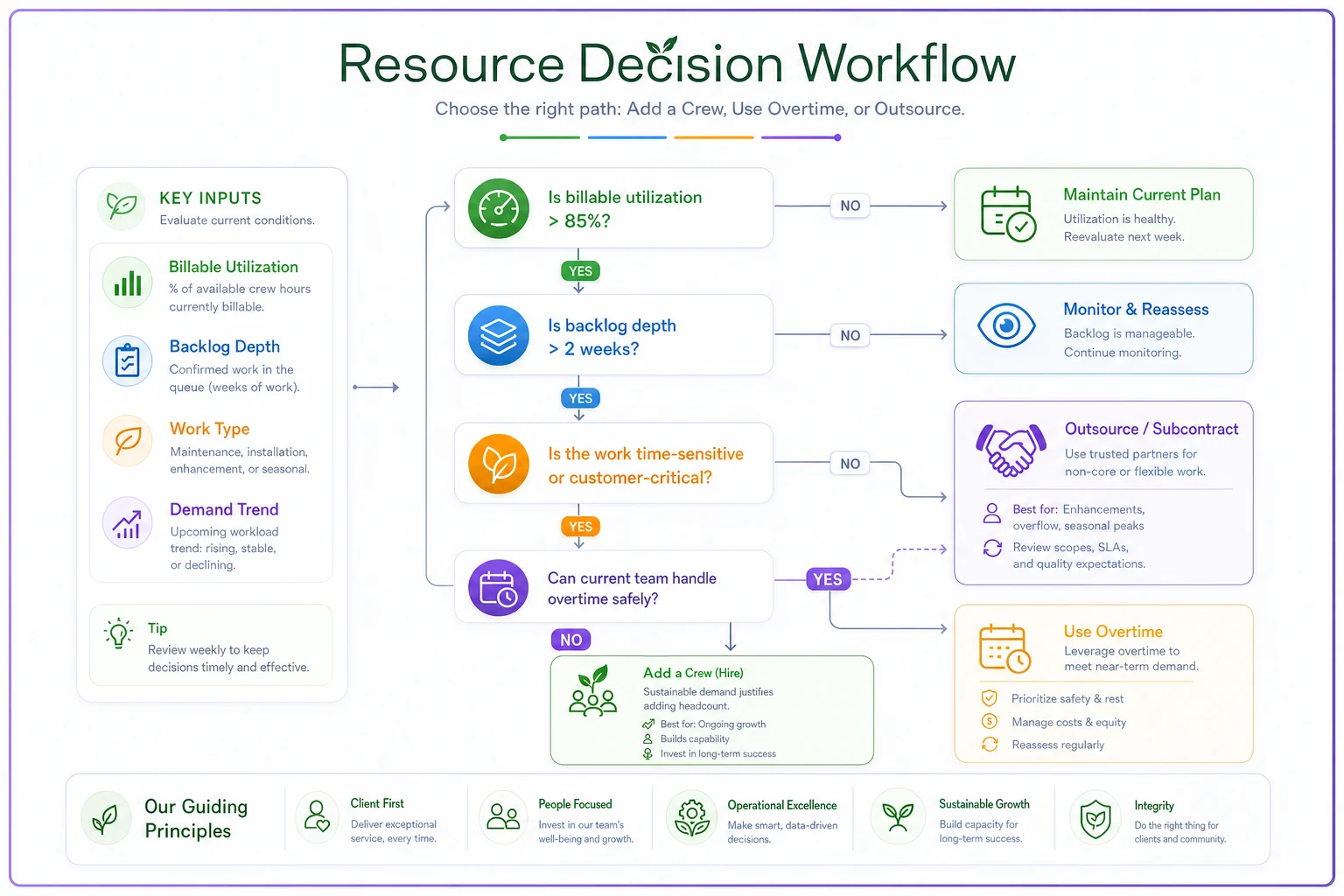
Use the workflow to check utilization, backlog and work type before making a hire.
Use the retention window before you use the hiring window
A soft labor market is a better time to keep good people than to find new ones. Your experienced crew leads are worth more than three fresh laborers in the fall rush, and right now they're less likely to be fielding offers.
Before you post a single job, do a quiet retention pass:
-
Lock in your best crew leads for the fall/winter stretch with a clear hours commitment, so they're not nervous about seasonal slowdown.
-
If you run any productivity-based pay, make sure the minimum guarantees are visible — in an uncertain market, people care more about floor than ceiling.
-
Have the "what does winter look like for you" conversation now, before November, so nobody's quietly lining up a warehouse job.
The owners who get hurt when the market cools aren't usually the ones who can't find labor — it's the ones who lost a seasoned lead in August and are now trying to rebuild that knowledge with green hires while demand is flat. Retention is cheaper and faster than replacement, and the window where your people are least likely to leave is right now.
Pricing and bids: don't let soft demand panic you into discounting
A cooling market makes people nervous, and nervous owners discount. That's usually the wrong reflex. CNBC's preview of the September report flagged moderating wage growth — worth sitting with, because your labor cost pressure is easing a little, but so is your clients' spending confidence. If you slash prices to chase soft demand, you give up margin at the exact moment your own cost relief is small and temporary.
Better approach for fall/winter bids:
-
Hold your maintenance pricing. Recurring work is your stability. Don't discount the contracts that carry you through winter.
-
Repackage the optional work instead of cutting it. Instead of knocking 15% off a bed redesign, offer to phase it — do the structural part now, plantings in spring. Same total revenue, lower upfront ask, easier yes for a cautious client.
-
Build a little cost uncertainty into longer bids. For anything touching equipment purchases or extending into next spring, leave yourself an escalation clause. Financing costs and material prices are still unsettled.
-
Protect your deposit and milestone terms. Soft markets mean slower-paying clients. This is the wrong time to loosen payment structure to win a bid.
The owners who come out of a slowdown strongest usually hold price and adjust structure — phasing, deposits, packaging — rather than caving on the number.
A short real scenario
A mid-size operation running 4 crews in a suburban market went into last fall with the "labor's available, let's grow" mindset. They hired two extra laborers in September and quoted aggressively — shaving maintenance renewals by about 10% to lock clients down against a soft economy.
By December the problems stacked: the discounted renewals meant roughly $11k less contracted revenue across the account base, and the two extra laborers were running well under full billable hours once one-time cleanups dried up. They weren't quitting either, because the market was cold. The owner ended up doing layoffs in January — the hardest possible timing — and walked into the next renewal cycle with a client base anchored to discounted rates.
How it should have gone: hold renewal pricing, cover the fall spike with overtime plus one subbed-out install, and only convert overtime into a permanent hire if billable utilization held above roughly 85% into the winter contracts. Same busy season, none of the January bleeding.
The difference wasn't effort or market conditions. It was whether the hiring and pricing calls were gated or reactive.
When staffing up actually makes sense right now
A soft labor market is a real opportunity in specific cases. Adding crew now makes sense when:
-
Your existing crews are genuinely maxed — 85%+ billable for several weeks, not one hot stretch.
-
Your backlog is recurring and contracted, not one-time cleanups.
-
You've got committed winter work — snow, commercial maintenance — that bridges the gap between fall and spring.
-
You have the seasoned lead capacity to actually train and supervise new hires without dropping quality.
In that situation, cheaper and more available labor with less turnover risk is a real advantage. The point isn't "don't hire." It's "don't let easy hiring substitute for an actual capacity decision."
Where this gets hard: you can't gate what you don't measure
Everything above assumes you can see billable utilization, backlog depth, and crew-level profitability clearly. A lot of operations can't — the numbers live across spreadsheets, a scheduling whiteboard, and the owner's head. When that's the case, every hiring and pricing call gets made on feel, which is exactly what a cooling market punishes.
This is where having scheduling, time tracking, and job costing in one operational system starts to matter more than it sounds. When utilization and backlog are visible in real time, the "add a crew vs. run overtime vs. sub it out" decision stops being an argument and becomes a number you can check. You're not trying to remember how busy last week felt — you're looking at whether crews actually billed 85% of their hours. That's the whole difference between gating a decision and guessing at one.
Bottom of the season checklist
Before you make your next fall staffing or pricing move, run through this:
-
[ ] Pull billable utilization per crew for the last 3–4 weeks
-
[ ] Separate recurring/contracted backlog from one-time work
-
[ ] Have retention conversations with your crew leads before posting jobs
-
[ ] Check that productivity-pay floors and minimums are clearly communicated
-
[ ] Default to overtime or subbing for seasonal spikes before permanent hires
-
[ ] Hold maintenance renewal pricing — adjust structure, not the number
-
[ ] Add escalation terms to bids extending into spring
-
[ ] Confirm winter/bridge work before adding fixed labor cost
A cooling labor market hands you cheaper, stickier labor and a jumpier client base at the same time. Neither one tells you what to do. Your own utilization numbers do. Make the slowdown work for you by tightening the gate on every hire and every bid — the operators who treat this as a chance to staff up and discount their way through usually find out in January that the easy decisions were the expensive ones.
A cooling labor market hands you cheaper, stickier labor and a jumpier client base at the same time. Neither one tells you what to do. Your own utilization numbers do. Make the slowdown work for you by tightening the gate on every hire and every bid — the operators who treat this as a chance to staff up and discount their way through usually find out in January that the easy decisions were the expensive ones.
Ready to grow your landscaping business?
Join 2,000+ landscaping pros using Yardyly to save time, reduce task chaos, and deliver outstanding client results.