

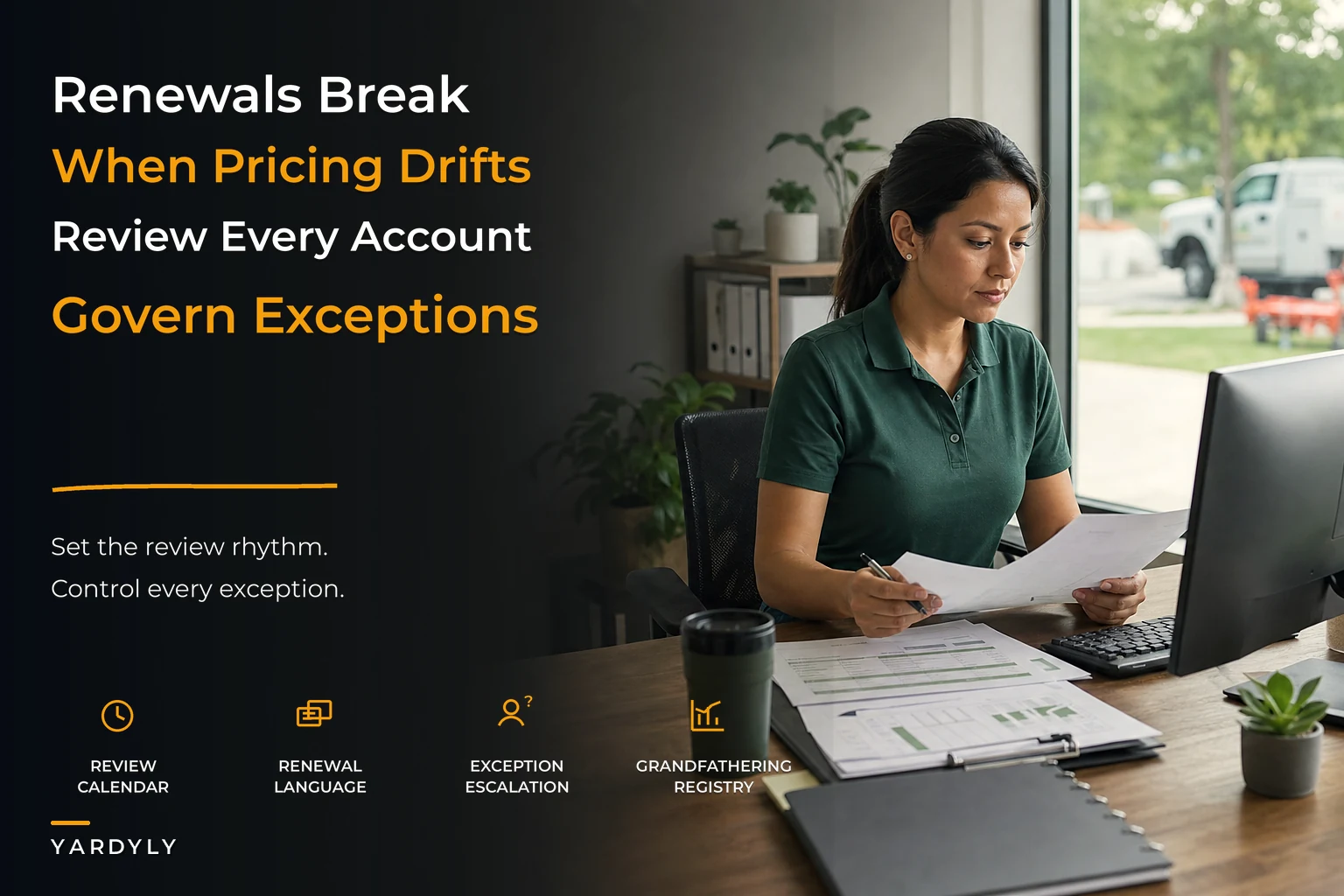

Most landscaping businesses don't have a pricing problem. They have a pricing governance problem. The difference matters. A pricing problem means your numbers are wrong. A governance problem means nobody knows who's allowed to change the numbers, when they change, what the default is when nothing gets reviewed, and which of the 40 special deals from three years ago are still floating around your accounts receivable like ghosts.
You can have a perfectly good pricing model and still bleed margin every renewal cycle because the rules around the rules were never written down. That's the gap this article is about.
The tricky part is that governance failures don't announce themselves. Nobody sends you an invoice for "money lost to inconsistent renewals." It shows up as slow erosion — a commercial account that's been at the same rate since 2021, a residential client paying $38 a cut while the neighbor two doors down pays $52 for the same lawn, a "one-time discount" your sales guy gave that somehow became permanent. None of these feel like emergencies. Together they can quietly eat a real chunk of your net.
The core failure: pricing changes without a system that decides them
Here's the pattern that shows up across landscaping operations of almost every size. Pricing gets set deliberately when a client signs. Then it just... sits. Nobody revisits it. The client keeps paying, the crew keeps mowing, and the number becomes invisible.
Meanwhile your costs don't sit still. Fuel moves. Labor moves — usually up, and fast. Disposal fees creep. Insurance renews higher. Your actual cost to service a $145/month property in year one is not your cost in year three. But the price never got the memo, because there was no mechanism forcing anyone to look at it.
-
No trigger. Renewals roll automatically or informally, so there's no moment that forces a decision.
-
No owner. When everyone can approve a price and nobody is responsible for reviewing prices, review doesn't happen.
-
No memory. Special deals get made in trucks, texts, and hallway conversations. There's no registry, so nobody knows what promises exist.
-
Fear of the conversation. Owners avoid raising prices on long-term clients because they don't want the awkward call, so they let it ride another year. And another.
None of these are pricing math failures. They're process failures. And process failures compound at scale.
What actually breaks as you grow
At two crews, you can hold pricing in your head. You know the weird accounts. You remember that the church gets a discount and the property manager down the road negotiated a flat rate that's honestly a little tight. Governance is informal and it mostly works because you are the governance.
Never miss a job detail again.
Yardyly helps you plan, confirm, and manage every landscaping project seamlessly.
- Centralized project scheduling
- Automated client updates
- Crew and resource management
No credit card required
That stops working somewhere around the point you can't personally recall every account's terms — usually when you cross into multiple crews and a real book of recurring clients. Now you've got estimators quoting, an office manager handling renewals, maybe a salesperson closing new work. Each of them is making pricing decisions with their own logic and their own tolerance for discounts.
-
Discount drift. Salespeople discover discounting closes deals faster, so quotes creep downward. Nobody tracks the cumulative effect until margin reports look off.
-
Renewal inertia. The office is busy, so renewals go out at last year's rate because that's the path of least resistance. A 4% cost increase you never passed through is a 4% margin cut you volunteered for.
-
Exception sprawl. One-off accommodations multiply. Each one made sense in the moment. Collectively they're a spreadsheet nobody's ever built.
-
Inconsistency clients notice. Neighbors talk. HOA board members talk. When two similar properties are paying wildly different rates for no defensible reason, you eventually get a very uncomfortable phone call.
The connective tissue here is that pricing governance touches almost everything else — service-line profitability, how you structure tiered recurring maintenance prices, and how tightly your commercial bids hold up over a multi-year term. Governance is the layer that keeps all of those from decaying once they're live.
The four pieces of a working pricing governance system
You don't need a corporate pricing committee. You need four small, boring mechanisms that force decisions to happen on purpose.
The single highest-leverage fix is putting pricing review on a calendar so it happens whether or not anyone feels like doing it.
1. An annual review calendar
The single highest-leverage fix is putting pricing review on a calendar so it happens whether or not anyone feels like doing it. Not "we'll look at prices when we get a chance." A specific window, a specific owner, a specific list of accounts to touch.
Most landscaping operations should tie this to their season. A common rhythm looks like this:
| Timing | Action | Owner |
|---|---|---|
| Late fall (post-season) | Pull cost data, calculate actual cost-to-serve by account tier | Owner / bookkeeper |
| Early winter | Set next-year rate adjustments and default increase % | Owner |
| Mid-winter | Send renewal notices with new pricing | Office manager |
| Pre-season | Handle pushback, escalations, and exceptions | Owner + sales |
The point isn't the exact calendar — it's that the review is scheduled and assigned. The most expensive words in this business are "we meant to raise that one."
Set a default annual increase as your baseline, not your ceiling.
That way the question flips. Instead of "should we raise this account?" — which invites doing nothing — it becomes "is there a reason not to apply the standard increase here?" Inertia now works for you.
2. Default renewal language
Half your renewal battles are avoidable if the contract already says prices adjust. When your agreement is silent on increases, every raise becomes a negotiation. When your agreement states that pricing is reviewed annually and may adjust with costs, the raise becomes an expectation.
-
Annual review clause. State plainly that rates are reviewed each year and may adjust based on labor, fuel, material, and disposal costs.
-
Notice period. Commit to a notice window — 30–45 days before the new term — so it feels fair, not sprung.
-
Auto-renewal terms. Define how the agreement renews and at what rate if neither party acts.
-
Scope reference. Point back to the defined scope so "the price went up" is clearly separable from "you're also asking for more work." Clear scope boundaries are exactly what keep these conversations clean — the same discipline that prevents scope disputes on commercial bids.
This is prevention, not paperwork. The businesses that struggle most with renewals are almost always the ones whose contracts never mentioned that prices could move.
3. An escalation path for exceptions
Exceptions aren't the enemy. Undocumented, unapproved exceptions are. You will always have accounts that need special handling — the big commercial client, the referral source who sends you three jobs a year, the property that's a pain but pays on time. The goal is to make exceptions a decision, not a reflex.
-
Anyone can apply the standard rate and standard increase without approval.
-
A discount up to a defined threshold (say 5%) requires a documented reason.
-
Anything beyond that, or any frozen price, requires owner sign-off.
-
Every exception gets logged with a reason and a review date so it doesn't become permanent by accident.
That last line is the one people skip. Exceptions without an expiration date turn into the grandfathered mess we're about to talk about.
4. A grandfathering registry
This is the piece almost nobody has and almost everybody needs. A grandfathering registry is one living record of every account paying anything other than your current standard pricing, and why.
Without it, you have no idea how much money is tied up in old deals. You can't answer basic questions like "how many accounts are still on 2022 pricing?" or "what would we gain if we brought the bottom 15% up to standard?" With it, grandfathered pricing becomes a deliberate portfolio you manage instead of a landfill you keep adding to.
-
Current rate vs. current standard rate (the gap, in dollars)
-
Reason for the exception
-
When it was granted and by whom
-
Scheduled review or sunset date
-
Migration plan — how and when you intend to bring them to standard, if ever
The discipline of just seeing that gap changes behavior. When you realize you've got a dozen accounts collectively priced $600–$900/month below standard for reasons nobody remembers, the "awkward" renewal call starts feeling a lot less awkward.
Sample workflow: an account-level price adjustment
Here's how the pieces work together when a single account comes up for renewal.
The annual review calendar hits its winter window. The office manager pulls the renewal list. For Account #418 — a residential recurring client at $132/month, on a rate set two years ago — the system flags that current standard for that property tier is around $152.
Here's the flow in practice.
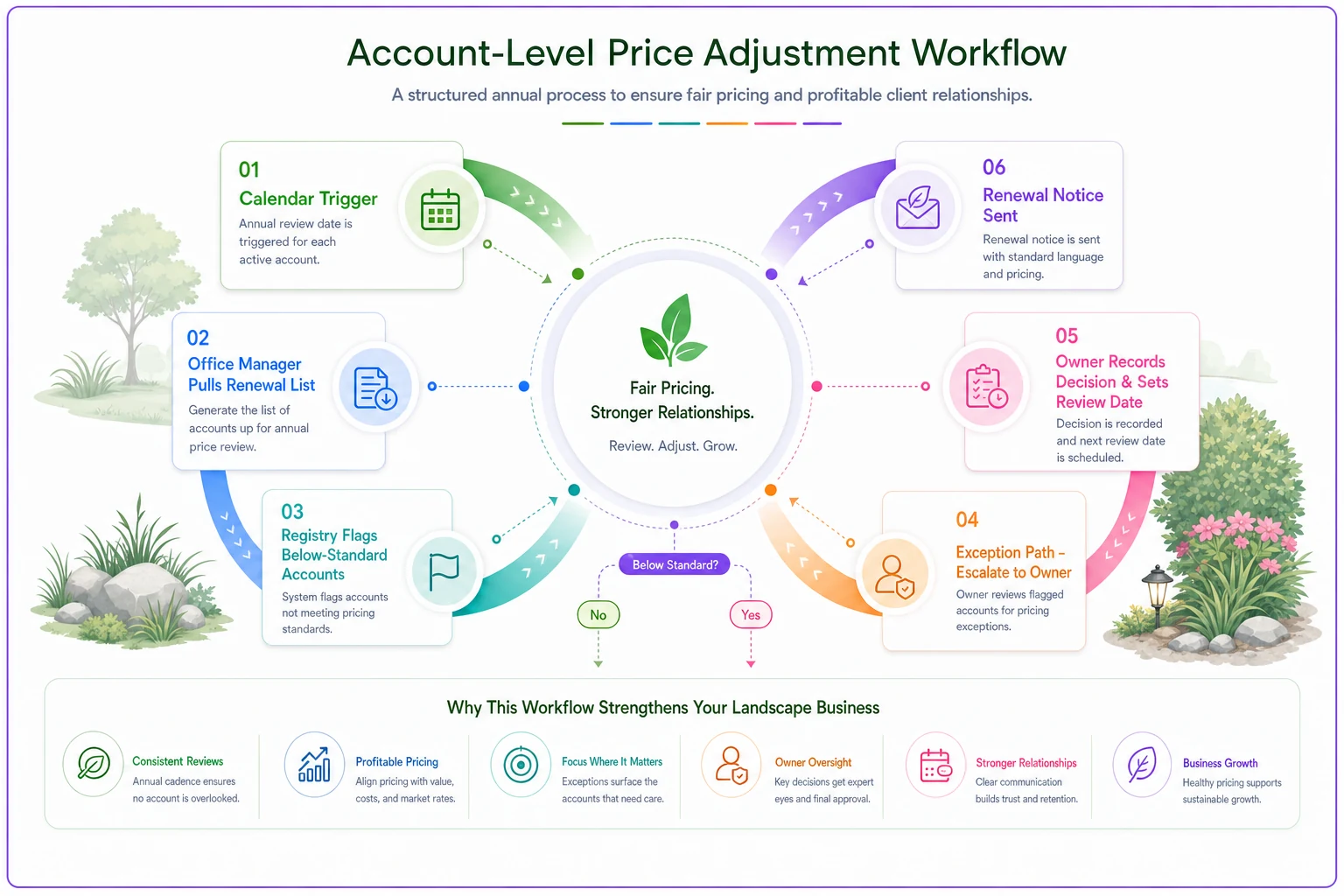
The default rule applies the standard 5% increase, taking them to about $139. But the registry shows this account was intentionally held below standard because they're a strong referral source, granted 18 months ago with no sunset date. That triggers the exception path.
Because the discount now exceeds threshold and has been sitting unreviewed, it escalates to the owner. The owner makes an actual decision: keep the referral discount but narrow it — move them to $146 this cycle, log the new gap, and set a review date for next year with a note to reassess whether the referrals are still coming. Renewal notice goes out with the 30-day window and the standard annual-review language attached.
That's the whole point. The account didn't drift. Somebody decided, the decision is on record, and it has an expiration.
A real scenario
A mid-sized maintenance company running four crews had roughly 190 recurring accounts. Pricing was set at signing and renewed informally — meaning it mostly renewed at the same rate unless a client complained or asked for more work.
When they finally built a grandfathering registry over a winter, they found something uncomfortable: about 30 accounts, nearly all older residential clients, were priced 12–20% below their current standard for that property type. A handful of commercial accounts hadn't seen an increase in three seasons despite obvious labor cost growth. The total gap landed somewhere in the $2,800–$3,400/month range of margin they'd volunteered away without ever deciding to.
They didn't fix it all at once — pushing a 20% increase through in one cycle is how you lose clients. Instead they applied the standard annual increase across the board, then set a two-year migration plan to bring the worst-gap accounts up in steps, with referral-source exceptions kept but capped and reviewed. Attrition ended up minimal — a couple of accounts they were arguably underpricing enough to lose without much pain. Within about a year and a half, most of the gap had closed. More importantly, no new gap opened because the calendar and registry now caught it.
The recovered margin mattered. But the durable win was that pricing stopped being something that happened to them.
When tight governance makes sense — and when it doesn't
When this is worth building: once you're past the point of holding every account's terms in your head. If you have multiple people quoting or renewing, a real book of recurring clients, or you've ever been surprised by a rate on an invoice, you need this yesterday.
When it's overkill: a solo operator with 20 accounts doesn't need a formal registry and escalation matrix. You are the system, and adding bureaucracy to a business that small just slows you down. What you do need even at that size is the annual review habit and the renewal language in your contracts — those cost nothing and prevent the drift before it starts.
Who should be careful: businesses that lean heavily on relationship pricing and personal deals. Governance doesn't mean killing those deals. It means recording them so they're chosen, not accidental. If your whole model is bespoke handshake pricing, the registry is even more important, not less — because you're the operation most exposed to forgotten promises.
Where software quietly earns its keep
The manual version works fine until it doesn't. A spreadsheet registry and a calendar reminder can carry you a long way. The point at which it strains is when the number of accounts and exceptions grows past what any one person keeps mentally current.
Operational platforms that centralize client records, contract terms, and rate history make this noticeably easier — not because of anything flashy, but because the gap between "current rate" and "current standard" becomes visible automatically instead of something you rediscover once a year during a painful audit. When renewal windows, notice periods, and exception review dates can be tracked and surfaced in the same place your team already works, governance stops depending on someone remembering to check. The best use of automation here is genuinely boring: flagging accounts that haven't been reviewed, surfacing below-standard pricing, making sure exceptions actually hit their sunset dates instead of quietly living forever.
But the tool is downstream of the discipline. Software that enforces rules you haven't defined just automates confusion faster. Build the four mechanisms first. Then let the system carry them.
Pricing governance in landscaping isn't about squeezing clients or running a rigid pricing bureaucracy. It's about making sure every price on your books is a price somebody actually decided — with a reason, a review date, and an owner. The margin most operations leave on the table isn't lost to bad math. It's lost to good numbers that nobody revisited.
Put the review on the calendar. Put the language in the contract. Give exceptions a path and an expiration. Build the registry so you can finally see what your old deals are costing you. Do that, and renewals stop being the season where margin quietly slips through your fingers — and start being the season where you actually catch it.
Ready to grow your landscaping business?
Join 2,000+ landscaping pros using Yardyly to save time, reduce task chaos, and deliver outstanding client results.