



Most landscaping businesses don't lose margin because they price too low. They lose it because they price the wrong way for the type of work. A mulch install priced like a mowing account. A tricky rehab job jammed into a flat monthly rate. A steady commercial maintenance contract quoted as time-and-materials, so the client nickel-and-dimes every visit.
The mistake isn't the number. It's the pricing architecture — the underlying decision about how a service should be priced given its complexity, how much it varies job to job, and what it does to your crew's capacity.
Get the architecture right and pricing gets easier, disputes drop, and your margins stop leaking in ways your P&L never quite explains. Get it wrong and you can raise prices all year and still bleed.
This is the piece your whole service menu hangs on.
The three variables that actually decide pricing model
Forget "what do competitors charge" for a minute. Before you pick subscription, tiered, time-and-materials, or fixed project pricing, you're really answering three operational questions:
1. Complexity — How much judgment, skill, or coordination does the work require? Pushing a mower is low complexity. Diagnosing why a client's boxwoods are dying and rehabbing the bed is high complexity.
2. Variability — How predictable is the work from one instance to the next? Weekly mowing on the same lawn is low variability. Storm cleanup is wildly high variability — you don't know what you'll find until you're standing in it.
3. Capacity impact — Does this work lock up crew hours predictably, or does it spike and swallow a day you'd planned for three other stops?
These three variables interact. A job can be low complexity but high variability (leaf cleanup — simple work, unpredictable volume). It can be high complexity but low variability (monthly irrigation system checks — skilled, but the scope repeats).
The pattern most owners miss: the pricing model should absorb whichever variable is the biggest risk to your margin. If variability is your enemy, you don't want a flat price. If capacity predictability is what you need to build routes, you want recurring revenue even if it means giving up some upside.
The decision matrix
Find where a service line lands, and the pricing approach usually picks itself.
Never miss a job detail again.
Yardyly helps you plan, confirm, and manage every landscaping project seamlessly.
- Centralized project scheduling
- Automated client updates
- Crew and resource management
No credit card required
| Complexity | Variability | Capacity Impact | Best Pricing Model | Why |
|---|---|---|---|---|
| Low | Low | Predictable | Subscription / flat recurring | Same work, same route, same time — price it once and stop re-quoting |
| Low–Med | Low | Predictable | Tiered recurring | Repeatable but clients want different service levels |
| Med | Medium | Semi-predictable | Tiered + add-on menu | Core is stable, extras vary — bundle the base, meter the extras |
| Med–High | High | Unpredictable | Time-and-materials | You can't price what you can't scope; protect yourself with hourly + materials |
| High | Low–Med | Locks up a crew | Fixed project bid | Defined scope, defined outcome — client wants a number, you want a margin buffer |
| High | High | Locks up a crew | Project bid with allowances/contingency | Big scope with unknowns — bid it, but build in documented allowances |
The rows people get wrong most often are the middle ones. That's where mispricing quietly lives.
Here's a simple workflow to visualize choosing the model based on the three variables.
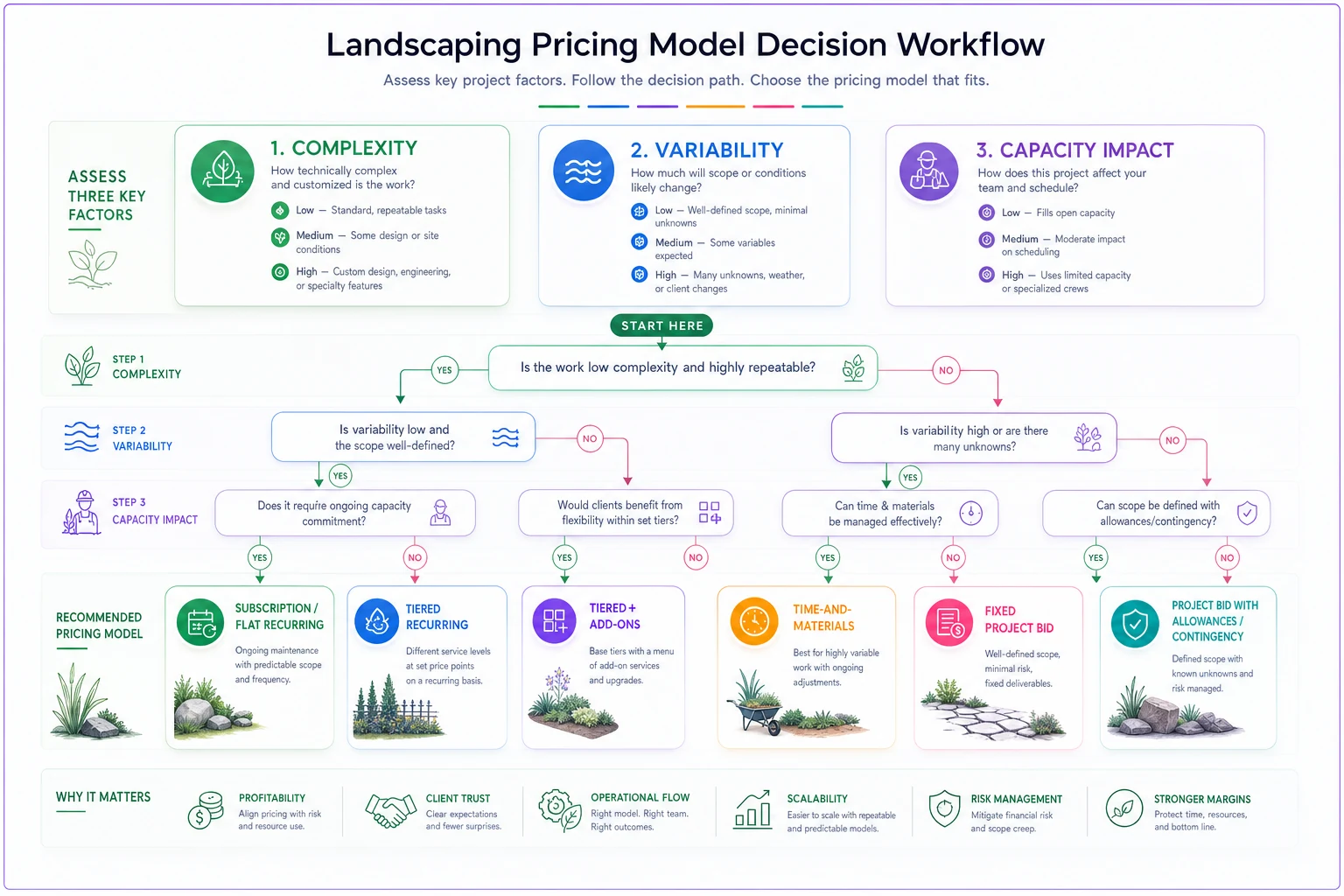
Use this flow to pick the model that absorbs your biggest margin risk.
Where each model earns its keep — and where it backfires
Subscription / flat recurring
When it makes sense: Truly repeatable work on a stable property. Weekly mowing, standard bed maintenance, a defined turf program. The property doesn't change much, the crew knows it cold, and you can slot it into a route without thinking.
When it's a bad idea: The second the property becomes unpredictable — big deciduous canopy dumping variable leaf loads, a client who keeps "just adding a little something" each visit — flat recurring turns into a margin trap. You've locked your price while the work quietly expands.
The classic failure: an owner signs a flat annual maintenance number in April, and by October the crew is spending 40% more time per visit than the estimate assumed. Nobody re-ran the math. The account technically "makes money" on the invoice but loses it in labor hours nobody tracked.
Tiered recurring
This is the workhorse for maintenance-heavy operations, and it deserves real thought. Tiering lets you serve the price-sensitive client and the premium client on the same route, which is huge for capacity efficiency.
The mistake is building tiers around features clients don't value instead of around cost-to-serve. If your "Premium" tier just adds services that barely cost you more, you're leaving money on the table. If it adds high-labor services priced like low-labor add-ons, you're underwater on your best-sounding tier.
If you're structuring these, the mechanics of drawing the lines — what goes in each tier, what triggers an upgrade — are worth doing deliberately. We broke down that decision logic in How to Choose Tiered Recurring Maintenance Prices for Landscapers, and it pairs directly with this matrix.
Time-and-materials
When it makes sense: High variability, low scope certainty. Storm cleanup, drainage problems you can't fully see until you dig, rehab work where you genuinely don't know what's under the surface. T&M shifts the variability risk to the client, which is fair when neither of you can predict the work.
When it's a bad idea: For anything a client expects to be predictable. Homeowners hate open-ended invoices. Quote a "simple" spring cleanup as T&M and you'll spend more time defending the invoice than doing the work.
A pattern that shows up constantly: businesses use T&M as a lazy default because it feels safe — "we'll just bill our time." But T&M with no cap and no communication is how you get disputes. If you're going T&M, you need a not-to-exceed number and a check-in trigger so the client isn't surprised at the end.
Fixed project bids
When it makes sense: Defined scope, defined deliverable. Patio install, planting design, irrigation install. The client wants a number they can approve, and you can scope it tightly enough to bid with a margin buffer.
When it's dangerous: When your takeoff is sloppy. Fixed-price is only safe if your scope is airtight. The hidden costs — disposal, access issues, soil conditions, restoration — are exactly what eat fixed bids alive. Before you commit to a number, the pre-bid discipline matters enormously; our Small Project Takeoff Checklist walks through the line items that most often get missed and turn a "profitable" bid into a break-even headache.
Packaging rules: how to bundle without bleeding
Packaging is where architecture becomes real money. A few rules that hold up across service lines:
-
Bundle the predictable, meter the variable. Put stable, repeatable work into flat or tiered pricing. Keep anything with variable volume (leaf cleanup, storm debris, seasonal blowouts) as metered add-ons, even for recurring clients.
-
Never bundle high-complexity work into a low-complexity price. If a maintenance visit includes "minor pruning as needed," define what "minor" means in hours. Otherwise skilled work leaks into an unskilled price.
-
Anchor every package to cost-to-serve, not a round number. A $199/month package that costs you $180 in labor and materials is a worse business than a $149 package that costs you $95. Margin percentage beats headline price.
-
Price the tier jump to reflect the real capacity cost. If upgrading a client adds an hour per visit across 30 visits a year, that's 30 crew-hours. Price the jump to cover those hours plus margin, not just to "feel" like more.
-
Keep one clean exit valve per package. Every recurring package needs a re-quote trigger — a defined condition (scope grows past X, property changes, service frequency changes) that reopens the price. Without it, packages calcify while the work grows.
Anchor tier jumps to measured crew-hours so the pricing reflects real capacity impact.
That last rule is the most overlooked. Businesses obsess over the initial price and never build a mechanism to revisit it. That's why so many "good" accounts are secretly your worst — they were priced correctly three seasons ago.
A worked example: repricing a mixed service menu
Say a two-crew operation runs this menu, all priced the same lazy way — mostly flat, a little T&M when they feel nervous:
-
Mowing — low complexity, low variability, predictable. → Flat subscription. Clean.
-
Bed maintenance — medium complexity, low-medium variability. → Tiered recurring, with a defined pruning-hour cap so skilled work doesn't leak.
-
Seasonal cleanups — low complexity but high variability in volume. → Metered add-on, priced per unit (per bag, per hour, per property zone), never flat-bundled into the annual.
-
Planting projects — high complexity, low-medium variability, locks a crew. → Fixed project bid with a proper takeoff and contingency line.
-
Drainage fixes — high complexity, high variability, unknowns underground. → T&M with a not-to-exceed and a mandatory check-in at 75% of the cap.
Before this exercise, the operation was flat-pricing the cleanups and eating the volume spikes — a few hundred dollars of uncompensated labor per heavy-leaf property each fall, across roughly 20 properties. That's not a rounding error. That's real money disappearing into a pricing model that didn't fit the work.
After splitting cleanups into metered add-ons and capping the pruning inside bed maintenance, the same route generated noticeably better margin without raising a single base rate. Nothing about the work changed. Only the architecture did.
Who should NOT restructure everything at once
Pricing architecture can become a rabbit hole fast. You don't need to re-engineer your whole menu overnight, and doing it mid-season is a good way to confuse clients and crews simultaneously.
Skip the full overhaul if:
-
You're a solo operator with 10 accounts — your capacity constraint is just you, and flat pricing you actually understand beats a clever matrix you don't.
-
You're mid-season with signed agreements — wait for renewal windows rather than reopening live contracts.
-
You don't yet know your true cost-to-serve per service line. Repricing without cost data is just guessing with extra steps.
That last point matters most. Every decision in this matrix assumes you know what each service line actually costs to deliver — labor, materials, disposal, drive time, all of it. If you're pricing on gut feel, fix the measurement before you touch the model. A time-allocated P&L that shows profitability by service line is the foundation the whole matrix sits on. Without it, you're optimizing blind.
How the pieces connect as you scale
The architecture that fits a two-crew shop breaks at five crews.
At small scale, a few mispriced accounts are annoying but survivable — you're close enough to the work to feel the pain and adjust informally. At scale, mispricing compounds. A model that leaks 15% on one service line, replicated across 200 accounts and multiple crews, becomes a structural hole you can't out-hustle.
Scale also changes which variable hurts most. Solo, complexity is your bottleneck — you can only do so much skilled work yourself. Multi-crew, variability becomes the bigger enemy, because unpredictable work wrecks route planning and the capacity buffers you depend on to keep utilization high. That's why growing operations lean harder on subscription and tiered recurring: predictable revenue makes predictable routes, and predictable routes are how you keep crews productive.
The coordination layer matters too. When one person prices everything, the architecture lives in their head. Add estimators or crew leads quoting work, and inconsistent pricing models create chaos — one person quotes cleanups flat, another meters them, and your margin varies by who answered the phone. The fix isn't just a rule; it's a shared decision map everyone uses, so the same job type gets the same pricing model regardless of who scopes it.
That consistency is the real endgame of pricing architecture. Not any single clever price — a repeatable system for choosing the right model, so complexity, variability, and capacity get accounted for every time, on every service line, by every person quoting.
Bringing it together
Mispricing rarely looks like a mistake on the invoice. It looks like a busy, profitable-seeming account that somehow never contributes what it should. It looks like a fixed bid that "should have" made money. It looks like a maintenance contract you dread every October.
Almost always, the root cause is the same: the pricing model didn't match the shape of the work. Complexity, variability, and capacity impact were never really considered — a number got picked, and the architecture got skipped.
Run your service lines through the matrix. Bundle what's predictable, meter what varies, bid what's defined, and put a not-to-exceed on what you genuinely can't scope. Build a re-quote trigger into every recurring package so nothing calcifies while the work grows. And before any of it, make sure you actually know what each service line costs to deliver.
Do that, and pricing stops being the thing you second-guess and starts being the thing that quietly protects your margin — job after job, season after season.
Ready to grow your landscaping business?
Join 2,000+ landscaping pros using Yardyly to save time, reduce task chaos, and deliver outstanding client results.