



Most landscapers set their recurring maintenance prices once — usually the first spring they win a contract — and then quietly resent that number for the next three years. The property fills in. Shrubs double in size. Fuel jumps. And the crew still spends the same hour there every week for the same $45 they agreed to when the client had a bare front yard and two saplings.
Recurring maintenance pricing is fundamentally different from bidding a patio or a planting job because the mistake compounds. A bad install price hurts once. A bad maintenance price bleeds you every single visit, for years, and it usually gets worse because properties grow and costs climb while your rate sits frozen.
So this isn't really about picking a good number. It's about building a pricing system — tiers that actually mean something, triggers that tell you when to reprice, a yearly cadence that clients expect, and comparison tables that make the whole thing easier to sell.
Why flat maintenance pricing quietly kills margin
Here's a pattern that shows up in almost every maintenance-heavy landscaping business that's been running for more than a couple seasons: the older the account, the worse the margin.
That sounds backwards. You'd think long-term accounts would be your most profitable — you know the property, the crew knows the route, no learning curve. But the opposite is usually true, because those accounts are locked into pricing from years ago and nobody built a mechanism to move them up.
It usually happens for three reasons at once:
-
The property changed. Beds got bigger, plants matured, the client added a fire pit area — now there's more edging and blowing every single week.
-
Costs changed. Labor, fuel, disposal, insurance — all of it drifted up while the rate didn't.
-
The relationship got comfortable. Nobody wants to bring up a price increase with a client who's been loyal for six years, so the conversation just never happens.
Your "best" clients — the long, loyal ones — are often the ones dragging your average margin down. When you finally run a service-line breakdown and look at profit per account instead of revenue per account, the ranking flips. That's the moment most owners realize they've been subsidizing their oldest customers with the margins from their newest ones.
Tiers should describe scope, not quality
The most common tiering mistake is naming packages like they're effort levels — "Basic," "Better," "Best." Clients read that as "cheap, decent, and the one where you actually try." Nobody wants to buy the package that implies you'll do a worse job.
Never miss a job detail again.
Yardyly helps you plan, confirm, and manage every landscaping project seamlessly.
- Centralized project scheduling
- Automated client updates
- Crew and resource management
No credit card required
Tiers work better when each one describes a scope of work and level of coverage, not a quality rank. A client should be able to look at three columns and understand exactly what's included and what isn't — without feeling like the lower tier means neglected.
Think of your tiers as being organized around three things: frequency, breadth of services, and responsiveness.
-
Frequency — how often you show up (weekly vs. biweekly, seasonal vs. year-round).
-
Breadth — how many service types are bundled in (mow only vs. mow + beds + fertilization + seasonal cleanups).
-
Responsiveness — how fast you respond to off-cycle requests, and whether small extras are billed separately or absorbed.
When you tier on those three axes, the price differences make sense to clients because they can see what they're getting. And it protects your margin because each tier has a defined labor envelope you can actually predict.
A decision rule for which tier to quote
-
Measure the maintainable area and count the friction features. Tight fence lines, tree rings, steep banks, lots of hand-trimming — these are the things that blow up time-per-visit. If you don't already have a per-feature time model, the per-feature time-multiplier thinking used for estimating project costs applies here too — count the features, not just the square footage.
-
Decide required visit frequency based on turf type, growth rate, and client expectations.
-
Check the responsiveness expectation. A client who calls three times a month for "can you just swing by" belongs in a higher tier or on a rate that accounts for it.
-
Route to the tier whose labor envelope matches. If a property straddles two tiers, quote up — never down. The downgrade conversation is easy. The "we underpriced you and need more money" conversation is not.
That last rule matters more than it looks. Underquoting a recurring account isn't a small error you fix next visit. You're locked in until renewal, and the property only gets more demanding.
Package templates that actually hold up
Here's a small-business-friendly three-tier template. The dollar ranges here are illustrative — your real rates depend on your market, labor cost, and route density — but the structure is what matters.
| Feature | Essential | Complete | Premium |
|---|---|---|---|
| Mowing / edging / blowing | Biweekly | Weekly | Weekly |
| Season length | Growing season | Year-round | Year-round |
| Bed weeding & maintenance | Not included | Monthly | Biweekly |
| Fertilization / weed control | Add-on | 4 apps included | 6 apps included |
| Seasonal cleanups (spring/fall) | Billed separately | Spring included | Spring + fall included |
| Off-cycle response time | 5–7 days | 2–3 days | 1–2 days |
| Small extras (minor trimming, debris) | Billed | Included up to a cap | Included |
| Typical monthly range | $$ | $$$ | $$$$ |
Two things worth noticing. The jumps between tiers aren't just "more visits" — they add whole service categories, which is what justifies the price gap and gives clients a real reason to move up. And the "off-cycle response time" row does quiet but important work: it sets expectations so a client on the cheapest tier doesn't expect same-day service, and gives your dispatcher a clear rule to follow.
When each tier actually makes sense
Essential fits smaller residential properties, budget-conscious clients, and anyone whose yard genuinely doesn't need weekly attention. Don't push people out of it — a well-priced Essential account on a dense route can be perfectly profitable.
Complete is where most residential clients should land, and it's usually your best margin tier because it bundles enough services to justify a full crew stop.
Premium fits high-visibility properties, HOAs, and clients who want everything handled with zero back-and-forth. If someone is a high-touch client, the responsiveness they want is the product — price it accordingly.
Triggers: when to reprice an existing account mid-relationship
The whole reason flat pricing decays is that there's no mechanism to reprice. You need a short list of conditions that automatically flag an account for a rate review — so it's not an emotional decision, it's just a rule.
Triggers worth tracking:
-
Visit time drift. If a property that used to take 45 minutes now takes 65, that's roughly a 44% labor increase you're absorbing. When actual time exceeds your estimate by more than ~20% for three consecutive visits, flag it.
-
Scope creep. The client keeps adding "can you also just..." requests. Two or three of those and the account has quietly outgrown its tier.
-
Property changes. New beds, new plantings, a hardscape addition, a pool. Anything that adds recurring labor.
-
Cost-side shocks. Fuel spikes, disposal fee increases, wage bumps. These hit every account at once and justify across-the-board adjustments.
-
Responsiveness mismatch. The client is requesting off-cycle service far more than their tier assumes.
The mistake most owners make is treating each of these as a one-off annoyance instead of a signal. One extra trim request isn't worth a call. But when the same account trips three triggers over a season, that's a clear, defensible reason to move them to the next tier — and you have the documentation to back it up.
This connects to how you track operational metrics generally. If you've set up decision-mapped KPIs that trigger pricing and hiring moves, your reprice triggers should live right alongside them, because a repricing decision is really just a metric crossing a threshold.
The annual increase cadence
Even with no scope changes, prices need to move every year because your costs do. The single most valuable habit you can build into a maintenance business is a predictable annual increase that clients expect.
The key word is expect. When a price increase arrives out of nowhere every few years as a big jump, clients push back hard — it feels like a negotiation. When a modest increase arrives at the same time every year, built into the renewal, it feels like weather. Just how things work.
-
Set a review month. Late winter, before the season starts, is ideal. You're repricing before you're slammed with work.
-
Apply a baseline annual adjustment to every account — a standard bump that covers cost drift. Most clients absorb a modest yearly increase without issue if it's communicated as routine.
-
Layer trigger-based adjustments on top for specific accounts that tripped triggers during the prior season. These get individual, documented reasons.
-
Send renewals with the new rate as the default, not as a request. "Your service renews at the updated seasonal rate below" lands differently than "we'd like to raise your price."
-
Grandfather nothing silently. If you choose to hold a rate for a great client, make it a visible, intentional decision — not because you forgot to reprice.
A visual of this annual cadence clarifies the steps.
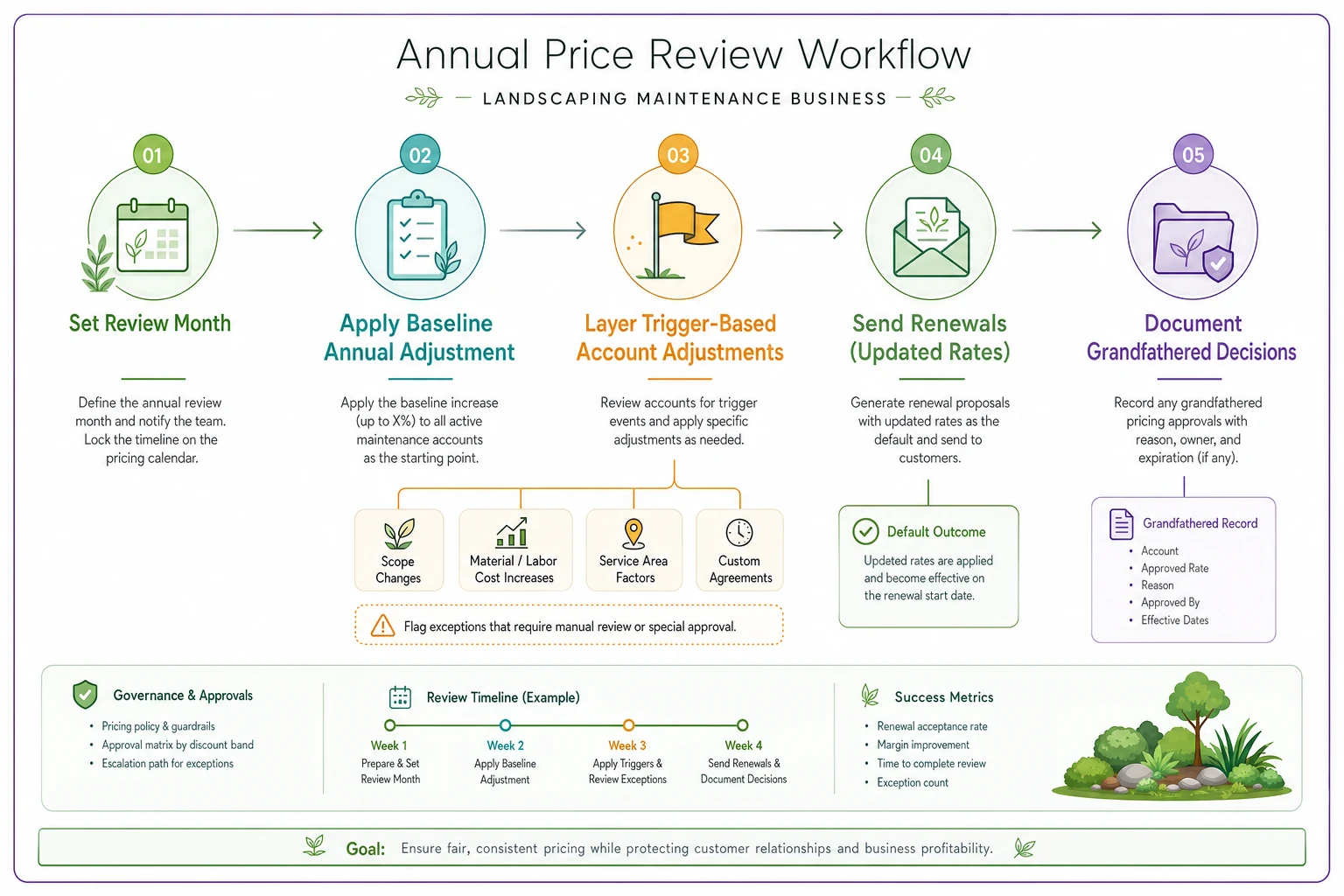
The baseline keeps the whole book from decaying. The framing keeps the increase from becoming a fight.
A quick word on the increase conversation
Businesses that struggle with annual increases are almost always the ones that skipped years. If you haven't raised a client's rate in four years and then try to close the whole gap at once, you're looking at a 20%+ jump that feels outrageous — even though it's just four years of normal drift stacked together. Small and yearly isn't just easier on the client; it protects you from ever having to have the ugly version of that conversation.
Client-facing comparison tables that do the selling for you
A comparison table isn't just internal — it's a sales tool. When a prospect sees three clearly-scoped columns, two things happen. They self-select, usually toward the middle, which is where you want them. And they stop asking "why does it cost that much?" because the table already answered it.
-
Lead with what's included, not what's excluded — but keep exclusions visible so there's no dispute later.
-
Show the responsiveness difference between tiers, because that's often what moves a hesitant client up a level.
-
Use the same feature rows across all tiers so differences are obvious at a glance.
-
Avoid quality-ranking language entirely.
Scope disputes on maintenance accounts almost always come from the client not understanding what tier they bought. A clear comparison table, signed off at the start, eliminates most "I thought that was included" arguments before they start.
A real scenario
A two-crew residential maintenance company with around 90 recurring accounts had never built a repricing system. Rates were set at signup and mostly left alone. When they finally ran the numbers, they found about a dozen accounts that had been on the same rate for four-plus years — several of which had grown noticeably. A couple of those properties were taking close to 30% more crew time than the original estimate had assumed.
Over one off-season they did three things: rebuilt their packages into three scope-based tiers with a real comparison table, set visit-time-drift and scope-creep triggers and flagged every account that tripped them, and introduced a standard late-winter renewal with a modest baseline increase across the whole book.
The baseline increase alone added a few percent across every account. The trigger-based reprices on the dozen worst accounts recovered meaningfully more per visit. A couple of clients pushed back; one left. But heading into the season, monthly recurring margin was noticeably higher — and maybe more importantly, the owner stopped dreading every visit to the overgrown property he'd been servicing at a loss for years.
Nothing about that required more crews or more accounts. It came entirely from pricing the work they already had correctly.
Where a system beats spreadsheets
You can run all of this on a spreadsheet, and plenty of small operations do. The problem is that repricing triggers require you to notice things across dozens or hundreds of visits — and nobody reliably notices visit-time drift from memory.
This is where operational software earns its keep. When your scheduling and job tracking already record actual time on site per visit, the "this property now takes 20% longer" signal surfaces on its own instead of waiting for you to feel it. AI-assisted operational platforms can flag accounts crossing your reprice thresholds, tag properties that have tripped multiple triggers in a season, and line up your annual renewal batch so the review month doesn't get skipped. The pricing rules are still yours — the system just makes sure the signals don't get buried in a busy season.
Log actual time on site per visit so visit-time drift surfaces automatically in your scheduling tool.
The point isn't to automate the decision. It's to make sure the decision actually gets made, on schedule, with the right data behind it — instead of getting ignored until you're three years underwater on your best client.
Bringing it together
Recurring maintenance pricing isn't a number you set — it's a system you maintain. Scope-based tiers give you defensible price gaps. Decision rules route new accounts consistently. Triggers catch the accounts that outgrow their rate mid-relationship. An annual cadence keeps the whole book from decaying and makes increases feel routine rather than confrontational. And clear comparison tables turn all of that into something clients actually understand and sign off on.
Get those five pieces working together and the thing that used to bleed you slowly — the frozen rate on the growing property — becomes the thing that quietly grows your margin every year. Same crews, same accounts, priced right.
Ready to grow your landscaping business?
Join 2,000+ landscaping pros using Yardyly to save time, reduce task chaos, and deliver outstanding client results.