



Most landscapers nail the obvious stuff on small project takeoffs—mulch, labor, drive time. But the real profit killers aren't what you'd expect. They're buried in soil conditions, disposal runs, and those annoying little adjustments that eat 30% of your margin before you even realize it.
Small jobs actually demand tighter takeoff discipline than big commercial projects. You're working with thinner margins, less room for error, and clients who remember every dollar. One missed line item on a $1,200 hardscape repair can wipe out the profit from three regular maintenance accounts.
And these hidden costs compound. Forget soil amendment on a flower bed install, and you're not just eating material cost—you're burning extra labor breaking up compacted clay, making multiple supply runs, and dealing with callbacks when plants struggle. What looked like a profitable Tuesday afternoon turns into a three-visit headache that barely breaks even.
Why small landscape takeoffs fail differently
Small project takeoffs fail in specific, predictable ways that bigger commercial estimates don't face. Residential quirks, tight access, homeowners who change their minds mid-job.
The access problem shows up constantly. That backyard patio removal seems straightforward until you realize everything needs to be wheelbarrowed through a 36-inch gate, around the pool, past the prize-winning roses. Suddenly your two-hour demo becomes a five-hour marathon. Commercial sites have loading docks and wide lanes. Mrs. Johnson has a narrow side yard and a territorial schnauzer.
Then there's the disposal trap. Commercial projects often include dumpsters in the base bid. Small residential jobs? You're loading your trailer, driving to the transfer station, waiting in line, then paying by weight for material you underestimated. That "quick" sod replacement just added $180 in disposal fees nobody budgeted for.
Material minimums hit small projects especially hard. Need 2.5 yards of topsoil? The supplier has a 5-yard minimum and a $95 delivery fee. Your material cost just doubled, but the client's still comparing your quote to Jimmy's Lawns who'll "just bring some dirt in his pickup."
Small crews face unique productivity problems too. With two or three people, one person calling out sick drops your output by a third to half. No bench strength means owner-operators end up running equipment and answering client texts at the same time. The inefficiency compounds fast when you're trying to knock out multiple small jobs in a day.
The hidden cost catalog every small crew misses
Certain hidden expenses show up repeatedly across small landscape operations. These aren't edge cases—they're standard costs that somehow vanish during takeoff.
Never miss a job detail again.
Yardyly helps you plan, confirm, and manage every landscaping project seamlessly.
- Centralized project scheduling
- Automated client updates
- Crew and resource management
No credit card required
| Hidden cost | Example detail |
|---|---|
| Soil amendments | destroy profitability faster than almost anything else. That new planting bed needs more than digging and mulch. Compacted clay requires amendment, proper drainage needs gravel, and decent growing conditions demand compost. A 200-square-foot bed can easily need $240 in soil prep materials that never made the estimate. The labor to properly mix and integrate amendments? Another two hours minimum. |
| Compaction equipment rental | gets forgotten constantly. Small hardscape projects need plate compactors or jumping jacks. Sure, you might own one, but when it breaks Tuesday morning, that $135 daily rental wasn't in your numbers. Even when equipment works, nobody accounts for fuel, maintenance allocation, or transport time between sites. |
| Utility marking delays | kill small project flow. Call 811, wait 48-72 hours, hope they actually show up. That garden bed installation scheduled for Thursday is now next Tuesday, and you've got a crew scrambling. The inefficiency ripples through your whole week's schedule. |
| Hand-digging zones | near utilities or irrigation multiply labor time. That 50-foot drainage trench takes two hours with a trencher, but the 15 feet near the gas line? Another three hours of careful hand work. Irrigation repairs compound this—every sprinkler head potentially sits atop a web of pipes you can't see until you're carefully excavating with a trowel. |
| Multiple material runs | plague small projects. The math says you need 3.5 yards of mulch, so you order 4. But spreading reveals hollow spots needing fill, and suddenly you're sending someone back for two more bags. That's vehicle time, fuel, employee wages, and lost productivity. These micro-runs add $75-150 to jobs that were priced with zero margin for error. |
| Existing plant protection | takes serious time on small residential jobs. Laying tarps around established perennials, working carefully around root systems, moving potted plants out of the work zone—it's fussy, slow work that commercial sites rarely require. Add 20-30 minutes just for setup and breakdown of protection measures. |
Soil amendments destroy profitability faster than almost anything else. That new planting bed needs more than digging and mulch. Compacted clay requires amendment, proper drainage needs gravel, and decent growing conditions demand compost. A 200-square-foot bed can easily need $240 in soil prep materials that never made the estimate. The labor to properly mix and integrate amendments? Another two hours minimum.
Compaction equipment rental gets forgotten constantly. Small hardscape projects need plate compactors or jumping jacks. Sure, you might own one, but when it breaks Tuesday morning, that $135 daily rental wasn't in your numbers. Even when equipment works, nobody accounts for fuel, maintenance allocation, or transport time between sites.
Utility marking delays kill small project flow. Call 811, wait 48-72 hours, hope they actually show up. That garden bed installation scheduled for Thursday is now next Tuesday, and you've got a crew scrambling. The inefficiency ripples through your whole week's schedule.
Hand-digging zones near utilities or irrigation multiply labor time. That 50-foot drainage trench takes two hours with a trencher, but the 15 feet near the gas line? Another three hours of careful hand work. Irrigation repairs compound this—every sprinkler head potentially sits atop a web of pipes you can't see until you're carefully excavating with a trowel.
Multiple material runs plague small projects. The math says you need 3.5 yards of mulch, so you order 4. But spreading reveals hollow spots needing fill, and suddenly you're sending someone back for two more bags. That's vehicle time, fuel, employee wages, and lost productivity. These micro-runs add $75-150 to jobs that were priced with zero margin for error.
Existing plant protection takes serious time on small residential jobs. Laying tarps around established perennials, working carefully around root systems, moving potted plants out of the work zone—it's fussy, slow work that commercial sites rarely require. Add 20-30 minutes just for setup and breakdown of protection measures.
Real line items for a 3-person crew operation
Here's what actual takeoff sheets should include for common small landscape projects:
Basic Mulch Refresh (400 sq ft, 3" depth)
Materials:
-
Mulch
4 yards @ $38/yard = $152
-
Pre-emergent herbicide
1 bag @ $47 = $47
-
Edging repair materials
$25 allowance
-
Landscape fabric patches
$18
Labor:
-
Edge definition and cleaning
1.5 hours @ $65/hour = $97.50
-
Old mulch removal/grading
1 hour @ $65/hour = $65
-
Fabric repair
0.5 hours @ $65/hour = $32.50
-
Mulch spreading and detail work
2 hours @ $65/hour = $130
-
Cleanup and protection removal
0.5 hours @ $65/hour = $32.50
Hidden costs usually missed:
-
Disposal of old mulch/debris
$45
-
Drive time (both ways)
0.75 hours @ $65/hour = $48.75
-
Material pickup or delivery fee
$40
-
Equipment fuel/wear allocation
$15
-
Tarp and protection setup
$18
Total: $746.25 (not the $350 many contractors would estimate)
Small Paver Patio (120 sq ft)
Materials:
-
Pavers
120 sq ft @ $4.50/sq ft = $540
-
Base material
2 yards @ $45/yard = $90
-
Sand
0.5 yards @ $52/yard = $26
-
Polymeric sand
2 bags @ $24/bag = $48
-
Edge restraints
40 linear feet @ $3.50/ft = $140
Labor:
-
Excavation (6" depth)
3 hours @ $65/hour = $195
-
Base prep and compaction
2.5 hours @ $65/hour = $162.50
-
Paver installation
4 hours @ $65/hour = $260
-
Cutting and fitting
1.5 hours @ $65/hour = $97.50
-
Sand application and final compaction
1 hour @ $65/hour = $65
Hidden costs:
-
Soil disposal (2 yards)
$120
-
Compactor rental
$135/day
-
Blade replacement for saw
$45
-
Material delivery fees
$95
-
Utility marking wait time (2 days schedule impact)
$200 (opportunity cost)
-
Hand excavation near utilities
1 hour @ $65/hour = $65
Total: $2,284 (often quoted at $1,400)
Planting Bed Installation (150 sq ft)
Materials:
-
Plants (15 @ various prices)
$420
-
Mulch
2 yards @ $38/yard = $76
-
Compost
1 yard @ $55/yard = $55
-
Soil amendments
$85
-
Landscape edging
50 feet @ $2.50/ft = $125
Labor:
-
Bed preparation and edging
2.5 hours @ $65/hour = $162.50
-
Soil amendment and mixing
1.5 hours @ $65/hour = $97.50
-
Planting
2 hours @ $65/hour = $130
-
Mulching and detail
1 hour @ $65/hour = $65
-
Initial watering setup
0.5 hours @ $65/hour = $32.50
Hidden costs:
-
Existing grass removal and disposal
$95
-
Plant warranty reserve (10% of plant cost)
$42
-
Soil testing (if needed)
$35
-
Multiple trip charges for plant availability
$60
-
Root barrier installation
$48
-
Irrigation adjustment
0.75 hours @ $65/hour = $48.75
Total: $1,521.25 (commonly estimated at $950)
Disposal math that actually works
Disposal costs wreck more small landscape quotes than almost any other single factor. The formula most crews use is broken because it ignores how disposal actually works in the field.
Real disposal cost includes: actual dump fees + drive time both ways + wait time at the facility + fuel + truck/trailer wear + lost production time. For a typical trailer load of mixed landscape debris, you're looking at $180-240 all-in, not the $50 dump fee you dropped in the estimate.
Green waste seems cheap until you factor in moisture content. Fresh grass clippings and pruning debris weigh significantly more than you'd expect—sometimes 40% more than estimated. Soil and sod? The weight miscalculation gets worse. Wet clay can weigh around 2,800 pounds per yard. Your half-ton pickup isn't making it in one trip.
A more realistic disposal calculation:
Sod removal (500 sq ft):
-
Volume
~6 cubic yards
-
Weight
~4,200 lbs (wet)
-
Loads needed (standard trailer)
2
-
Dump fees
2 × $45 = $90
-
Drive time
2 × 1.5 hours @ $65 = $195
-
Fuel
$35
-
Total
$320
Compare that to the "$50 for disposal" most contractors throw on their estimates. That's a $270 miss on just disposal for a simple sod replacement job.
Mixed construction debris costs even more. Many facilities charge premium rates for concrete, asphalt, or mixed loads. That broken concrete from the old walkway? It's $85/ton at the recycling facility, not the $30/ton you pay for green waste. One small patio demo can generate $400 in disposal costs alone.
The smartest operators build disposal partnerships—some work deals with property owners who need fill, others maintain relationships with composting facilities that take clean green waste for free. But those arrangements require planning that extends well beyond individual job takeoffs.
Common amendment costs by soil type
Soil conditions vary dramatically within the same neighborhood, let alone across a full service area. The amendment costs that catch contractors off guard tend to fall into predictable categories.
Heavy clay soil demands serious intervention. You're adding compost at 2-3 inches depth minimum, possibly gypsum for sodium-affected clay, and usually coarse sand for drainage. For a 200-square-foot planting area:
-
Compost
2 yards @ $55 = $110
-
Gypsum
100 lbs @ $0.30/lb = $30
-
Coarse sand
1 yard @ $45 = $45
-
Tilling/mixing labor
2.5 hours @ $65 = $162.50
-
Total amendment cost
$347.50
Sandy soil seems easier but has its own demands—organic matter for water retention and nutrients. Same 200-square-foot area:
-
Compost
2.5 yards @ $55 = $137.50
-
Peat moss
4 bales @ $12 = $48
-
Starter fertilizer
$25
-
Mixing labor
2 hours @ $65 = $130
-
Total
$340.50
Compacted soil around new construction multiplies every cost. You might need mechanical tilling equipment rental ($125+), double the normal amendment rate, extended labor for breaking up hardpan, and possibly subsoil drainage solutions.
The killer scenario happens when you discover hardpan or caliche layers mid-project. That reasonable planting bed quote becomes a construction project requiring equipment you don't own and techniques your crew hasn't done before. Smart operators probe soil conditions during estimation or build real contingencies into their bids—not just a 5% buffer that evaporates immediately.
When to walk away from small projects
Not every small project deserves a yes. Recognizing the money-losers before you quote saves more than profit—it protects your reputation and your crew's morale.
Walk away when access costs more than the job pays. That backyard patio might be a $3,000 project, but if everything needs to be carried 200 feet uphill through a narrow gate, your labor cost triples. No amount of efficiency recovers from that math.
Contaminated soil areas are a different level of risk. Old gas station sites, former auto shops, properties with industrial history—special disposal costs thousands per load, and your regular insurance probably excludes contaminated material handling. One unknowing load of petroleum-contaminated soil could generate fines that exceed your annual profit.
Unrealistic client expectations around existing irrigation or utilities signal future problems. When homeowners insist their sprinkler system "just needs minor adjustments" or swear they know where all utilities run, that's usually code for expensive surprises. The callback complaints and damage claims from hitting unmarked lines eliminate any possible profit.
Projects requiring permits that cost more than the job is worth rarely pencil out for small operators. A simple retaining wall might need engineering, permits, and inspections adding $2,000 to a $3,500 job. The time value of navigating municipal requirements while your crew sits idle makes these projects genuinely painful.
The technology shift in small project management
Running accurate takeoffs while juggling 15-30 small projects monthly is where modern operational software changes the economics for a lot of crews.
Smart landscape operations now centralize their estimating data. Instead of recreating disposal calculations or amendment costs from scratch on every quote, they maintain living databases of actual costs by project type. When amended soil cost $347 on one job, that becomes the baseline for similar conditions on the next quote. This kind of pattern matching prevents the repetitive underestimation that kills margins over time.
Digital job costing workflows catch hidden expenses as they happen. When your crew leader logs an unexpected dump run or material pickup, that cost flows to the job file immediately. No more discovering three weeks later that a "profitable" mulch job actually lost money after four untracked trips to the supplier. The feedback loop between estimated and actual costs tightens from months to days.
AI-powered platforms are genuinely useful here—not because they replace estimator judgment, but because they catch the $200 oversights that happen when you're rushing between site visits. They prompt for disposal costs when soil removal is specified, flag when equipment rental might be needed based on project scope, automatically calculate drive times based on actual distances.
The bigger efficiency gain comes from templating successful takeoffs. That comprehensive paver patio estimate with all hidden costs identified becomes the framework for the next ten similar projects. Estimating time drops significantly while accuracy actually improves—crews report cutting quote time by more than half.
Communication improves too. When every cost line item is documented in the system, client questions get answered without digging through notes. "Why is disposal $320?" Here's the exact breakdown: weights, trips, time allocated. That transparency builds trust and reduces payment friction on small projects where every dollar matters.
Operations using integrated estimation and job costing software consistently see meaningful improvements in gross margins on small projects—not from charging more, but from actually capturing what work costs and pricing accordingly.
Building your small project takeoff system
The best takeoff process for small landscape projects isn't about perfection—it's about consistency and continuous improvement. Start with templates for your five most common project types. Build in every hidden cost covered here, then adjust based on your actual job costing data.
Track your misses. Every time actual costs exceed estimates by more than 10%, document why. Disposal weight? Soil conditions? Equipment failures? These patterns become your profit protection system. After twenty similar projects, you'll know exactly what that soil type in that neighborhood really costs to work with.
After twenty similar projects, use the observed average amendment and disposal costs as baseline inputs for templates rather than guesses.
Price for reality, not hope. That drainage project might go perfectly—no utility conflicts, ideal soil, single-load disposal. But it probably won't. Build your quotes on typical scenarios, not best-case outcomes. Clients who choose you despite higher prices value reliability.
Your crew's experience is estimating input you're probably underusing. They know which neighborhoods have impossible parking, where soil turns to soup when wet, and which suppliers consistently short-deliver. Bring field knowledge into your takeoff process. The gap between office estimates and field reality shrinks when the people doing the work help set the prices.
Small project profitability comes from disciplined attention to details others ignore. Every forgotten dump run, unaccounted amendment, or missed equipment rental creates a gap between expected and actual profit. Systematically capture these hidden costs and price accordingly, and small projects become the profitable backbone of a sustainable landscape operation rather than the thing that quietly drains your margins all season long.
Below is a simple workflow diagram showing the key steps in building and maintaining a small-project takeoff system.
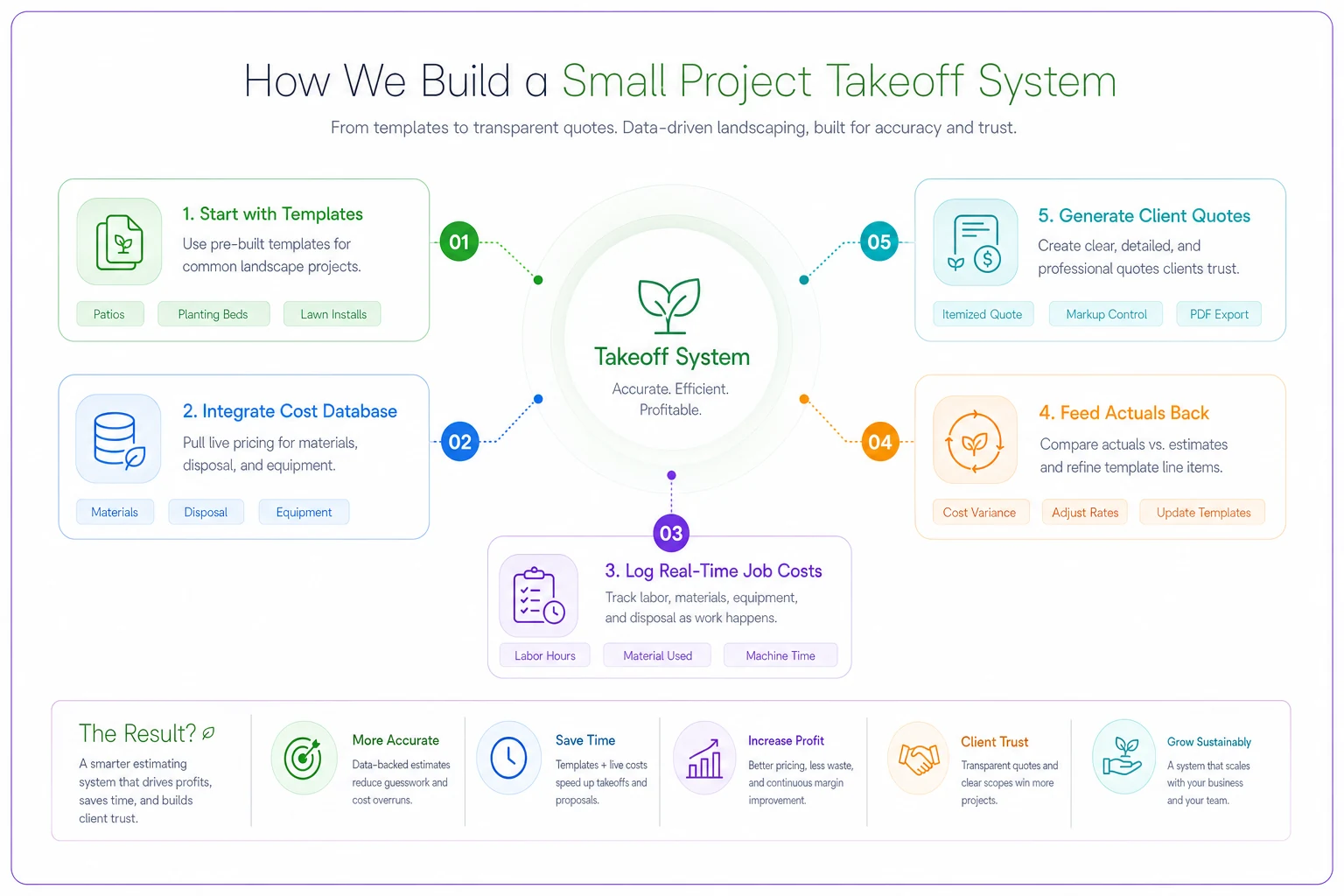
Use templates, capture real costs, update the database, repeat.
Small project profitability comes from disciplined attention to details others ignore. Every forgotten dump run, unaccounted amendment, or missed equipment rental creates a gap between expected and actual profit. Systematically capture these hidden costs and price accordingly, and small projects become the profitable backbone of a sustainable landscape operation rather than the thing that quietly drains your margins all season long.
Ready to grow your landscaping business?
Join 2,000+ landscaping pros using Yardyly to save time, reduce task chaos, and deliver outstanding client results.