



Most landscaping companies lose commercial contracts not because their price was wrong, but because their bid packet documentation created operational confusion that scared property managers away. The difference between a $180,000 annual maintenance contract and a polite rejection email often comes down to how you structure scope appendices, write exclusions, and present milestone invoicing terms.
Commercial property managers review dozens of bid packets every quarter. They've developed an almost instant ability to spot contractors who will become operational headaches versus those who run smooth operations. Your bid packet signals which category you fall into long before anyone calls your references.
The scope appendix problem that creates instant doubt
Property managers want to see exactly what happens during each visit, not vague promises about "comprehensive maintenance." Yet most contractors submit scope appendices that read like marketing brochures instead of operational documents.
A maintenance director managing 14 properties once showed me two bid packets side by side. The first listed "complete lawn care services" with seasonal adjustments. The second broke down visit frequencies by zone, specified blade heights for different grass types, included edge trimming linear footage, and detailed which areas received spot treatment versus broadcast applications. Both contractors bid within $400 of each other monthly. Guess who got the contract.
The winning scope appendix included a property-specific visit calendar showing exactly what tasks happened each week of the year. Week 17 showed mowing zones A-C, edging 1,800 linear feet of walkways, spot-treating broadleaf weeds in zones B and D. Week 18 added mulch touch-ups to entrance beds. This level of detail takes maybe three extra hours to prepare but immediately separates serious operators from companies winging it.
Your scope appendix should answer questions before they're asked. Include service windows (Tuesday/Thursday between 7am-noon), rain delay protocols, and specific quality standards. Define what "edging" actually means - manual string trimming or bed redefinition with a bed edger? These distinctions matter when disputes come up six months into a contract.
Why exclusions determine profit margins
Exclusions aren't about avoiding work - they're about setting operational boundaries that protect your margins and prevent scope creep. Poorly written exclusions create two problems: they either leave gaps that clients exploit, or they sound so defensive that property managers assume you're difficult to work with.
Never miss a job detail again.
Yardyly helps you plan, confirm, and manage every landscaping project seamlessly.
- Centralized project scheduling
- Automated client updates
- Crew and resource management
No credit card required
The sweet spot is structuring exclusions as operational clarifications. Instead of writing "snow removal not included," specify "snow removal services available under separate agreement at $XXX per inch accumulation, triggered at 2-inch threshold, response time within 4 hours of snow cessation." That frames the exclusion as an available service with clear parameters rather than a hard no.
Common exclusions that small contractors forget until it's too late:
| Common Exclusions |
|---|
| irrigation repairs beyond basic head adjustments |
| pest control requiring licensed applications |
| tree work above 15 feet |
| hardscape repairs |
| drainage corrections |
| special event preparations |
Each missing exclusion becomes an awkward conversation or unpaid work that quietly eats your margins.
What really matters is tying exclusions to specific cost triggers. "Leaf removal included for volumes up to 30 cubic yards per visit. Volumes exceeding this threshold billed at $45 per additional cubic yard." This sets clear expectations while giving you a framework for handling the inevitable variations.
Milestone invoicing that actually gets paid
Commercial clients hate invoice surprises. They budget quarterly or annually, and unexpected charges create internal problems that end up reflecting poorly on you. Your milestone invoicing terms need to align with how commercial properties actually process payments.
Most contractors default to monthly billing, but that creates 12 opportunities for payment delays annually. A better approach is establishing quarterly milestone payments tied to seasonal service transitions. Spring startup (including small project components), summer maintenance, fall cleanup, winter prep. Each milestone includes specific deliverables that trigger payment.
A milestone structure might look like this: Q1 payment covers spring cleanup, bed edging, first fertilization, mulch installation, and 13 weekly visits. Payment due upon completion of mulch installation, typically around week 14. Clients get a clear trigger event. You get larger, less frequent payments that improve cash flow.
Include payment terms that reflect commercial realities. Net 45 is standard, but specify that service continues only with current payment status. A 5% early payment discount for payments received within 15 days works well - many controllers will take it, which helps your cash flow more than you'd expect.
A 5% early payment discount for payments received within 15 days works well - many controllers will take it, which helps your cash flow more than you'd expect.
The thing most contractors miss: remedy periods and cure notices. "Payment delays exceeding 60 days trigger service suspension with 10-day written notice. Service resumes within 48 hours of payment receipt." This language protects you while giving clients a clear path to resolution rather than just cutting them off cold.
Subcontractor coordination that prevents disasters
Small landscaping companies often rely on specialized subs for irrigation, tree work, or chemical applications. Your bid packet needs to clarify how this coordination works without making you look like you're just brokering services.
Property managers worry about finger-pointing when problems arise. Your subcontractor coordination notes should establish you as the single point of accountability while being transparent about specialized service delivery. "Tree pruning services performed by certified arborists from [Company Name], scheduled and supervised by [Your Company]. All work covered under our insurance and warranty terms."
Include coordination timelines. "Irrigation activation scheduled 14 days prior to April 15 target date. Tree pruning completed before March 31 to avoid nesting season restrictions. Chemical applications scheduled 72 hours after mowing to prevent granular pickup." These details show you understand the operational complexity of coordinating multiple trades - and that you've actually done it before.
Address communication protocols directly. Who does the property manager call when irrigation breaks? How quickly will tree work estimates be provided? What happens if your chemical applicator's license lapses? Answer these questions proactively in your bid packet rather than leaving them to surface at the worst possible moment.
Clarify liability boundaries too. Your insurance covers general landscape maintenance, but does it cover misapplied chemicals that kill turf? Does your sub's insurance cover property damage from fallen branches? Making these coverages explicit upfront avoids expensive surprises for everyone.
Payment milestone calculations for different property types
Property type affects how you structure milestone payments. Office parks want predictable quarterly payments. HOAs need board approval for amounts over certain thresholds. Retail centers tie everything to their fiscal calendar.
A milestone framework that adapts across property types:
Office Parks (typically 2-5 acres)
-
Q1 (March-May)
35% of annual contract - covers startup costs and heavy spring work
-
Q2 (June-August)
25% - steady-state summer maintenance
-
Q3 (September-November)
25% - includes fall cleanup prep
-
Q4 (December-February)
15% - minimal winter work, planning next year
HOA Properties (multiple zones, 5-15 acres)
-
Monthly base fee
70% of averaged annual cost
-
Seasonal supplements
30% split across major service periods
-
Allows stable monthly billing while capturing seasonal variations
Retail Centers (high visibility, 1-3 acres)
-
Bi-monthly billing aligned with their accounting periods
-
Enhanced service periods (holidays) billed separately
-
Damage remedy fund
$2,000 held in reserve for emergency repairs
A milestone framework that adapts across property types:
The review process advantage
Smart contractors include a structured review process in their bid packets. Not to create more meetings - to prevent small issues from becoming contract terminations.
Specify quarterly business reviews: 30-minute meetings to go over service quality, discuss upcoming seasonal transitions, and address any concerns. Include standard agenda items: completed work summary, upcoming schedule, budget status, and improvement opportunities.
Build in an annual contract review 60 days before renewal. This creates a natural discussion point for price adjustments, scope modifications, and service enhancements. Property managers appreciate the predictability, and you avoid scrambling at renewal time.
Include escalation paths for issues. "Day-to-day concerns directed to Crew Leader (phone number). Operational issues to Account Manager (email). Contract modifications to Owner (scheduled meetings only)." This prevents every small complaint from becoming a crisis while making sure serious issues get proper attention.
Red flags that kill commercial proposals instantly
Certain mistakes disqualify your bid packet regardless of price. Generic company descriptions copied from your website. Insurance certificates that expire before the contract term ends. Residential references submitted for commercial work. Math errors in pricing tables.
Vague timeline commitments are another killer. "Spring cleanup completed in early April" means nothing. "Spring cleanup initiated April 1-5, completed within 10 working days, weather permitting" sets actual expectations.
Inconsistent terminology throughout the document signals sloppy operations. If page 3 mentions "weekly mowing" but page 7 says "bi-weekly cutting," property managers will assume your actual service delivery is equally disorganized.
Weak warranty terms signal a lack of confidence. Include specific remedy procedures: "Areas showing decline within 30 days of service receive priority re-treatment. Plant material warranty excludes acts of nature, vandalism, or improper irrigation." Clear limits actually increase client confidence more than open-ended promises do.
Converting bid packets into operational systems
The best commercial bid packets become your operational blueprint. Every promise in your documentation needs a corresponding operational procedure behind it. Your scope appendix becomes crew task lists. Exclusions become training topics for client communication. Milestone triggers become scheduling priorities.
This alignment prevents the classic problem where sales promises something operations can't actually deliver. When your bid packet accurately reflects operational reality, contract administration becomes straightforward instead of constant crisis management.
The diagram below shows how scope appendices become visit schedules and how milestone triggers feed invoicing.
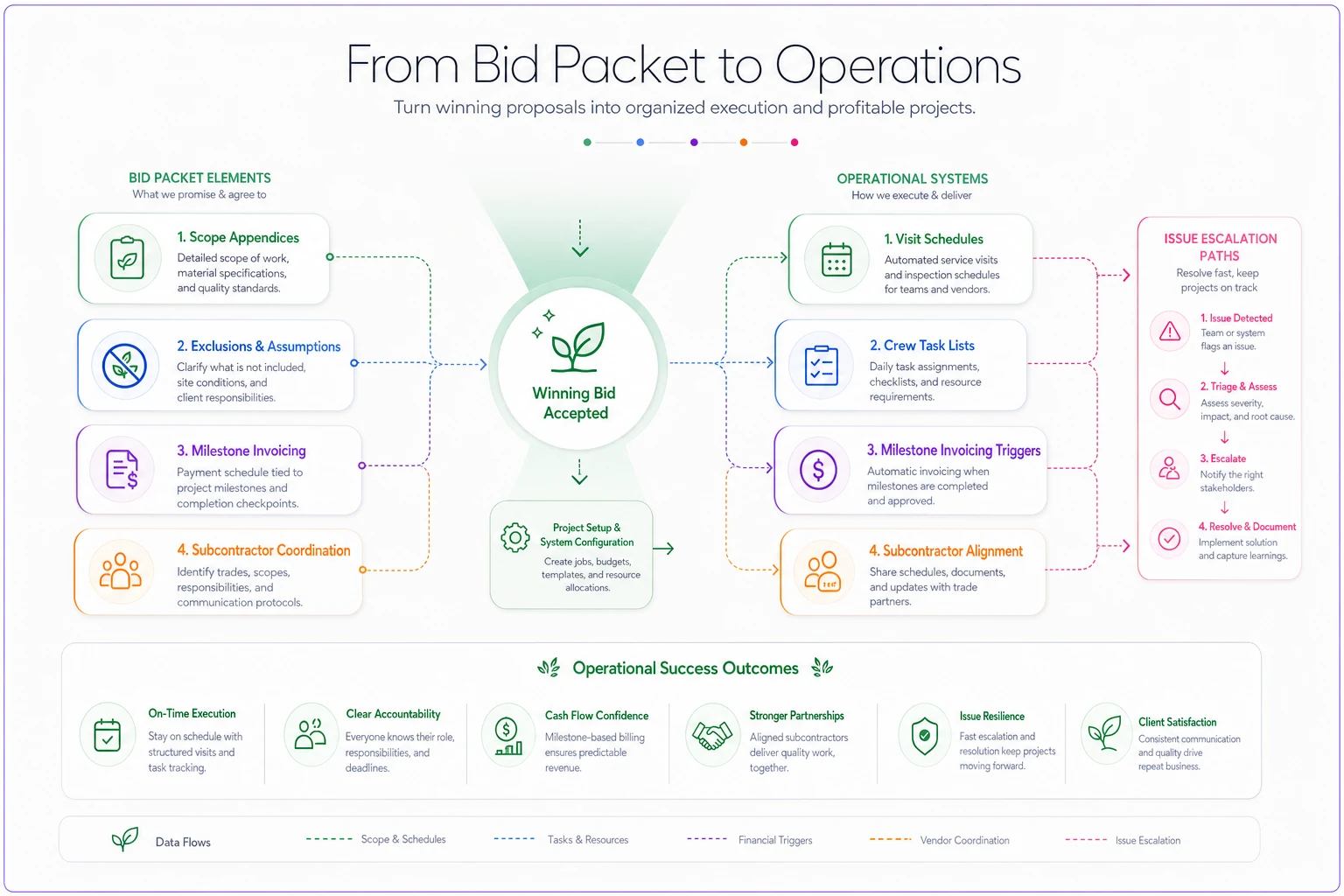
AI-powered operational software can help maintain this alignment in practice. Modern platforms can automatically generate visit schedules from scope appendices, track milestone completion for invoicing triggers, and flag when excluded services get requested. That kind of automation helps ensure your bid packet promises translate into consistent field execution rather than getting lost between the proposal and the crew.
The coordination between bid documentation and daily operations is ultimately what determines whether commercial contracts become profitable long-term relationships or expensive lessons in overpromising.
Building your commercial bid packet template
Start with a modular template that adapts to different property types while maintaining consistent quality. Core sections stay stable: company capabilities, insurance documentation, reference lists. Variable sections adjust based on property needs: scope details, exclusions, pricing structures.
Pull from standardized libraries of scope descriptions, exclusion language, and terms. This ensures consistency while still allowing customization. When you refine an exclusion based on a bad field experience, every future proposal benefits from that adjustment.
Track which bid packet elements correlate with wins versus losses over time. Did detailed scope appendices improve close rates? Did quarterly milestone billing attract more property managers? That data helps you refine the template continuously rather than guessing.
Your bid packet represents your operational maturity. Property managers read dozens of these documents annually and they've gotten good at spotting the difference between contractors who actually understand commercial operations and those just trying to land bigger contracts.
The initial investment in developing a professional commercial bid packet - typically 20-40 hours for the template, plus 3-5 hours per customized proposal - pays off through higher close rates and better client relationships. More importantly, it forces you to work through operational details that prevent problems months into the contract.
Commercial contracts can transform a landscaping company from a seasonal scramble into a stable business. But landing and keeping these contracts requires documentation that demonstrates real operational sophistication. Your bid packet is often the only chance to make that case. Make it count.
Ready to grow your landscaping business?
Join 2,000+ landscaping pros using Yardyly to save time, reduce task chaos, and deliver outstanding client results.