

Most landscaping companies don't have a traffic problem. They have a conversion problem.
Your Google Business Profile shows up in the map pack for "landscaping near me." People click, look at your page, and then nothing. No call, no form, no booking. They scroll back up and dial the next company because that company's number was easier to find or they had 40 more reviews.
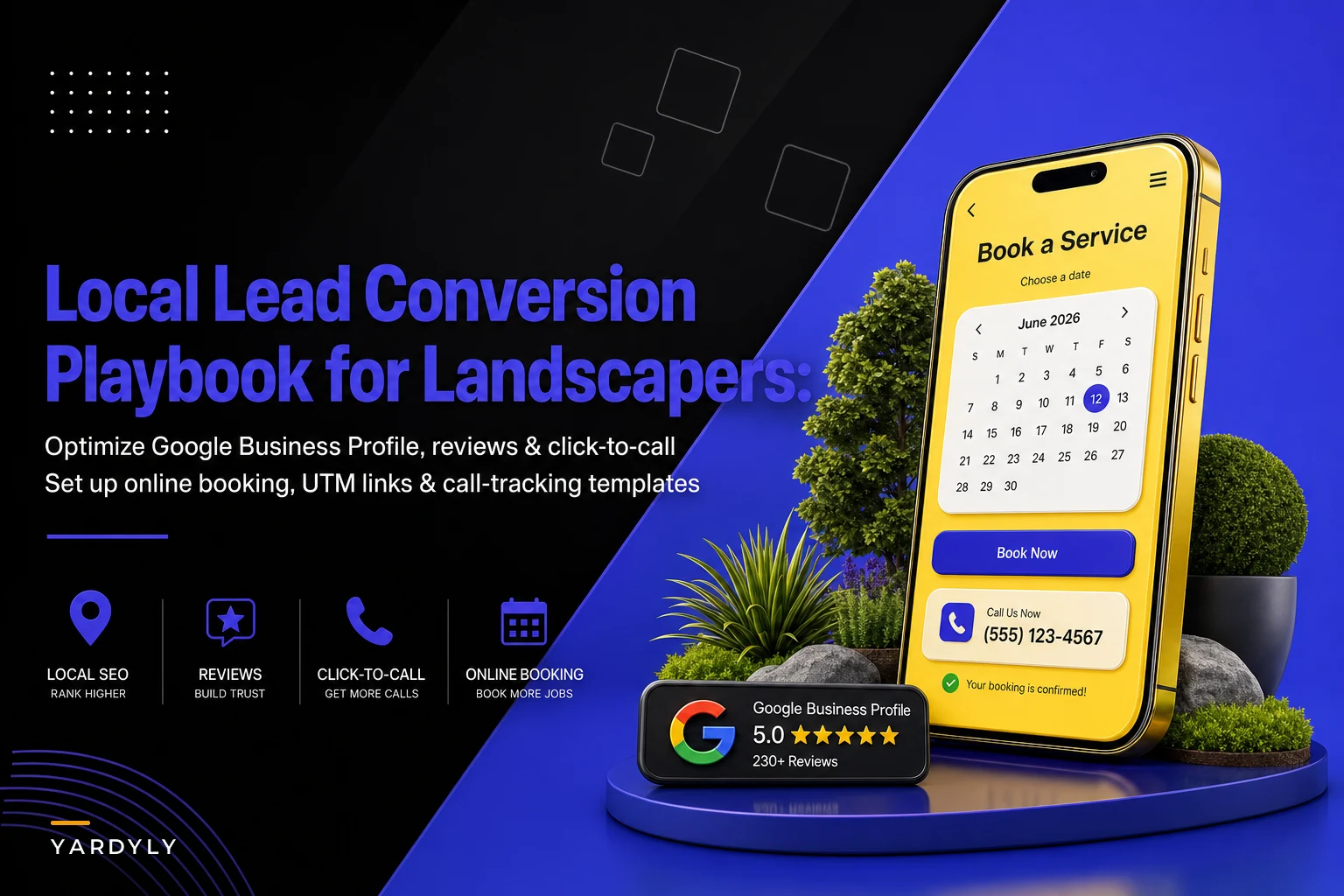
That gap—between someone finding you and someone actually booking you—is where most of the money leaks. And it costs almost nothing to fix compared to buying more clicks. This playbook walks through the exact steps to tighten that funnel: profile setup, reviews, click-to-call, online booking, and the tracking that tells you what's actually working.
One thing before we start: this is the conversion half of the equation. This post assumes you're already getting some local traffic and you want more of it to convert. If you want to also tie this into broader growth decisions and capacity sequencing, the growth-gates operating model covers that side of things.
Start by figuring out where the leak actually is
Before you touch anything, get a rough sense of your current numbers. Not perfect—rough. Most owners genuinely have no idea how many people view their profile versus how many actually contact them.
Pull up your Google Business Profile insights (now called "performance") and look at the last 90 days. You'll see calls, bookings, directions, and website clicks. Then compare that to your total searches and views.
A pattern that comes up constantly: a profile getting 1,400 monthly views but only 18 calls. That's roughly a 1.3% action rate, and the owner thinks their marketing is fine because the phone rings sometimes. It's not fine. A decently optimized landscaping profile in a suburban market should convert views to contacts somewhere in the 3–7% range, depending on season and competition.
| Metric | Weak | Decent | Strong |
|---|---|---|---|
| Profile views → contact (call/form/book) | under 2% | 3–5% | 6%+ |
| Website visitor → lead form submit | under 1.5% | 2–4% | 5%+ |
| Click-to-call answered rate | under 60% | 70–80% | 85%+ |
| New lead → booked estimate | under 25% | 35–45% | 50%+ |
| Reviews gained per 10 completed jobs | 0–1 | 2–3 | 4+ |
Don't obsess over hitting "strong" everywhere. Find the one row where you're weakest and start there. That's your leak.
The Google Business Profile conversion checklist
Most GBP advice is about ranking. This is about making the people who already see your profile pick up the phone. A profile can rank #1 and still convert terribly.
Never miss a job detail again.
Yardyly helps you plan, confirm, and manage every landscaping project seamlessly.
- Centralized project scheduling
- Automated client updates
- Crew and resource management
No credit card required
-
Phone number is a local number, not a call center or a cell with no voicemail setup. People trust local area codes for home services. If you use call tracking (more on that below), make sure the forwarding actually works nights and weekends.
-
Business hours are accurate and account for when you're closed. If you're dark on Sundays but someone searches Sunday night, a "Request a quote" button catches them. Dead hours equal dead leads.
-
The booking button is turned on and points somewhere useful. Most landscapers leave this blank. Big miss.
-
Services are listed individually—mowing, cleanups, mulch, hardscape, irrigation—each as its own entry. People searching for one specific thing want to see that exact word on your profile.
-
At least 15–20 real job photos, geotagged, showing before/after work. Not stock images. Not your logo five times. Actual yards you've worked on.
-
The "from the business" description mentions your service area towns by name. "Serving Maple Grove, Brooklyn Park, and Plymouth" reads as local and trustworthy in a way that "serving the greater metro area" doesn't.
-
Q&A section is seeded with 3–5 real questions. Post them yourself and answer them. "Do you do one-time cleanups or only seasonal contracts?" stops someone from leaving to find that answer elsewhere.
-
Pricing hints where allowed. Even a "cleanups starting around $X" range filters tire-kickers and warms up buyers who are ready.
The single most common miss: the booking button is empty while the owner wonders why the phone doesn't ring enough. You're literally hiding the contact option.
Reviews: the part everyone knows matters and nobody systematizes
Review count and recency are probably the biggest conversion levers on your profile. A landscaper with 110 reviews averaging 4.8, with the most recent one from last week, beats a competitor with 30 reviews from two years ago—even if that competitor ranks a little higher.
The ask has to be built into the job
> "Really glad you're happy with how it turned out. If you've got 30 seconds, a quick Google review genuinely helps a small crew like ours. I'll text you the link right now so it's easy—no pressure at all."
-
In person at job completion — crew lead asks and texts the link in that same minute.
-
Same evening — a follow-up text if they didn't leave one yet: "Thanks again for having us out today! Here's that review link if you have a sec: [link]"
-
Three days later, once only — a soft final nudge for maintenance customers you'll see again. Never more than that.
A crew that asks consistently on even half their jobs pulls in 2–4 reviews per 10 completed jobs. Twenty jobs a week at a 25% ask-to-review rate is a steady flow that keeps your profile looking active.
Responding to reviews
> "Thanks so much, [Name]! The crew really enjoyed working on your [project]. We appreciate you taking the time, and we're here whenever you need us."
> "Hi [Name], I'm sorry the [specific issue] didn't meet expectations—that's not the standard we hold ourselves to. I'd like to make it right. Could you call me directly at [number]? I want to understand what happened and fix it."
Never argue publicly. Never get defensive about weather or scheduling. Future buyers are watching how you handle friction, not who was technically right.
Make it easy to contact you
Once someone decides they want you, every extra step bleeds off a chunk of them. This is where a lot of otherwise-solid landscaping funnels fall apart—everything is fine until the contact moment, and then it asks for too much.
Click-to-call
Most local landscaping searches happen on mobile. Your phone number needs to be tappable. A number typed as plain text instead of a real "tel:" link forces people to copy it, switch apps, and paste. Half won't bother.
-
The number on your GBP, website header, and landing pages is a live click-to-call link.
-
Someone actually answers during business hours, or a real voicemail with a callback promise exists. "We return calls within 2 hours during the workday" converts better than silence.
-
You track missed calls. An unanswered call during peak season is a lost job—same logic as tracking per-truck shortages that cost you jobs mid-shift. What you don't measure, you keep losing.
Online booking and quote requests
Not everyone wants to call. Younger homeowners and busy professionals often prefer to request a quote at 11pm. If your only contact option is a phone call, you lose that whole segment.
-
Name
-
Address or ZIP
-
Phone and email
-
Service type (dropdown
mowing, cleanup, mulch, design, etc.)
-
One optional free-text box
That's it. Every extra required field drops your completion rate. Asking for budget, lot size, timeline, and preferred contact method upfront feels thorough but kills conversions. Get the lead first. Qualify on the follow-up call.
Tracking: stop guessing which channel actually books jobs
Most owners run a Facebook post, a Nextdoor mention, a GBP listing, and maybe some Google Ads—and cannot tell you which one produced the three jobs they booked last week. So they either cut the wrong thing or keep paying for the thing that doesn't work.
UTM templates for the channels you actually use
A UTM is a tag added to your link so Google Analytics knows where a visitor came from. Build them once, reuse forever.
yoursite.com/quote?utmsource=X&utmmedium=Y&utm_campaign=Z
| Channel | Example tagged link |
|---|---|
| Google Business Profile | ?utmsource=google&utmmedium=gbp&utm_campaign=profile |
| Facebook post | ?utmsource=facebook&utmmedium=social&utmcampaign=springcleanup |
| Nextdoor | ?utmsource=nextdoor&utmmedium=social&utm_campaign=local |
| Email newsletter | ?utmsource=email&utmmedium=newsletter&utmcampaign=fallservices |
| Yard sign QR code | ?utmsource=yardsign&utmmedium=offline&utm_campaign=referral |
Keep a spreadsheet of your tagged links and stay consistent. The second you start mixing "fb" and "facebook" and "FB," your reports turn to noise.
Call tracking
Use a separate tracking number for each major source—one for GBP, one for your website, one for print or truck signage. When a call comes in, you know where it originated. Most call-tracking services run $20–40/month and pay for themselves the first time you discover that your expensive channel drives almost no calls while your free GBP drives most of them.
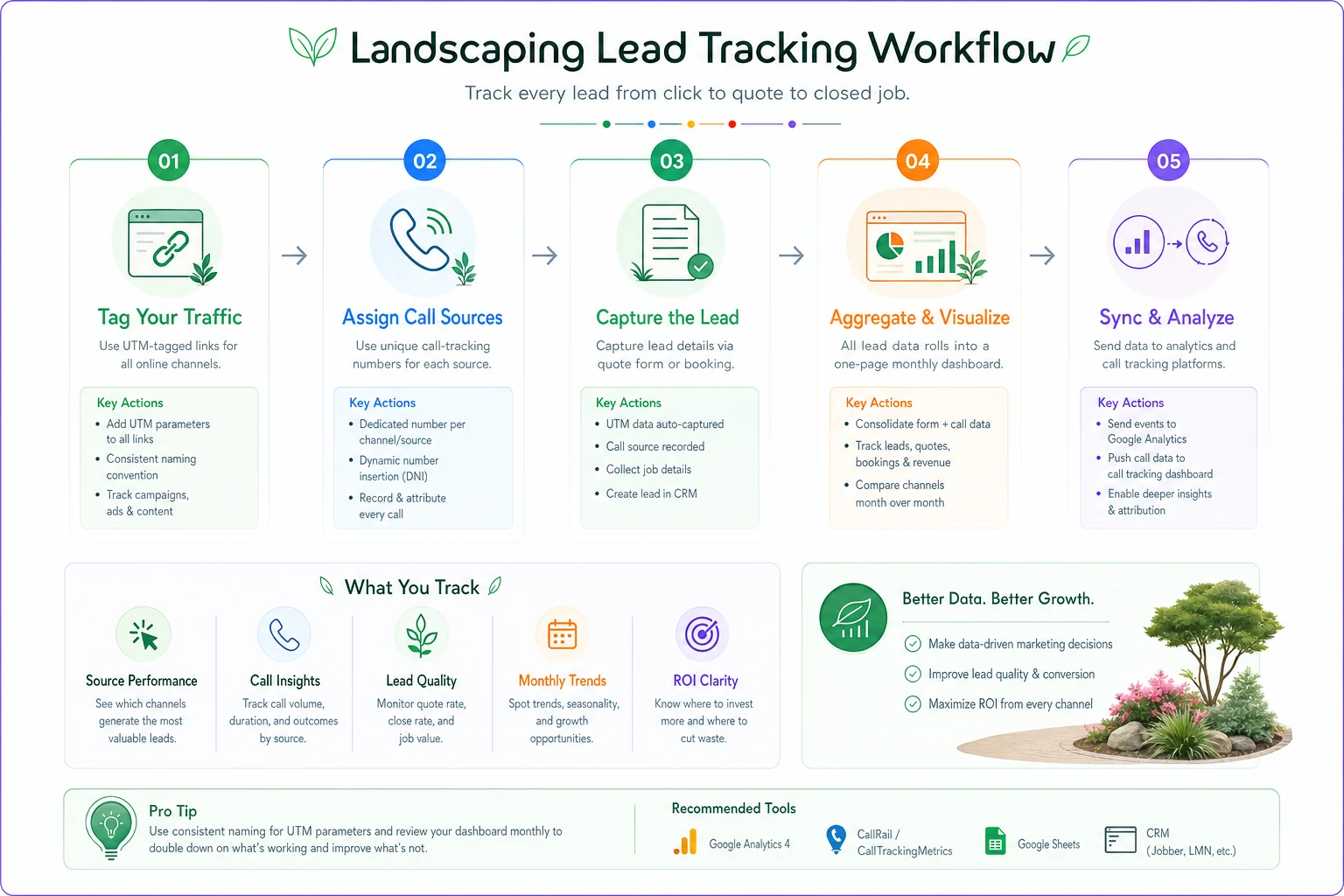
A pattern that shows up repeatedly: owners assume paid ads drive their phone, then install call tracking and find out 60–70% of their calls come from the free Google Business Profile. That single discovery reshapes the whole budget.
Prioritized, low-cost channels—in the order that actually pays off
You don't need ten channels. You need the two or three that convert for your market, done consistently. Here's the priority order for most small-to-mid landscaping companies:
-
Google Business Profile — free, highest intent, biggest lever. Fix this fully before anything else.
-
Reviews — free, compounds over time, lifts every other channel's conversion rate.
-
A simple quote-request landing page — cheap to build, captures after-hours demand.
-
Nextdoor and local Facebook groups — free to low cost, strong for neighborhood word-of-mouth. Real recommendations outperform ads here.
-
Yard signs and truck branding with a QR code — nearly free, and the QR code lets you actually track the source.
-
Google Local Services Ads — paid and high intent, but only worth it after the free stuff is dialed in.
The mistake is jumping to #6 while #1 and #2 are half-built. You're paying to send traffic into a leaky funnel.
When paid ads make sense
Running Local Services Ads is worth it when your organic profile is already converting around 4%+ and you have crew capacity to take on more work. If you can't service the jobs, buying more leads just creates angry callbacks and bad reviews—which hurts conversion everywhere. Capacity has to come before demand. That sequencing logic is the whole point of the growth-gates operating model: don't buy demand you can't fulfill.
When paid ads are a bad idea
If your profile converts under 2%, if you have no review system, or if calls go unanswered half the time—don't run ads yet. You'll burn money proving that your funnel is broken. Fix the free stuff first.
A real scenario
A two-crew maintenance and cleanup company in a mid-size suburban market was getting steady profile views—somewhere in the 1,200–1,500 range monthly—but booking maybe 14–16 jobs from online sources. The owner was about to put money into ads.
Within about three months:
-
Reviews went from 34 to roughly 70.
-
Online-sourced bookings climbed into the high 20s to low 30s per month.
-
Call tracking showed almost all of it came from the free profile—so they held off on ads entirely and kept that budget.
No new traffic. Same market. They just stopped losing the leads they already had.
The one-page monthly dashboard
You don't need fancy software to stay on top of this. One page, updated monthly. Track these:
-
Profile views (from GBP performance)
-
Calls received (from call tracking)
-
Calls answered %
-
Form and booking submissions
-
View → contact rate (contacts ÷ views)
-
New reviews this month
-
Current review count and average rating
-
Leads → booked estimates %
-
Top source (which channel drove the most booked jobs)
Fill it in on the first of every month. Takes fifteen minutes. The value is in the trend—if your view-to-contact rate drops two months in a row, something broke (a buried phone number, a dead booking link, slow callbacks) and you'll catch it before it costs you a season.
If you want to connect these marketing numbers to broader operational metrics so lead flow ties into hiring, routing, and pricing decisions, it's worth building consistent definitions across both. The canonical KPI taxonomy for landscapers is a good reference for keeping your marketing dashboard and your ops dashboard speaking the same language.
Where to start Monday morning
If you do nothing else this week, do these three things in order.
-
Pull your 90-day profile numbers and calculate your view-to-contact rate. That one number tells you whether you have a visibility problem or a conversion problem. Most will find it's conversion.
-
Turn on your booking button and make your phone number tappable everywhere. That's an afternoon of work and it's often the single biggest jump you'll see.
-
Write the review ask into your crew's job-completion routine and test it this week. Consistency here is what compounds over a season—not a one-time push.
The companies that win local search aren't usually the ones spending the most. They're the ones who make it easy to book them, ask for reviews every time, and actually measure which channel pays. None of that requires a big budget—just the discipline to close the gap between getting found and getting hired.
The companies that win local search aren't usually the ones spending the most. They're the ones who make it easy to book them, ask for reviews every time, and actually measure which channel pays. None of that requires a big budget—just the discipline to close the gap between getting found and getting hired.
Ready to grow your landscaping business?
Join 2,000+ landscaping pros using Yardyly to save time, reduce task chaos, and deliver outstanding client results.