


Most landscaping owners don't get burned by staying small. They get burned by growing at the wrong time, in the wrong direction, using cash they needed for something else.
The stories all rhyme. A maintenance company adds hardscaping because a big client asked for it, then discovers the margins are thinner and the labor is completely different. A three-crew operation opens a second yard 40 minutes away and watches drive time quietly eat the profit that made the expansion look attractive on paper. A profitable owner gets a franchise pitch, likes the idea of "passive royalties," and spends 18 months building systems that were never designed to be handed to a stranger.
None of these were dumb people. They just made big moves off gut feel instead of running them through a gate. A strategic growth model for landscaping isn't a business plan you write once and file away. It's a set of thresholds and pilot rules that tell you when a move is allowed to happen and when it isn't—before your emotions and a good sales pitch get involved.
That's what this article lays out. Not motivation. Not "believe in yourself." A working decision framework you can actually use the next time something big lands on your desk.
The real problem: big moves get judged by revenue, not by readiness
There's a pattern that shows up constantly. An owner evaluates a strategic move by asking, "Will this bring in more revenue?" Almost anything brings in more revenue. Adding a snow division brings in revenue. Opening a second location brings in revenue. Taking on a giant commercial contract brings in revenue.
-
Does the existing business run without me touching it daily?
-
Is the current operation profitable enough to survive the drag a new venture creates?
-
Do I have the cash to fund the move and absorb it going sideways for six months?
-
Can this thing be measured well enough that I'll know early if it's failing?
When those questions don't get asked, growth becomes a series of expensive experiments funded by the healthy part of the business. And the healthy part can only bleed for so long before both sides are sick.
What separates operators who scale cleanly from the ones who stall out isn't ambition. It's that they refuse to make a strategic move until it clears specific gates. The move has to earn the green light.
What actually breaks at scale
Small operations are held together by the owner's brain. You know every client, every crew member's strengths, which trucks are due for service, which invoices are late. That works beautifully at one or two crews. It's the whole reason small landscapers can out-service the big regional players.
Never miss a job detail again.
Yardyly helps you plan, confirm, and manage every landscaping project seamlessly.
- Centralized project scheduling
- Automated client updates
- Crew and resource management
No credit card required
Attention gets split, and the core business drifts. The new hardscape division needs your focus, so you stop riding along on maintenance quality checks. Three months later your renewal rate slips and you don't notice until the spring re-sign numbers come in soft. The new thing didn't fail—it quietly damaged the old thing.
The cost structure changes shape. Maintenance is high-frequency, low-ticket, predictable. Installs are lumpy, capital-heavy, and cash-flow brutal. Snow is a coin flip against weather. Bolting these together without understanding how each behaves financially is how owners end up "busy and broke."
Coordination overhead explodes. Two crews need one dispatcher's head. Six crews across two service lines and two yards need actual systems, or the whole thing turns into a daily scramble of texts and phone calls. Complexity doesn't grow linearly with size—it grows faster.
This is why you can't evaluate a growth move in isolation. Every big decision either strengthens or strains the system you already have. Before you understand where you can go, you need brutal clarity on where you actually are—which starts with knowing your true numbers by service line, not blended. A time-allocated P&L system that shows profitability per service line is the foundation the entire growth model sits on. If you can't tell me which line makes money today, you're not ready to add a new one.
The gate system: what has to be true before you're allowed to move
Think of gates as locks on the door. You don't get to walk through until every lock is open. Here are the four gate categories worth building.
1. KPI gates (is the core business actually healthy?)
Before any expansion, the existing operation has to be hitting stable, boring numbers. Not record numbers—stable ones. A move made from a shaky base multiplies the shakiness.
-
Net margin on the core line consistently above your minimum (many maintenance-heavy operators use 12–18% as a floor before they'll expand)
-
Client retention/renewal steady or climbing for at least two full seasons
-
Revenue per crew hour trending flat or up, not down
-
Owner working on the business a meaningful chunk of the week, not stuck in the truck
The KPIs you already use to trigger hiring and pricing decisions are the same ones that should gate strategic moves. If you've built out decision-mapped KPIs that trigger hiring, pricing, and routing, you extend that same logic upward—the metrics that tell you to hire a crew are cousins of the ones that tell you whether you're ready to open a division.
2. Minimum staffing gates (can you cover the new thing without robbing the old one?)
The most common quiet failure: pulling your best foreman to run the new venture, then wondering why quality dropped on the core work he used to anchor.
The gate rule is simple. You don't launch a strategic move by moving your key people—you launch it with either dedicated hires or genuine excess bench capacity. If the plan only works because your A-players get stretched across two things, the plan doesn't work. It just hasn't failed yet.
A good test: could the core business run at current quality if you were gone for two weeks? If not, you don't have the staffing depth to add anything. Fix that first.
3. CapEx and cash gates (can you fund the move and survive it going sideways?)
Every expansion has a real number and a survival number. The real number is what you think it'll cost. The survival number is what it costs when it takes twice as long to break even as you planned—which it will.
The gate: don't commit capital to a strategic move unless you can fund it and keep 60–90 days of core operating expenses in reserve. If the expansion drains your cushion, one bad month in your core business takes down both.
4. Reversibility gate (how expensive is it to back out?)
This one gets skipped constantly. Some moves are cheap to unwind—drop a service line, let a contract lapse. Some are brutal: a signed multi-year lease on a second yard, a financed excavator, a franchise agreement. The more irreversible the move, the higher every other gate should be set.
A comparison of the three big moves
The three strategic moves owners weigh most often—new service line, franchise, or sell—are completely different animals, even though they all get filed under "growth." Here's how they actually compare.
| Factor | Add a Service Line | Franchise | Sell |
|---|---|---|---|
| Capital required | Moderate–high | High (systems, legal, support) | None (you're the one getting paid) |
| Reversibility | Medium (can wind down) | Very low (long agreements) | Zero (it's done) |
| Core-business risk | High (attention drift) | High (systems must be bulletproof) | N/A |
| Skills needed | Operational | Systems + training + brand | Deal-making + clean books |
| Time to payoff | 6–18 months | 2–4 years | Immediate |
| Biggest failure mode | Margin dilution | Undocumented processes | Selling at the wrong moment |
The table makes something clear that owners often miss: franchising is not "growth lite." It's arguably the hardest of the three, because it requires your operation to work perfectly in someone else's hands—which is a far higher bar than getting it to work in yours.
Pilot before you commit: the staged-launch protocol
The single biggest safeguard against a bad strategic move is refusing to go all-in on day one. Almost anything can be piloted at small scale first. The owners who blow up are the ones who skip the pilot because they were "sure."
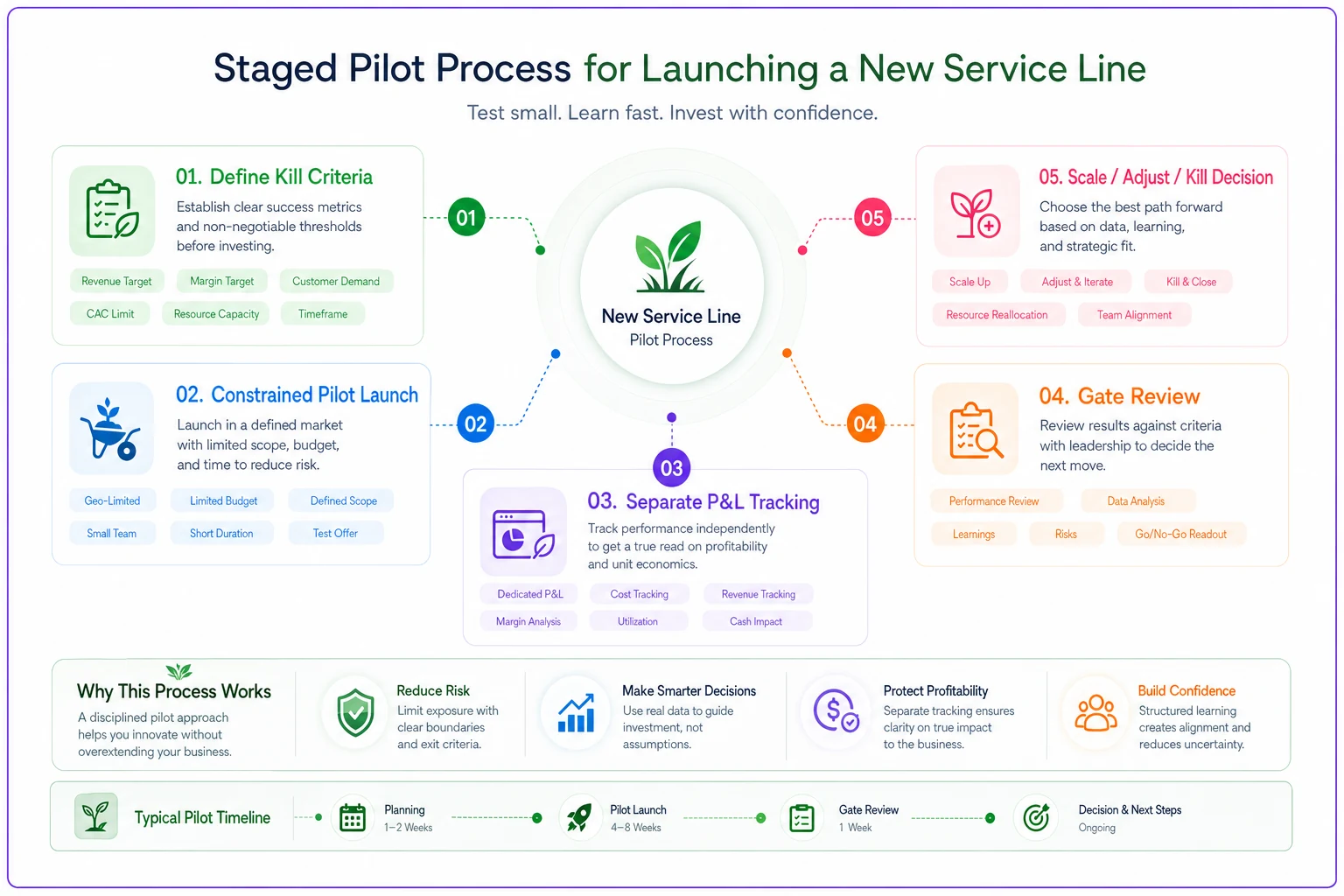
Set kill criteria using simple job counts and margin thresholds so the decision is clear.
-
Define the kill criteria before you start. Write down what failure looks like in advance, in numbers. "If we're below X gross margin after 8 completed jobs, we stop." Deciding this while emotionally neutral is the entire point. You will not make this call cleanly once you're invested.
-
Run a constrained pilot. Cap it. One crew, one geography, a set number of jobs, a fixed time window. Maybe 8–12 jobs of the new service line, or one season of snow with rented rather than purchased equipment.
-
Track the pilot on its own P&L. Blended numbers will lie to you. The new line has to be measured separately or you'll never see whether it's actually carrying its weight. This is where per-line financial tracking pays for itself.
-
Check every gate at the review. Did the pilot hit target margin? Did it damage core quality? Did it require pulling key people? Did the cash flow behave like you expected?
-
Decide
scale, adjust, or kill.
Three options, not two. "Adjust and re-pilot" is often the right answer and gets ignored because owners want a clean yes or no.
The discipline is that kill criteria are set in step one and honored in step five. Everything in between is just gathering evidence.
Below is a visual of how a pilot moves from setup through to a final decision—simple on paper, harder in practice when you've already told a client the new service is coming.
Most owners who skip pilots aren't reckless—they're impatient. The pilot feels like delay when it's actually the cheapest insurance you can buy before committing serious capital.
A pilot template you can copy
Running a proper pilot means filling this out before the first job. Not after. Not during. Before—while you're still thinking clearly and haven't told anyone it's definitely happening.
-
Service line being tested __
-
Pilot duration __ (weeks/jobs)
-
Crew assigned __ (dedicated or existing?)
-
Target gross margin __%
-
Kill threshold below _% margin after _ jobs
-
Max capital at risk $__
-
Core-business guardrail core quality scores must stay above __
-
Review date __
-
Decision owner __ (who makes the final call)
If you can't fill in the kill threshold and the max capital at risk, you're not ready to run the pilot. Those two lines are where undisciplined growth goes to die.
A real scenario: the maintenance company that wanted hardscaping
A maintenance-focused operation—four crews, somewhere around $900k a year—kept getting asked by good clients to handle patios and retaining walls. The owner was ready to hire an install crew and buy a mini-excavator and a dump trailer, call it $55k–$70k committed before the first job.
Instead, he ran it through gates. Core net margin was healthy, retention was solid, so the KPI gate was open. But the staffing gate wasn't: the only person who knew hardscaping was his best foreman, the one holding maintenance quality together. Pulling him would've cracked the core.
So he ran a pilot instead of a launch. He subcontracted the install labor for the first eight hardscape jobs, rented equipment as needed, and tracked the whole thing on a separate P&L. Kill criterion set in advance: below 20% gross margin after eight jobs, they stop.
The result wasn't what he expected. Jobs sold fine, but margin came in around 14–16%—well under target—because he was underpricing complexity and eating change orders. Under the old "just go for it" plan, he'd have bought $70k of equipment and then discovered the pricing problem, with a note payment due monthly.
Because it was a pilot, the fix was cheap. He re-priced, tightened his scope language, re-piloted, and the next batch cleared his margin floor. Then—and only then—did he hire and buy. The pilot cost him a few thousand in slightly-thin early jobs. Skipping it would've cost him a financed excavator sitting on a mistake.
Worth noting: the pricing problem in that story traced straight back to scope. Underpriced complexity and uncontrolled change orders are what kill new-line margins, which is why solid scope appendices, exclusions, and milestone terms matter even more when you're entering unfamiliar work than when you're doing what you already know cold.
When each move actually makes sense
Adding a service line makes sense when: your core is stable and boring-profitable, you have real staffing depth (not stretched A-players), the new line serves your existing client base, and you can pilot it without major capital. The best expansions are ones your current clients are already asking to pay you for.
Franchising makes sense when: your operation runs on documented systems that a stranger could follow, your brand means something in your market, and your core business is so dialed that you're genuinely bored running it. If you're still the answer to every question in your own company, you have nothing to franchise—you have a job.
Selling makes sense when: the business is at or near peak performance, your books are clean enough to survive due diligence, and either the market's paying strong multiples or you're personally ready to move on. The painful truth: the best time to sell is usually when you least feel like it, because that's when the numbers look best to a buyer.
When each move is a bad idea
Knowing when not to move is honestly more useful than knowing when to go. Most of the operators who end up in trouble weren't missing ambition—they were missing a reason to wait.
-
Don't add a service line to fix a margin problem in your core. A weak core doesn't get healthier when you split your attention. Fix the core first.
-
Don't franchise to escape operational chaos. Franchising amplifies your systems. Amplifying chaos just gives you more chaos, further away, harder to control.
-
Don't sell in a panic year. Selling off your worst season locks in your worst valuation. If you can afford to wait one more good season, you usually should.
-
Nobody should make any of these moves while the owner is still the single point of failure. If you're the dispatcher, the estimator, the QC, and the closer, none of these three doors should open yet.
The owner-as-single-point-of-failure issue tends to be the one people acknowledge and then ignore, because fixing it means trusting people before you're comfortable trusting them. That discomfort doesn't go away—you just decide it's worth it, or you don't.
Where systems quietly decide your ceiling
Every gate above depends on one thing: knowing your real numbers, fast, by service line and by crew. The owners who make good strategic calls aren't smarter—they can just see their operation clearly enough to judge readiness honestly.
Operational software earns its place here not as a growth hack, but as the instrument panel. When your job data, crew hours, and per-line costs flow into one place, checking a KPI gate takes ten minutes instead of a weekend of spreadsheet archaeology. AI-powered platforms can automate the tracking that usually gets skipped when things get busy—flagging when core margins start drifting, surfacing crew hour trends across service lines, and making per-job cost data available without someone manually pulling it together. Pilots become measurable because the separate P&L already exists in the data. The "is my core drifting while I chase the new thing?" question has an actual answer instead of a gut feeling.
The point isn't the tool. Strategic decisions made on stale, blended, half-remembered numbers are gambles dressed up as strategy. Clean data turns them back into decisions.
Growth kills more good landscaping companies than stagnation does, because stagnation is slow and visible while a bad strategic move looks like ambition right up until the money's gone.
The fix isn't to avoid big moves. It's to make them earn their way through gates—healthy core, real staffing depth, funded with a cushion, and piloted at small scale with kill criteria written down before anyone gets emotionally attached. Add the service line, franchise the model, or sell the company. Just don't do any of them because a good pitch landed on a good day. Do them because the move cleared every lock on the door, one at a time.
That's the whole model. Boring, disciplined, and the reason some operators scale to something worth selling while others just stay busy.
Ready to grow your landscaping business?
Join 2,000+ landscaping pros using Yardyly to save time, reduce task chaos, and deliver outstanding client results.