


There's a specific kind of pain that only happens around 11:40am on a Tuesday. Crew two is at the third property of the day, halfway through a spring cleanup, and they're out of contractor bags. Not low. Out. The foreman calls the shop. The shop calls the owner. The owner is on a bid across town and now has to decide: send someone on a 40-minute round trip to the supply house, or have the crew skip the bagging and come back tomorrow.
Either way, you just lost money. And this isn't a supply chain problem in the dramatic sense — the bags exist, they're $18 a box, they're twenty minutes away. This is a procurement governance landscaping problem. Nobody owned the rule for what lives on that truck, who checks it, and when it gets refilled.
Most landscaping operations don't have a materials system. They have a habit. And habits break the moment you add a second crew, a busy week, or a new hire who doesn't know where the string trimmer line lives. This article is about building the actual system — per-truck kit policies tied to route plans, a weekly replenishment cadence, approved substitutions so nobody's improvising, and escalation paths so a supplier's backorder doesn't quietly become your problem at 11:40 on a Tuesday.
Why mid‑shift shortages are a symptom, not the disease
The truck running out of bags is rarely the real failure. It's the last visible link in a chain that broke days earlier.
Walk it backward. The truck was short because nobody restocked it Monday morning. It wasn't restocked because there's no standard for what "fully stocked" even means on that truck. There's no standard because the truck runs a different route mix every week, so the "right" load keeps shifting. And the load keeps shifting because materials are decided by whoever loads the truck that morning, based on memory, based on yesterday.
So you get two equally expensive failure modes running at the same time. Some trucks run short and lose billable hours to emergency runs. Other trucks run fat — carrying six bags of fertilizer for a week with two fert applications, blocking bed space, tying up cash in inventory that's just riding around burning fuel.
Owners tend to obsess over the shortage side because it's loud and visible, and completely ignore the overstock side because it hides. But overstock is where the slow margin leak lives — expired product, damaged bags, "borrowed" supplies that never come back, and the classic $400 of irrigation fittings that live permanently in a truck bed and get reordered anyway because nobody can find them.
The fix isn't "order more" or "order less." It's tying what's on the truck to what the truck is actually going to do that week.
Kits should be built from routes, not from the shop shelf
The core move in serious procurement governance: a truck's material load is a function of its route plan, not a function of what's sitting in the shop.
Never miss a job detail again.
Yardyly helps you plan, confirm, and manage every landscaping project seamlessly.
- Centralized project scheduling
- Automated client updates
- Crew and resource management
No credit card required
Most operations do it backward. They stock the truck from whatever's in inventory, then discover mid-route that the load doesn't match the jobs. The better model builds a per-truck kit that changes based on the week's route mix.
Think of it as three layers:
Base kit — the stuff every truck carries no matter what. Trimmer line, blades, safety gear, first aid, common fasteners, tie-downs, a set of hand tools, trash bags, flagging tape. This layer barely changes week to week.
Route kit — materials driven by the specific jobs scheduled. If Wednesday's route has three mulch installs, the route kit adds the mulch, the edging, the landscape staples. If Thursday is heavy on fert-and-squirt, the route kit swaps in product and marker flags.
Contingency kit — a small buffer of the things that fail unpredictably. One spare blade, an extra roll of trimmer line, a few common irrigation fittings. Not a warehouse on wheels. A deliberate, counted buffer.
The insight most people miss: the base kit and contingency kit should be boring and stable. That's the whole point. The volatility lives entirely in the route kit, which you can plan because you already know the route. If your base kit is where all the guessing happens, you've built the system wrong.
Here's a simplified version of what a per-truck kit policy looks like on paper:
| Layer | Example Items | Who Sets Quantity | Refill Trigger |
|---|---|---|---|
| Base kit | Trimmer line, blades, safety gear, trash bags, tie-downs | Fixed standard | Weekly count Monday AM |
| Route kit | Mulch, fert, edging, plants, hardscape materials | Route plan for the week | Loaded per day/route |
| Contingency kit | Spare blade, extra line, common fittings | Owner-set buffer | When buffer is opened, flag it |
Keep base and contingency kit lists stable month-to-month so the only variability you manage is the route kit.
Notice the last column. The refill trigger matters as much as the quantity. A kit policy without a trigger is just a wish list.
The weekly replenishment cadence that actually holds
The reason most stocking systems collapse isn't the list — it's the rhythm. If restocking happens "whenever someone notices," it happens too late, every time.
A weekly cadence works because it matches how landscaping actually runs: you schedule in weeks, you buy in weeks, your suppliers deliver in weeks. Managing materials daily creates noise; managing them monthly lets shortages compound. Weekly is the natural unit.
-
Friday afternoon — route lock. Next week's routes are set enough to know the material mix. Not perfect, just committed enough to plan against.
-
Friday/Saturday — needs roll-up. Someone converts the route plan into a materials list: how much mulch, how many bags of product, which plants, how many fittings. This is a 30-minute job when routes are locked and a nightmare when they aren't.
-
Monday early — supplier order placed. Consolidated, not five panic-buys across the week. One order beats five, both in price and in your time.
-
Monday AM — truck kit reset. Base and contingency kits get counted back to standard. Route kits get loaded for the day.
-
Daily — top-off, not restock. Crews replenish route-specific consumables from the shop, not from a supply run. If the shop is short, that's a flag, not a road trip.
The thing that separates smooth operations from chaotic ones is step 5. In a broken system, a shortage triggers a trip. In a governed system, a shortage triggers a flag — the buffer already covered today, and the flag fixes next week. You stop paying for emergencies with billable hours.
One more thing worth noting: consolidating to a weekly order connects directly to your other cost centers. If you're already thinking about how dump fees and transfer-station scheduling get batched into the week, the same logic applies to inbound materials. Batching disposal trips and batching supply runs are the same discipline pointed in opposite directions.
Here's a quick visual of the weekly replenishment workflow.
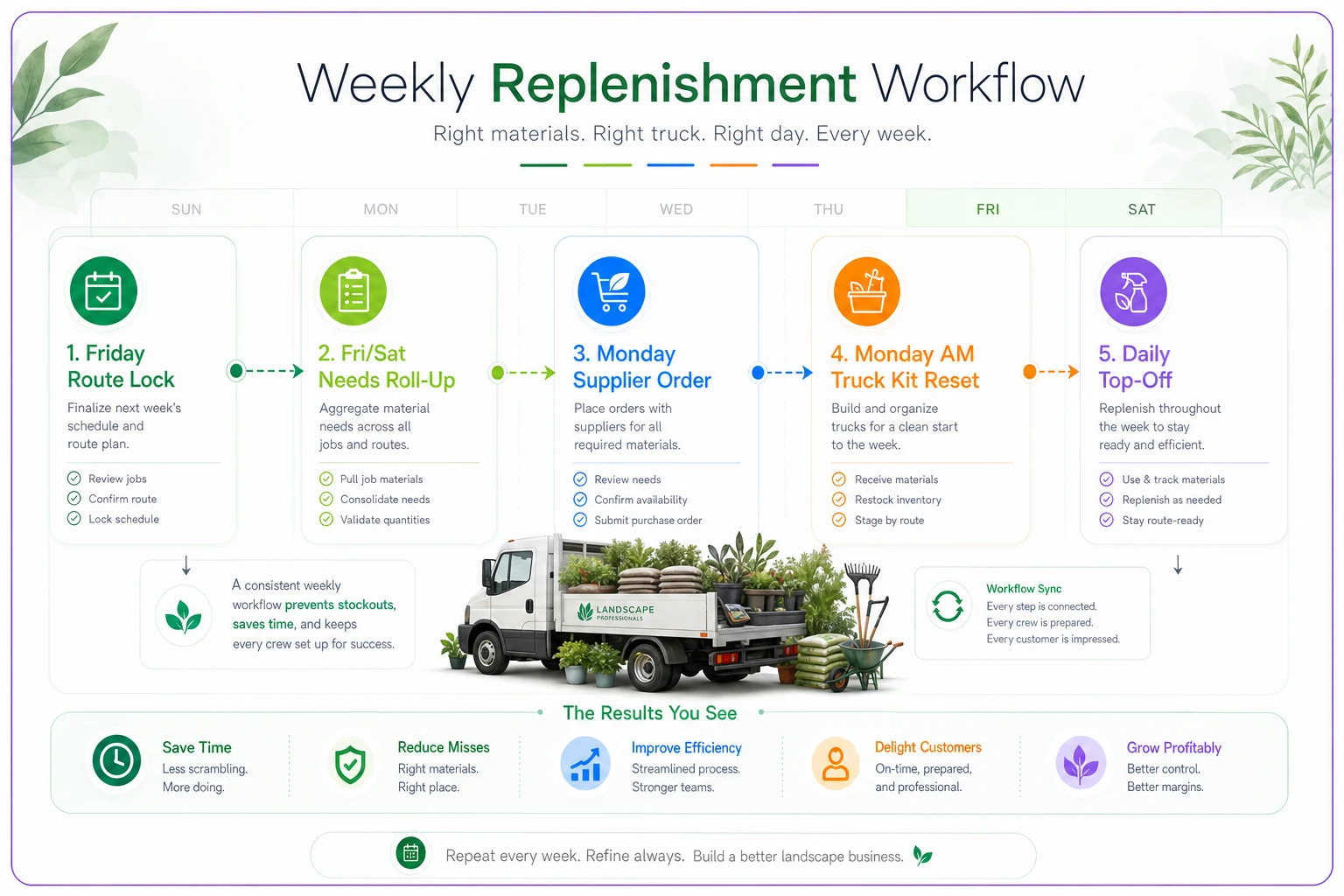
The thing that separates smooth operations from chaotic ones is that a shortage becomes a flag in the system, not an emergency run.
Approved substitutions: the rule that keeps crews from improvising
Here's a failure mode that's more expensive than it looks. A crew is on a mulch install, the supplier is out of the double-shredded hardwood the client's contract specifies, and the foreman — trying to keep the job moving — grabs dyed mulch instead. Job gets done. Client notices the color three days later. Now you're back on site, pulling and replacing, eating labor and material on a job you already billed.
The problem wasn't the substitution. Substitutions are normal. The problem was that it was unauthorized and undocumented. Nobody defined in advance what an acceptable swap looked like, so a field decision under time pressure became a callback.
An approved substitution list makes the good decisions pre-decided. For each common material:
-
Acceptable substitutes — what can be swapped in without a phone call
-
Requires-approval substitutes — what needs a quick owner or account-manager yes
-
Never-substitute items — anything spec'd in a contract, anything visible to a client, anything that affects warranty
The checklist a foreman should be able to run in the field, in under a minute:
-
Is the original material actually out, or just hard to reach on the truck?
-
Is there a pre-approved substitute for this item?
-
If yes → use it, log it, keep moving.
-
If it needs approval → one call, get the yes or no, then act.
-
If it's never-substitute → stop, don't guess, escalate.
Substitution rules are how you push good judgment down to the field without pushing risk down with it. A new seasonal hire shouldn't have to know your entire client contract history to make a safe call. The list carries that knowledge for them.
Supplier escalation paths so a backorder doesn't become your emergency
Every operation eventually hits the week where the supplier lets you down. The mulch yard is out. The fittings are backordered. The plant material didn't come in on the truck. What separates a governed operation from a scrambling one is whether there's a defined next step — or whether the next step is "the owner starts calling around."
Escalation paths are just pre-answered questions. When the primary supplier fails, then what? Most shops answer that question live, under pressure, at the worst time. Answering it in advance costs almost nothing.
Tier 1 — Primary supplier, normal order. Your default. Best pricing, established terms.
Tier 2 — Secondary supplier, pre-vetted. You already have an account, you know their pricing is within a tolerable margin, and you've confirmed they carry your common items. This is your "primary is out" answer, decided before you need it.
Tier 3 — Retail / emergency source. The big-box store, the premium price. You accept the cost hit because keeping the crew productive is worth more than the markup — but only for genuinely urgent items, and only with a note on which job ate the cost.
Shops that lack Tier 2 default straight to Tier 3 every single time and don't even realize how much they're spending on retail markup because it's scattered across dozens of small emergency buys. Consolidate a season of "quick runs to the store" and it's often a four-figure number that a single vetted secondary supplier would have cut in half.
Escalation also needs a lead-time buffer rule. For anything with a known long lead time — specialty plants, custom hardscape, certain irrigation components — the order trigger moves earlier in the cadence. You don't wait for the weekly roll-up on an item that takes two weeks to arrive. Long-lead items get their own calendar.
What breaks at scale — and why one truck hides all of it
With a single truck, none of this feels necessary. The owner loads it, the owner drives it, the owner notices when something's low. The whole system lives in one person's head and it works fine.
The second truck is where the cracks show. Now two people are making loading decisions with different assumptions. Now "we're out of X" could mean truck one or truck two and nobody's sure. Now a supply run for crew two pulls someone off crew one's job. The informal system that ran perfectly at one truck starts leaking at two and hemorrhages at four.
-
Knowledge fragments. The stocking logic that lived in the owner's head now needs to live somewhere everyone can see. If it doesn't get written down, every new crew relearns it by making the same mistakes.
-
Shortages become invisible. With one truck, a shortage is obvious. With five, a chronic shortage on one truck can hide for weeks because it's just "that crew always seems to run short."
-
Overstock compounds silently. Each truck accumulates its own hoard of "just in case" material. Multiply a $400 dead-stock pile by five trucks and you've got real cash sitting in truck beds.
-
Supplier relationships get messy. Five people placing panic orders under the company account is a pricing and accountability disaster. Consolidation isn't just cheaper — it's the only way to keep spend legible.
This is the same structural lesson that shows up in equipment planning. The reason a real equipment lifecycle and CapEx forecast matters is identical to why kit policies matter: as you scale, the informal "I'll just handle it" approach stops scaling with you, and undocumented decisions turn into surprise costs. Materials and equipment are the two places where small-fleet chaos hides in plain sight.
Where this system genuinely helps — and where it's overkill
When this makes sense: Two or more trucks, a route mix that varies week to week, and any history of emergency supply runs. If you've ever pulled a crew off a job to grab materials, you're already paying the cost of not having this. The system pays for itself the first month you stop doing 40-minute round trips at $60+ an hour of loaded crew time.
When it's overkill: One truck, one crew, the owner drives and loads it. Building a three-tier kit policy and a formal escalation matrix for a single-truck operation is process for its own sake. Keep a simple running list, buy weekly, move on. Add the structure when you add the second crew — not before.
Who should NOT do this the heavy way: Operations mid-transition — say, you're about to change your entire service mix or you're seasonal and just spinning down. Don't build an elaborate governance system around routes that are about to change. Build it around your stable service lines first and let the volatile stuff run loose until it settles.
A real scenario: three trucks, one recurring 11am problem
A maintenance-focused operation running three crews had a persistent pattern: two or three emergency supply runs a week, almost always mid-morning, almost always for consumables — bags, trimmer line, a specific fertilizer. Each run pulled a crew member for the better part of an hour and occasionally pushed the last job of the day into overtime or a reschedule.
They weren't tracking it as a line item, so it was invisible on the P&L. Rough math: two runs a week, roughly an hour of loaded labor plus fuel each, across the busy season — somewhere in the range of a few thousand dollars a year in lost billable time, before counting the reschedules and the occasional annoyed client.
The fix wasn't complicated. They wrote a base kit per truck, built route kits off the Friday-locked schedule, set a Monday-morning reset, and added one vetted secondary supplier so a stockout at the primary yard didn't mean a big-box run. They also counted the "just in case" material riding in each truck — and found close to $1,200 in duplicated fittings and product spread across the three beds that they'd been reordering anyway.
Within about six weeks, the mid-morning runs mostly stopped. Not perfectly — you still get the occasional genuine surprise — but the routine emergencies went away because the routine was now planned. The overstock got pulled back into the shop and worked down instead of reordered. Nothing dramatic on paper. Just a noticeable, steady improvement in how the mornings ran.
Keeping it running: the part everyone skips
Building the kit policy is the easy part. Keeping it accurate as routes shift, seasons change, and crews turn over is where systems die. A policy written in March that nobody updated by August is worse than no policy, because people trust it and it lies to them.
The maintenance discipline is small but non-negotiable: the Friday route lock has to actually happen, the Monday reset has to be somebody's named job, and the substitution and escalation lists have to get reviewed when your supplier lineup or your contract specs change. This is exactly the kind of recurring operational bookkeeping that gets forgotten when it lives on paper — and remembered when it lives in the software you're already using to schedule routes and track jobs. When the material list is generated from the route plan instead of retyped next to it, and a shortage flag from the field lands somewhere the person doing Monday's order will actually see it, the whole thing becomes self-sustaining. The tool matters far less than the fact that the trigger and the owner are defined and don't depend on anyone's memory.
Procurement governance in landscaping isn't about controlling every screw and bag. It's about making sure the truck matches the work, the refill matches the rhythm, and the backup plan exists before you need it. Get those three right and the 11:40 Tuesday phone call — the one that costs you a job and a client's patience — mostly just stops happening. Not because you got lucky. Because you built the system that made luck unnecessary.
Ready to grow your landscaping business?
Join 2,000+ landscaping pros using Yardyly to save time, reduce task chaos, and deliver outstanding client results.