

Most landscaping owners already know their crews vary. One crew leaves a client thrilled every single visit. Another does technically fine work but leaves clippings on the walkway, forgets the gate, and generates a callback every third job. Everyone can feel the difference. What almost nobody does well is turn that gut feeling into a system that actually shifts behavior.
That's the real gap. Plenty of companies have a quality checklist. Very few have a loop — where the score a crew earns feeds coaching, coaching feeds pay, and pay feeds who gets promoted or handed the good accounts. When those pieces aren't connected, quality becomes a nag rather than a culture. You end up repeating the same reminders in every morning huddle and wondering why nothing sticks.
This article is about wiring those pieces together. Not a pile of tips — the actual mechanics of how scorecards, coaching, and pay reinforce each other, where the whole thing tends to break as you add crews, and how to build it so it survives growth.
Why quality "programs" fail even when the checklist is good
Here's the pattern. A company builds a solid field audit and scorecard, uses it for a couple months, and quietly abandons it. The checklist wasn't the problem. The consequence was missing.
If a crew scores a 68 one week and a 91 the next, and nothing changes in their day, their pay, or their standing — the score is just paperwork. People are extremely good at figuring out what actually matters versus what management says matters. When a low score has zero downstream effect, crews figure out within a few weeks that the scorecard is theater, and they stop trying to move the number.
The second failure is the opposite: the score has consequences, but they only show up as punishment. Owner sees a bad audit, chews out the crew leader, docks nothing formally but sours the relationship. Now the crew starts gaming it — cleaning up only when they know the auditor is coming, hiding the messy jobs — and the score stops reflecting reality.
A quality‑performance culture only works when three things are true at once:
-
The score is measured consistently enough that crews trust it
-
The score triggers coaching automatically, not just when the owner is annoyed
-
The score connects to money and opportunity in a predictable, published way
Miss any one of those and the whole thing collapses back into nagging. If you haven't built the measurement layer yet, that's the prerequisite — our quality assurance system for landscapers walks through the mobile field audits and scorecard mechanics this article assumes you already have running.
Designing a scorecard crews actually respect
The most common design mistake is building a scorecard with 40 line items weighted equally. It feels thorough. It's useless. A crew can nail 37 items, blow the three that clients actually notice, and still score an 85. The number stops predicting client satisfaction, which is the whole point.
Never miss a job detail again.
Yardyly helps you plan, confirm, and manage every landscaping project seamlessly.
- Centralized project scheduling
- Automated client updates
- Crew and resource management
No credit card required
A scorecard should be weighted toward what the client sees and what causes callbacks, because those two things drive revenue and retention. Everything else is secondary.
Here's a weighting structure that holds up in the field:
| Category | Weight | Why it's weighted this way |
|---|---|---|
| Client‑visible finish (edges, blow‑off, cleanup) | 30% | This is what determines if the client feels the job was "done right" |
| Callback/rework risk (missed areas, damage, scalping) | 25% | Directly ties to cost and churn |
| Scope completion (everything on the work order actually done) | 20% | Prevents the "we thought that was extra" disputes |
| Site conduct (gates, pets, property care, timing) | 15% | Small stuff that quietly loses accounts |
| Documentation (photos, notes, flags for the office) | 10% | Feeds the rest of your operation |
Notice documentation is only 10%. It matters, but weight it too high and you'll get crews that photograph everything beautifully and still leave grass clippings across a patio. Weight toward outcomes the client actually experiences.
One more thing: keep the scoring scale coarse. A 1–5 per category beats a 1–100 overall. Precision you can't defend just invites arguments. A crew leader will fight you over why they got an 84 instead of an 88. They won't fight nearly as hard over a "3 — needs improvement" on finish quality, because it's a judgment call everyone understands is a judgment call. Coarse scales also make audits faster, which means you actually run more of them.
Favor a short per-category scale (1–5) to speed audits and reduce disputes.
Coarse scales also make audits faster, which means you actually run more of them.
Coaching triggers: making the score do the work
This is the part that separates a real system from a spreadsheet. The score should decide automatically when someone gets coached, so it doesn't depend on the owner's mood or memory.
A trigger is just a rule: when X happens, Y coaching action fires. The value is that it removes the emotional negotiation. Nobody feels singled out because everyone's held to the same threshold.
-
Single audit below threshold (any category scoring a 2 or lower) → crew leader gets a same‑week 10‑minute field walkthrough on that specific category. Not a lecture. A "here's what a 4 looks like on this account" walk.
-
Two consecutive audits with the same low category → this is now a pattern, not a bad day. Structured coaching session with a documented improvement note and a re‑audit scheduled within two weeks.
-
Three‑audit rolling average below a set line → formal review. Pay and assignment consequences enter the conversation.
-
Sudden drop from an established high performer → different trigger entirely. A crew that ran 4.5s for two months and drops to 3.0 usually signals something operational — new crew member, equipment issue, an impossible route. Investigate before you coach.
That last one matters more than people expect. A good crew that suddenly slips is almost never a motivation problem. Treating a fatigue or staffing issue like a performance failure is how you lose your best people.
The other thing to protect: coaching triggers should fire close to the event. Coaching a crew in October about a July audit is worthless — nobody remembers the job, and it feels like ambush accounting. The tighter the loop between the score and the conversation, the more behavior actually moves. Your weekly ops huddle is the natural place to surface which crews hit a trigger that week and assign who owns the follow‑up, so nothing slips to next month.
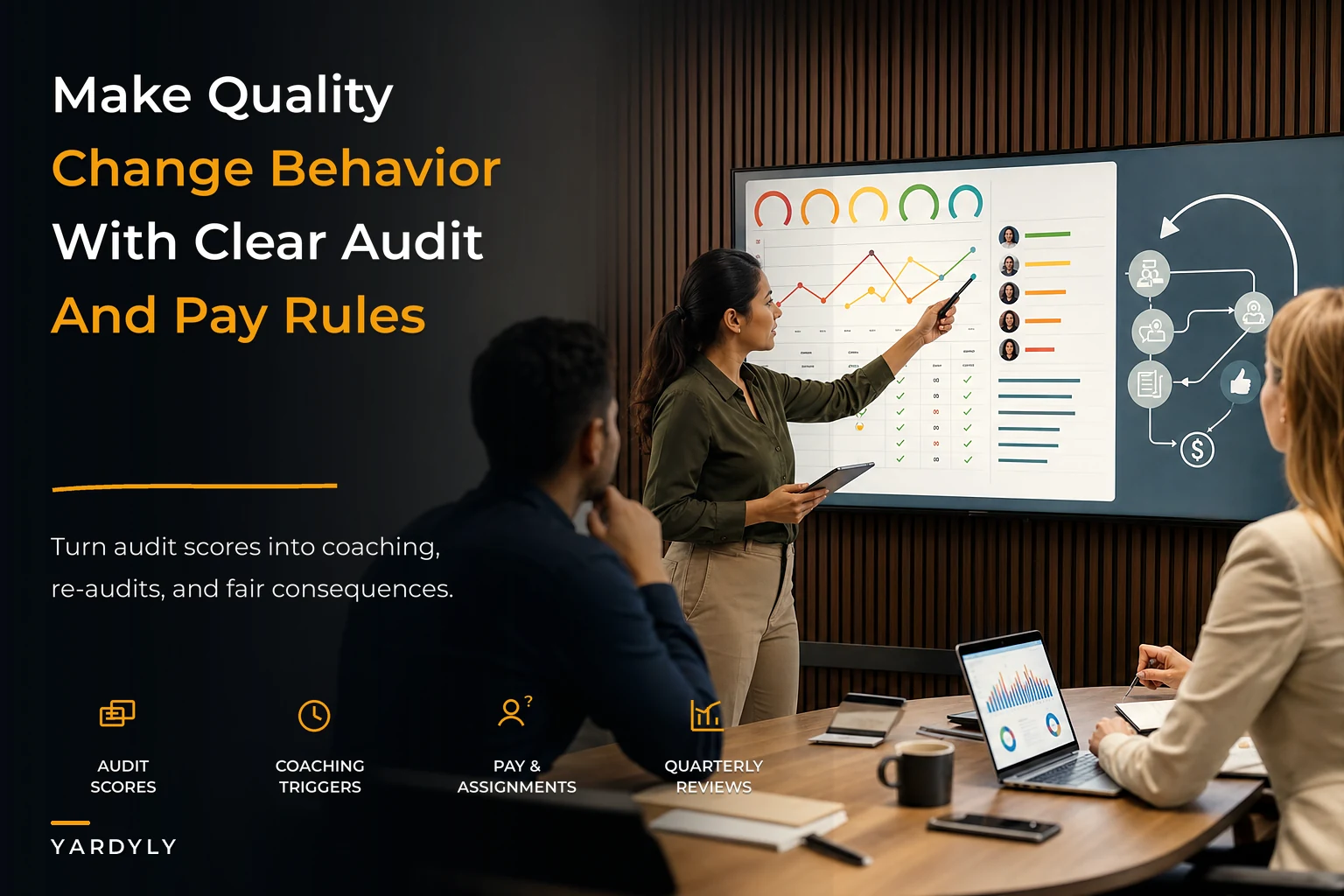
Here's a simple visual of how an audit score flows into coaching and escalation.
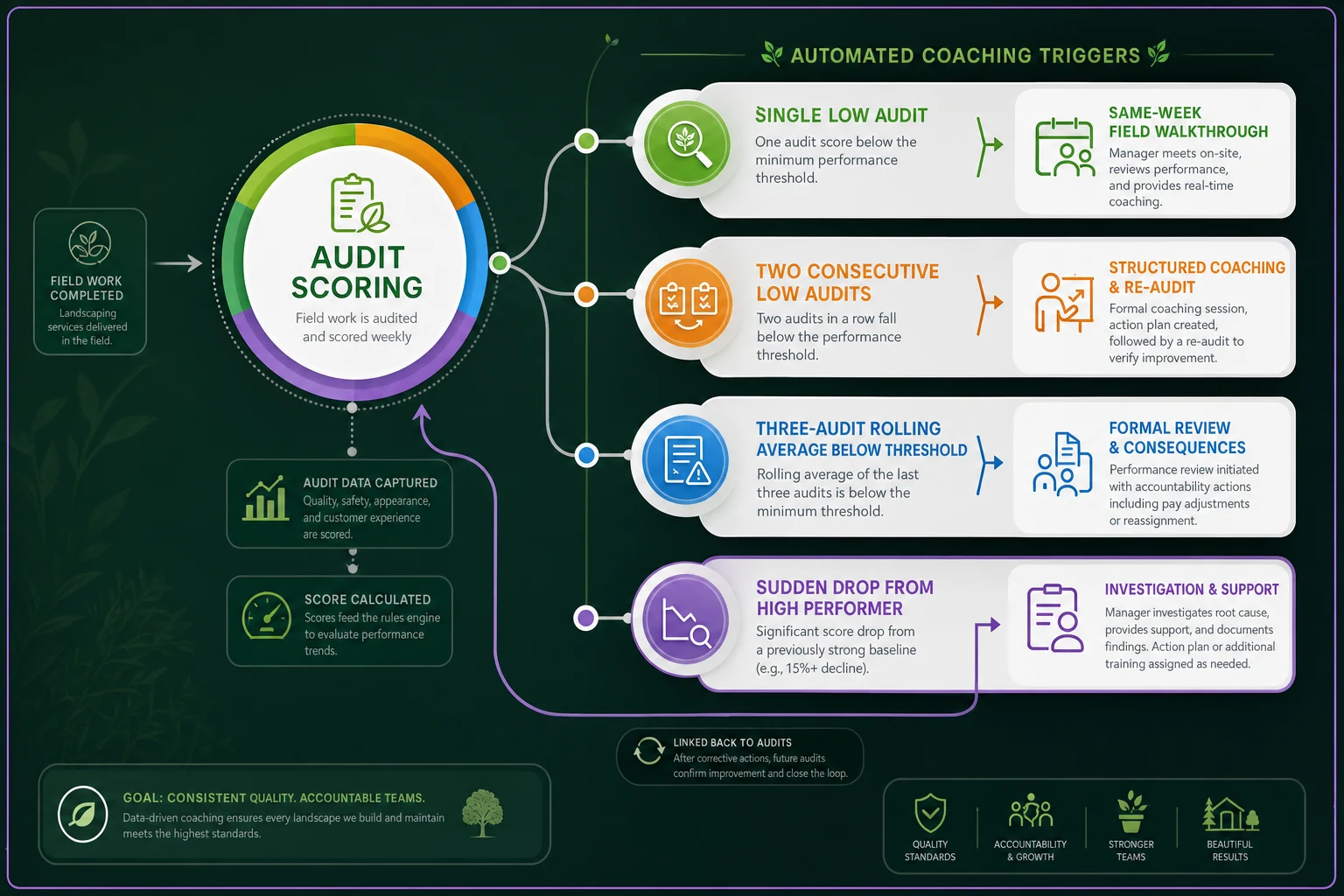
The tighter the loop you can make between the score and the coaching action, the more behavior actually moves.
Connecting scores to pay without wrecking morale
This is where owners get nervous, and reasonably so. Tie pay to quality wrong and you either bankrupt yourself with bonuses or create a culture of fear. The goal is to make quality worth money without making a single bad week feel like a paycheck threat.
A few principles that keep this sane:
Use rolling averages, not single scores, for anything touching pay. One bad audit shouldn't move money. A three‑ or four‑audit rolling average should. This protects crews from the random rough day — bad weather, a genuinely difficult property — while still rewarding consistency.
Make the quality tie a bonus, not a penalty, wherever possible. People respond very differently to "earn an extra $1.50/hr by holding a 4.0 average" than to "lose pay if you drop below." Same math, completely different culture. Fear‑based quality pay produces gaming; opportunity‑based quality pay produces effort. If you're layering this on top of productivity incentives, the interaction gets tricky fast — our breakdown of hybrid piece‑rate models and minimum guarantees covers how to keep speed pay from quietly eroding quality.
Publish the thresholds. Every crew should know exactly what average earns the quality bonus, exactly what triggers a review, and exactly how the number is calculated. Secrecy breeds suspicion. When the rules are visible, crews start managing their own numbers — which is the whole goal. You want them checking the finish before they leave because they can do the math on their own paycheck, not because someone's watching.
Here's roughly how a tiered structure might land for a maintenance crew:
-
Rolling average 4.3+ → quality tier bonus (roughly $1.25–$1.75/hr for that pay period)
-
Rolling average 3.5–4.2 → standard pay, no bonus, no flag
-
Rolling average below 3.5 → no bonus, enters coaching/review track
-
Below 3.5 for two review cycles → affects assignment and promotion eligibility, not base pay
That last tier is deliberate. You're not cutting someone's base wage — that's a fast track to losing crew you can't easily replace. You're gating upside and opportunity behind quality.
Assignment and promotion: the consequence that actually moves people
Pay bonuses get attention. But the strongest lever in a quality‑performance culture is who gets the good accounts and who gets promoted.
Every landscaping company has premium accounts — the high‑visibility commercial properties, the repeat residential clients who tip and refer, the contracts where the relationship is worth far more than the ticket. These should not be assigned by seniority or convenience. They should be assigned by quality track record.
When you make it explicit that consistent high scorers get first claim on the best routes and highest‑margin accounts, three things happen. Your best crews get more protective of their standing. Your middle crews have a concrete reason to climb. And your best accounts get your best work, which protects the revenue that matters most.
Same logic for promotion. A crew member moving up to crew leader should have a quality history behind it, not just tenure. If everyone knows the path to leadership runs through the scorecard, the scorecard stops being paperwork and becomes a career map. That's what culture actually means in practice — not a poster on the wall, but a clear, lived understanding that quality is how you get ahead here.
The mistake to avoid: making assignment consequences feel like punishment for crews who don't get the premium work. Frame it as earned access, published like everything else. "Accounts at this tier require a 4.0+ history" is a standard, not a slight. Crews respect a standard they can meet.
The quarterly review that ties it all together
Weekly coaching handles the day‑to‑day. But a performance culture needs a slower rhythm too — a quarterly review where the rolling data gets looked at as a whole and the bigger decisions get made.
Quarterly works because it's long enough to see real trends and short enough to matter. Annual reviews are useless for field work — too much happens in twelve months, and the seasonal swing muddies everything. Quarterly lets you separate signal from noise while people still care about the outcome.
What the quarterly review should actually cover:
-
Rolling averages per crew and per crew leader, viewed as a trend line, not a snapshot
-
Coaching triggers fired vs. resolved — did the coaching actually move the number, or are we addressing the same issue every cycle?
-
Pay tier movement — who earned into a higher tier, who dropped, and whether the thresholds still make sense
-
Assignment and promotion decisions — who's earned access to premium accounts, who's ready for a leadership conversation
-
Scorecard drift — are auditors scoring consistently, or has one auditor gotten soft or harsh over the quarter?
That last item is the one everybody forgets. Your scorecard is only as good as the consistency of whoever's scoring it. Over a quarter, auditors drift. One starts grading easy because they like the crew; another gets stricter after a bad callback. Spot‑check by having two people audit the same job occasionally and comparing notes. If the scores diverge by more than a point, your data's getting soft — and every downstream decision about pay, coaching, and promotion is built on sand.
What breaks at scale
Everything above works fine with three crews and an owner who sees most of the work. The system exists partly in the owner's head. Then you hit six, eight, ten crews, and the informal parts snap.
At three crews, you're auditing most jobs yourself and the "system" is really just your judgment applied consistently. At six crews you can't be everywhere, so you delegate auditing — and immediately hit the consistency problem above. At ten crews, coaching triggers pile up faster than any one person can act on them, and the quarterly data becomes a spreadsheet nobody has time to actually dig into.
-
Auditing frequency drops because there's more work and the same number of hours, so scores go stale and lose credibility
-
Coaching gets skipped because the person who should coach is buried in operations
-
Pay calculations get messy because rolling averages across dozens of crews by hand is error‑prone, and one payroll mistake destroys trust in the whole system
-
Assignment decisions revert to convenience because matching quality history to account tier from memory stops being realistic
This is where the manual version of the system quietly dies and companies fall back to the nagging culture they started with. The fix isn't more discipline — it's making the loop run without depending on one person holding it all in their head.
Where a system layer helps
The reason to move quality‑performance tracking into proper operational software isn't the software itself — it's that the loop has to survive the owner not being everywhere. When audits feed a rolling average automatically, when a below‑threshold score flags a coaching action to the right person without anyone remembering to check, when pay tiers calculate off clean data, and when account assignment can be filtered by quality history — the culture stops depending on the owner's memory.
That's the whole value. AI‑assisted operational platforms can surface which crews hit a coaching trigger this week, flag scorecard drift between auditors, and keep rolling averages clean enough that you'd actually trust them to touch payroll. Not because it's clever technology, but because at ten crews the human version simply stops working — and a quality culture that only works at three crews isn't a culture, it's a phase.
A real scenario
A mid‑size maintenance company running eight crews had a decent scorecard but used it purely as a checklist. Audits happened maybe twice a month per crew, coaching was whenever the owner got frustrated, and pay had no connection to quality at all. Callback rate hovered around 12–14% of jobs, and their two best crew leaders were quietly frustrated that a sloppy crew earned the same as they did.
They rebuilt the loop over about a quarter. Weighted the scorecard toward client‑visible finish and callback risk. Set automatic coaching triggers off rolling three‑audit averages. Added a quality bonus of roughly $1.50/hr for crews holding a 4.3+, and gated their premium commercial accounts behind a 4.0+ history. Ran a real quarterly review instead of an annual one.
Within two quarters, callbacks dropped to somewhere around 6–7%. The change wasn't dramatic week to week — it was gradual, crews cleaning up more carefully before leaving because it now touched their pay and their shot at the better routes. The two strong crew leaders stopped grumbling; one moved into a supervising role because the scorecard finally made the case for it on paper. Nothing about the crews changed. The consequences did.
The bottom line
A quality‑performance culture in landscaping isn't built on better checklists or sterner huddles. It's built on a connected loop: a scorecard people trust, coaching that fires automatically off that score, pay and account access that reward consistency, and a quarterly rhythm that keeps the whole thing honest. Break any link and you're back to nagging. Wire all four together and quality stops being something you enforce — it becomes the thing your best people compete to be known for.
Ready to grow your landscaping business?
Join 2,000+ landscaping pros using Yardyly to save time, reduce task chaos, and deliver outstanding client results.