

Most landscaping quality problems don't show up on the job site. They show up three weeks later when a commercial property manager sends an email with photos of scalped turf edges and mulch dumped over an irrigation head. By then the crew that did it is halfway across town, the account is already frustrated, and you're stuck guessing whether it was a one-off or a pattern.
The gap isn't skill. Most crews know what good work looks like. The gap is that nobody is checking work consistently, scoring it against a standard, and feeding that back into how people get trained and paid. Quality drifts because there's no loop. A QA program is really just closing that loop — turning a vague sense of "our work is usually good" into something measurable and connected to the rest of your operation.
This is a system article, not a checklist dump. The point is to show how the pieces — audits, scoring, escalation, coaching, and payroll — hook together, and where each one tends to break as crew count goes from two to twelve.
Why "we do good work" falls apart around crew number four
A one or two crew operation runs on the owner's eyeballs. You're on site, you catch the bad edge before you leave, you fix it, nobody outside knows it happened. Quality control is invisible because it lives in your head.
The trouble is that this doesn't scale, and it fails quietly. Somewhere around the third or fourth crew, you physically can't be everywhere, and the standard in your head never got written down. Each crew lead starts running their own version of "good enough." One thinks blowing clippings into the beds is fine. Another leaves the trimmer line too long. You don't notice until callbacks cluster or an account cancels, and by then you're reverse-engineering what went wrong from angry photos.
The first real QA failure at a growing shop isn't usually a quality failure at all — it's a visibility failure. The work might be fine on eleven of twelve properties. But you have no way to know which eleven, so every complaint feels like a five-alarm fire and you can't tell coaching problems from equipment problems from one crew that's rushing to hit a piece-rate number.
That last point matters more than people expect. When crews are paid partly on output, quality and speed pull against each other constantly. If you've built any kind of productivity pay structure — and if you haven't worked through how that trade-off plays out, it's worth reading how to pay for productivity without quality risk — a QA system is what keeps speed from quietly eating your quality.
Don't audit everything. Roll out five checks that catch most of the damage.
The instinct when building QA is to make a giant form covering every possible thing a crew could do wrong. Forty line items, five categories, photos on everything. Crews stop filling it out honestly by week two because it takes twenty minutes and half of it doesn't apply to the property in front of them.
Never miss a job detail again.
Yardyly helps you plan, confirm, and manage every landscaping project seamlessly.
- Centralized project scheduling
- Automated client updates
- Crew and resource management
No credit card required
A better move is a prioritized rollout. Start with the five checks that account for most of your callbacks and account losses, get those running clean, then expand. For most maintenance-heavy operations, those five look something like this:
-
Edge and trim lines — the single most visible quality signal to a client, and the fastest to judge in a photo.
-
Cleanup and debris — clippings in beds, on hardscape, blown into the street. This drives more complaints than actual mowing quality.
-
Damage and near-miss — nicked bark, cracked sprinkler heads, ruts in wet turf. Catching these on the day they happen saves the account.
-
Scope completion — was everything on the service ticket actually done? Skipped back beds are a top cancellation driver.
-
Property condition on arrival — a quick note or photo of anything already wrong (dog damage, pre-existing dead plant) so you don't get blamed for it later.
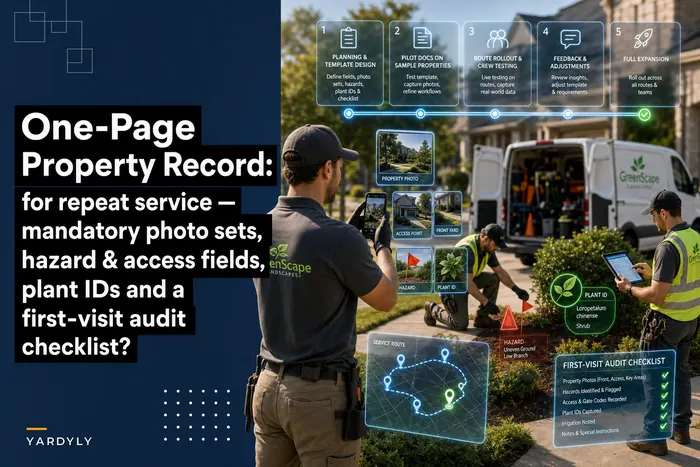
That last one connects directly to your property records. If you're already keeping a one-page property record with photo sets and hazard fields, your arrival check basically writes itself — the crew compares today against the baseline instead of guessing.
Five well-chosen checks, done on 100% of audited visits, beats forty checks done sloppily on 30% of visits. Coverage and honesty matter more than comprehensiveness. You can always add checks 6 through 10 once the first five are habit.
The mobile audit template: what it actually looks like in the field
A field audit has to survive a crew lead standing in the sun with dirty hands. If it takes longer than about 90 seconds, it won't get done truthfully. So the template has to be brutal about what it asks for.
A workable structure: each of the five checks is a simple pass / needs-attention / fail, plus one required photo when something is flagged. No essays. The photo is the evidence — you don't need the crew to write a paragraph, you need the picture so a manager can judge it later and so the account can't dispute it.
Two design details make or break adoption. First, the audit should be tied to the specific job and property, not a floating form. When it's attached to the visit, you can see patterns by crew, by property, and by service type. A free-floating checklist gives you paper; a job-linked audit gives you data. Second, decide who audits. There are three models, and each fits a different stage:
| Audit model | Who does it | Best for | Main weakness |
|---|---|---|---|
| Self-audit | Crew lead scores own work | 2–4 crews, high trust | Grade inflation; people don't fail themselves |
| Peer/rotating audit | Crews audit each other's routes weekly | 4–8 crews | Scheduling overhead; can get political |
| Dedicated QA visits | Manager spot-audits a sample | 8+ crews | Only covers what you sample |
Require a photo for any flagged check — it makes coaching specific and removes ambiguity in disputes.
Most shops end up running a blend: crews self-audit daily on the five checks, and a manager does dedicated spot-audits on a rotating sample to keep the self-scores honest. The spot-audit isn't there to catch everyone — it's there to make sure the self-audit scores mean something. When a crew's self-score says "all pass" and the spot-audit says otherwise three times running, you've found your real problem, and it's usually not the trimmer line.
Scoring: turn photos into a number you can act on
A pile of photos isn't a QA system. You need a score, because a score is what lets you set thresholds and trigger action automatically instead of relying on someone's memory.
Keep the math simple. Each of the five checks is worth points — say each check is worth 20, for a 100-point visit. A "needs attention" knocks off a partial amount, a "fail" takes the full 20. That gives you a per-visit score, and rolling those up gives you a per-crew weekly average.
-
90–100 clean, no action.
-
80–89 logged, watched. No callback risk yet but the trend matters.
-
70–79 coaching trigger. The crew lead gets a specific note tied to the failed check and the photo.
-
Below 70, or any damage-check fail immediate escalation to a manager, same day.
The mistake people make with scoring is treating the number as a report card at the end of the month. By then it's useless. A score is only valuable if something happens the moment it crosses a line. A 68 that sits in a spreadsheet until payroll runs teaches nobody anything. A 68 that pings a manager the same afternoon, with the photo attached, turns into a two-minute conversation while the crew still remembers the property.
This is exactly the kind of trigger logic that's tedious to run by hand. When you've got a handful of crews doing dozens of visits a day, manually reading every audit, tallying scores, and deciding who needs a nudge is a part-time job nobody has time for. Operational software with basic automation earns its place here — not doing anything clever, just watching incoming scores and routing the low ones to the right person immediately, so the loop closes in hours instead of weeks.
Automated escalation: the part that ties QA to the rest of the business
Escalation is where a QA program stops being a paperwork exercise and starts changing outcomes. The whole idea is that a bad score shouldn't require someone to notice it — it should route itself.
Here's the workflow in plain terms. A crew finishes a property and submits the five-check audit from their phone. The score calculates automatically. If everything's above threshold, it files and nobody's bothered. If a check fails or the score drops below the coaching line, the system does three things without anyone lifting a finger:
-
It flags the specific check and attaches the photo, so the manager sees what failed, not just a low number.
-
It routes to the right person based on severity — a coaching note goes to the crew lead, a damage fail goes straight to the ops manager.
-
It creates a remediation task if the failure is client-facing, so someone owns fixing the actual property before the client sees it.
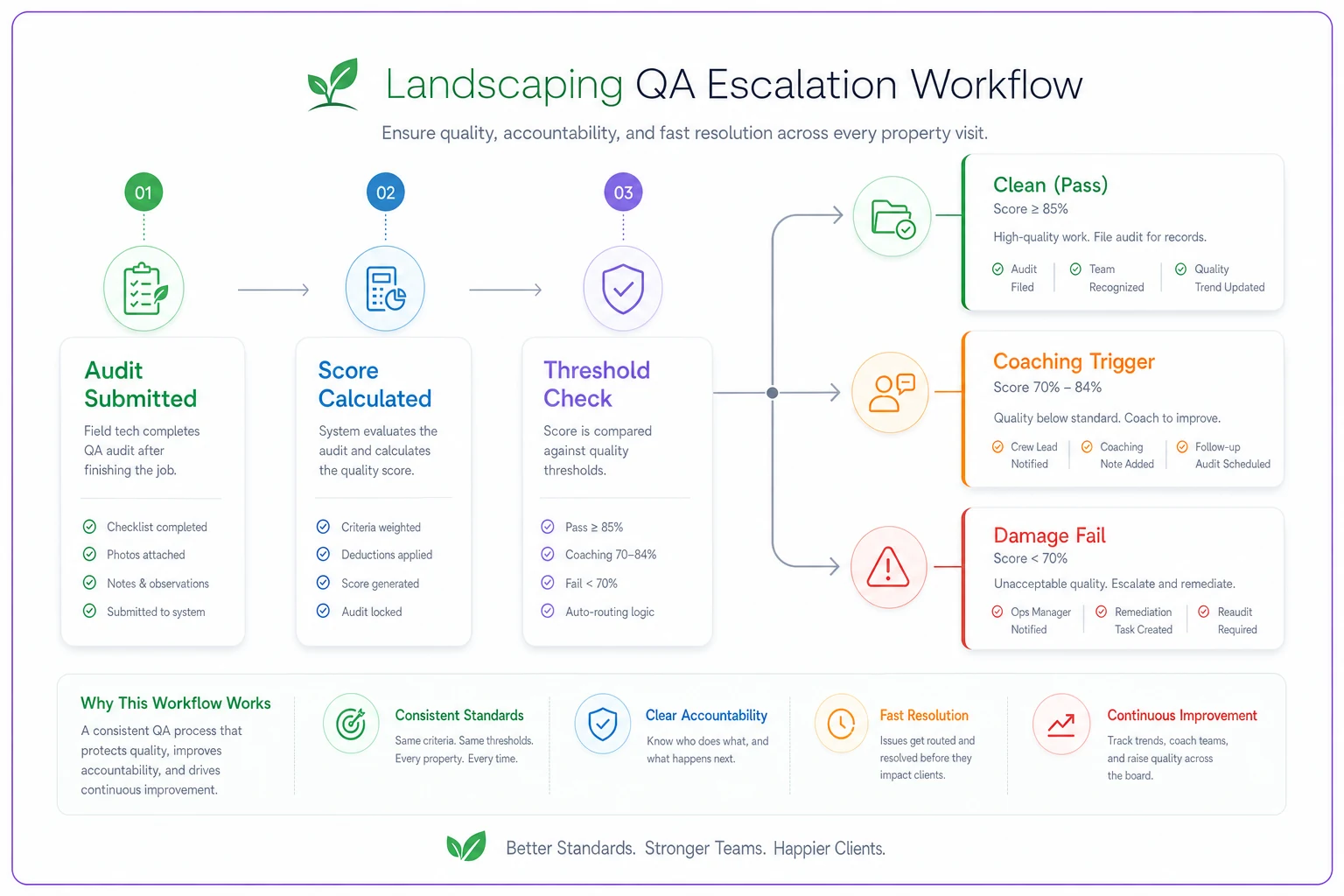
That third branch is the one that saves accounts. A missed back bed or a cracked sprinkler head caught by the audit becomes a same-day return trip before the property manager notices, instead of a defensive apology three weeks later. The accounts you lose aren't usually the ones where something went wrong once — they're the ones where something went wrong and nobody caught it until the client did.
Where this gets genuinely useful is when escalation connects to coaching and pay. Repeat low scores on the same check for the same crew lead shouldn't live as scattered memories in your head. They should roll into that person's coaching record so the conversation is about a pattern, not a bad day. And if any part of pay is tied to output, quality scores become the guardrail — you can hold back a productivity bonus when the QA average dips below a set line, which is the whole mechanism behind protecting margin in a productivity-based pay model. Speed only pays if the work passes.
Coaching triggers: the point of the whole system
None of this matters if the data just accumulates. The output of a QA system should be better crews, and that only happens if scores turn into specific, timely coaching.
The pattern that works: coaching is tied to the check that failed, not to the person's overall grade. "Your edges scored low on three properties this week — here's what a clean edge looks like on the Hartman account" lands completely differently than "your numbers are down." One is teachable and specific. The other feels like a performance review and puts people on the defensive.
Timing is the other half. A coaching note delivered the same day, while the crew still remembers the property, sticks. The same note delivered at a monthly review is just a grievance. This is why the escalation has to be near-instant — the value of a coaching trigger decays by the hour.
One pattern worth naming: when a whole crew's scores drop on the same check at the same time, that's almost never a coaching problem. That's an equipment problem, a scheduling-crunch problem, or a new hire was thrown on the truck without enough time to get up to speed. If everyone's edges got worse the same week, check whether the edger blade is shot or whether you overloaded the route before assuming the crew forgot how to edge. QA scores diagnose the system, not just the people.
A real scenario: mid-size maintenance shop, six crews
A residential and light-commercial maintenance operation running six crews was losing accounts it couldn't explain. Callbacks ran somewhere around 9–11% of visits during peak season, and a few commercial contracts didn't renew with the vague feedback that "quality slipped." The owner was spending most Saturdays personally re-inspecting properties clients had complained about.
They rolled out the five-check mobile audit — self-scored by crew leads daily, with the owner doing spot-audits on a rotating two-properties-per-crew-per-week basis to keep scores honest. Anything below 75 or any damage flag routed to the ops lead the same afternoon.
The first month was ugly, and that's normal. Self-scores came in inflated, spot-audits contradicted them, and two crew leads clearly weren't taking it seriously. But once coaching notes started landing same-day and tied to specific checks, things shifted. Over roughly a season, callbacks dropped to the 4–5% range. More useful than the number: the owner could finally see that most of the damage came from one crew rushing a too-tight route, not a broad quality problem. Fixing the route did more than any coaching conversation. Saturdays stopped being re-inspection days.
The lesson wasn't "audits fixed our quality." It was that audits gave them the visibility to find the actual cause — which turned out to be a scheduling decision, not a skills gap.
When a formal QA system makes sense — and when it doesn't
This is worth being honest about, because a full QA loop is overhead, and overhead you don't need is just friction.
When it makes sense: you're running four or more crews, you can't personally inspect the majority of work, callbacks are showing up as a pattern you can't diagnose, or any part of pay is tied to productivity. At that point the loop pays for itself by protecting accounts and giving you a real diagnosis instead of guesses.
When it's a bad idea: you're a single crew and you're on every job. Building formal audits, scoring, and escalation for work you're personally watching is bureaucracy for its own sake. A mental standard and a quick end-of-job walk is genuinely enough at that size.
Who should not do this yet: shops whose standards aren't written down at all. If you can't state what a passing edge or a passing cleanup actually looks like, don't build a scoring system — you'll just be measuring against a moving target and every score will turn into an argument. Write the standard first. The audit measures against a standard; it can't invent one.
Building it without drowning in overhead
The reason most QA programs die isn't that they don't work — it's that they become an administrative burden nobody maintains. The paper forms pile up unreviewed. Scores never get tallied. Coaching never happens because reading forty audits a week isn't anybody's actual job.
The practical constraint is this: the field part must be under 90 seconds per visit, and the office part — scoring, routing, coaching triggers, tying it to payroll guardrails — has to run mostly on its own. That's the whole case for putting this inside operational software rather than a clipboard and a spreadsheet. Not because the software is smart, but because it does the tedious watching so the loop actually closes instead of dying in a drawer. Crews audit from their phones, scores calculate, low ones route to the right person the same day, patterns roll into coaching records, and pay guardrails apply themselves. Nobody has to remember to make it happen.
Quality assurance in landscaping isn't really about catching people doing bad work. It's about building a loop where the field, the office, coaching, and pay all talk to each other — so a problem on a Tuesday morning becomes a fix on Tuesday afternoon instead of a lost account next month. Get five checks running clean, tie the scores to real action, and the rest of the operation can finally see what's actually happening on the trucks.
Ready to grow your landscaping business?
Join 2,000+ landscaping pros using Yardyly to save time, reduce task chaos, and deliver outstanding client results.