



Most landscaping operations run their weekly meetings backwards. They spend forty minutes reviewing what went wrong last week, then rush through this week's schedule in the final five minutes. Meanwhile, the same problems keep happening—wrong equipment at job sites, crews showing up to properties that aren't ready, owners making reactive calls because they're looking at scattered information.
The difference between landscaping companies that scale and those that stay stuck at three crews usually comes down to how they structure their weekly operations huddle. Not whether they have one, but specifically how those 20-30 minutes flow and what decisions actually get made.
Why traditional landscaping meetings fail
Your typical Monday morning meeting probably looks like this: everyone shows up (mostly), you review the week's schedule, someone mentions a broken mower, there's a side conversation about that difficult client on Maple Street, and everyone leaves knowing their routes but not much else. These meetings run at task level when they need to run at decision level.
The core problem is that most weekly huddles mix three incompatible meeting types into one messy conversation—scheduling, equipment problems, and customer complaints all bleeding together. Nobody's tracking who owns which follow-up. The same issues surface week after week because there's no systematic way to close loops.
This gets worse in multi-crew operations because each crew lead has their own informal tracking system. One keeps notes in their phone, another uses a pocket notebook, someone else just tries to remember. When you're running two crews, this works fine. At four crews with seasonal staff rotating through, it guarantees dropped balls and repeated mistakes.
The real cost shows up in ways owners rarely connect back to their meeting structure. That emergency supply run on Wednesday because nobody flagged low fertilizer inventory during Monday's huddle? That's around $185 in crew downtime. The customer who cancels after their edging gets missed three weeks straight represents $2,400 in lost annual revenue. These aren't random failures—they're predictable outcomes of meetings that don't systematically review the right operational triggers.
The one-page agenda that changes everything
Companies that break through the three-crew ceiling tend to converge on roughly the same meeting structure, whether they've thought about it intentionally or not. They've figured out how to compress operational review, decision-making, and follow-up assignment into a repeatable 25-minute format.
Never miss a job detail again.
Yardyly helps you plan, confirm, and manage every landscaping project seamlessly.
- Centralized project scheduling
- Automated client updates
- Crew and resource management
No credit card required
Here's what that one-page agenda looks like in practice:
Part 1: KPI Scan (5 minutes)
Start with five specific numbers that tell you if you're about to hit an operational wall. Not revenue or profit—those are outcomes. You need leading indicators that trigger decisions.
Weekly route completion rate tells you if you're overselling capacity. When this drops below 94%, you're either understaffed or overbooked. Last week's overtime hours per crew tells you if you're burning out your leads. Equipment downtime hours shows if you're heading toward a maintenance problem. Customer complaint ratio (complaints per 100 services) signals quality control gaps. And quote-to-close percentage reveals if your pricing is off or crews are overpromising during estimates.
You don't discuss these at length. Scan them, note which are outside normal range, move on. The discussion happens in the next section.
Part 2: Decision Triggers (8 minutes)
This is where most landscaping meetings fall apart—they try to solve problems without clear decision authority. Your one-page agenda should list five decision points with clear thresholds:
-
Hiring trigger
"If route completion is below 94% for two consecutive weeks, we post for a new crew member"
-
Pricing adjustment
"If quote-to-close drops below 35%, we review pricing on the next three estimates"
-
Route optimization
"If any crew has 3+ overtime days in a week, we redistribute Monday routes"
-
Equipment replacement
"If downtime exceeds 12 hours on any unit, we schedule a replacement evaluation"
-
Service suspension
"If a customer has 2+ justified complaints in 30 days, we review the service agreement"
The key is that these decisions are pre-authorized. You're not debating whether to hire when you're understaffed—the trigger makes the decision, the meeting just confirms execution.
Part 3: Follow-up assignments (7 minutes)
This section kills the "I thought someone else was handling that" problem. Every action item gets three things: an owner, a deadline, and a check-in point.
Your agenda template should have ten pre-numbered lines for follow-ups. Not everything will use all ten, but the structure forces specificity. "Steve will handle the Johnson property issue" becomes "Steve owns: Call Johnson by Tuesday 2pm about drainage concern, text update to group by Tuesday 5pm."
Use the pre-numbered ten-line follow-up template to force specificity.
The check-in point is what most operations skip. Assigning a task isn't enough—you need to specify when you'll verify completion. Without that, you get the three-week drift where everyone assumes something got handled but nobody actually confirmed it.
Part 4: Standard reports (5 minutes)
End with the same three report snippets every week. Not full reports—just critical excerpts that inform near-term operations.
Next week's weather impact summary (two sentences max). Upcoming property access issues (gate codes, construction, events). Equipment rotation for the next 14 days. Same format every week, different content. Everyone knows what's coming and can prepare accordingly.
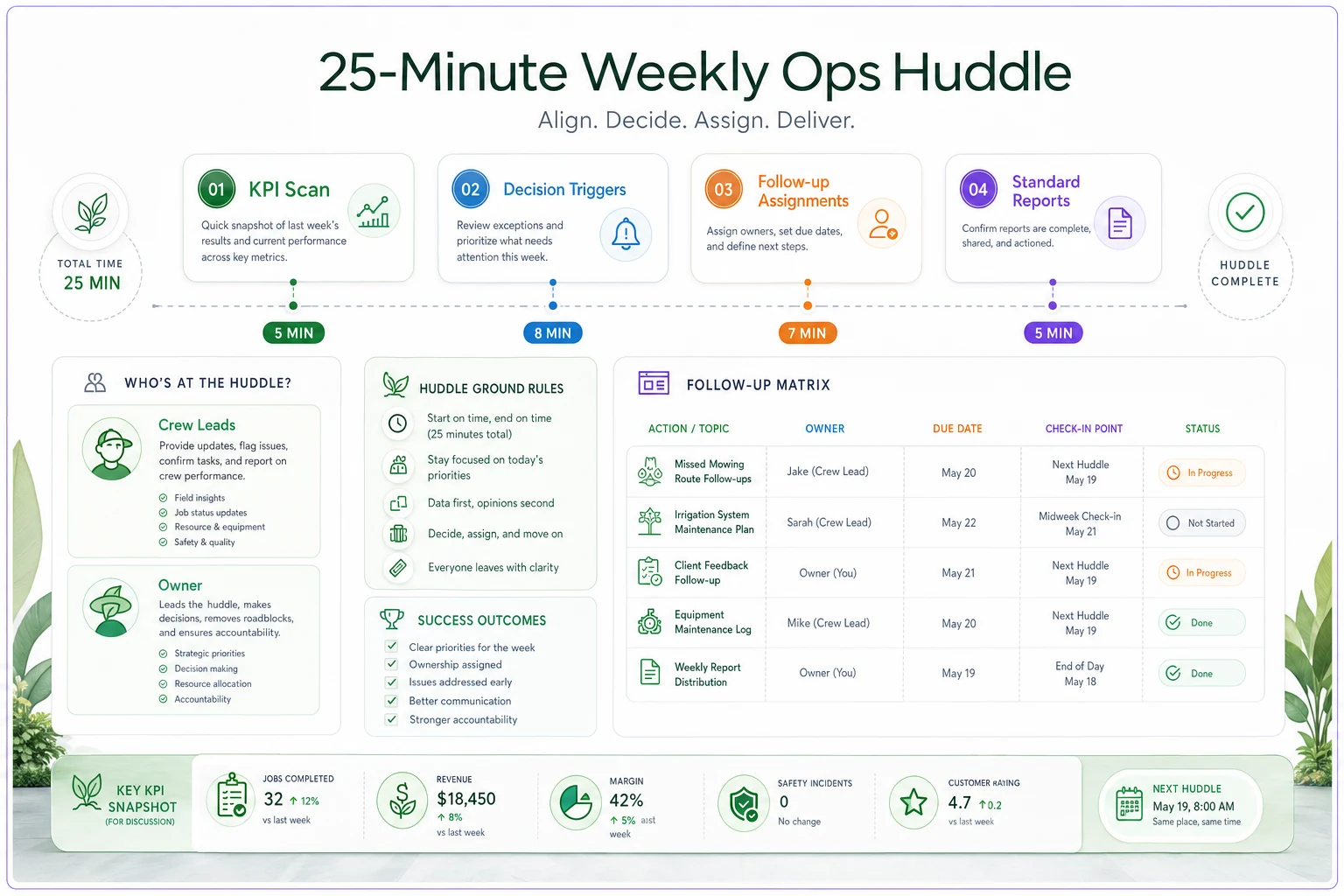
A quick visual of the 25-minute flow helps teams stick to timing and responsibilities.
Real numbers from a Virginia operation
A 4-crew operation outside Richmond implemented this structure in March. Before the structured weekly huddle, they were averaging 6-8 customer complaints weekly, mostly about missed or incomplete services. Route completion rate hovered around 87%—roughly one in eight scheduled services getting pushed to the following week.
The first week using the one-page agenda felt awkward. The owner kept wanting to dive into discussions about specific properties. Crew leads weren't used to the rapid-fire KPI review. But they pushed through it.
By week three, something shifted. The KPI scan immediately flagged that overtime hours had jumped 40% across all crews. Instead of a long conversation about why, the decision trigger kicked in—routes needed redistributing. The follow-up assignment was specific: operations manager owns route analysis by Wednesday, new routes implemented Monday.
After eight weeks, route completion hit 96% and held there. Customer complaints dropped to 2-3 weekly, mostly weather-related. But the bigger shift was decision speed. Issues that used to drag on for two weeks were getting resolved in 3-4 days.
The owner estimated they were saving around $1,100 weekly in reduced overtime and emergency supply runs. The less quantifiable improvement was morale—crew leads stopped feeling like they were constantly putting out fires because they knew problems would surface Monday and get resolved systematically.
The decision checklist that prevents analysis paralysis
The hardest part of running a multi-crew landscaping operation isn't the physical work—it's making dozens of small decisions fast enough to keep things moving. Most owners either make snap decisions without enough information or postpone decisions until problems become critical.
Your weekly huddle needs a decision checklist that forces resolution on common operational questions. Not every item gets addressed every week, but the checklist ensures nothing important sits unresolved for more than seven days.
Crew capacity decisions:
-
Any route taking 15%+ longer than estimated? (Reassign or reprice)
-
Any crew consistently finishing an hour or more early? (Route capacity available)
-
Any crew lead showing burnout signs? (Missed details, communication gaps)
Customer service decisions:
-
Any property needing special attention next week? (Assign specific crew lead)
-
Any customer on service watch for quality or payment issues?
-
Any quotes pending over 7 days? (Follow up or close out)
Equipment and supply decisions:
-
Any equipment approaching 80% of its maintenance interval? (Schedule service)
-
Any supply levels below a two-week minimum? (Order this week)
-
Any tools missing or damaged? (Replace or repair—assign it)
Financial decisions:
-
Any invoices 30+ days outstanding? (Collection action)
-
Any jobs significantly over or under estimated hours? (Pricing model adjustment)
-
Any new service requests outside normal scope? (Price or decline)
The point isn't having perfect answers. It's systematically reviewing the same decision points weekly so nothing festers. When crews know these questions are coming, they start gathering the information proactively.
Who owns what: the follow-up matrix that actually works
The biggest failure point in landscaping operations isn't bad decisions—it's good decisions that never get implemented. You decide to fix the trailer lights, nobody explicitly owns it, and three weeks later you're getting pulled over again.
Multi-crew operations need a follow-up matrix that's visible and updated in real time. Not complex project management software—just a simple grid showing who owns what and when it's due.
Your one-page agenda should include this grid:
| Task | Owner | Due | Check-in | Status |
|---|---|---|---|---|
| Trailer light repair | Mike | Wed 3pm | Wed 5pm text | Open |
| Johnson property callback | Steve | Tue 2pm | Tue 5pm update | Open |
| Fertilizer order placement | Julie | Thu noon | Thu email confirm | Open |
| New hire posting | Owner | Fri 5pm | Monday meeting | Open |
| Route redistribution plan | Amy | Wed end of day | Thu morning review | Open |
The "Check-in" column is what makes this work. Assigning a due date isn't enough—you need to specify how and when completion gets confirmed. This prevents the "I forgot to mention I handled that" problem.
During the huddle, spend exactly two minutes reviewing last week's assignments. Complete? Move on. Incomplete? It stays on the list with a new date and a brief note. No long discussions, no excuses—just accountability.
Report snippets that inform without overwhelming
Most landscaping operations drown in data they never use while missing critical information they actually need. Your weekly huddle shouldn't include full reports—nobody can digest them in the moment. Instead, use standardized snippets that deliver exactly what's needed for operational decisions.
The weather impact summary should be two sentences max: "Tuesday afternoon storms likely, finish priority properties Monday. Thursday-Friday clear, schedule heavy equipment work." Not a full forecast—just operational implications.
Property access updates cover only changes: "Maple Street has construction through Thursday, enter from the south. Harrison property has a new gate code: 4822. Johnson property has a graduation party Saturday, skip if possible."
Equipment rotation stays brief: "Mower 3 goes for service Wednesday morning, use the backup. Trailer 2 gets tire replacement Thursday. Everything available Monday, Tuesday, Friday."
These snippets work because they're consistent week to week. Crews know exactly what information they'll receive. The consistency also speeds up preparation—whoever owns each update knows exactly what format to follow.
Common failure points in the first month
Even with a solid agenda template, most landscaping operations struggle through the first few weeks. Knowing where things typically go wrong helps you push through the awkward phase.
Week one usually fails on timing. The meeting runs 45 minutes because everyone wants to discuss everything in detail. It feels rushed. This is normal—you're breaking years of meeting habits.
Week two tends to fail on preparation. Nobody has the KPI numbers ready. The equipment report is missing. Follow-ups from last week are fuzzy because nothing got written down clearly. The meeting still happens, but it's clunky.
Week three is when crew leads start pushing back. "This feels like micromanagement." "We don't need all these check-ins." "Can't we just handle things as they come up?" This usually comes from leads who've been operating independently and don't love the new visibility into their decision-making.
By week four, something clicks. The KPI scan takes five minutes because everyone knows their numbers. Decisions happen fast. Follow-ups actually get completed because ownership is explicit. The meeting ends in 22 minutes.
The operations that fail give up during weeks two or three. They revert to their old meeting style, telling themselves it's more "flexible." Six months later, they're still fighting the same operational fires and wondering why they can't scale.
Making it stick with your specific operation
The one-page agenda needs customization for your operational reality. A primarily residential mowing operation has different decision triggers than a commercial landscape installation company. The structure stays the same; the specific KPIs, decisions, and reports need to match your business.
Start by identifying your five most painful recurring operational problems. These become your KPI focal points. If you're constantly running out of specific supplies, track inventory levels. If crew scheduling is the nightmare, track schedule adherence. If equipment breaks down regularly, track maintenance completion rates.
Your decision triggers should directly address these pain points. Don't create theoretical triggers for problems you don't have. If customer complaints aren't an issue, skip the complaint ratio trigger. Focus on the decisions that actually keep you up at night.
The follow-up matrix needs to match your team's communication style. If crews live on text messages, make text updates the default check-in method. If everyone's in the shop each morning, verbal updates can work. The system has to fit your operational flow, not fight against it.
For report snippets, think about what information gaps cause the most scrambling mid-week. If you're constantly calling clients about access issues, the property access update becomes critical. If weather regularly catches you off-guard, the weather summary needs more detail. If equipment availability is rarely a problem, that snippet can stay minimal.
The technology layer that multiplies effectiveness
A paper agenda works fine initially, but multi-crew operations benefit from digitizing their weekly huddle—not with complex project management software, but with simple operational platforms that centralize key information flows.
The most effective approach uses AI-powered operational software to automatically populate your KPI dashboard before Monday's meeting. Instead of manually calculating route completion rates or overtime hours, the system pulls that directly from crew time tracking and job completion data. This eliminates the Sunday night scramble to prepare meeting metrics.
Decision-mapped KPIs become even more powerful when they're automatically tracked and flagged. Your operational platform can highlight when triggers are hit, making the decision portion of your huddle faster. You're not debating whether the threshold was met—the system shows you clearly.
The follow-up assignment matrix works best when it's visible to everyone throughout the week, not just during Monday's huddle. A shared digital workspace where crew leads can update task status in real time prevents the "I forgot to mention" problem. When check-in points are automated with reminder notifications, completion rates improve noticeably.
Some operations use AI-assisted platforms to automatically compile their standard report snippets. The system pulls weather forecasts and translates them into operational impact. It tracks equipment maintenance schedules and flags upcoming service needs. It monitors customer notes for access changes or special requests, surfacing only what's relevant for the upcoming week.
This technological layer doesn't replace your huddle—it makes it more effective. You still meet for 20-30 minutes Monday morning, but now you're making decisions with complete information instead of best guesses. The automation handles data gathering and compilation, letting your team focus on operational judgment and execution.
Beyond Monday morning: when the system really proves itself
The real test of your weekly operations huddle isn't how smooth Monday's meeting runs—it's how your Thursday afternoon crisis management improves.
When problems surface mid-week, teams with strong huddle discipline handle them differently. Instead of panic calls and dropped responsibilities, issues get logged for the next huddle while immediate fixes get implemented. The crew lead who discovers a hydraulic leak on Wednesday knows it'll be addressed systematically Monday while the immediate repair gets handled. The Thursday customer complaint gets acknowledged right away but reviewed properly in the next huddle's decision section.
This approach reduces operational stress in ways that are hard to measure but impossible to miss. Crew leads stop feeling solely responsible for every problem. Owners stop getting panicked texts about issues that aren't actually urgent. The whole operation finds a rhythm where problems get solved at the right level with the right urgency.
Your onboarding process for seasonal staff also becomes more effective when new crew members understand that operational issues have a clear escalation and resolution path. They learn quickly that problems raised in Monday's huddle get resolved, so they start tracking issues proactively instead of hoping things work themselves out.
The compound effect of operational discipline
After 90 days of structured weekly operations huddles, most landscaping operations report the same transformation. Problems don't disappear—they just stop compounding into crises. The broken trimmer gets fixed before it delays a job. The difficult customer gets addressed before they leave a one-star review. The understaffed crew gets support before the lead burns out and quits.
That operational discipline creates space for actual business growth. When you're not constantly firefighting, you can focus on winning new contracts, improving service quality, developing your team. The 30 minutes you invest in a structured Monday huddle saves hours of reactive problem-solving throughout the week.
Multi-crew landscaping operations that scale successfully share this trait: they've learned to be proactive with operational management. They catch problems early through systematic review. They make decisions quickly through clear triggers. They ensure execution through explicit ownership. And they do it all in a focused 20-30 minute weekly huddle that keeps everyone aligned without wasting anyone's time.
Your Monday morning meeting might be the most important operational investment you make. The question isn't whether you need a structured agenda—it's whether you'll implement one before or after your next operational crisis.
Ready to grow your landscaping business?
Join 2,000+ landscaping pros using Yardyly to save time, reduce task chaos, and deliver outstanding client results.