

Your best mowing crew finishes 14 yards by 2pm while another crew barely manages 8 by 5pm. Both get the same hourly rate. The fast crew starts dragging their feet after lunch because finishing more jobs just means more jobs. The slow crew milks the clock because there's no reason not to.
This productivity gap kills landscaping businesses slowly. Not because owners don't see it—they absolutely do—but because the obvious fix creates a worse problem. Pay purely by the job and quality tanks. Edges get missed, debris stays on sidewalks, callbacks pile up. Crews start cherry-picking easy properties while dodging the tough ones.
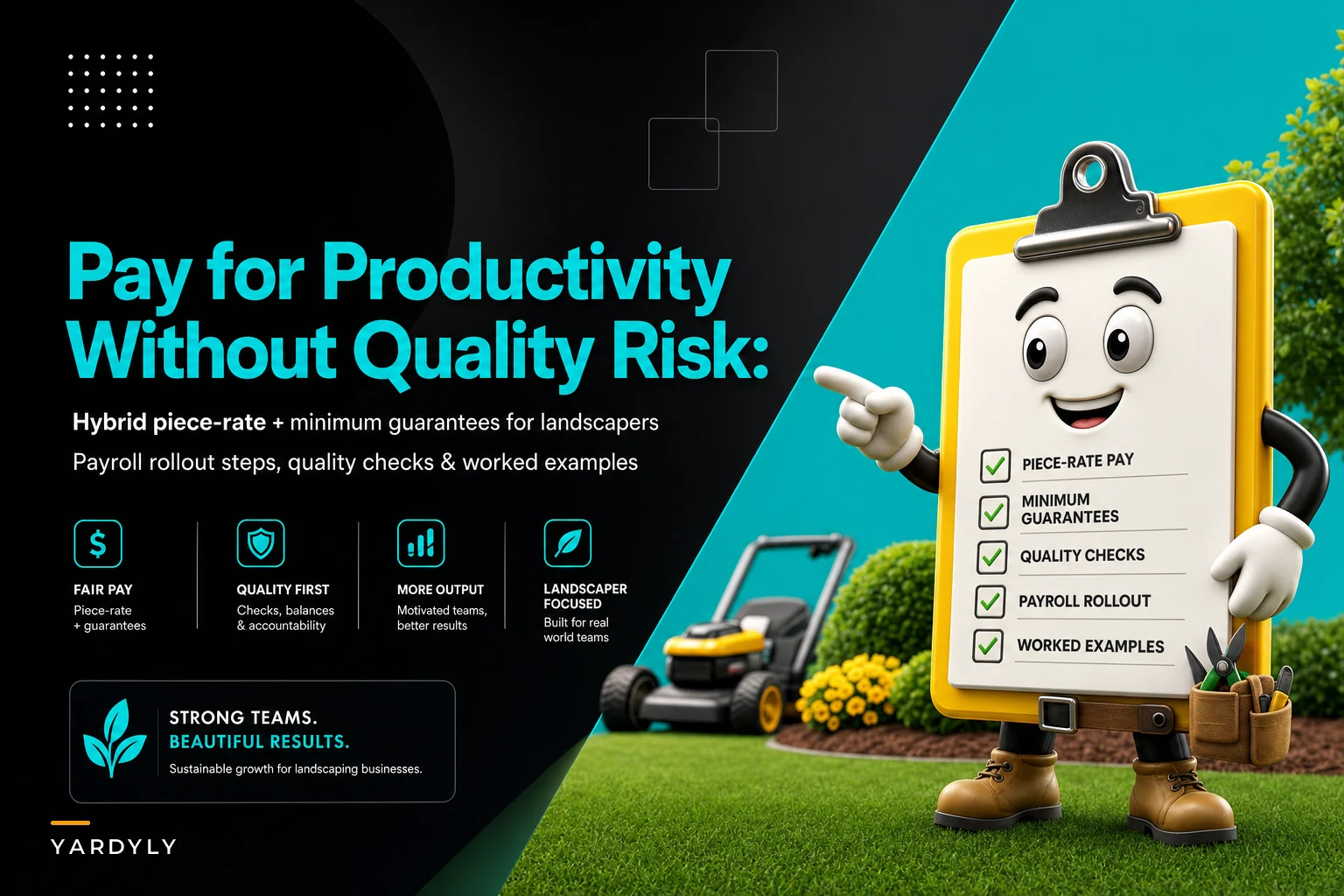
The solution isn't choosing between hourly wages and piece-rate pay. It's building a hybrid structure that rewards speed without sacrificing quality, protects workers with minimum guarantees, and actually fits into your existing payroll setup.
Why Pure Piece-Rate Falls Apart in Landscaping
Pure piece-rate sounds perfect on paper. Pay $25 per standard lawn, crews hustle, everyone makes more money. Except landscaping isn't factory work. Every property varies, weather changes daily, and quality directly impacts customer retention.
Three weeks into pure piece-rate, here's what usually happens: crews start "speed mowing"—cutting higher to move faster, skipping string trimming in tight spots, blowing grass onto neighbor's driveways. They fight over route assignments because the compact neighborhood route pays way better than the spread-out acreage route. When equipment breaks, nobody wants to stop for maintenance because downtime means zero pay.
Spring cleanup season is where it really unravels. Nobody wants to touch those first-cut-of-the-year properties that take three times longer. Scheduling falls apart as crews dodge difficult jobs, and customers start calling about rushed work.
Weather makes everything worse. That thunderstorm rolling in at 11am? Under pure piece-rate, your crew loses their entire afternoon income. After a few washout days, your good workers start looking for steadier jobs.
Building the Hybrid Structure
The hybrid model that actually works combines three elements: base guarantees, productivity bonuses, and quality checkpoints. Here's the structure that holds up across dozens of landscaping operations:
Never miss a job detail again.
Yardyly helps you plan, confirm, and manage every landscaping project seamlessly.
- Centralized project scheduling
- Automated client updates
- Crew and resource management
No credit card required
Base Guarantee Layer Every crew member gets a minimum hourly guarantee—typically $16–18/hour depending on your market. This covers equipment prep, travel between jobs, weather delays, and any non-billable work. It's the safety net that ensures they can pay rent even during a rainy week.
Productivity Payment Layer On top of the guarantee, crews earn per-job completion rates. A standard residential mow might pay $8–12 per completion split among the crew. Larger properties or special services have their own rates. These stack on top of the hourly minimum, not instead of it.
Quality Checkpoint System Random quality checks on roughly 20% of completed properties. Pass the check, keep the full productivity payment. Fail, and that job's productivity payment gets cut by 50%. Three fails in a week triggers a review. This isn't about perfection—it's about maintaining the standard that keeps customers around.
Set your base guarantee at a level crews consider a real safety net so they stay willing to accept the added variability of piece pay.
The hybrid model blends security and incentive so crews are motivated to be faster without being reckless, and owners don't trade quality for throughput.
The Math That Makes This Work
Traditional Hourly Model:
-
8 hours × $18/hour = $144 per person
-
Complete 12 properties (average crew pace)
-
Daily cost
$288 for the crew
Hybrid Model, Same Day:
-
Base guarantee
8 hours × $16/hour = $128
-
Productivity
12 properties × $10/property = $120 split between two = $60 each
-
Total per person
$188
-
Daily cost
$376 for the crew
But here's what changes—that same crew starts completing 16 properties instead of 12 because they're actually motivated to move:
Hybrid Model with Increased Productivity:
-
Base guarantee
8 hours × $16/hour = $128
-
Productivity
16 properties × $10/property = $160 split = $80 each
-
Total per person
$208
-
Daily cost
$416 for the crew
You're paying $128 more per day but completing 4 additional properties that bill at roughly $45 each. That's $180 in extra revenue for $128 in extra cost. Scale that across a full season and the math gets hard to ignore.
Setting Your Rate Structure
Piece rates need careful calibration. Too low and crews stick to the hourly minimum. Too high and you'll destroy your margins. Here's a testing framework that works:
Start by calculating your current average properties-per-crew-hour during peak season. Most residential crews handle somewhere between 1.5 and 2 properties per hour. Take that number and multiply by your base hourly rate to find your break-even piece rate.
Example: your crew averages 1.75 properties/hour at $17/hour base. Your starting piece rate should land around $9.70 per property ($17 ÷ 1.75). Round to $10 for simplicity.
Then add property complexity multipliers:
| Property Type | Base Rate | Multiplier | Final Rate |
|---|---|---|---|
| Standard residential (under 8k sq ft) | $10 | 1.0x | $10 |
| Large residential (8k–15k sq ft) | $10 | 1.5x | $15 |
| Corner lots with extra edging | $10 | 1.3x | $13 |
| Properties with pools/obstacles | $10 | 1.4x | $14 |
| Commercial with detail work | $10 | 2.0x | $20 |
Adjust these multipliers based on actual time studies from your routes. The goal is crews earning 15–25% above base when working efficiently—but not so much that they start cutting corners.
Quality Guardrails That Actually Get Followed
Quality checks fail when they're subjective. "Looks professional" means nothing. "No grass clippings on hard surfaces" is enforceable.
Build your checklist around real customer complaint patterns. If clients complain about missed spots along fence lines, that becomes a checkpoint. Grass in flower beds? Add it.
A working quality checklist for standard mowing:
Critical Points (automatic fail if missed):
-
All turf areas cut to specified height
-
All edges trimmed within 6 inches of structures
-
No visible grass clippings on driveways or sidewalks
-
Gates closed and locked
-
No damage to property or plants
Standard Points (need 4 of 5 to pass):
-
Mowing pattern alternates from last visit
-
Tree rings cleanly edged
-
Grass blown off mulch beds
-
Equipment marks minimized
-
Debris picked up before mowing
The random check system matters more than checking everything. When crews know any job might get inspected, standards stay consistent. A simple approach: every 5th completion gets checked, or run a daily random number to pick which jobs get reviewed.
Rotate who does the checking between crew leaders, office staff, and yourself. Take photos of issues and share them immediately through your crew communication channel. This isn't about catching people—it's about catching problems before customers do.
Payroll Implementation Without the Nightmare
Most payroll systems weren't built for hybrid pay structures, but standard systems can handle it with the right setup.
Week 1–2: Shadow Tracking Run your current payroll normally but track what crews would earn under the hybrid model. Build a simple spreadsheet:
-
Column A
Employee name
-
Column B
Hours worked
-
Column C
Properties completed
-
Column D
Current pay
-
Column E
Hybrid model pay
-
Column F
Difference
This shadow period catches problems before they affect actual paychecks. You'll spot route imbalances, find where piece rates need adjustment, and see which crews adapt fastest.
Week 3–4: Partial Implementation Roll out the hybrid model for volunteer crews only. Usually your top performers jump at the chance. Keep everyone else on hourly. This creates natural competition and lets you refine the system with people who actually want it, rather than forcing it on skeptics.
Week 5+: Full Rollout Expand to all crews with these payroll modifications.
In QuickBooks or similar:
-
Set up two pay types per employee
Regular Hours and Piece Rate Bonus
-
Regular Hours = guaranteed base × hours worked
-
Piece Rate Bonus = (properties completed × rate) − guaranteed base
-
If Piece Rate Bonus is negative, enter zero
For time tracking, most crews use a simple daily sheet covering start time, end time, properties completed with addresses, quality check results, equipment issues, and weather delays. This feeds into a master spreadsheet that calculates both pay components. The logic is straightforward: if piece earnings exceed the hourly guarantee, pay the difference as a bonus. If not, pay the guarantee only.
Here's a simple workflow for rolling out hybrid pay.
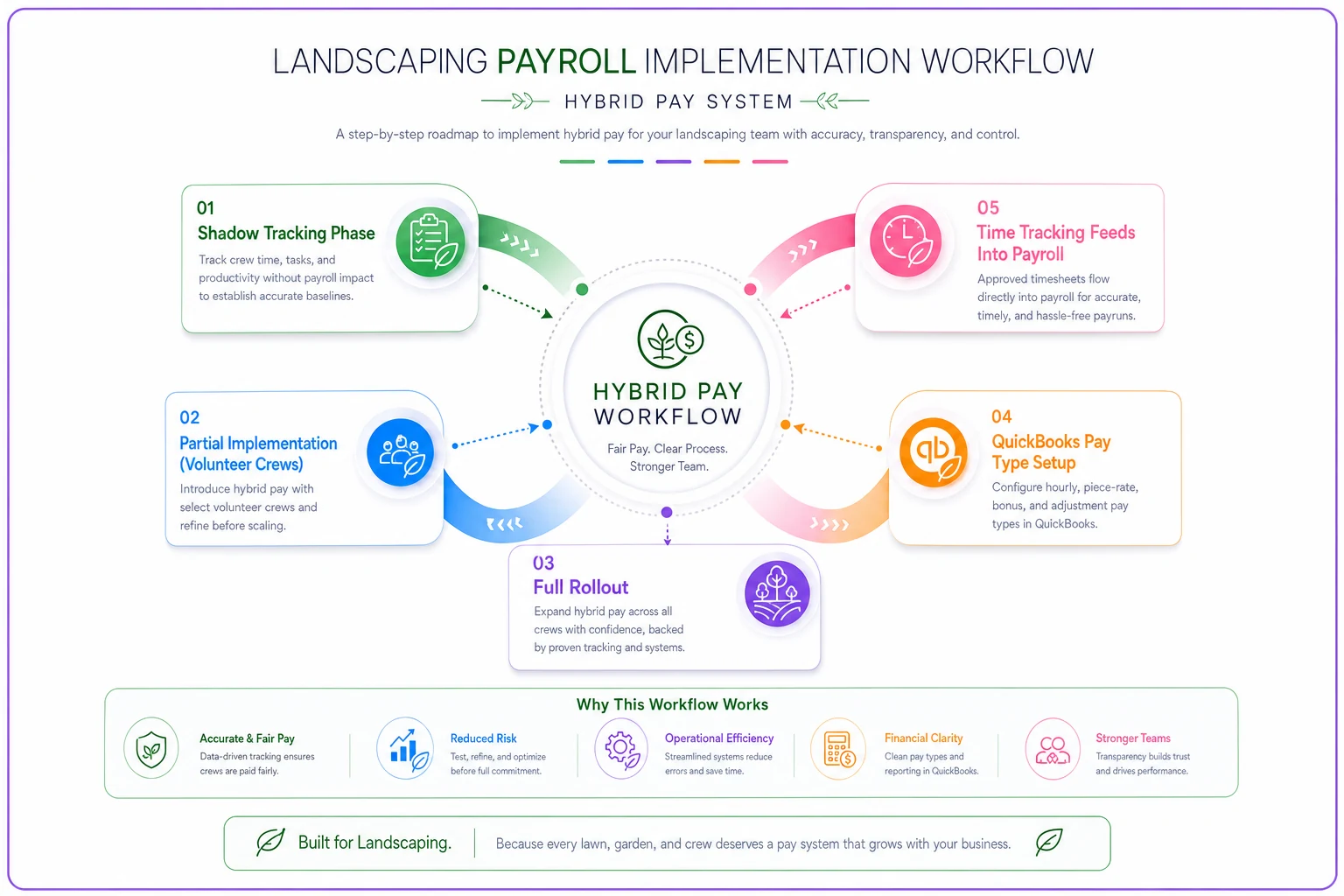
The shadow period, partial rollout, and full rollout steps help you catch issues early and refine piece rates before they affect everyone's paychecks.
Managing the Transition Risks
Shifting to hybrid pay surfaces problems you didn't know existed. Route imbalances become obvious when one crew consistently earns more despite similar skill levels. Equipment reliability suddenly matters more when breakdowns directly cost crews money. Your onboarding process for seasonal workers also needs updating to explain the pay structure clearly from day one—confusion about how the hybrid model works tends to create friction early on.
Route Balancing
That primo route with 22 small yards in a tight neighborhood creates pay inequity. The rural route with long drive times between acreage properties becomes a penalty assignment. Solve this by rotating routes weekly or balancing total earning potential rather than property count. Track average earnings by route for a month, then adjust assignments so weekly earning potential stays within about 10% across all routes.
Weather Contingencies
-
Full days lost to weather
pay 6 hours minimum guarantee
-
Partial days
pay actual hours at guarantee rate plus completed jobs
-
Crews can opt to wait out brief storms (unpaid) to finish routes
-
Saturday becomes an optional makeup day at full piece rates
Equipment Downtime
-
First 30 minutes
crew troubleshoots, paid at base rate
-
After 30 minutes
reassign to another truck or pay 75% of average daily earnings
-
Track equipment failures by operator to spot misuse patterns
These policies reduce disputes and make sure crews don't feel like every breakdown is their loss to bear.
The Resistance You'll Face
Your veteran hourly guys will resist hardest. They've optimized their pace for hourly work—steady, no rush, no stress. The hybrid model threatens that. They'll argue quality will suffer, customers will complain, and everyone will quit.
Some will. Usually the ones you probably should have let go anyway.
The key is involving resistant workers in building the standards. Have them define the quality checkpoints. Let them suggest the piece rates. When they help design the system, they're far more likely to accept it.
Younger, hungrier crews tend to embrace this immediately—they do the math fast. The challenge is preventing them from burning out or cutting corners, which is exactly what your quality checks and minimum guarantees are there to handle.
Making the Numbers Work Long-Term
After running hybrid pay for a full season, clear patterns show up. Labor cost as a percentage of revenue might tick up slightly—from 35% to 38%—but productivity gains more than offset it. Crews completing 25% more properties generate far more revenue than a 3-point bump in labor costs.
The real savings come from reduced supervision. When crews earn more by working efficiently, they self-manage better. Those four-hour productivity reviews you used to hold monthly become far less necessary.
Your KPI tracking systems become more useful too. Properties-per-labor-hour stops being a metric you monitor in isolation and becomes something crews actually care about. Customer retention improves because quality checks catch problems before customers even notice them.
Software That Handles Hybrid Complexity
Manual tracking of hybrid pay gets overwhelming fast once you're past 3 or 4 crews. You're juggling hours, property counts, quality scores, and weather adjustments across multiple workers. Spreadsheets break down. Disputes over counts pop up. Payroll processing drags on for hours.
Operational software built for landscaping handles this complexity by connecting time tracking, job completion, and quality checks in one place. Crews mark jobs complete on their phones, triggering automatic calculation of both hourly and piece-rate components. Quality checks get logged immediately with photo evidence. Payroll exports show exact breakdowns of how each dollar was earned.
The better platforms also give crews dashboards showing their daily earnings in real-time. When someone can see they've earned $247 by 2pm, they're going to push toward $300 by day's end. That immediate feedback drives productivity more effectively than a weekly paycheck ever will.
AI automation helps by flagging anomalies—crews claiming completion rates that don't add up, quality scores dropping below thresholds, routes showing unusual patterns. Instead of manually combing through everything yourself, you focus on what actually needs attention. It cuts the administrative load significantly without requiring you to rebuild your whole operation around it.
When Hybrid Pay Doesn't Make Sense
Not every landscaping business benefits from this. If you run high-end estate maintenance where quality absolutely cannot vary, hourly is probably the right call. If your model relies on training completely green workers every season, the complexity might not be worth it.
Hybrid models tend to fail when:
-
Routes are completely unpredictable (emergency storm cleanup, for example)
-
Quality standards are subjective (artistic landscape design)
-
Crew sizes change daily
-
You can't dedicate time to properly calibrate rates
They tend to work well when:
-
You have stable routes with similar properties
-
Quality standards are definable and measurable
-
Crews stay consistent season to season
-
You can track performance accurately
Worth being honest with yourself about which category you're in before you start building out the pay structure.
A Real Implementation Story
A landscape maintenance company outside Atlanta ran 6 crews doing mostly residential work. They averaged 11 properties per crew daily, paying $17/hour. Labor ran 38% of revenue. Customer churn sat around 15% annually, mostly from service quality complaints.
They rolled out the hybrid model over 6 weeks:
-
Weeks 1–2
Tracked shadow metrics and landed on a piece rate of $11 per property
-
Weeks 3–4
Tested with two volunteer crews
-
Weeks 5–6
Rolled out to all crews with daily tracking sheets
Three months in, crews averaged 14 properties daily—roughly a 27% increase. Labor costs climbed to 41% of revenue, but revenue jumped 22% from the added capacity. Customer churn dropped to 11% because quality checks caught problems early. The best crew averaged $24/hour; the slowest stayed at the $17 guarantee.
The owner stopped spending Saturdays catching up on missed properties. Crew leaders started coaching their own teams on efficiency. The business eventually picked up two commercial contracts it couldn't have handled before.
Moving Forward with Hybrid Pay
Pay for productivity in landscaping isn't about squeezing more work out of crews. It's about aligning everyone's interests—owners want efficiency, workers want higher pay, customers want consistent quality. The hybrid model delivers all three when you take the time to build it right.
Start small. Test with one willing crew. Track everything for a month. Adjust rates based on real data, not assumptions. Build quality standards around actual customer complaints, not some theoretical ideal.
Most importantly, involve your crews in designing the system. They know which properties take longer, which equipment slows them down, and what quality standards customers actually care about. When they help build it, they'll make it work.
The math is compelling. But the bigger shift is cultural. Instead of managing time, you're managing outcomes. Instead of preventing slacking, you're enabling earning. Your job moves from supervisor to supporter—making sure crews have everything they need to actually hit their numbers. That's when landscaping businesses stop grinding through seasons and start scaling profitably.
Ready to grow your landscaping business?
Join 2,000+ landscaping pros using Yardyly to save time, reduce task chaos, and deliver outstanding client results.