

Most landscaping companies don't have an estimating problem. They have a field-data problem that looks like an estimating problem.
The pattern shows up constantly: an estimator quotes a job off photos shot from the truck window, half of them blurry, none labeled, nobody tagged which house they belonged to. Three weeks later there's an argument about whether the retaining wall repair was in scope. The office pulls up the "record" — 14 photos in a shared drive folder named IMG_4471. No angle, no measurement reference, no before-shot. The client says one thing, the crew lead remembers another, and the company eats the difference because it can't prove anything.
That's not a communication failure. That's a data quality failure. And once you frame it that way, you realize field photos aren't just documentation — they're the raw input for estimating, quality assurance, and every dispute you'll ever have. Garbage in, garbage everywhere downstream.
This is a systems piece. Not "take better pictures." It's about how field-data quality connects the crew in the yard to the estimator at the desk to the client on the phone, and what breaks in that chain as you scale.
Why field data degrades the moment you have more than one crew
With one owner-operator, field data quality is basically invisible — it lives in one head. The same person who mowed it, quoted it, and argued about it are the same person. Nothing needs to survive a handoff.
The trouble starts around crew two or three. That's when the person collecting the data is no longer the person using it. A crew lead takes photos that make perfect sense to him — he knows it's the north bed, he knows that brown patch was there before you showed up, he knows the client already approved the extra. But none of that context got captured. It stayed in his head, and his head isn't in the estimating meeting.
-
Coverage gaps — crews shoot what's interesting, not what's required. You get 8 photos of the finished patio and zero of the drainage issue that'll cause a callback.
-
No naming discipline — files land as camera defaults, so nobody can find the right property record two months later without opening 40 images.
-
Missing "before" state — the single most expensive gap. Without a dated before-shot, you can't prove pre-existing damage, and you can't defend a scope line.
-
No reference for scale — a photo of a bare area tells you nothing without something in frame showing how big it actually is.
-
Metadata stripped or ignored — location and timestamp data exists but nobody uses it, so you can't even confirm which visit a photo came from.
Every one of these is survivable on a single job. The problem is they compound. Multiply sloppy capture across 300 properties and two seasons, and your "records" become a liability instead of an asset.
The three jobs your field photos are actually doing
If you want crews to shoot photos correctly, they have to understand that the same image gets used three different ways by three different people. Most crews only think about one.
Never miss a job detail again.
Yardyly helps you plan, confirm, and manage every landscaping project seamlessly.
- Centralized project scheduling
- Automated client updates
- Crew and resource management
No credit card required
| Use case | Who uses it | What they need from the photo | What breaks without it |
|---|---|---|---|
| Estimating | Estimator / owner | Scale reference, full-context wide shots, access/obstacle views | Under-quotes, missed line items, surprise labor |
| Quality assurance | QA lead / crew manager | Before + after pairs, consistent angles, dated | Can't verify work, coaching is guesswork |
| Disputes | Owner / client | Timestamped before-state, close-ups of pre-existing damage | You lose the argument and pay for it |
A photo optimized for one job is often useless for another. A pretty "after" shot of fresh mulch is great for marketing and worthless in a dispute. A wide before-shot with a measuring tape in frame is ugly but wins you money three different ways. When you set your standards, design for the estimator and the dispute — not the highlight reel.
Getting this right connects directly to how you build a durable one-page property record for repeat service. The photo set is the backbone of that record, and if the photos are junk the whole record is junk.
Mandatory photo sets: the non-negotiable shot list
The fix for coverage gaps isn't "take more photos." It's telling crews exactly which shots are required before a job is considered documented. When it's a defined list, it stops being judgment and starts being a checklist — and checklists survive handoffs in a way that general guidance never does.
-
Wide context shot of the full work area, from a fixed vantage point you'll reuse every visit. Consistency matters more than beauty here.
-
Before shot of any area you're touching, dated, with something for scale in frame.
-
Problem/hazard shots — anything pre-existing
dead plants, cracked hardscape, standing water, irrigation issues. These are your dispute insurance.
-
Access shots — gates, slopes, narrow side yards, anything that affects labor time and equipment choices.
-
After shots matching the before angles, so QA can actually compare apples to apples.
-
Detail close-ups of anything the client specifically flagged or paid extra for.
This isn't 30 photos. It's usually 8 to 12, but they're the right 8 to 12. Crews resist "more photos" and comply with "these six categories." The number that matters isn't quantity — it's whether every category got covered.
This same before/after discipline is what makes plant-decline arguments winnable. If you've dealt with a client blaming you for a dying shrub that was already stressed when you inherited the property, you know exactly what a missing before-shot costs you. The whole workflow for that situation is in the piece on avoiding scope disputes on plant decline, and it lives or dies on whether the mandatory shots exist.
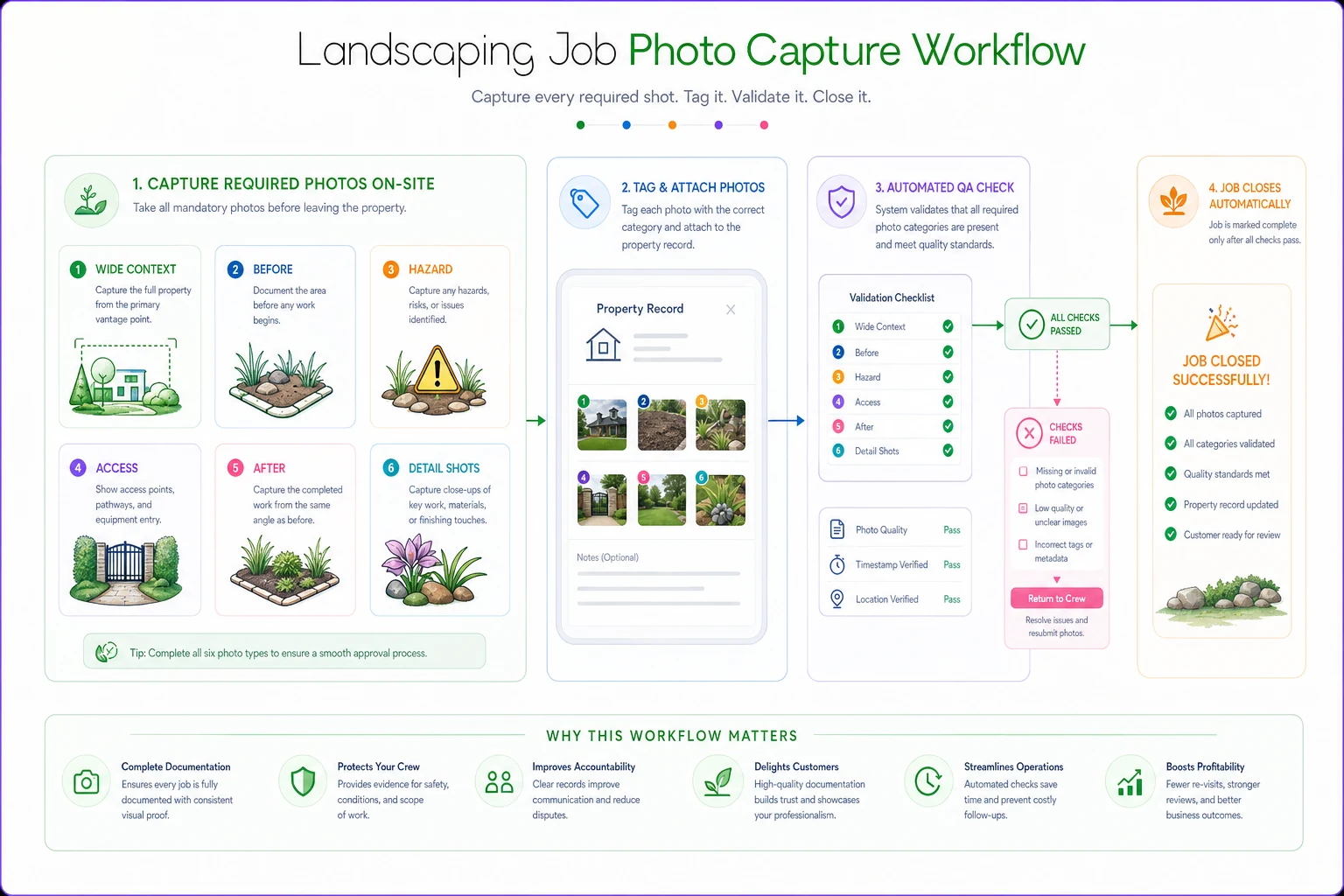
A simple workflow: capture the required shots, tag and attach them to the property record, run an automated completeness check, and only then allow the job to close.
Naming and tagging: the boring standard that saves the most time
Ask a crew to shoot great photos and they'll try. Ask them to rename files and they'll ignore you — which is exactly why naming has to be structured, minimal, and mostly handled at capture rather than as a manual chore afterward.
A naming standard that actually gets followed is short:
[PropertyID][Date][ShotType]_[Sequence]
So RIVERA-11872026-04-14BEFORE02 instead of IMG4471. The whole point is that a person — or a search — can find the right property, the right visit, and the right shot type without opening a single image.
Tags do the sorting work filenames can't. Keep the list short. The fastest way to kill a tagging system is to build 40 optional tags nobody remembers. A tight, mandatory set beats a comprehensive optional one every time:
-
Property ID (links the photo to the record)
-
Shot type (before / after / hazard / access / detail)
-
Job or service line (mow, install, cleanup, irrigation)
-
Flag (needs estimator review, dispute risk, callback)
That last one — the flag — is underrated. A crew lead who can tap "dispute risk" on a photo of a cracked driveway they didn't cause has just protected the company without writing a single sentence. That tag is worth more than a paragraph of notes nobody reads.
The "minimal metadata" principle
The mistake most owners make when they get serious about this is over-engineering it. They build a 20-field capture form, crews hate it, compliance drops to nothing, and you're back to IMG_4471 within a month.
Minimal metadata means capturing only what you'll actually use downstream: property, date, shot type, GPS/timestamp (the phone handles that for free), and one or two flags. Everything else is noise. The systems that stick are the ones a tired crew can complete in under a minute at the end of a hot day. If it takes longer than that, it won't survive July.
Require only the fields you'll use downstream so crews can finish metadata in under a minute.
If it takes longer than that, it won't survive July.
Automated QA checks: catching bad data before it becomes a bad estimate
This is the part that separates companies that talk about field data from companies that actually have good field data: you cannot rely on crews to police their own coverage. They're moving fast, they think they got everything, and often they didn't. The check has to happen automatically, at the moment the job gets marked complete.
The logic is simple. A job shouldn't be closeable if the mandatory set is incomplete. If the shot list requires a before, an after, and a hazard scan, and only two of three categories exist, the system flags it — before the crew leaves the property, when a fix costs 90 seconds instead of a return trip.
-
All mandatory shot categories present
-
Photos attached to the correct property record, not floating in a folder somewhere
-
Timestamp falling within the scheduled visit window
-
Any "dispute risk" or "needs estimator review" flag routed to the right person automatically
-
Minimum resolution met — not obviously blurry or dark
This is where operational software actually earns its keep. Not as a flashy add-on, but as the quiet enforcer that won't let a job close with holes in the record. A platform that ties photo capture to the property record and runs completeness checks turns "we hope the crews documented it" into "the job literally can't close until it's documented." The automation isn't the product. The trustworthy record is the product. The software just makes the standard impossible to skip.
A real scenario: what changed for a 4-crew maintenance operation
A mid-sized maintenance and light-install company — four crews, around 280 recurring properties — was losing a couple of scope arguments a season and re-quoting jobs because photos didn't have enough context to estimate confidently.
The specific pain: they'd win an install bid off truck-window photos, then discover on-site that access was worse than it looked and labor ran 20–30% over. And when a client disputed a pre-existing crack in a walkway, they had no dated before-shot, so they absorbed roughly $1,800 in "goodwill" repairs they hadn't caused.
They didn't do anything fancy. They defined a mandatory six-category shot list, adopted a PropertyIDDateShotType naming standard, cut their tag list down to four required tags, and set a rule that jobs couldn't close without the before/after/hazard categories present.
Over the next season, two things shifted. Estimator re-quotes on installs dropped because the wide and access shots gave enough context to price right the first time. And the next time a client claimed pre-existing damage was the crew's fault, the office pulled a dated before-shot in about two minutes and the conversation ended. The owner's rough estimate was somewhere in the range of $6k–$9k saved across the season — avoided goodwill payouts, fewer callbacks, tighter install quotes. Not a revolution. Just a leak that stopped.
When this level of rigor makes sense (and when it's overkill)
Not every operation needs a formal field-data system, and pretending otherwise is how you build something crews ignore.
This makes sense when:
-
You run two or more crews and the data collector isn't the data user
-
You do install or hardscape work where scope disputes carry real dollars
-
You service repeat commercial properties where documentation is contractually expected
-
You're feeding photos into estimating, not just filing them away
This is overkill when:
-
You're a solo operator who quotes and executes everything yourself
-
Your jobs are small, one-off, and low-dispute-risk
-
You're still figuring out basic scheduling and route flow — fix the bleeding first
Who should NOT start here: a company that hasn't nailed down its estimating inputs at all. If you don't yet have a consistent way to translate what's on the property into priced labor, tighten that first. The way you read yard features and turn them into time — the kind of logic in the per-feature mowing time model — depends on good field data, but the estimating logic and the data standard reinforce each other. Build both, but don't build photo discipline around an estimating process that doesn't exist yet.
The bottleneck this actually removes
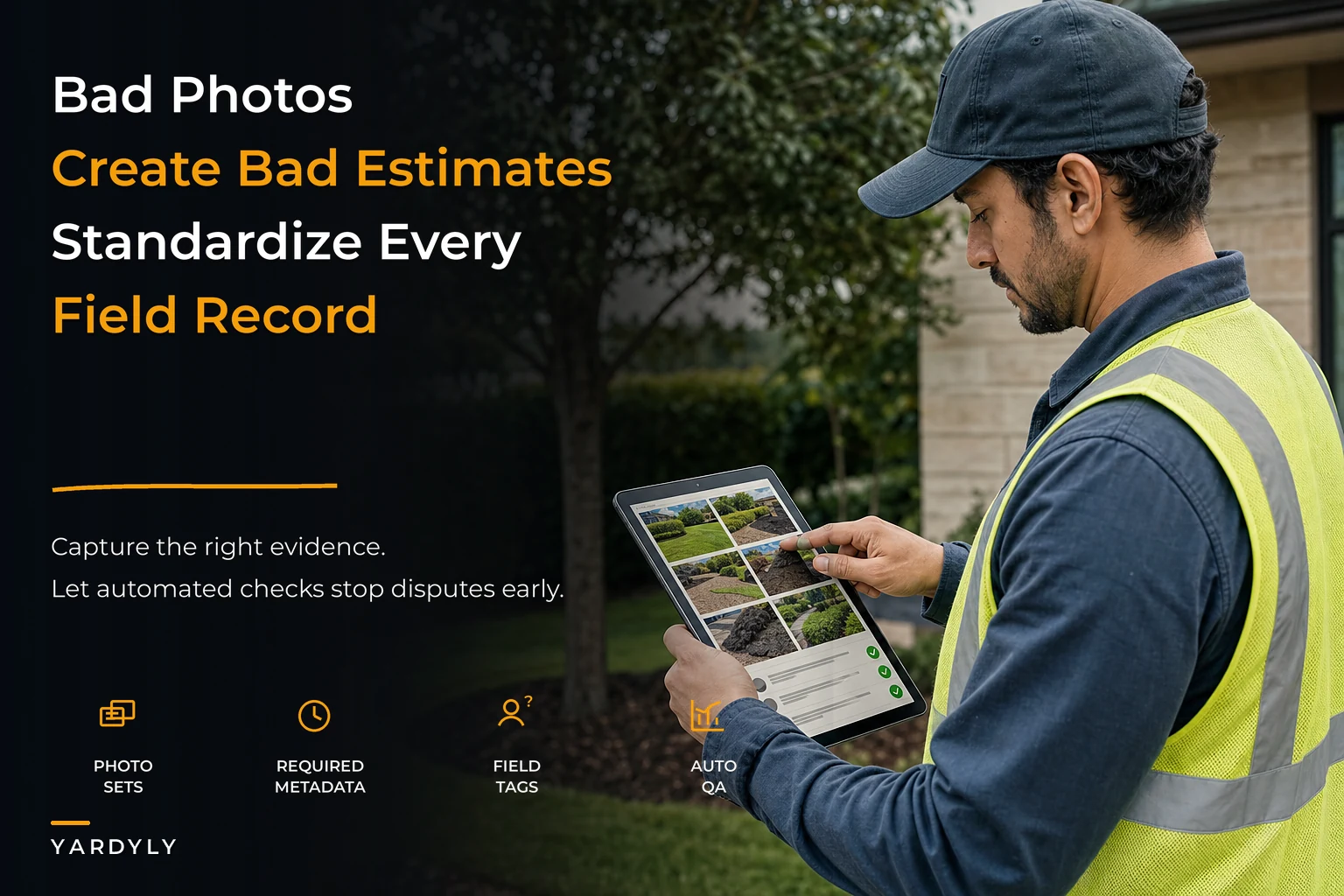
Bad photos don't just cost you one dispute. They make estimating a guessing game, they make QA impossible to enforce, and they leave you unarmed in every client argument. Fix the input, and all three improve without you touching them individually.
That's the whole point. You're not improving photos — you're improving the trustworthiness of the record that estimating, QA, and disputes all draw from. Do that with a defined shot list, a naming standard tight enough that crews actually follow it, minimal metadata that survives a hot afternoon, and automated checks that won't let junk data slip through, and you stop losing money in three places on one problem.
Start small. Pick the six shots that matter, name them consistently, and refuse to close a job without them. The estimating accuracy and the dispute wins follow from there.
Ready to grow your landscaping business?
Join 2,000+ landscaping pros using Yardyly to save time, reduce task chaos, and deliver outstanding client results.