


Plant health issues create the worst kind of operational mess for landscaping businesses. A client notices yellowing leaves on their Japanese maple. Your maintenance crew flags it during a routine visit. Three weeks later, you're in a heated email chain about whether this falls under your maintenance contract, requires a specialist consultation, or needs a separate treatment quote. Meanwhile, the plant keeps declining and the client gets increasingly frustrated.
The core problem isn't identifying sick plants—any decent crew member can spot yellowing leaves or wilting branches. The operational nightmare kicks in when unclear escalation processes create scope disputes between maintenance work, treatment estimates, and specialist referrals. Without standardized documentation and clear decision points, every plant health issue becomes a negotiation about who's responsible for what.
Why Plant Health Escalation Turns Into Scope Disputes
Most landscaping companies handle plant health issues reactively. A crew member texts a blurry photo to their supervisor. The supervisor makes a judgment call based on limited information. Sometimes they include treatment in the regular service, sometimes they quote separately, and sometimes they punt to a certified arborist. This inconsistency creates three real operational problems.
First, clients develop expectations based on how you handled their last plant issue. If you treated aphids for free last time but now want to charge for scale insects, they feel like you're nickel-and-diming them—even if you're technically correct about what's covered.
Second, your crews burn through time on back-and-forth communication. A typical plant health issue generates multiple texts, a couple of phone calls, and often a separate site visit just to clarify what's going on. That's easily 45 minutes of non-billable time per issue. Larger properties might see three or four issues in a season.
Third, delayed decisions let problems worsen. While everyone debates whether fungal treatment falls under "basic maintenance" or requires a separate quote, the infection spreads. What started as a $200 treatment becomes an $800 replacement job that nobody wants to pay for.
The Hidden Cost of Unclear Plant Health Boundaries
Beyond the obvious time waste, fuzzy plant health processes create cascading problems. Your best crews start avoiding flagging issues altogether because they don't want to get dragged into scope arguments. They'll maintain the lawn perfectly but pretend not to notice the declining azaleas.
Never miss a job detail again.
Yardyly helps you plan, confirm, and manage every landscaping project seamlessly.
- Centralized project scheduling
- Automated client updates
- Crew and resource management
No credit card required
Insurance and liability issues compound when documentation is weak. A client claims you should have caught black spot disease earlier. You insist you flagged it but they declined treatment. Without timestamped photos and documented recommendations, you're stuck in a he-said-she-said situation that damages the relationship regardless of who's actually right.
The financial hit lands hardest during peak season. Every May and June, when plants are most vulnerable and your schedule is already maxed out, plant health issues create scheduling chaos. Crews get pulled off profitable installation jobs to investigate plant problems that may or may not generate billable work. The opportunity cost during those weeks adds up fast.
Building a Field-Ready Symptom Checklist
A functional plant health escalation system starts with standardized field assessment. Your crews need a simple checklist that captures the right information without turning them into plant pathologists. The checklist should follow a three-tier observation structure:
Tier 1: Visual Symptoms (Any crew member can identify)
-
Leaf discoloration (yellowing, browning, spots)
-
Wilting or drooping despite adequate moisture
-
Visible pests or pest damage
-
Unusual growth patterns (stunted, leggy, distorted)
-
Branch dieback or dead sections
Tier 2: Pattern Recognition (Requires basic training)
-
Symptom distribution (entire plant, new growth only, older leaves only)
-
Timing correlation (after fertilization, during drought, following pruning)
-
Affected plant count (single specimen, multiple of same species, mixed species)
-
Environmental factors (shade changes, construction nearby, irrigation modifications)
Tier 3: Progression Indicators (Determines urgency)
-
Speed of decline (rapid within days, gradual over weeks)
-
Spread pattern (expanding from single point, random distribution)
-
Response to basic interventions (watering, fertilizer adjustment)
-
Seasonal correlation (spring flush, summer stress, fall preparation)
This structure lets crews provide useful information without making diagnoses they're not qualified to make. A maintenance tech can note "yellowing leaves on lower branches, spreading upward, started two weeks ago" without needing to identify chlorosis or a specific nutrient deficiency.
Mandatory Photo Standards That Prevent Disputes
Photos are your primary defense against scope disputes, but random smartphone snapshots won't hold up. You need specific standards that capture information that's actually useful—operationally and, if it comes to it, legally.
Every plant health issue requires four mandatory photos:
-
Photo 1
Full plant in context
Shows the entire plant with surrounding landscape visible. This establishes the plant's overall condition and environment. Include a measuring tape or common object for scale reference. -
Photo 2
Affected area close-up
Captures the specific symptom clearly. For leaf issues, place a white paper behind the leaf for contrast. For bark or stem problems, include a ruler or coin for scale. The photo should be sharp enough to see texture and color accurately. -
Photo 3
Comparison shot
Shows both affected and healthy tissue on the same plant, or compares the declining plant to a healthy specimen of the same species nearby. This helps establish what "normal" actually looks like. -
Photo 4
Environmental context
Captures potential stress factors—irrigation heads, downspouts, reflected heat from structures, competing root systems. This photo often reveals the actual cause that symptoms alone don't show.
Train crews to take photos immediately upon discovery, before any intervention. Timestamp everything automatically through phone settings or a field app. That metadata matters when clients claim issues were present longer than your records show.
Timestamp everything automatically through phone settings or a field app.
Store photos in a consistent folder structure: Property Address > Date > Plant Type > Issue Category. Without that organization, you end up with hundreds of plant photos with zero context six months later.
Temporary Mitigation Scripts for Field Teams
While waiting for escalation decisions, crews need clear guidance on what to say to clients and what basic mitigation steps are safe—meaning they won't make the problem worse or create liability.
Initial Client Communication Script: "We've noticed some concerns with your [plant type] that need further evaluation. I've documented the issue and notified our plant health specialist. To prevent any acceleration of the problem, we'll [specific mitigation action]. You'll receive a detailed assessment within 48 hours with recommendations and any associated costs."
This acknowledges the issue, sets expectations, and avoids making promises about coverage or diagnosis.
Safe Mitigation Actions by Symptom Type:
For wilting or drought stress:
-
Deep water immediately if soil is dry below 2 inches
-
Apply 2-3 inch mulch layer if bare soil is visible
-
Avoid fertilizer until diagnosed
For pest presence:
-
Spray off with water if soft-bodied insects are visible
-
Prune out heavily infested branches if less than 20% of plant is affected
-
Flag for no pruning if disease is suspected
For leaf discoloration:
-
Check and adjust irrigation coverage
-
Remove fallen infected leaves from the area
-
Document but don't treat until identified
For physical damage:
-
Clean cut damaged branches at proper pruning points
-
Avoid wound dressings or sealants
-
Photograph damage patterns for potential warranty claims
These steps buy time without committing to full treatment or accepting responsibility for outcomes. They show good faith without blurring the line around what's included in standard service.
The Escalation Timeline That Separates Estimates from Referrals
Clear timing thresholds prevent most scope disputes. When everyone knows exactly when an issue triggers a paid estimate versus a specialist referral, arguments about coverage mostly disappear before they start.
Within 24 hours of documentation, issues get categorized into three tracks:
| Track | Items |
|---|---|
| Track A | Included in Maintenance (No additional charge): Adjustment of existing irrigation; Basic pest spray-off with water; Removal of obviously dead material (under 15 minutes of work); Mulch adjustment or minor soil amendment |
| Track B | Requires Paid Estimate (Your team handles): Systematic pest treatment; Fungicide applications; Soil amendments beyond basic mulch; Selective pruning for disease management; Fertilization programs for deficiency |
| Track C | Specialist Referral Required (Outside scope): Potential disease requiring lab diagnosis; Structural tree issues requiring a certified arborist; Warranty claims on recently installed plants; Issues potentially caused by neighboring properties; Anything requiring a pesticide applicator license you don't hold |
48-Hour Communication Requirements:
For Track B (Paid Estimates):
-
Detailed estimate with specific treatment plan
-
Photo documentation attached
-
Clear statement of what's included and excluded
-
Timeline for treatment if approved
-
Consequences of declining treatment
For Track C (Specialist Referrals):
-
Explanation of why this exceeds your scope
-
Two or three recommended specialists with contact info
-
What temporary mitigation you've performed
-
Documentation package for the specialist
-
Clear statement that you're not liable for outcomes
This timeline forces decisions quickly, which prevents problems from festering—both botanically and operationally.
Digital Workflow Implementation
Manual checklists and photo standards fall apart without digital infrastructure. Paper forms get lost, photos sit unsorted on phones, and communication fragments across text threads. Operational software built for field teams consolidates this into one trackable workflow.
When a crew member spots a plant issue, they open a mobile form that walks through the symptom checklist. The app requires photo capture in the right format—you can't submit without all four photos. Location services automatically tag the property, and the issue links directly to that client's service history.
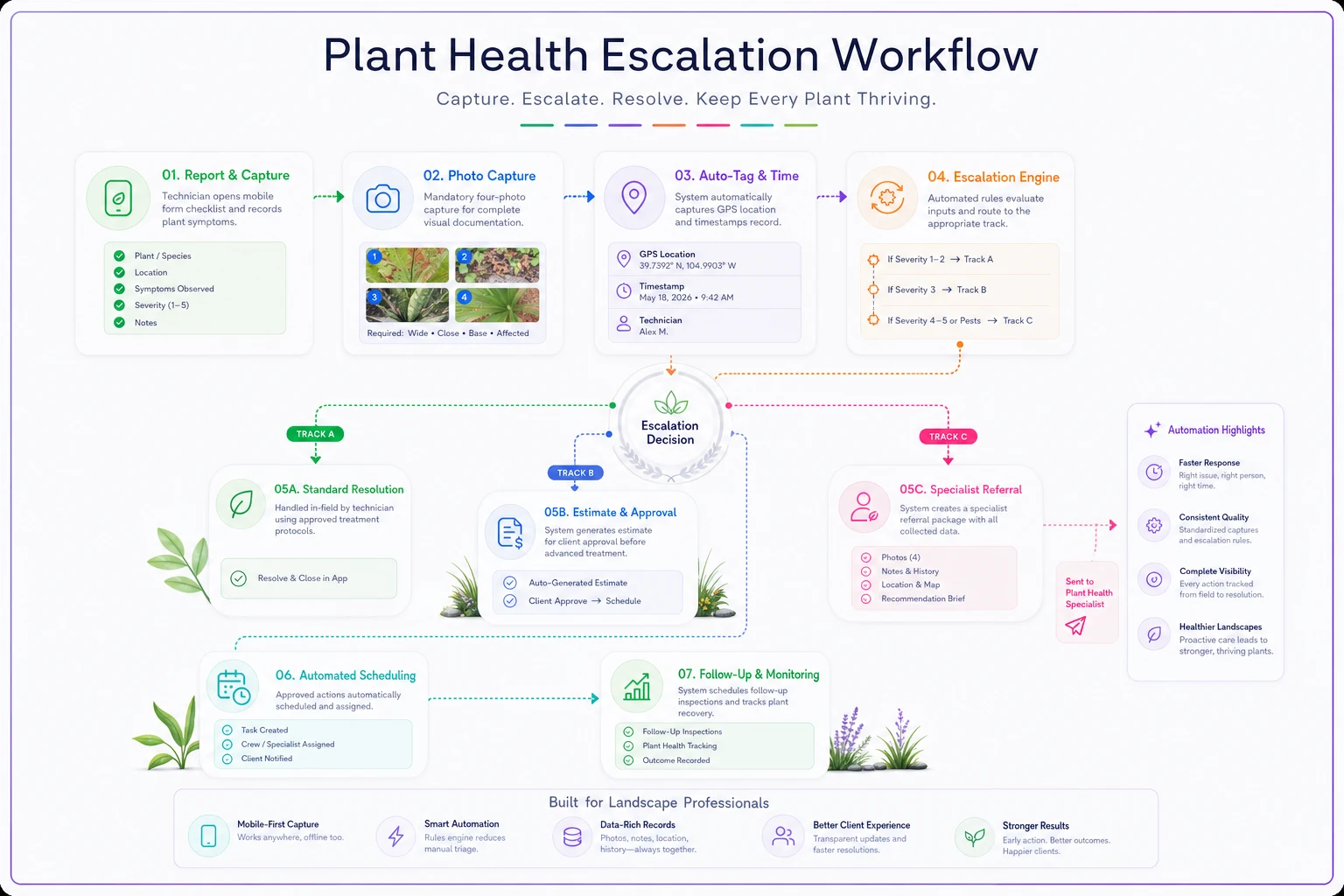
The graphic shows how a single field report moves through capture, classification, and action without fragmented communication.
Escalation can happen automatically based on checklist responses. Certain combinations trigger a Track C referral package immediately. Track B issues generate an estimate template pre-filled with standard treatment options and pricing.
All stakeholders see the same information in real-time. The crew supervisor reviews photos right away, the office sees the escalation decision, and the client receives professional documentation through a portal instead of a blurry text message. That transparency eliminates the information gaps where disputes breed.
The automation extends to follow-up scheduling too. Approved treatments automatically schedule based on crew availability and treatment windows. Declined treatments get documented with client acknowledgment. Follow-up inspections schedule 30 days out to check progression. The whole process takes under 10 minutes of field time instead of 45 minutes of back-and-forth.
Protecting Your Margins Through Process
Standardized plant health escalation isn't just about avoiding arguments—it's about protecting profitability. Every scope dispute costs margin through unbillable time, damaged relationships, and lost scheduling flexibility.
A mid-sized landscaping company handling 400 properties might run into 150-200 plant health issues per season. Without clear escalation, each issue can burn 45 minutes in coordination time. That adds up to well over 100 hours annually—essentially a month of crew time—spent on non-billable dispute management.
Clear processes flip that. Issues move through escalation in under 10 minutes. Documentation prevents the majority of disputes before they start. Crews stay on profitable work instead of investigating problems that won't generate revenue.
The client relationship improvements are worth noting too. Customers appreciate transparency. They might not love paying for treatment, but they respect clear documentation and consistent processes. The companies that lose clients over plant health issues aren't the ones charging for treatment—they're the ones with murky, inconsistent responses that feel arbitrary.
Done right, plant health escalation actually becomes a revenue center. Clear documentation justifies treatment pricing. Professional presentations increase approval rates. Consistent follow-up catches problems early when treatment is cheaper and more effective. Companies with strong plant health workflows often find meaningful additional treatment revenue they were previously leaving on the table through poor escalation.
Plant health issues will always create complexity in landscaping. Plants are living organisms subject to countless stress factors, and clients have real emotional investment in their landscapes. You can't prevent every disease or eliminate every pest—but you can eliminate the scope disputes that make plant problems unnecessarily painful.
The framework isn't complicated: standardized field assessment, mandatory photo documentation, clear escalation timelines, and a digital workflow to tie it together. No single component is difficult to implement. The combination is what transforms plant health from an operational liability into a manageable process.
Start with the symptom checklist and photo standards. These cost nothing to implement but immediately improve documentation quality. Add the escalation timeline to eliminate decision paralysis. Layer in digital tools when you're ready to scale beyond what manual processes can handle.
The companies struggling with plant health scope disputes aren't lacking horticultural knowledge. They're lacking operational structure. Build the structure, and the disputes largely disappear—along with the margin drain they create.
Ready to grow your landscaping business?
Join 2,000+ landscaping pros using Yardyly to save time, reduce task chaos, and deliver outstanding client results.