



Most landscaping crews estimate mowing time based on square footage alone. A 12,000 sq ft property? That's 40 minutes. Simple math, clean estimate. Except that same-sized property with a 15-degree slope and three flower beds takes 65 minutes, blowing up your entire afternoon schedule.
Why standard square footage rates wreck your daily schedule
The gap between basic square footage estimates and actual mowing time kills profitability in ways that compound. Your crew shows up late to the next job. Customers get frustrated. Routes get scrambled. What looked like eight properties in a day becomes six, and suddenly your labor cost per job jumped 33%.
After looking at operational data from landscaping businesses running everything from two-truck operations to 15-crew enterprises, one pattern keeps coming up: the most profitable companies track time multipliers for specific yard features. Not rough guesses or "add 10 minutes for obstacles" — actual multipliers built from measured field data.
Why square footage alone creates scheduling disasters
Square footage gives you a baseline, nothing more. Two properties with identical square footage can vary by 40+ minutes in actual mowing time depending on terrain and obstacles.
Never miss a job detail again.
Yardyly helps you plan, confirm, and manage every landscaping project seamlessly.
- Centralized project scheduling
- Automated client updates
- Crew and resource management
No credit card required
Think about what happens during actual mowing. A crew hits a property with moderate slope — maybe 12 degrees across the backyard. The zero-turn mower that normally covers 3.5 acres per hour drops to around 2.2 acres per hour on that slope. That efficiency drop isn't linear either. Steeper terrain forces more careful turns, more overlap passes for safety, and sometimes switching to walk-behind mowers entirely.
Then factor in stopping and starting around landscape features. Every tree means slowing down, circling, then accelerating again. Flower beds need edge work. Retaining walls create zones where the big mower can't reach, forcing an equipment switch.
The real scheduling killer is that these delays stack multiplicatively, not additively. A sloped yard with heavy tree coverage doesn't just add slope time plus tree time — the combination creates additional complications that a flat estimate misses entirely.
Building your time-multiplier framework
The most accurate mowing estimates come from breaking properties into feature categories, each with its own time multiplier. Here's the framework that actually works in the field:
Base Time Calculation: Start with your standard mowing rate for flat, open terrain. For most commercial mowers, that's somewhere around 2.5–3.5 acres per hour depending on deck size and conditions. Convert the property square footage to time based on that rate.
Slope Multipliers:
-
Flat to 5 degrees
1.0x (no adjustment)
-
6–10 degrees
1.15x
-
11–15 degrees
1.35x
-
16–20 degrees
1.6x
-
Over 20 degrees
2.0x or switch to specialized equipment
Obstacle Density Multipliers: Count trees, playground equipment, and garden features per 1,000 sq ft:
-
Light (0–2 obstacles)
1.05x
-
Moderate (3–5 obstacles)
1.2x
-
Heavy (6–8 obstacles)
1.4x
-
Dense (9+ obstacles)
1.65x
Planting Bed Multipliers: Calculate linear feet of bed edges per 1,000 sq ft:
-
Minimal (under 20 ft)
1.05x
-
Standard (20–40 ft)
1.15x
-
Extensive (40–70 ft)
1.3x
-
Elaborate (70+ ft)
1.5x
The table below summarizes all three multiplier categories in one view:
| Feature Category | Condition | Multiplier |
|---|---|---|
| Slope | Flat to 5° | 1.0x |
| Slope | 6–10° | 1.15x |
| Slope | 11–15° | 1.35x |
| Slope | 16–20° | 1.6x |
| Slope | Over 20° | 2.0x |
| Obstacle Density | Light (0–2 per 1k sq ft) | 1.05x |
| Obstacle Density | Moderate (3–5 per 1k sq ft) | 1.2x |
| Obstacle Density | Heavy (6–8 per 1k sq ft) | 1.4x |
| Obstacle Density | Dense (9+ per 1k sq ft) | 1.65x |
| Planting Beds | Minimal (under 20 ft edges) | 1.05x |
| Planting Beds | Standard (20–40 ft edges) | 1.15x |
| Planting Beds | Extensive (40–70 ft edges) | 1.3x |
| Planting Beds | Elaborate (70+ ft edges) | 1.5x |
The key thing to understand: these compound — you multiply them together, not add them.
The checklist that prevents estimate disasters
Before quoting any property, run through this assessment. Missing even one factor can throw off your estimate by 20+ minutes.
Terrain Assessment:
-
Walk the entire property perimeter
-
Check slope with an inclinometer app (not eyeball estimates)
-
Note any drainage issues creating soft spots
-
Identify zones requiring different equipment
-
Mark areas with limited mower access
Obstacle Mapping:
-
Count all trees over 4 inches diameter
-
Note low-hanging branches requiring ducking
-
Identify fixed features (mailboxes, lamp posts, play sets)
-
Check for hidden obstacles (irrigation heads, decorative rocks)
-
Measure total trimming footage needed
Planting Complexity:
-
Measure total bed edge length
-
Note curved vs straight edges (curves take roughly 30% longer)
-
Check mulch depth (deep mulch slows edging)
-
Identify delicate plantings requiring extra care
-
Count beds requiring hand work
Access Factors:
-
Gate width (can the zero-turn fit?)
-
Distance from truck to property
-
Steep driveways affecting equipment transport
-
Neighbor proximity (noise restrictions?)
-
Dump location for clippings
Special Requirements:
-
Striping pattern requests
-
Specific height requirements by zone
-
Areas requiring bagging
-
No-mow zones (rain gardens, wildflower areas)
-
Time-of-day restrictions
Missing slope assessment alone causes most estimate failures. A property that looks flat from the street might have a backyard dropping 15 degrees toward a creek. That's the difference between 35 minutes and 55 minutes on a single property.
Real calculation walkthrough
Here's an actual property estimate using this system. The property: 14,000 sq ft residential lot in a suburban development.
Base Calculation: 14,000 sq ft = 0.32 acres At 3 acres/hour baseline rate = 6.4 minutes base time Add setup/cleanup (8 minutes standard) = 14.4 minutes baseline
Feature Assessment:
-
Backyard slope
12 degrees average (multiplier: 1.35x)
-
Tree count
8 mature oaks plus 4 ornamentals = 12 total
-
Obstacles per 1,000 sq ft
12 trees / 14 = 0.86 per thousand, plus play set and fire pit = roughly 1.1 per thousand (multiplier: 1.2x for moderate density)
-
Planting beds
180 linear feet total edges
-
Bed edges per 1,000 sq ft
180 / 14 = 12.8 ft per thousand (multiplier: 1.05x for minimal)
Time Calculation: 14.4 minutes × 1.35 (slope) × 1.2 (obstacles) × 1.05 (plantings) = 24.5 minutes mowing time
Additional Time:
-
Trimming
180 ft beds + 85 ft fence line + around 12 trees = approximately 6 minutes
-
Blowing
3 minutes for driveway/walkways
-
Total
33.5 minutes on-site
Compare that to a basic square footage estimate that might quote 20 minutes total. That 13-minute difference doesn't sound catastrophic until you multiply it across 8–10 properties in a single day. By mid-afternoon, you're running 90 minutes behind and scrambling to call customers.
Here's a visual of the estimation workflow.
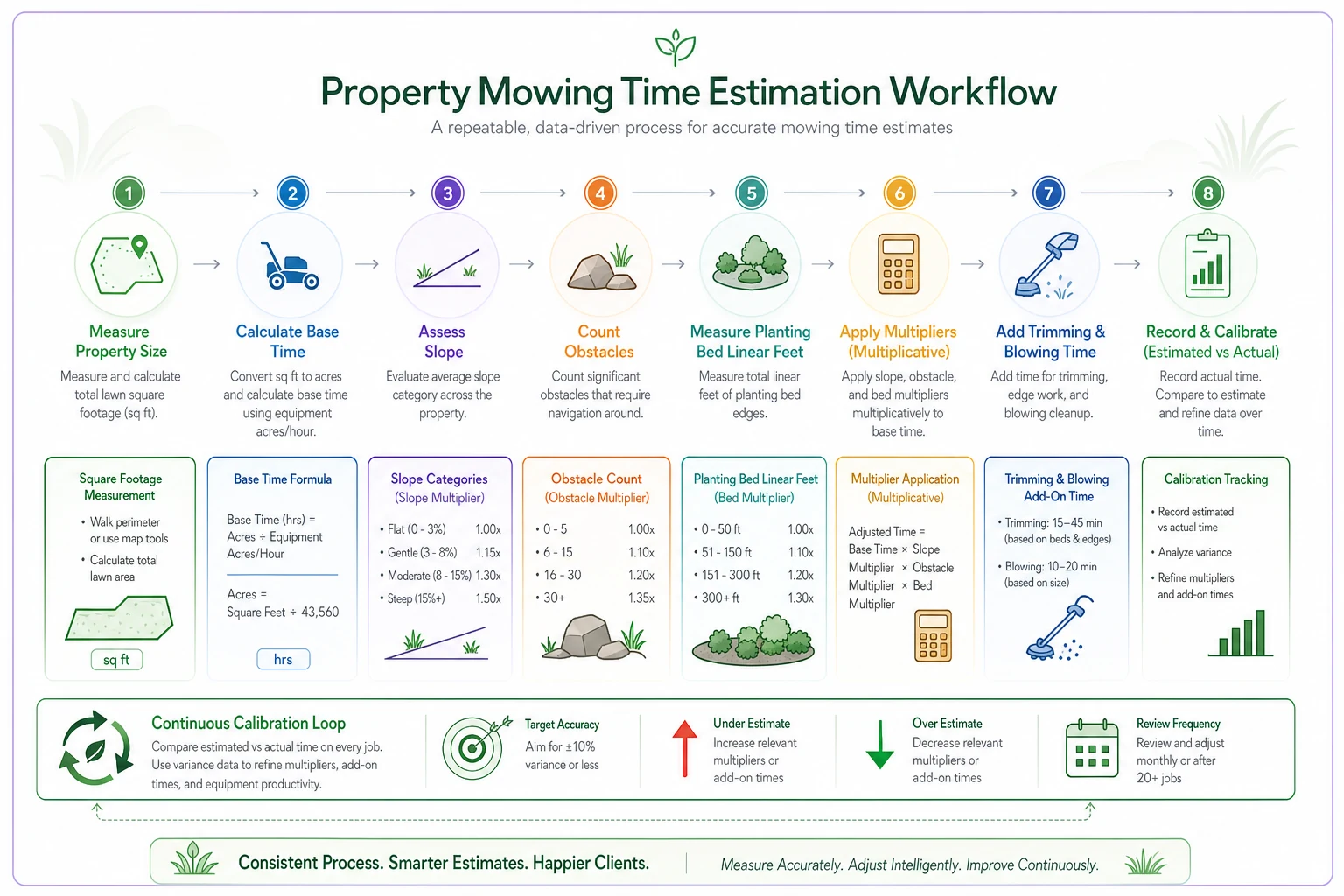
-
Measure total property square footage
-
Calculate base mowing time using your equipment's acre-per-hour rate
-
Add standard setup and cleanup time
-
Assess slope across all zones and assign slope multiplier
-
Count obstacles per 1,000 sq ft and assign obstacle multiplier
-
Measure total planting bed linear footage and assign bed multiplier
-
Multiply base time by all three multipliers (compounded, not added)
-
Add separate trimming and blowing time based on measured footage
-
Record estimated time against actual completion time for calibration
Use the step-by-step process above to keep estimates consistent and record outcomes for calibration.
When multipliers expose bigger problems
Sometimes running these calculations reveals properties that just don't work at standard rates. A half-acre lot with 25% slope and 30 ornamental trees might calculate to 90+ minutes of work. At typical mowing rates, you're losing money before the truck starts.
Those properties need a different pricing approach — either charge by time rather than square footage, or set a minimum fee that reflects what the job actually involves. The calculation gives you data to back up that conversation instead of just telling a customer their yard is complicated.
Properties with extreme multipliers often point to operational adjustments too. Maybe you dedicate a crew for complex properties, or you batch them together on days when schedule flexibility matters less. The multiplier model makes these patterns visible in a way that gut estimates never do.
Adjusting multipliers based on equipment and crew
Your specific equipment changes these multipliers in real ways. A 72-inch zero-turn handles slopes differently than a 52-inch model. Walk-behind mowers sometimes move faster through heavily obstructed areas where zero-turns constantly stop and pivot.
Crew experience shifts the numbers too. A two-year veteran might handle obstacle-heavy properties noticeably faster than someone in their first season. That same veteran probably won't show much speed advantage on wide-open properties — experience matters most where complexity is highest.
Track your actual times against estimates for the first several weeks using this model. You'll quickly see where your specific operation needs adjustment. Maybe your slope multipliers run higher because you prioritize safety. Maybe your obstacle multipliers run lower because you've dialed in a trimming sequence that saves real time.
The goal isn't matching these exact numbers — it's having a systematic model you can refine based on your own field data.
Software that handles the multiplication automatically
Manual calculations work fine for small operations, but they get unwieldy fast. Once you're estimating 15+ properties daily, the math alone eats serious time. This is where operational software with AI automation makes a real difference in the quoting process.
Modern landscaping management platforms can store your custom multipliers and calculate estimates automatically based on property features you input. The AI components learn from your actual completion times over time, adjusting multipliers to match your specific operation without constant manual tweaking.
Automation also catches the calculation errors that happen when you're rushing through quotes — forgetting to compound multipliers, missing a slope adjustment, that kind of thing. Estimates stay consistent across different team members, which eliminates the situation where one estimator always runs short and another pads everything by 20%.
And that data feeds directly into route optimization. When the software knows actual completion times rather than rough guesses, it builds routes that actually hold up through the day — no more showing up 40 minutes late to afternoon jobs because the morning ran long.
Beyond mowing: applying multipliers across services
This framework extends beyond mowing into other landscaping services. Leaf removal multipliers might factor in tree density and proximity to beds. Spring cleanup multipliers consider dormancy period and drainage patterns. Snow removal uses slope and obstacle multipliers with different coefficients.
Once you get into the habit of thinking in multipliers rather than flat additions, it changes how you approach all service estimates. You stop guessing and start calculating from measurable property features. That shift is more valuable than any single number in the model.
Making this system stick
Implementing feature-based time multipliers requires consistency. Every estimator needs to assess properties the same way. Field crews need to track actual times for calibration. The office needs a system for storing and applying the multipliers without each person doing it differently.
Start with a spreadsheet if you're not ready for dedicated software. Create columns for each multiplier category, build formulas that compound them correctly, and track estimated versus actual for at least 30 properties to calibrate your numbers. It doesn't need to be complicated at first — it just needs to be consistent.
Track estimated vs actual on each job and review weekly to speed calibration.
The companies that get this right quote more accurately, schedule more efficiently, and run more profitable operations. They're not guessing anymore.
Your mowing estimates affect every downstream operation. Get them wrong and you're constantly playing catchup — frustrated customers, stressed crews, blown schedules. Get them right using a systematic multiplier model and the days actually run the way you planned them. The difference between landscaping companies that scale past 8–10 crews and those that hit a wall often comes down to estimation accuracy, and square footage alone won't get you there.
Your mowing estimates affect every downstream operation. Get them wrong and you're constantly playing catchup — frustrated customers, stressed crews, blown schedules. Get them right using a systematic multiplier model and the days actually run the way you planned them.
Ready to grow your landscaping business?
Join 2,000+ landscaping pros using Yardyly to save time, reduce task chaos, and deliver outstanding client results.