



Most landscaping owners don't have a growth problem. They have a timing problem. They add a crew three months too early and eat payroll during a slow stretch, or they add one three months too late and burn out the people they already have while quality quietly craters. Same mistake, opposite direction, and both cost real money.
The reason this keeps happening is that "we're busy" isn't a number. It's a feeling. And feelings are terrible at telling you whether demand is genuinely outrunning capacity, or whether you're busy because your routes are sloppy, your estimates are optimistic, and your crews are spending 40 minutes a day driving to the wrong side of town.
This article lays out capacity gates—specific KPI thresholds and financial pre-conditions—that tell you when to add crews, when to outsource, and when to actually pause sales. Not vague advice. Actual triggers, monitoring templates, and a pilot rollout you can run over the next 6–12 months.
The Core Problem: You Can't See Capacity Until It's Already Broken
What makes capacity decisions so brutal in this trade is that the signals you're over-extended show up after the damage is done. Callbacks spike. A commercial client cancels. Your best foreman texts you on a Sunday saying he's done. By the time you feel the pain, you're already three weeks into a mess that's expensive to unwind.
Revenue almost never breaks first. It looks great right up until the wheels come off. What breaks first is the stuff nobody's watching: crew utilization creeping above healthy levels, backlog stretching past what clients will tolerate, gross margin per crew sliding because everyone's rushing and redoing work.
Owners typically track the wrong tempo—watching the sales pipeline like a hawk while checking operations maybe once a week. But capacity lives in operations. If you want to make good add-crew or outsource decisions, you need a handful of operational numbers watched weekly, with clear lines that trigger action.
The Four Numbers That Actually Gate a Capacity Decision
Forget the 30-metric dashboard. For capacity decisions specifically, four numbers do most of the work.
Never miss a job detail again.
Yardyly helps you plan, confirm, and manage every landscaping project seamlessly.
- Centralized project scheduling
- Automated client updates
- Crew and resource management
No credit card required
1. Crew utilization (billable hours ÷ paid hours). Your single most important gate. If a crew is paid 40 hours and bills 30, you're at 75%. In maintenance-heavy operations, healthy sustained utilization sits somewhere around 78–85%. Below that and you have slack you should fill before hiring. Above 90% sustained, you're not running efficiently—you're running people into the ground.
2. Backlog depth (days out you're booked). How far out is your next available slot for a new job? Two weeks on installs is normal and healthy. Six weeks means you're losing bids you don't even know you're losing, because prospects call three companies and go with whoever can say "next Tuesday."
3. Gross margin per crew. Revenue minus direct labor, materials, fuel, and equipment for that crew, tracked monthly. This tells you whether being busy is actually making you money. A fifth crew with lower margin than the four before it is more common than you'd think—because the incremental work is the leftover, low-margin, far-away stuff.
4. Callback / rework rate. Percentage of jobs requiring a return trip you don't get paid for. When this climbs, it's usually the first real sign crews are cutting corners to keep up.
Here's a quick reference for how these numbers point toward different decisions:
| Situation | Utilization | Backlog | GM per crew | Callback rate | Likely move |
|---|---|---|---|---|---|
| Genuine capacity shortage | >88% sustained 4+ wks | Growing, >4 wks out | Stable/strong | Starting to rise | Add crew or outsource |
| Busy but sloppy | 85–90% | Long but erratic | Sliding | Elevated | Fix routing/estimates first |
| Spiky demand | Swings 70%–95% | Volatile | OK | Normal | Outsource overflow |
| Overextended | >92% sustained | >6 wks | Falling | High | Pause sales, stabilize |
| Slack | <75% | <1 wk | Thin | Low | Don't hire—sell more |
If you want the fuller picture of how these tie into hiring, pricing, and routing decisions, we went deeper on that in Decision-Mapped KPIs for Landscaping. This article assumes you've got at least rough visibility into those numbers already.
Why the "Add a Crew" Reflex Fails So Often
The instinct when you're slammed is to hire. But adding a crew is the most expensive, least reversible capacity move you have. It's not just two or three wages—it's another truck or trailer, more equipment, more insurance, a foreman who can actually manage people, and weeks of ramp time where that crew is slow and making mistakes.
A typical scenario: an owner doing around $800k a year with four crews decides to add a fifth because summer is chaos. Fully loaded, that fifth crew runs somewhere in the $18k–$22k per month range once you count wages, truck payment, fuel, insurance, and equipment wear. To break even at a normal margin, they need to consistently bill—not just be scheduled, actually bill—around 32–35 productive hours a week from day one. New crews almost never hit that for the first 60–90 days.
So the crew joins in June, ramps through July, gets decent by August, and then the season turns. Now you're carrying full crew cost into a shoulder season where the work isn't there. One mistimed hire can wipe out the margin you made all summer.
The lesson isn't "never hire." It's that hiring should be the move you make when demand is structural, not seasonal, and when your finances can absorb the ramp period.
Financial Pre-Conditions: The Gate Before the Gate
KPIs tell you there's demand. Your finances tell you whether you can afford to chase it. Before any add-crew decision, three financial conditions should be true.
-
Cash runway of at least 8–10 weeks of the new crew's fully loaded cost, sitting in the bank. Not projected. Actual. New crews lose money before they make it.
-
Gross margin per existing crew is healthy and stable, not declining. If your current crews are already margin-thin, adding another one doesn't fix the problem—it multiplies it.
-
The demand is backed by signed or highly likely recurring work, not a pipeline of maybes. A crew justified by "we've been getting a lot of calls" is a crew justified by nothing.
If you can't check all three, the answer isn't necessarily "don't grow." It's "grow a cheaper way first"—which is exactly what outsourcing is for.
Outsourcing: The Move Most Owners Skip Too Early and Too Late
Outsourcing—subbing out overflow, seasonal spikes, or specialty work—is the capacity valve that keeps you from over-hiring. Variable cost instead of fixed cost. When the work dries up, so does the expense.
When outsourcing actually makes sense
-
Your demand is spiky and unpredictable, so you can't justify a permanent crew but you keep turning away work.
-
You've got one service line—large mulch installs, leaf cleanup season—that overwhelms you a few weeks a year and that's about it.
-
Utilization on your own crews is already healthy, and the overflow is the only thing pushing you over.
-
You want to test whether new demand is real before committing to a hire. Sub it out for a season, watch the numbers, then decide.
When outsourcing is a bad idea
-
The work is your core recurring maintenance with tight quality standards and repeat clients. Putting subs on bread-and-butter accounts is how you lose them.
-
Your margins are already thin—a sub takes their cut, so if you're barely profitable in-house, outsourcing can push a job underwater.
-
You have no system to inspect sub work before the client sees it. Outsourced quality problems are still your problems.
The most common mistake is treating outsourcing as a last resort you scramble to arrange mid-panic in July. By then you're taking whatever sub crew is available, which is usually the one nobody else wanted. Build sub relationships in the off-season, when you can vet them, agree on rates, and run a small trial job before it actually matters.
The Third Option Nobody Wants to Talk About: Pausing Sales
Sometimes the correct capacity move is to stop selling. Not forever—temporarily throttle new work until operations catch up.
Pausing sales feels like leaving money on the table. But selling work you can't deliver well is worse than not selling it. You take the deposit, deliver late or sloppy, eat the callback, get a bad review, and turn a customer into a liability. This usually surfaces when backlog stretches past what clients will tolerate and callback rates start climbing at the same time.
Softer versions work better:
-
Raise prices on new work. If you're slammed, your prices are probably too low. A 10–15% bump slows intake naturally and improves margin on the work you do take.
-
Extend your quoted lead times honestly. Tell prospects "we're booking six weeks out." Self-selection does the throttling for you.
-
Pause only the least profitable line. Stop taking new one-off installs while protecting recurring maintenance intake.
-
Prioritize existing-client requests over new leads until the backlog clears.
The signal to pause is specific: utilization sustained above roughly 92%, backlog past what your clients will accept, callback rate climbing, and crew turnover risk rising. When those line up together, more sales just accelerate the collapse. Most owners wait too long to pull this lever because slowing sales feels like failure—but by the time you're at that threshold, it's the only move that doesn't make things worse.
A 6–12 Month Pilot Rollout for Capacity Gates
You don't flip all this on at once. Here's a rollout that builds the monitoring habit before you're forced to make a big decision under pressure.
Month 1–2: Instrument the four numbers. Get utilization, backlog, GM per crew, and callback rate into a weekly view. A spreadsheet works fine to start. The goal is just seeing them consistently. Most owners are surprised by their real utilization once they measure paid hours against billable hours honestly.
Month 2–3: Set your thresholds. Based on your own data, pick the lines that trigger action. Your healthy utilization band might be 80–88%; someone else's might be 75–85%. Set them from your numbers, not a generic benchmark.
Month 3–5: Run the weekly review. Add a five-minute capacity check to your existing ops meeting—if you don't run one, the Weekly Ops Huddle framework is a solid starting point. Someone owns reporting the four numbers every week. When one crosses a threshold, it goes on the decision list.
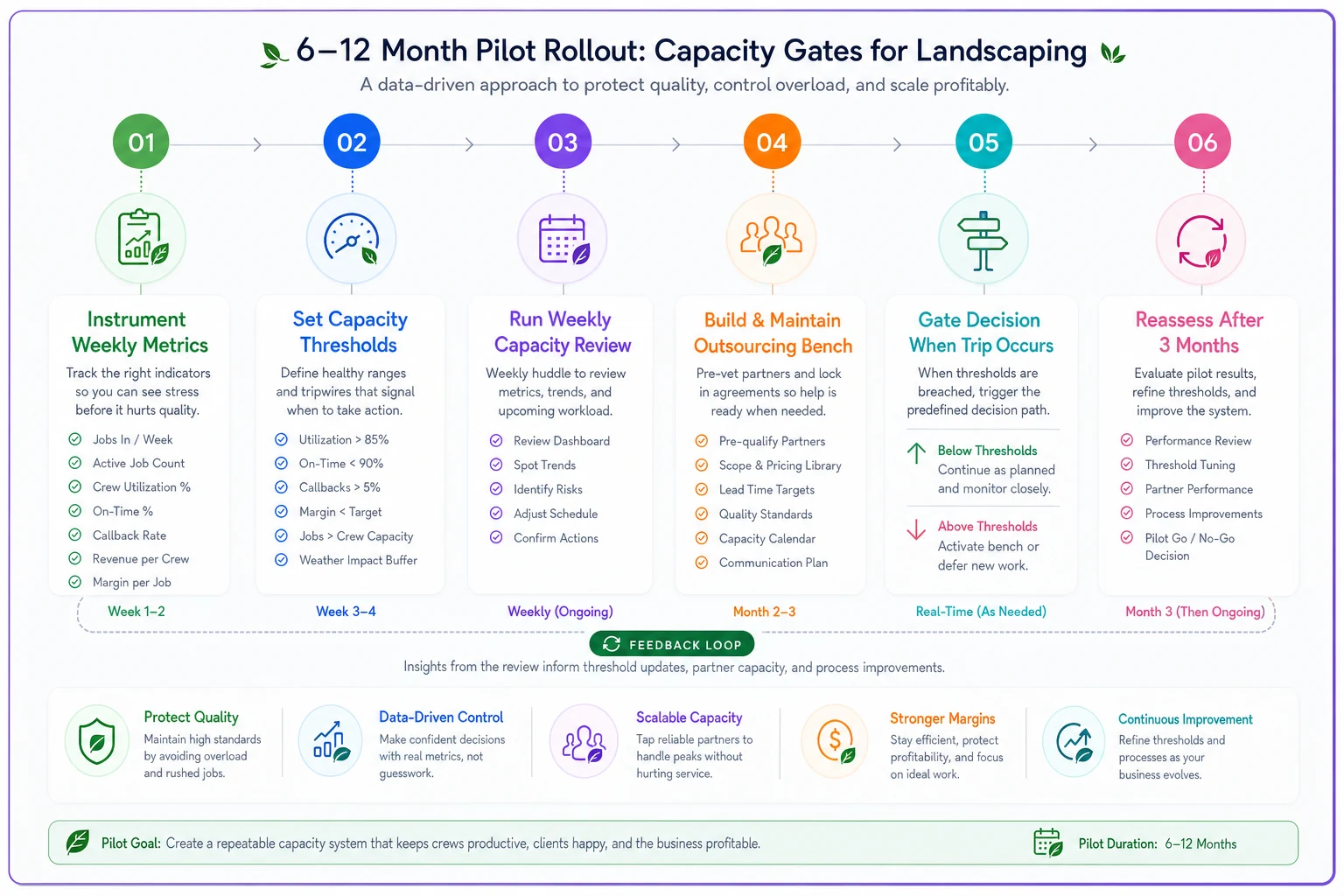
A simple visual of the rollout is helpful for teams to follow the sequence.
Month 4–6: Build your outsourcing bench. Vet two or three sub crews during the shoulder season. Agree on rates. Run one small trial job so you're not scrambling later.
Month 6–12: Make one real decision using the gates. When a threshold trips, work through the framework instead of your gut. Document what you decided and why. Three months later, check whether the numbers moved the way you expected. That feedback loop is what turns this from theory into actual judgment.
Start with a simple spreadsheet—don't overbuild a dashboard before you have clean data.
The rollout is deliberately slow because the point isn't to build a dashboard—it's to build a habit. Once the weekly review is routine, the decisions get easier because you're not starting from scratch every time something feels off.
A Quick Real Scenario
A maintenance-focused operation doing around $650k a year, three crews, kept feeling underwater every spring and had been on the verge of hiring a fourth crew for two seasons running. When they finally tracked utilization honestly, it was sitting at roughly 72%. Not a capacity problem at all. The real issue was routing and estimate slop—crews were driving too much and jobs were running long compared to what was quoted.
Instead of hiring, they tightened routes and cleaned up their time estimates over about a quarter. Utilization climbed into the low 80s on the same three crews. Backlog shortened. The urgent need for a fourth crew quietly disappeared—and the $20k a month or so that crew would've cost never left the bank. When demand genuinely did grow a season later, they added that crew from a position of stable margin and real cash runway. Same decision, completely different timing, and the numbers made the difference.
The Bigger Picture
Capacity isn't one decision. It's a system with three levers—hire, outsource, throttle—and the right lever depends entirely on which numbers are moving and why. Owners who scale well aren't smarter or luckier. They watch a small set of operational numbers weekly, set honest thresholds, and let the data tell them which lever to pull instead of reacting to whichever fire is loudest that week.
The question of when to add crews almost never has the answer your gut gives you. Your gut says hire when you're slammed. The numbers usually say fix your utilization first, outsource the spikes, and only add fixed cost when the demand is structural and your finances can carry the ramp.
Build the monitoring habit now, in a calm month, so the next time you're staring down a big capacity call, you're reading gauges instead of guessing.
Ready to grow your landscaping business?
Join 2,000+ landscaping pros using Yardyly to save time, reduce task chaos, and deliver outstanding client results.