

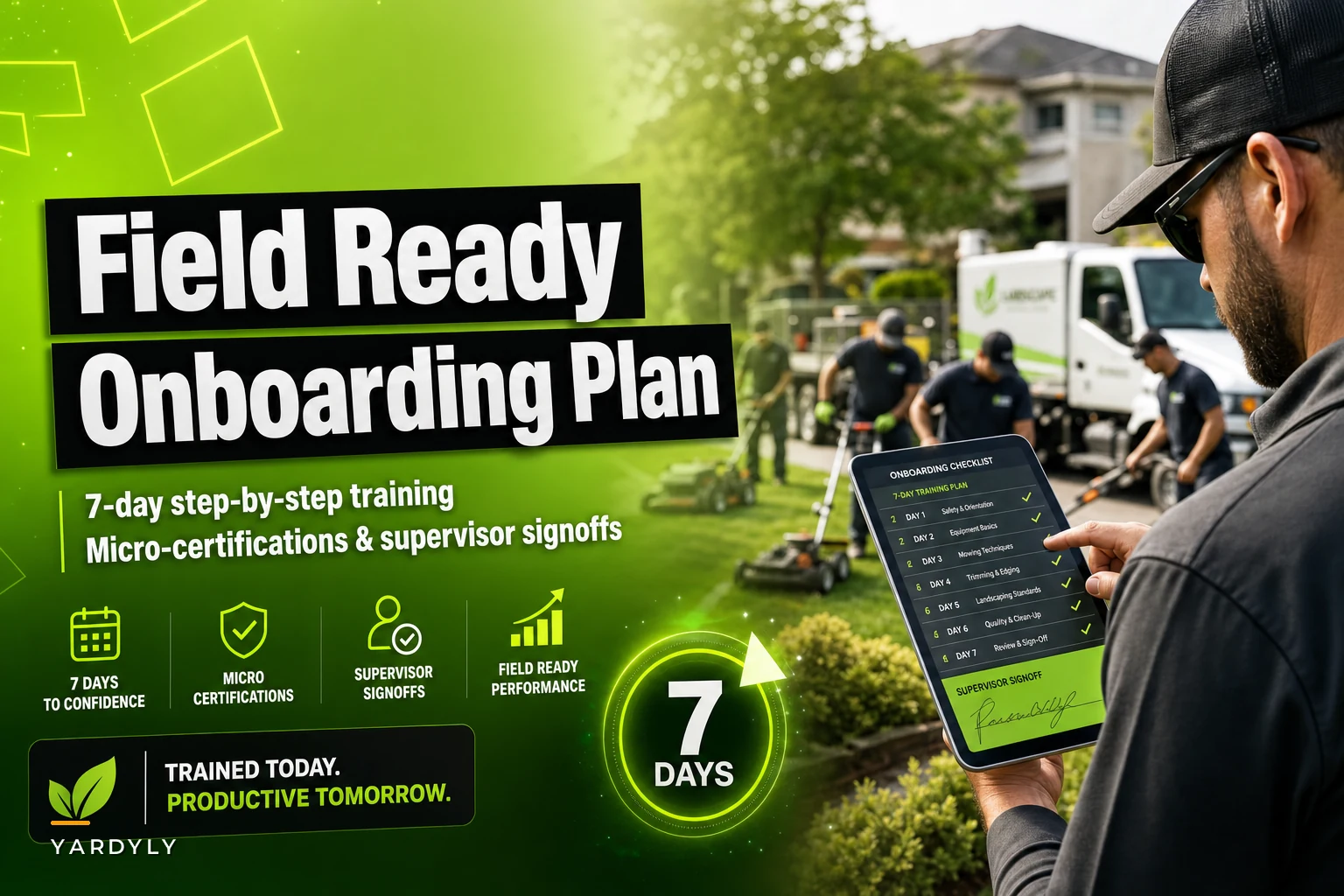

Your first seasonal hire shows up Monday morning. Seven days from now, they need to operate a zero-turn mower on a $2.8 million property without destroying the irrigation heads, scalping the turf, or backing into the client's Mercedes.
Most landscaping companies handle this with the "shadow and pray" method—new hires follow experienced crew for a few days, then get thrown onto a route when things get busy. The results are predictable: damaged equipment, unhappy clients, and that sinking feeling when you realize your new hire just trimmed through a fiber optic line because nobody explained utility markers.
The companies that actually retain seasonal workers and avoid property damage don't rely on informal training. They run structured programs with daily skill checkpoints, documented competency tracking, and progressive responsibility increases.
The Real Cost of Unstructured Onboarding
A mid-sized landscaping company in Charlotte hired twelve seasonal workers last spring. By week three, they'd lost four to preventable incidents: one quit after destroying a client's prized Japanese maple with improper pruning, another was let go after repeatedly failing to secure equipment on the trailer, and two simply stopped showing up after feeling overwhelmed and undertrained.
The damage went deeper than turnover. Insurance claims jumped by around $14,000 that quarter. Client complaints doubled. The operations manager spent roughly 15 hours a week handling problems that proper training would have prevented. Their best crew leaders burned out constantly fixing rookie mistakes instead of focusing on quality and efficiency.
Landscaping has unique training challenges. Unlike retail or food service, mistakes here cause immediate, visible, expensive damage. You can't ease someone gradually into operating dangerous equipment or handling chemicals—they either know the safety protocols or they don't. They either understand proper mowing patterns or they leave stripes that scream "amateur operation" to every neighbor watching.
Day 1: Safety Foundations and Basic Equipment Orientation
Monday starts in the shop, not on a property. Before anyone touches equipment, they need to understand what can kill them, hurt them, or cost the company thousands in damages.
Never miss a job detail again.
Yardyly helps you plan, confirm, and manage every landscaping project seamlessly.
- Centralized project scheduling
- Automated client updates
- Crew and resource management
No credit card required
Morning session covers PPE requirements and basic hazard recognition. Don't lecture—make it interactive. Set up stations around the shop: one with damaged equipment showing what happens when safety protocols get ignored, another with proper PPE setup, a third with common hazards labeled on actual equipment.
The micro-certification for Day 1 focuses on hazard identification. Give new hires a walkthrough test: identify ten safety issues planted around the shop and equipment. Things like unsecured mower blades, missing safety guards, improper fuel storage, damaged electrical cords on trimmers. They need eight out of ten correct to pass.
Afternoon moves to basic equipment familiarization—not operation, just identification and basic maintenance checks. Show them how to check oil levels, identify damage, understand equipment limitations. End with trailer loading basics: weight distribution, securing equipment, checking straps.
Your crew leader signs off on three competencies: hazard identification test passed, can perform basic equipment safety checks, understands trailer loading principles. No signatures, no progression to Day 2.
Day 2: Hand Tool Mastery and Client Property Awareness
Tuesday focuses on tools they'll use immediately: string trimmers, edgers, blowers. These seem simple but cause the most property damage when used incorrectly.
Start with trimmer line types and when to use each. Set up a practice area with different obstacles: vinyl siding, painted surfaces, mulch beds, gravel areas. New hires practice maintaining consistent distance and angle. The difference between a professional edge and property damage is about two inches and fifteen degrees of wrist angle.
Property awareness training happens through scenarios. Walk them through a typical residential property—at your shop or a friendly client's location. Point out invisible hazards: irrigation heads, cable boxes, invisible dog fences, septic tank covers. Explain how each gets damaged and what it costs to repair.
The Day 2 micro-certification requires demonstrating proper trimmer technique around five different surface types without causing damage. They also complete a property hazard identification quiz using photos from actual job sites.
Supervisor checks three boxes: demonstrates safe trimmer operation, identifies common property hazards, understands damage prevention protocols.
Day 3: Mower Progression Level 1—Walk-Behind Fundamentals
Wednesday introduces powered mowing equipment, starting with walk-behinds. Even if they'll eventually run zero-turns, everyone starts here. Walk-behinds teach pattern discipline and height adjustment without the complexity of hydraulic controls.
Morning covers pre-operation checks: oil, air filter, blade condition, safety features. Use a checklist they'll follow every single day. Make them repeat the checks three times until it becomes automatic. Include unusual scenarios—what if oil looks milky? What if blades are bent but not broken? What if the safety bail doesn't engage properly?
Practice happens on your worst properties first—the ones with obstacles, slopes, and difficult terrain. Better they learn there than on the pristine lawn of your pickiest client. Teach the three basic patterns: stripes, checkerboard, circular. Explain when each makes sense and why pattern consistency matters for professional appearance.
The progression test requires mowing a 5,000-square-foot area with proper pattern execution, no scalping, and correct overlap. Time doesn't matter yet—accuracy does. They also need to identify three mechanical issues on a deliberately sabotaged mower.
Crew leader certification: operates walk-behind safely, maintains consistent patterns, performs pre-operation checks correctly.
Day 4: Chemical Handling and Application Basics
Thursday covers the aspects that require actual licensing in many states—fertilizers, herbicides, pesticides. Even if new hires won't apply chemicals immediately, they need to understand storage, transport, and emergency procedures.
Start with reading labels and SDS sheets. Make it practical: here's a jug of 2,4-D herbicide. What's the mixing ratio? What PPE is required? What happens if it gets in someone's eyes? What plants will it kill besides weeds? Run through scenarios using actual products from your shop.
Calibration training uses water and food coloring. Show them how improper calibration leads to striping, burning, or ineffective treatment. Let them mix batches and test spray patterns. Explain the difference between broadcast and spot treatment, pre-emergent versus post-emergent, selective versus non-selective.
The micro-certification includes a written test on label comprehension and a practical demonstration of proper mixing and cleanup procedures. They don't need to be licensed applicators—but they need to understand what the licensed crew members are doing and why.
Supervisor verifies: understands chemical hazards, can read product labels, knows emergency procedures, demonstrates proper PPE use.
Day 5: Mower Progression Level 2—Zero-Turn Introduction
Friday escalates to zero-turn mowers, but only in controlled conditions. These machines cause the most expensive damage when operated incorrectly. One wrong move tears up $10,000 of sod or destroys an irrigation zone.
Begin with stationary operation. Engine off, explain every control. Let them practice lever movements while parked. The biggest mistake new operators make is treating zero-turns like cars—steering wheels turn gradually, but zero-turn levers create instant direction changes that can tear turf or throw an operator.
Move to slow-speed operation in an open area. Focus on smooth starts, stops, and turns. Teach the three-point turn technique for end-of-row direction changes. Explain weight transfer on slopes and why zero-turns flip easier than any other mower type.
Advanced training covers troubleshooting common problems: what causes uneven cutting, why hydraulic fluid overheats, how to identify belt wear. Include efficiency tips like optimal speed for different grass types and why mowing patterns should change weekly.
Day 5 certification requires navigating an obstacle course without hitting markers, demonstrating proper slope technique, and completing a 10-point safety check.
Crew leader confirms: operates zero-turn under supervision, understands stability limits, performs complete safety checks.
Day 6: Route Simulation and Time Management
Saturday simulates an actual route day. New hires experience the full workflow: loading trucks, traveling between properties, managing equipment, handling unexpected issues.
Set up three mock properties at different locations. Each presents different challenges: one with extensive trimming, another with difficult terrain, the third with specific client requests documented in work orders.
This is where time awareness begins. Not pressure—just consciousness. How long does proper trimming actually take? What's realistic for mowing an acre? How much time gets lost to poor organization or equipment problems?
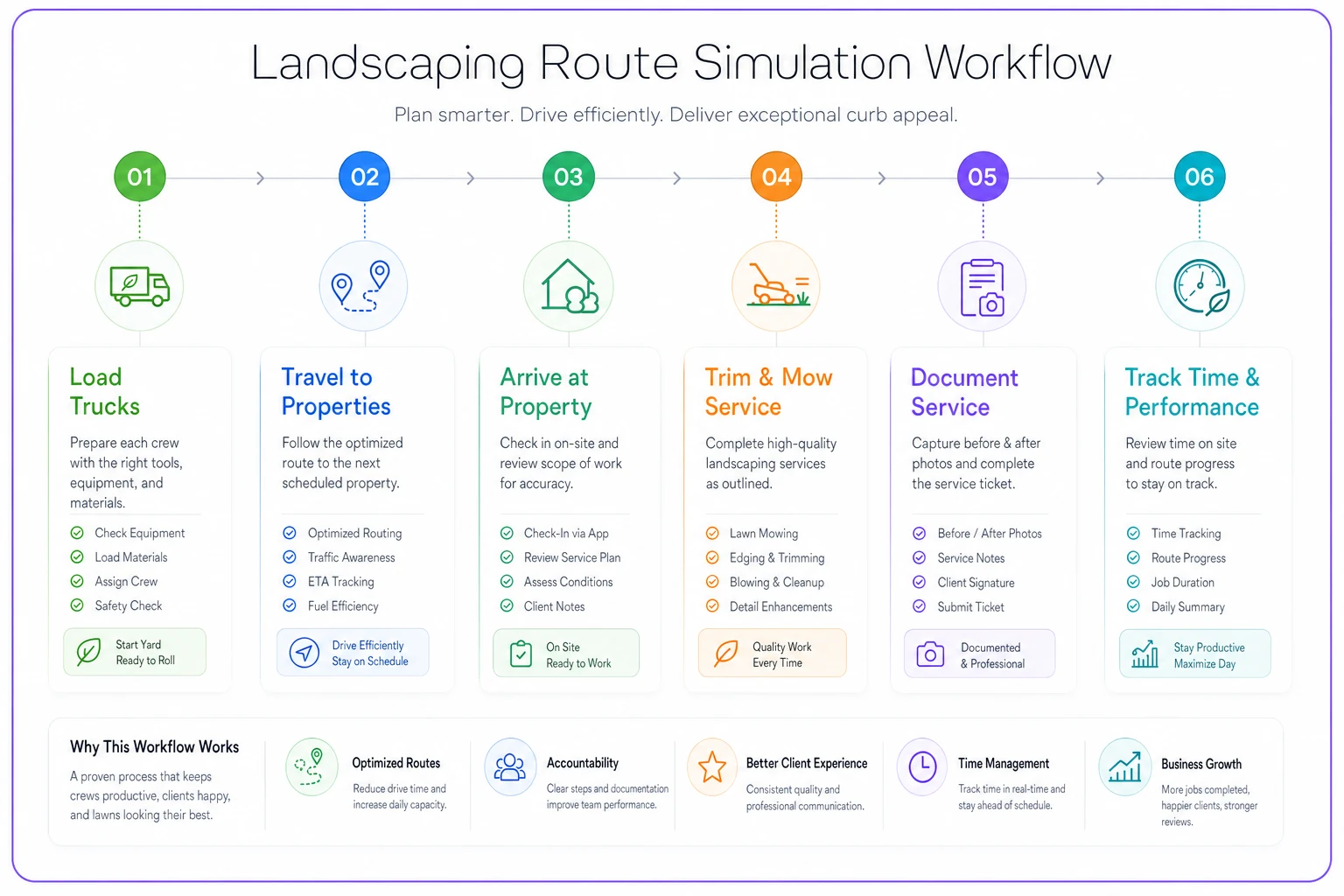
This graphic shows the route simulation workflow for Day 6.
Include paperwork and documentation. Show them how to complete service tickets, note property issues, document completion photos. Walk them through whatever operational software or systems you use for routing, time tracking, and client communication. Modern landscaping runs on information flow as much as it does on equipment.
The Day 6 assessment combines multiple skills: complete three properties meeting quality standards, properly document service delivery, demonstrate time awareness without sacrificing safety or quality.
Supervisor evaluation covers: follows complete workflow, maintains quality standards, documents work properly.
Day 7: Final Assessment and Crew Integration
Sunday serves as final evaluation and transition to crew placement. Morning starts with a comprehensive equipment operation test covering everything they'll use in their first month. Include breakdown scenarios: what do you do when the trimmer won't start? How do you clear a clogged mower deck? What's the procedure for equipment damage?
The crucial element is decision-making assessment. Present scenarios requiring judgment: weather changes during service, client makes an unexpected request, equipment fails mid-route, crew member gets injured. You're not looking for perfect answers—you're confirming they know when to call for guidance versus when to make a field decision.
Final certification happens through a complete solo property service under observation. They perform all tasks from arrival to departure: equipment unloading, property walk-through, mowing, trimming, edging, blowing, cleanup, documentation, equipment loading. One experienced crew member observes but doesn't intervene unless safety requires it.
Tracking Progress and Documentation
Every daily certification needs written documentation. Not complicated—simple checksheets work fine:
Day 1 Competencies:
| Day 1 Competencies |
|---|
| - [ ] Identifies 8/10 safety hazards correctly |
| - [ ] Performs equipment safety check |
| - [ ] Demonstrates trailer loading knowledge |
| Supervisor signature: Date: |
This documentation protects everyone. Insurance companies love training records. Employees value clear expectations and recognized progress. Store these records somewhere supervisors can pull them up instantly. When someone asks "Can the new hire run the zero-turn on the Henderson property?"—you need an immediate, definitive answer, not a shrug.
Making the Program Sustainable
The seven-day structure only works if experienced crew actually implement it. The biggest failure point is around Day 3 or 4 when regular work picks up and someone says "just throw them on a crew, they'll figure it out."
Assign dedicated trainers who understand their dual role: maintaining regular productivity while actually developing new talent. Compensate them accordingly—training is skilled work that directly impacts company profitability.
Pay trainers for their time and schedule dedicated training blocks so skill development doesn't get sacrificed to daily production.
Build flexibility into the program too. Not everyone progresses at the same pace. Some might need eight or nine days. Others demonstrate competence faster. The checkpoints matter more than the timeline, but having a standard structure prevents training from dragging on indefinitely.
Common Failure Points and Solutions
The most frequent breakdown happens when companies skip foundational days to address immediate labor needs. "We need bodies on crews NOW" leads to sending half-trained workers into the field. Six weeks later, those workers have developed bad habits, damaged equipment, and possibly hurt themselves or others.
Another failure point: inconsistent standards between trainers. Your veteran crew leader might have different safety priorities than your operations manager. Create written standards for each checkpoint. "Demonstrates safe trimmer operation" needs specific criteria: maintains 2-inch distance from structures, keeps trimmer at correct angle, uses appropriate throttle control, watches for thrown debris.
The third breakdown occurs when certification becomes a rubber stamp. Supervisors sign off without real assessment because they like the new hire or feel pressure to approve everyone. This destroys program credibility and creates dangerous situations. Make it clear: signatures mean personal accountability for that worker's readiness.
Measuring Success Beyond Week One
Track metrics that actually matter: injury rates for first-year employees, equipment damage incidents, client complaints about new crew members, and seasonal retention rates. Companies running structured programs typically see significantly better retention through the first season and fewer incidents requiring insurance claims.
Quality metrics matter too. Properties serviced by properly trained seasonal workers should meet the same standards as those handled by veteran crew. Mystery shop your own properties—can clients tell which crew member is new versus experienced?
The real test comes during peak season when every crew runs at capacity. That's when proper training pays off. Instead of constantly fixing problems and fielding complaints, you're scaling operations smoothly. Your experienced crew leads teams instead of babysitting. Your supervisors coordinate instead of constantly intervening.
Technology and Systematic Documentation
Manual tracking of certifications, progress notes, and competencies gets messy fast. By the third or fourth seasonal hire, paper checksheets start disappearing, signatures get missed, and nobody can quickly verify who's certified for what.
Operational software built for service businesses makes a real difference here. Instead of hunting through filing cabinets to verify someone's zero-turn certification, supervisors pull up records on their phones in seconds. Training progress tracks as each checkpoint gets completed. When someone asks whether the new hire can handle the Johnson property with its steep slopes, you have immediate access to their Day 5 slope training results.
Good operational platforms also help identify training gaps before they become field problems. If three different seasonal hires all struggle with the same Day 4 chemical handling concepts, that signals something in your program needs adjusting. If certain trainers consistently produce field-ready workers faster, you can study what they're doing and replicate it.
The documentation also feeds into performance management and development paths. That seasonal hire who aced every checkpoint becomes a crew leader candidate next season. The one who showed exceptional equipment knowledge might transition into fleet maintenance. Systematic records turn gut feelings into decisions you can actually defend.
Beyond the First Seven Days
The seven-day program establishes foundation skills, but development continues throughout the season. Week two might introduce specialized equipment like aerators or overseeders. Week three could cover advanced techniques like ornamental trimming or hardscape maintenance.
Create a progression pathway that seasonal workers can see and pursue. After mastering basic operations, what's next? Can they earn certifications in irrigation repair, plant health care, or landscape installation? Clear advancement opportunities transform seasonal jobs into something people actually want to come back to.
The best seasonal workers often become your best full-time hires. They've proven themselves under real conditions, understand your operations, and have established relationships with clients and crew. The seven-day program isn't just about getting through the busy season—it's about building your future workforce.
Implementation Checklist
Ready to build your own seven-day program? Start with these steps:
-
Map your essential equipment and identify must-have competencies for each
-
Create simple pass/fail assessments for each daily checkpoint
-
Assign and train your designated trainers (don't assume they know how to teach just because they're experienced)
-
Set up practice areas for each skill—trimming obstacles, mowing zones, mock properties
-
Build documentation templates for daily sign-offs
-
Establish minimum standards for each competency
-
Create a backup plan for slow progressors
-
Define escalation procedures for training failures
-
Connect training records to your scheduling and operational systems
-
Schedule program reviews after each season to incorporate lessons learned
The difference between landscaping companies that scale well and those that struggle through every season comes down to systems. Equipment breaks, weather disrupts schedules, clients change their minds—but properly trained crews handle these challenges without constant crisis management.
Your seasonal hires represent real potential or real risk. Seven days of structured training determines which way that tips. When mid-July hits and every property needs service, you'll either feel confident in your crew's capabilities or you'll be sweating every job that goes out the door.
The companies that get this right invest seven days upfront to save weeks of problems later. They track competencies because guessing is expensive. They build programs that turn eager beginners into competent professionals—and they document every step of that transformation.
That documentation, that systematic approach to developing people, becomes a competitive advantage that compounds season after season. While competitors scramble to find and retain anyone willing to work, you're building a pipeline of progressively skilled professionals who know exactly what's expected and how to deliver it.
Ready to grow your landscaping business?
Join 2,000+ landscaping pros using Yardyly to save time, reduce task chaos, and deliver outstanding client results.