

Most maintenance accounts leak money in a quiet way. The crew is standing in a yard every single week. They see the dying junipers, the mulch that's blown thin, the drip line that popped, the bed that's half-swallowed by weeds. And then they load up and drive to the next stop, and none of it ever becomes a line item.
The upsell revenue was right there, on the ground, in front of three people who already noticed it. It just never made it back to the office in a usable form. That's the real problem with trying to upsell maintenance accounts in landscaping. Not that opportunities don't exist — it's that the people who see them aren't the people who sell them, and the handoff between those two groups is almost always broken. So this post is narrow on purpose: how to build a trigger-based upsell system that runs off what crews already observe, uses one-line scripts instead of sales training, and has a follow-up cadence the office actually sticks to.
Why crews notice everything and sell nothing
Walk through the mechanics of a normal route day and the breakdown becomes obvious pretty fast. A two-person crew hits 9–12 properties. At property number four, the lead tech notices a boxwood with heavy winter burn and a client who's home, waving from the porch. He thinks, "We should probably treat those." Then he gets pulled into edging, the client goes back inside, and by the time they're loading the trailer the thought is gone. At property seven something similar happens. By 4pm the crew has seen maybe six genuine upsell triggers and reported zero.
-
Timing mismatch. The crew is busy executing scheduled work. Stopping to pitch a $400 shrub replacement feels like it slows the route, and routes are tight.
-
Role mismatch. Field techs didn't sign up to sell. Asking a 22-year-old crew lead to "close" a bed renovation is asking him to do a job he's uncomfortable with and not built for.
-
Memory mismatch. Even motivated crews can't hold six observations in their head across a full day. Without a capture step, the information just evaporates.
Owners typically try to fix this with motivation — "guys, keep your eyes open for upsells, there's commission in it." That works for about two weeks. Motivation isn't a system. Triggers are.
Start with trigger signals, not sales goals
Everything gets easier when you stop asking crews to sell and start asking them to flag. Flagging is a yes/no observation. Anybody can do it. Once you define the exact signals that count, the guessing disappears.
Never miss a job detail again.
Yardyly helps you plan, confirm, and manage every landscaping project seamlessly.
- Centralized project scheduling
- Automated client updates
- Crew and resource management
No credit card required
Two categories of triggers cover most of the money in a maintenance account: plant health signals and property feature signals. Plant-health triggers are the perishable ones — the stuff that gets worse if nobody acts, which also makes them easier to bring up with a client because there's a real reason behind them. Property-feature triggers are more about the physical state of the landscape and tend to turn into bigger-ticket enhancement work.
Here's a working trigger list. It's not meant to be exhaustive — it just needs to be specific enough that a crew member can match what they see to a named flag in under five seconds.
| Trigger signal | Category | Likely offer | Rough ticket size |
|---|---|---|---|
| Shrubs with dieback / winter burn / 30%+ browning | Plant health | Pruning + treatment or replacement | $150–$500 |
| Yellowing turf in a defined patch | Plant health | Soil test + targeted fertilization | $90–$250 |
| Visible insect damage or webbing | Plant health | Pest treatment program | $120–$350 |
| Mulch under ~1.5" / soil showing through beds | Property feature | Seasonal mulch refresh | $300–$900 |
| Beds with heavy weed breakthrough | Property feature | Pre-emergent + bed renovation | $200–$600 |
| Overgrown shrubs touching structures/windows | Property feature | Reduction prune / shaping | $150–$400 |
| Exposed/popped drip line or dry zones | Property feature | Irrigation repair / audit | $100–$450 |
| Edging worn, bed lines blurred | Property feature | Edge redefine + install | $250–$700 |
Notice these aren't vague ("yard looks rough"). They're specific enough that two different crew members would flag the same thing. That consistency is what makes the office's follow-up feel credible later.
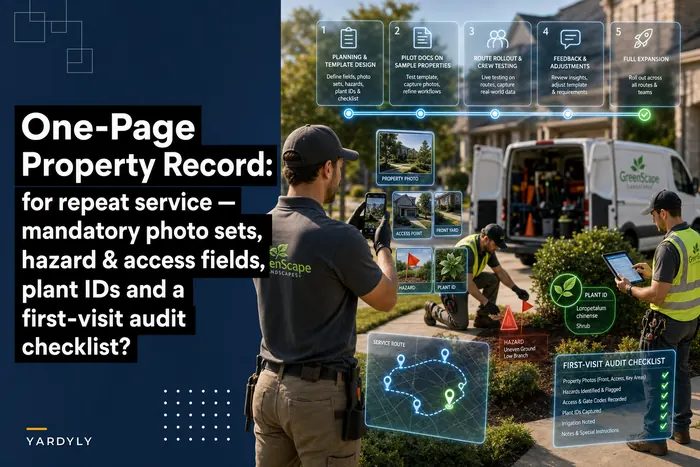
If you already run a one-page property record for repeat service, these triggers should live on the same sheet. The crew's already documenting hazards and plant IDs — adding an "upsell flag" line is a small addition, not a new process.
The one-page crew script (and why it's one line, not a pitch)
Owners push back on this part, so I'll be direct: your crews should not be delivering a sales pitch. The more you script, the less they'll actually say anything. A pitch feels like acting. A single honest sentence feels like doing their job.
> "Hey, I noticed your boxwoods have some dieback on the north side — I flagged it for our office so they can send you options if you want them handled."
That's it. No price. No close. No "would you like to go ahead with that today." The crew names what they saw and makes it clear the office will follow up. This keeps the crew from having to negotiate, protects your margin because nobody's quoting on the spot, and still plants the seed with the client.
The one-pager that lives in every truck has three parts:
-
The trigger list (the table above, trimmed to what that crew actually handles).
-
The one-line template "I noticed [trigger] — I flagged it for our office so they can send you options."
-
The capture step photo + trigger tag + property, logged before leaving the stop.
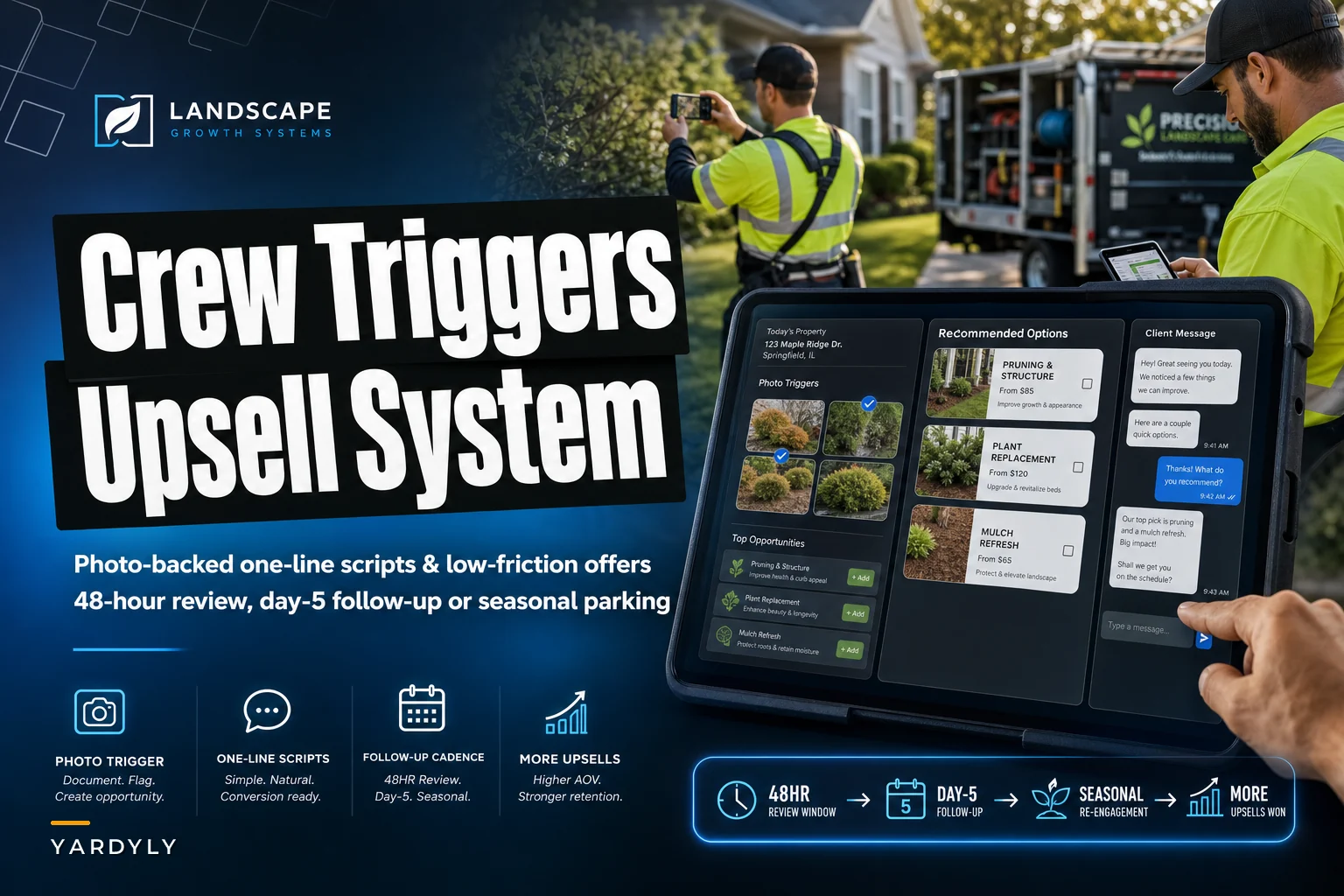
That capture step is the hinge everything swings on. A flag with no photo becomes a he-said-she-said conversation that goes nowhere. A flag with a clear photo becomes a quote the office can send with confidence, and gives the client something concrete to look at. It's the same photo discipline that keeps you out of trouble when clients argue about plant decline and scope disputes — you're just pointing the same camera at opportunities instead of liabilities.
What crews should not do
-
Don't quote prices. Ever. They don't know your margins and they'll undercut you without realizing it.
-
Don't promise timelines. "The office will reach out" is enough.
-
Don't push. One mention, then move on. If the client wants it, the office handles it.
-
Don't flag everything. If a crew tags 11 things per property, the office drowns and nothing gets quoted. One or two real triggers per visit is the right pace.
That capture step is the hinge everything swings on. A flag with no photo becomes a he-said-she-said conversation that goes nowhere.
The office follow-up cadence (where the money actually closes)
Flags are worthless without a follow-up rhythm. This is where most upsell attempts die. The crew does its part, the photos pile up in a group text or a notebook, and the office — buried in scheduling and invoicing — never circles back. Within a week the client has forgotten the conversation and the lead is cold.
The fix is a boring, predictable cadence owned by one person in the office. Not a committee. One person who owns the upsell list.
-
Same day or next morning Flags from the previous day's routes get reviewed. Office confirms the photo is usable and the trigger is clear. Junk flags get dropped here.
-
Within 48 hours of the flag The client gets a short, specific message — not a generic "we noticed some stuff," but something like "Our crew flagged dieback on your boxwoods and thinning mulch in the front beds during Tuesday's visit. Here are two options to handle them." Photo attached.
-
Day 5–6 if no response One soft follow-up. Still specific, still tied to the original observation. "Just making sure you saw the options on your boxwoods."
-
After second no-response Move it to a seasonal bucket. Don't keep poking. Re-surface it at a natural moment — mulch flags come back up in spring, treatment flags at the next relevant service window.
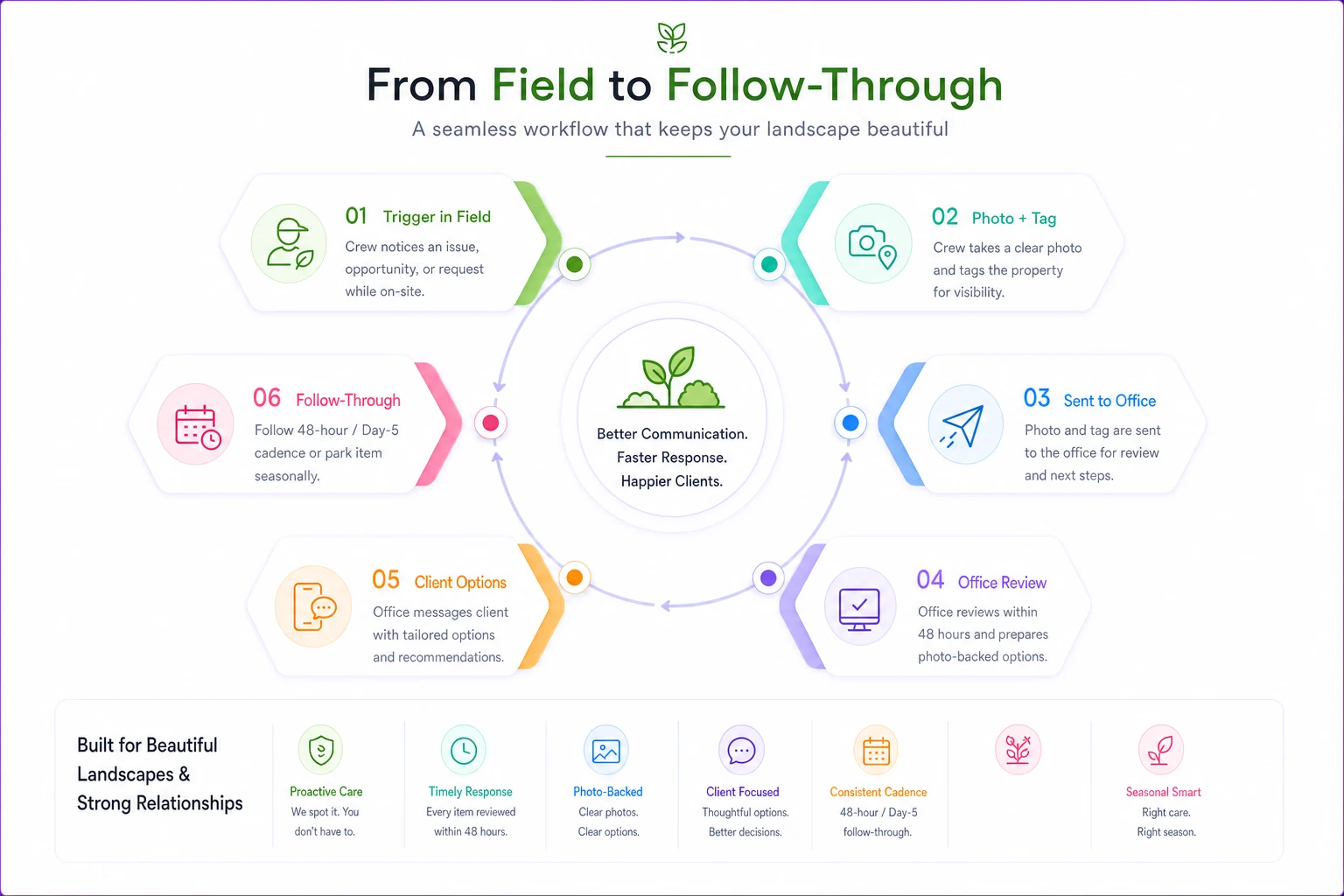
Simple visual showing the handoff helps the office stick to the 48-hour rule and makes responsibilities obvious.
Two failure patterns to watch for. First, offices wait too long — a flag from three weeks ago feels random to the client and your close rate drops hard. The 48-hour window matters because the client still remembers the crew mentioning it. Second, some offices over-follow, hitting the same client five times on a $200 prune until it starts feeling like harassment. Two touches, then park it.
Sizing offers to crew capacity — the part everyone skips
This is the mistake that quietly breaks upsell systems: the office sells work the crews can't fit.
-
Low-friction, in-route offers. Small stuff a crew can knock out during their existing visit or in a 20–30 minute add-on: a reduction prune, a drip repair, a small bed touch-up. These are the ones you push hardest because they barely dent the schedule. A crew can usually handle one or two per day without rerouting anything.
-
Scheduled enhancement offers. Bigger work — bed renovations, mulch refreshes across a whole property, irrigation audits — that needs its own time block or a dedicated enhancement crew. These get quoted and scheduled, not squeezed in.
The practical rule: let the office freely push low-friction offers up to crew slack capacity, and route the bigger offers through whoever owns the schedule before promising a date.
The practical rule: let the office freely push low-friction offers up to crew slack capacity, and route the bigger offers through whoever owns the schedule before promising a date. Match the follow-up language to the tier too. For a drip repair: "We can handle that on your next visit." For a full bed reno: "We'll get you on the enhancement schedule — likely 2–3 weeks out."
When you ignore this, you get the worst of both worlds. Crews resent the office for overselling, the office resents crews for not flagging, and clients get burned by missed promises. Getting the sizing right fixes all three.
A real scenario
A residential maintenance outfit running three crews — roughly 180 recurring accounts — had basically zero systematic upsell revenue. Enhancements happened by accident, when a client happened to ask. Maybe $1,500–$2,000 a month in add-on work, almost entirely reactive.
They changed three things. Crews got a trimmed one-page trigger sheet taped inside each truck. The crew's only job was flag + photo + one line to the client if they were home. One office person took ownership of the follow-up list with a 48-hour rule.
The first month was messy — crews over-flagged, the office got buried, a few quotes went out late. By month two it settled. Crews were flagging one or two real triggers per property instead of ten. The office was sending specific, photo-backed options within two days. Close rate on low-friction offers ran noticeably higher than the bigger enhancement quotes, which wasn't surprising.
By the back half of the season they were pulling somewhere in the $6k–$8k range per month in enhancement work off the maintenance base — most of it low-friction stuff that slotted into existing routes without disrupting anything. Not a dramatic transformation. Just the money that was already on the ground, finally making it to an invoice.
When this system makes sense — and when it doesn't
It makes sense when you have a stable maintenance base you're visiting repeatedly, crews who are at properties the client genuinely cares about, and at least a little schedule slack to absorb small add-ons. That repeat-visit relationship is the whole advantage — you're not cold-pitching, you're pointing out something real to someone who already trusts you.
It's a bad idea when your crews are so slammed they can't absorb a single add-on and you have no enhancement capacity at all. Selling work you can't deliver is worse than not selling. Fix capacity first, then turn the system on.
Who should skip it: very small solo operations where the owner is on every property anyway — you're already seeing and selling in real time, so a formal flag-and-cadence system is overhead you don't need. This pays off once there's a real gap between who sees the opportunity and who follows up on it.
The one thing to get right
Separate seeing from selling. Crews see. The office sells. The crew's job is a flag, a photo, and one honest sentence — nothing more.
The office's job is a specific, fast, photo-backed follow-up sized to what the crews can actually deliver. Keep those roles clean and the upsell revenue stops depending on anyone being a natural salesperson. It becomes a process — trigger in the field, cadence in the office, offer sized to capacity. That's the difference between noticing money on the ground every week and actually collecting it.
Keep those roles clean and the upsell revenue stops depending on anyone being a natural salesperson. It becomes a process — trigger in the field, cadence in the office, offer sized to capacity. That's the difference between noticing money on the ground every week and actually collecting it.
Ready to grow your landscaping business?
Join 2,000+ landscaping pros using Yardyly to save time, reduce task chaos, and deliver outstanding client results.