

Most landscaping owners don't make the subcontractor-vs-employee call on purpose. They back into it. A big install lands in June, the two-truck crew is already booked solid, and someone knows a guy with a skid steer who can start Thursday. So you hire the guy. Cash or check, no paperwork, "we'll sort it out later."
That "later" is where the trouble lives. The misclassification fines, the uninsured-injury bill, the client who withholds final payment because a sub damaged an irrigation line and nobody's coverage responds — none of that shows up on the day you make the decision. It shows up three months later, and by then you've already built a routing habit around a person who was never set up correctly.
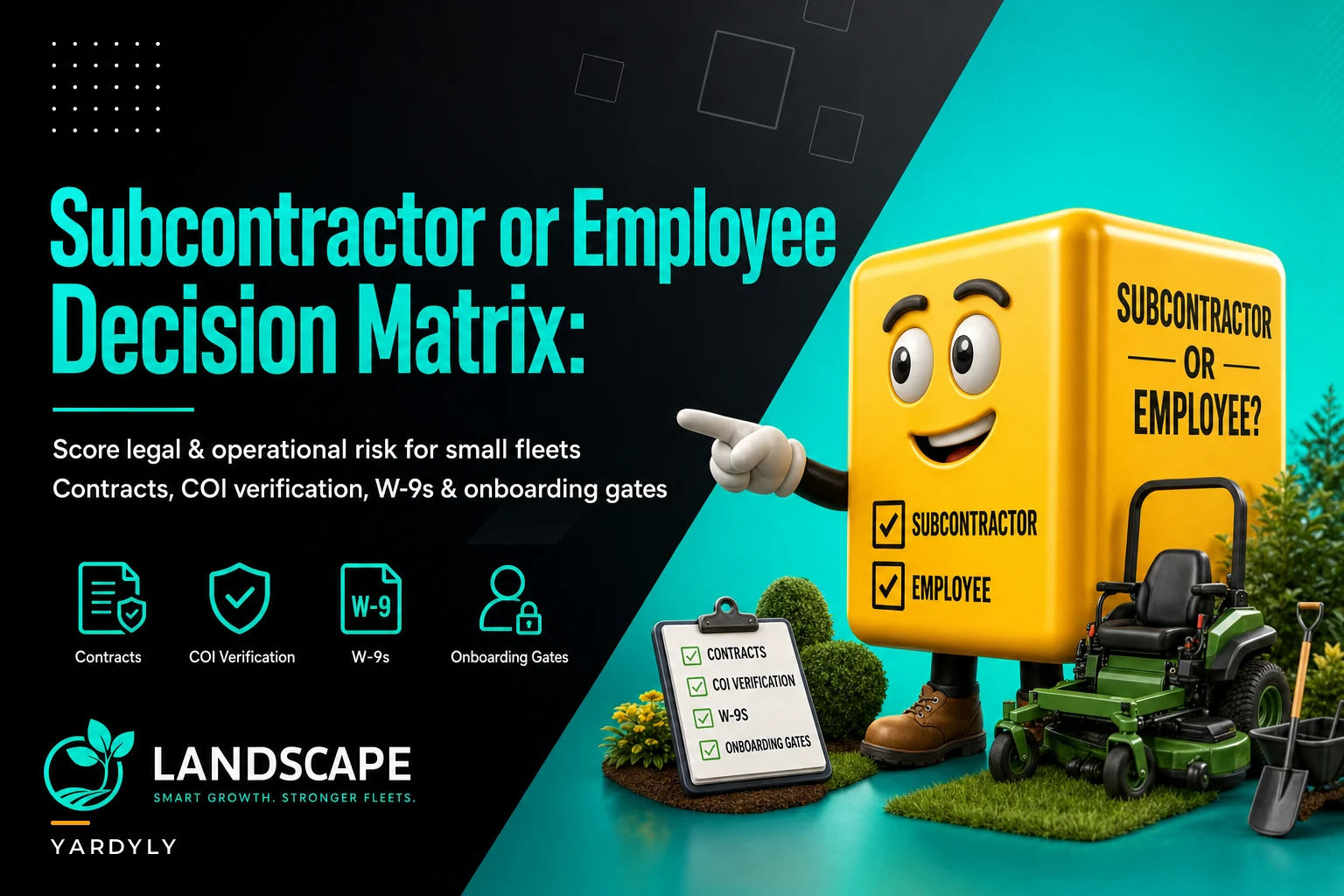
This post is about making that call deliberately — a scoring approach for who should be a sub vs an employee, the minimum contract language you actually need, the insurance and invoicing checklist that keeps you from carrying someone else's risk, and how to fold subs into daily routing without opening a compliance hole. We're staying narrow on purpose. This isn't a tax lecture. It's an operations playbook for a small fleet.
Start with the risk/benefit score, not the tax form
The mistake almost everyone makes is treating "subcontractor vs employee landscaper" as a legal question first. It's an operational question first. The legal exposure follows from how you actually use the person day to day.
The pattern worth internalizing: the more your business controls how, when, and with what tools the work gets done, the more that person looks like an employee — regardless of what your invoice says. Calling someone a 1099 sub while you hand them your truck, your uniform, your schedule, and your step-by-step instructions is the fastest way to lose a misclassification audit.
So before contracts or insurance, run each role through a simple risk/benefit score. Rate each factor 1 (strong employee signal) to 5 (strong sub signal). Add it up.
| Factor | Leans Employee (score 1–2) | Leans Sub (score 4–5) |
|---|---|---|
| Who sets the daily schedule | You do, hour by hour | They set their own hours to hit a deadline |
| Whose equipment | Yours (mowers, trucks, trimmers) | Theirs (they bring a skid steer, hardscape tools) |
| How work is directed | You tell them the method | You define the outcome, they choose the method |
| Ongoing vs project | Recurring, indefinite | Defined scope, defined end date |
| Other clients | Works only for you | Runs their own book, other customers |
| Payment basis | Hourly, every crew day | Per project or per milestone |
| Integration into crew | Part of a route, wears your logo | Shows up as an outside contractor |
Add the seven factors. Rough read:
-
7–17
treat as employee. The control level is too high to defend as a sub.
-
18–25
gray zone. Tighten the relationship one direction — don't leave it fuzzy.
-
26–35
legitimate subcontractor. Document it properly and move on.
The gray zone is where most small fleets actually live, and it's where the leaks happen. A "sub" scoring a 20 is a lawsuit waiting for a slow week. The fix isn't to argue about it — it's to push the relationship decisively toward one column. Either you stop directing their method and let them use their own gear (push toward sub), or you accept they're really staff and put them on payroll (push toward employee).
When a sub actually makes sense — and when it's a bad idea
Subs are a tool for capacity you can't justify carrying year-round. That's the whole logic. If the work is spiky, specialized, or tied to a single project, a sub keeps you from paying for idle staff in the shoulder seasons.
Never miss a job detail again.
Yardyly helps you plan, confirm, and manage every landscaping project seamlessly.
- Centralized project scheduling
- Automated client updates
- Crew and resource management
No credit card required
When it makes sense:
-
A hardscape or large install job that needs a skill your crew doesn't have (retaining walls, low-voltage lighting, grading).
-
Overflow during peak weeks where the alternative is turning down profitable work.
-
A one-off requiring equipment you don't own and won't buy (a mini-ex for two days).
-
Snow season, if you run summer maintenance and want plow coverage without hiring for four months of the year.
When it's a bad idea:
-
You're using the sub for your core recurring routes. If they're mowing the same 15 lawns every week on your schedule with your mowers, that's an employee wearing a sub costume.
-
You need them to represent your brand to clients and follow your service standards to the letter. That level of control undermines the classification.
-
You're doing it purely to dodge payroll taxes on someone who works like staff. That's the exact fact pattern auditors look for, and the back taxes plus penalties will dwarf what you "saved."
There's an operational cost people forget too: subs don't run through your onboarding and quality systems the same way. If you've built a real crew-development pipeline — like a structured 7-day field-ready onboarding for seasonal crews — a rotating cast of subs never absorbs those standards. Fine for a two-day grading job. It's a quality problem if subs are touching client-facing recurring work.
The minimum contract clauses (don't overthink this)
You don't need a 12-page master services agreement for a subcontractor mowing overflow for three weeks. You need a short, signed document that does five things. Skip these and the contract won't protect you when it matters.
The five clauses that actually earn their place:
-
Scope and completion terms. What's being done, at which properties, and what "done" means. Vague scope is how subs and owners end up arguing over final payment. Tie payment to a defined deliverable, not to hours logged.
-
Independent contractor acknowledgment. A plain statement that they control their own methods, provide their own tools, carry their own insurance, and are responsible for their own taxes. This one sentence won't win an audit by itself, but its absence hurts you.
-
Insurance and indemnification. They must carry their own general liability (and workers' comp if they have employees), name you as additional insured, and indemnify you for damage or injury caused by their work. This is the clause that keeps a sub's mistake off your policy.
-
Payment terms and timing. Amount, milestones, and how fast you pay after an approved invoice. Be specific — "net 15 after completion sign-off," not "we'll pay you when the job's done."
-
Termination and standards. How either side ends the arrangement, and the quality/safety baseline they must meet. Keep the standards outcome-focused (finished quality) rather than method-focused (exactly how to do it) so you don't accidentally re-create employee-level control on paper.
One practical note: the contract should be signed before the first day on site, not backfilled after something breaks. A contract dated the week of the incident is nearly worthless and looks worse.
The insurance and invoicing checklist that stops leaks
An uninsured sub is functionally your liability. If a sub cuts a fiber line, drops a wall on a client's fence, or injures himself on your job with no coverage, the injured party — and the client — will come looking at the biggest wallet in the chain. That's usually you.
-
[ ] Certificate of Insurance (COI) on file, current dates, not expired mid-project
-
[ ] General liability minimum you're comfortable with (many small fleets require $1M/$2M)
-
[ ] You listed as additional insured on their GL policy — not just "they have insurance"
-
[ ] Workers' comp if the sub brings their own helpers (this is where injury claims explode)
-
[ ] W-9 collected before first payment, so 1099s aren't a January scramble
-
[ ] Signed contract dated before start
-
[ ] Business license / entity proof if your state or municipality requires it
-
[ ] Auto insurance if they're driving to sites hauling equipment
On the invoicing side, the discipline is just as important. Real independence shows up in the paper trail:
-
Subs invoice you — you don't hand them a paystub. If you're generating their pay slip, that's an employee tell.
-
Invoices reference the scope and milestone, not hours-per-day like a timesheet.
-
Payment goes to a business name / EIN where possible, not a personal Venmo every Friday.
Keep COIs, W-9s, and signed contracts in one folder per sub so a renewal or an audit is a five-minute pull, not a two-day file hunt.
The single most common leak? Expired COIs. A sub is properly covered in April, the policy lapses in July, nobody checks, and the August incident lands on your uninsured desk. Set a reminder to re-verify coverage dates on every recurring sub, every renewal cycle. This is exactly the kind of check that quietly falls through in a busy fleet — which is why keeping it inside your job management or scheduling system, with a flag that blocks a sub from being assigned to a route until their COI date is verified, beats keeping it in someone's memory.
Payment cadence that reinforces the classification
How you pay is evidence. Employees get regular payroll on a fixed cycle. Subs get paid against completed work. Mixing these up quietly erodes your position.
A clean cadence for subs looks like:
-
Deposit or mobilization payment for larger project subs (covers their material/setup, common on installs).
-
Milestone payments tied to defined completion points — grading done, wall built, lighting installed and tested.
-
Final payment on sign-off, net 10–15 after an approved invoice.
Avoid paying mods on your payroll run alongside W-2 staff. It's convenient, and it's a red flag. Same goes for paying a flat weekly amount that never varies with the work — that looks a lot like a salary. If your employee pay is built around productivity models like the ones in hybrid piece-rate pay with minimum guarantees, keep that system firewalled from how you pay subs. Subs price the job; you don't set their earning formula.
Onboarding a sub into daily routing without the leak
There's a real tension here: to run efficiently, you want subs on the same route sheet, the same job notes, the same site access as your crews. But the more you integrate them, the more they look like employees. The answer isn't to keep subs disorganized — it's to integrate the logistics while keeping the control signals clean.
-
Verify before assign. Contract signed, COI verified, W-9 collected. No sub gets added to a route until this trio is complete. Make it a hard gate.
-
Assign by outcome, not by method. Give them the property, the scope, the completion standard, and the deadline. Don't hand them a minute-by-minute schedule of how to do it — that's the control line you don't want to cross.
-
Give scoped site access. They see the job they're doing — access notes, gate codes, hazard flags for that property. They don't get folded into your full crew management as if they're staff.
-
Route around them, not through them. Slot the sub's project into the day's plan so your crews don't collide with them on shared sites, but let the sub control their own hours within the deadline.
-
Quality check on outcome. Inspect the finished work against the contract standard. Coaching a sub on how to trim isn't your role; verifying the wall is level and the site is clean is.
The workflow that keeps this from becoming a paperwork nightmare is centralizing the compliance docs in the same place you manage jobs. When a sub's record carries their COI expiration, signed contract, and W-9 status right next to the properties they're assigned to, the "can this person legally be on this route" question answers itself.
A simple visual of the onboarding flow can make it obvious which step is the hard gate.
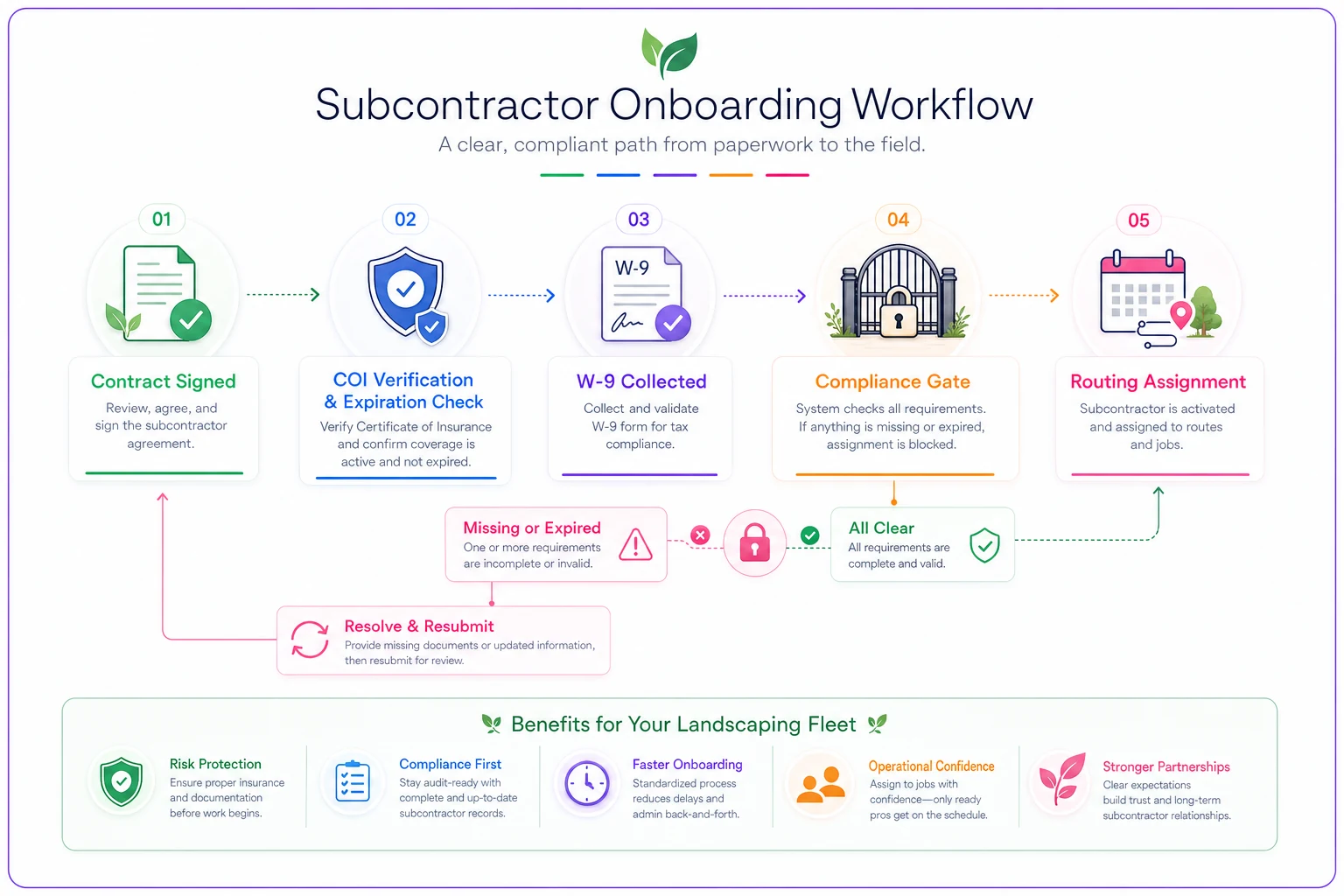
The routing system simply won't let an uncovered or unsigned sub get slotted — and that's the difference between compliance being something you have to remember and compliance being a step you can't skip.
A real scenario: overflow install season
A three-truck fleet doing residential maintenance picks up a run of paver patios and retaining walls in late spring — roughly $60k–$70k of hardscape work their crews aren't fast at. Rather than turn it down or burn out their staff, they bring on two subs with their own equipment.
Year one, the sloppy version: No signed contracts, COIs "on the way," paid weekly by personal check. One sub's helper twists an ankle on a site. No workers' comp. The claim, plus a scramble to prove the fleet wasn't the employer, plus a state inquiry into how the subs were paid, cost them somewhere in the low five figures once you count the legal time and the settlement. The install profit basically evaporated.
Year two, the clean version: Short signed contract per sub, COIs verified before start with the fleet named additional insured, W-9s collected up front, milestone payments against completion, and subs slotted into routing only after that trio cleared. Same volume of work. The hardscape line came in around a 30–35% margin and stayed there, because no incident ate it and no audit followed. The difference wasn't the work. It was refusing to let anyone onto a route until the compliance gate was cleared.
Who should NOT lean on subs at all
If your entire model is recurring weekly maintenance on tight routes with your equipment and your standards, subs are the wrong tool for the core work. You'll fight the classification line constantly and lose the consistency clients pay you for. Hire and develop crew instead.
Subs earn their place at the edges — the specialized, the spiky, the one-off. Kept there, documented properly, and gated behind a real compliance check, they let a small fleet take on work it couldn't otherwise touch without carrying year-round overhead.
The whole thing comes down to one habit: decide the classification on purpose, before the busy week forces your hand, and never let anyone onto a route until the contract's signed, the coverage is verified, and the paperwork's in one place you can actually find. Do that, and the subcontractor-vs-employee question stops being a landmine and becomes just another operational decision you already know how to make.
Ready to grow your landscaping business?
Join 2,000+ landscaping pros using Yardyly to save time, reduce task chaos, and deliver outstanding client results.