


The worst version of this isn't the cancellation itself. It's the 20-odd minutes you burn standing in the shop, staring at a whiteboard, trying to figure out whose Thursday just fell apart. Two guys called out, the truck's already loaded for the wrong route, and you've got a commercial account that will absolutely notice if you skip them.
Most owners handle this by gut feel. They call whoever complains the loudest, push the "nice" clients who never push back, and hope nobody churns. That works fine until you scale past two or three crews — then the guessing starts costing real money. Not in dramatic ways. More like a slow bleed: one lost maintenance contract here, a comped visit there, a foreman making a $600 routing decision at 6:45 AM with no framework behind it.
This is about building the decision tree before the phone rings. Who gets reassigned first, who gets bumped, what you say, and how a float crew plugs the hole without you touching the schedule for 20 minutes.
Why the same‑day scramble goes sideways
The reassignment problem isn't really a scheduling problem. It's a prioritization problem that only shows up under time pressure.
When you plan a normal week, you have hours to think. When a crew cancels at dawn, you have maybe ten minutes before the remaining crews need to roll, and every minute you spend deciding is a minute the whole fleet sits idle. Decisions get made fast and badly. The default human instinct under pressure is to protect relationships you can feel — the chatty homeowner, the client who tipped last month — over relationships that actually carry margin, like the property manager quietly controlling nine doors.
A typical example: a two‑man crew calls out sick, taking eight stops with them. The owner spends the morning personally covering the three "important" jobs, which turn out to be three residential mows he happened to know by name. Meanwhile the HOA common‑area contract — worth roughly $2,400 a month — gets pushed to Friday without a call. Nobody at the HOA notices for two visits. Then they do, and the renewal conversation gets uncomfortable.
The failure isn't laziness. It's that there was no scoring rule sitting in front of the person making the call.
The core idea: score the client, not the mood
You need two things decided in advance:
Never miss a job detail again.
Yardyly helps you plan, confirm, and manage every landscaping project seamlessly.
- Centralized project scheduling
- Automated client updates
- Crew and resource management
No credit card required
-
A priority score for every client, set when they're onboarded — not invented at 6:40 AM.
-
A reassignment matrix that turns "a crew went down" into "here's exactly what moves."
Client priority isn't about who you like. It's a blend of contract value, churn sensitivity, and how visible a miss is. A commercial site with a signed SLA and a property manager watching is high priority even if they're pleasant and low‑maintenance. A one‑off cleanup for a first‑time customer is low priority even if they were friendly on the phone.
Here's a simple scoring frame that holds up in the field:
| Factor | Weight | What earns a high score |
|---|---|---|
| Contract type | Heavy | Signed maintenance / SLA with penalty or renewal risk |
| Miss visibility | Heavy | Commercial, HOA common areas, storefronts — people notice |
| Revenue per stop | Medium | Larger recurring value, or gateway to more doors |
| Churn sensitivity | Medium | Clients with a history of complaining or shopping around |
| Timing rigidity | Light | Event prep, pre‑listing cleanups, hard deadlines |
Score each client 1–5 on those factors and total it once. Tag them A / B / C. That tag is what your foreman reads when the route breaks — not a fresh judgment call every time.
The thing most people miss: a client can be low‑revenue and still be an A if a miss is highly visible or triggers a penalty. And a client can be high‑revenue and still be a C for reassignment purposes if they're flexible and won't churn over a one‑day slip. Reassignment priority is about fragility under a miss, not lifetime value.
The reassignment matrix
Once clients are tagged, the same‑day decision becomes almost mechanical. The matrix answers one question: when a crew goes down, what happens to their stops?
-
A‑tier stops → covered same day, no exceptions. Pulled onto a float crew or absorbed by the nearest crew with capacity.
-
B‑tier stops → covered same day if there's slack; otherwise moved to the next open slot within 48 hours with a proactive call.
-
C‑tier stops → rescheduled to the next logical route day, notification only, no comp.
The "nearest crew with capacity" piece matters more than people expect, because reassignment collides with geography. Dumping an A‑tier stop onto a crew 40 minutes away just creates a second schedule failure. When you reassign, you're not just asking "who's free" — you're asking "who's free and close." If you've built any kind of clustering logic into your week, this is where it pays off. The same thinking behind job‑pairing and travel buffers applies directly to emergency reshuffles.
The 6‑step triage sequence
-
Confirm the gap. Which crew, which stops, how many hours of work are now homeless?
-
Pull the tier tags. Split the orphaned stops into A / B / C piles.
-
Assign A‑tier first to the nearest crew with slack, or dispatch the float crew.
-
Test B‑tier against remaining capacity. Cover what fits; queue the rest for a 48‑hour reslot.
-
Reslot C‑tier to the next route day and log it.
-
Fire the notifications — different script per tier (below).
The order is the point. People instinctively start with whoever's calling the most, which is usually a B or C. Starting with A‑tier means the highest‑fragility work is locked before anyone has had time to derail you.
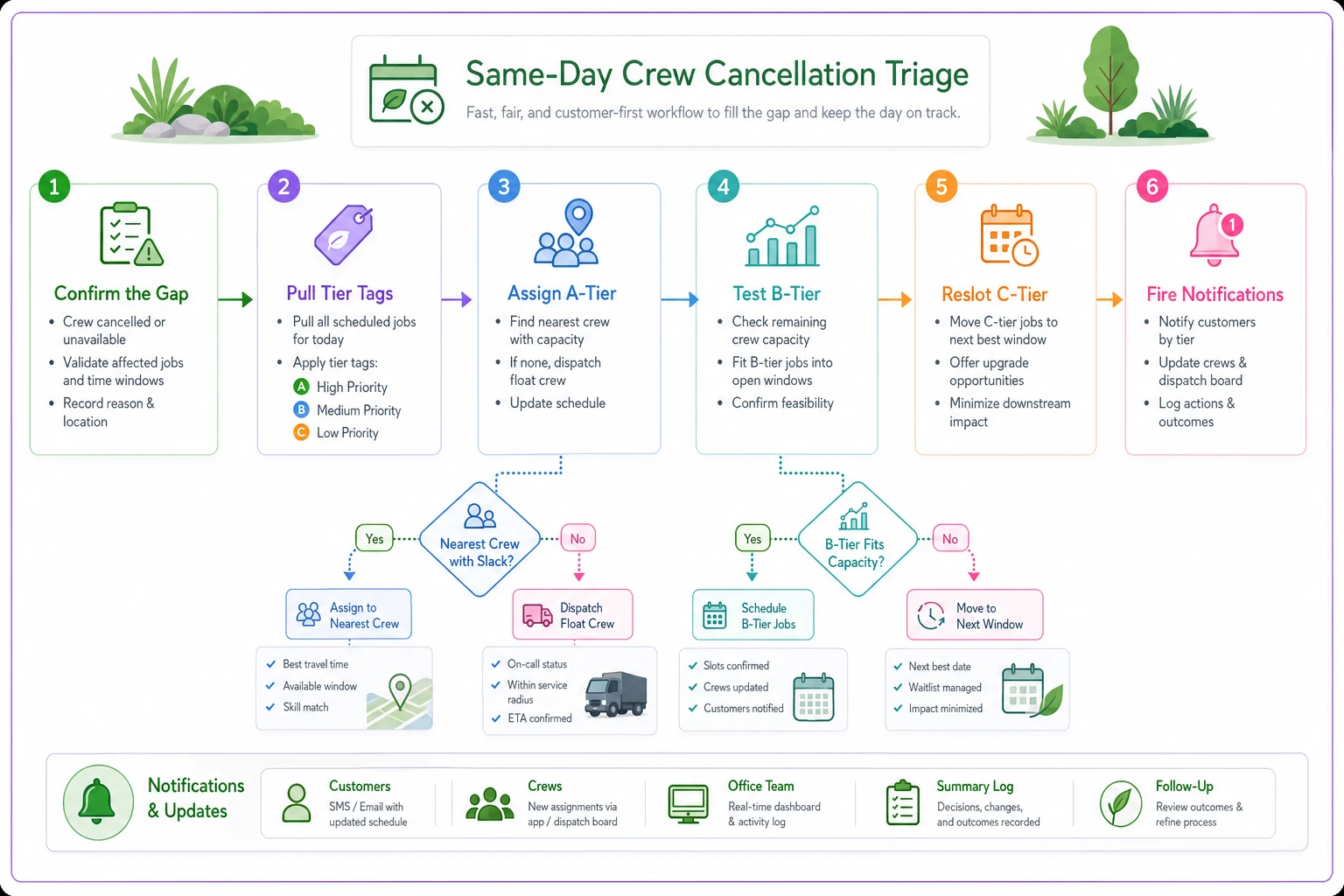
Use this sequence exactly in the morning triage; it should take under five minutes.
Float‑crew rules that actually work
A float crew is the cleanest fix, but most small operations set it up wrong. They either don't have one, or they build one that's too specialized to plug random holes.
A float crew's job is coverage, not craftsmanship. It should be able to handle 70–80% of your routine stops — mow, blow, edge, basic cleanups — competently. It doesn't need to be your install team. The mistake is staffing your two best, most expensive guys as the float and then feeling like you're wasting them on light days.
Rules that keep a float crew useful:
-
Keep them semi‑loaded. A general‑purpose trailer that can hit most maintenance stops without a return trip to reload.
-
Cap their normal workload at around 60% of a full route so there's real absorption room. If your float crew is booked solid, it isn't a float crew — it's just another crew.
-
Give them the day's A‑tier map in advance. They should already know which accounts they'd cover if something breaks, before it breaks.
-
Don't let float coverage become permanent. If the same crew is down three Thursdays running, that's a staffing problem, not a triage problem.
When a float crew doesn't make sense
If you're running one or two crews total, a dedicated float crew is overkill — you can't afford the idle capacity. In that case your "float" is really slack you deliberately build into each route. Leave 60–90 minutes of buffer per crew per day and let that be your shock absorber. Same principle, different mechanism.
Keep the float trailer stocked with common consumables so they rarely need to return to the yard mid‑day.
At four or more crews, though, and you're still absorbing cancellations by personally driving out — the math has already flipped. An owner's time covering routes almost always costs more than a lightly loaded float crew.
The client scripts (tier by tier)
The reassignment decision is half the job. How you communicate it decides whether a bumped client stays or churns. The difference between an A‑tier and a C‑tier isn't just whether you call — it's the tone and what you offer.
A‑tier — you're covering them anyway, so lead with reassurance: > "Hi [name], quick heads‑up — we had a crew out today so a different team is handling your property. Same scope, still on schedule. You shouldn't notice a thing. Anything specific you want them to watch for?" That last question does quiet work. It converts a potential complaint into a service touchpoint.
B‑tier — you're moving them a day or two, so be proactive and specific: > "Hi [name], we're short a crew today and I want to make sure your property gets the full service instead of a rushed one. I'd like to move your visit to [day]. Does that work, or would you prefer we squeeze in a partial today?" Offering the partial matters even if they rarely take it. It signals you're not just shoving them aside.
C‑tier — notification, not negotiation: > "Hi [name], we're adjusting today's route and your service will move to [next route day]. No change to your billing. Reply if that's a problem and we'll sort it out." C‑tier doesn't get excessive apologies or comps. Over‑apologizing to a flexible client trains them to expect credits. The confirmation‑and‑contingency logic behind these messages ties into a broader cancellation and confirmation cadence — same‑day triage is really the emergency branch of that system.
Credit and comp policy — before you're guilted into it
The fastest way to erode margin isn't the cancellation. It's the reflexive "sorry, here's 20% off" that a stressed owner hands out to end a phone call.
-
A‑tier covered same day no comp. You delivered.
-
A‑tier that slipped a day despite the rules small make‑good — a free add‑on next visit (edge cleanup, extra blow‑down), not a cash credit.
-
B‑tier moved with notice no comp. The proactive call is the service.
-
B‑tier moved with no notice (you dropped the ball) one‑time credit, capped.
-
C‑tier never comp for a routine reslot.
The pattern worth internalizing: comp for your failures, not for the weather, not for a sick employee, and not for a client who's simply impatient. A crew calling out is a real operational event, and clients on a maintenance plan implicitly accept that occasional shuffling happens. Comping for normal operational reality just teaches your best‑paying clients to expect discounts.
One more rule: cap comps in dollars per client per quarter and make someone track it. Otherwise the "just this once" credits pile up invisibly across dozens of accounts and you find out at year‑end when the numbers look weird.
A real scenario
A four‑crew maintenance operation in a mid‑size suburb kept losing roughly a stop's worth of value every time someone called out — somewhere between 8 and 10 orphaned stops on a bad morning, with the owner covering three or four himself while the rest slid.
The visible cost was small per incident. The hidden cost was the owner burning two or three mornings a month in the field instead of quoting jobs, plus a slow drip of comped visits that added up to somewhere around $200–$350 monthly, most of it handed out to placate clients who'd never actually have churned. They did three things: tagged every account A/B/C during a slow week, converted one existing crew into a 60%‑loaded float crew with a pre‑assigned A‑tier coverage map, and wrote the three tier scripts onto a laminated card in each truck. No new software, no dramatic overhaul.
The shift wasn't a revenue explosion. Cancellation mornings stopped eating the owner's calendar — the foreman ran the matrix in under ten minutes and the trucks rolled. Comps dropped to near zero because C‑tier clients stopped getting apologized at. The HOA‑style accounts stopped slipping because "cover A‑tier first" was now a rule instead of a hope. The owner got maybe two mornings a month back. That's the actual win — not a headline number, just the firefighting going away.
Who should not build this
If you run a solo operation or a single crew, this is too much machinery. Your triage is one line: call the client, move them, done. Building tier scores and a matrix for a schedule you hold entirely in your head is wasted effort.
This starts paying off around three crews, and it becomes close to mandatory at four or five, where no single person can hold the whole route in their head and the reassignment decision has to be readable by whoever's in the shop at 6:40 AM.
Putting it in place this week
You don't need a full system to start — you need three artifacts:
-
Tier tags on every active account (do this once, revisit quarterly).
-
A one‑page matrix taped where morning decisions get made.
-
Three scripts in every truck.
Where a scheduling or ops platform earns its keep is holding the tier tags and live crew capacity in the same view, so when a crew goes down the "nearest crew with slack" answer is already on screen instead of reconstructed from memory. That's an accelerator, not a prerequisite. The tiers and the matrix are what actually stop the scramble.
The businesses that handle cancellations calmly aren't the ones with the best crews or the fewest callouts. They're the ones who decided who wins the reshuffle on a quiet afternoon — long before anyone called in sick.
Ready to grow your landscaping business?
Join 2,000+ landscaping pros using Yardyly to save time, reduce task chaos, and deliver outstanding client results.