


The silent profit killer that landscapers accept as normal
The silent profit killer that landscapers accept as normal
Three trucks sitting in your driveway at 9:47 AM on a Thursday.
Your crew lead just called — the first two jobs of the morning canceled overnight. One text at 11 PM, one voicemail at 6 AM. Now you've got six guys on the clock with nowhere to go for at least three hours.
Why landscaping cancellations hit different than other service industries
Landscaping cancellations create an operational headache that most service industries don't deal with. Unlike a plumber who can pivot to an emergency call or a painter working solo, you're managing multiple crews with specific equipment loads, predetermined routes, and weather dependencies baked in.
Never miss a job detail again.
Yardyly helps you plan, confirm, and manage every landscaping project seamlessly.
- Centralized project scheduling
- Automated client updates
- Crew and resource management
No credit card required
The standard advice about "just confirm the day before" misses how landscaping clients actually behave. Mrs. Johnson doesn't check her email. The property management company has three different people who might cancel. Your commercial clients treat you like an afterthought until their boss complains about the grass height.
Most landscapers treat cancellations like bad weather — unavoidable. But the difference between companies running at a 2% cancellation rate and those stuck at 15% comes down to specific operational choices, not luck.
Building a confirmation cadence that actually works
Forget the single confirmation call. Landscaping needs a "touch cascade" — multiple lightweight touchpoints that feel helpful rather than annoying.
Seven days out, your initial touch isn't a confirmation, it's positioning. A simple text: "Hi [Name], getting next week's routes organized. You're on our schedule for Thursday morning. Any changes to gate codes or special requests?" That plants the appointment in their mind without pressuring them to confirm anything.
Three days out, shift to logistics. "Thursday's weather looking perfect for your service. Our crew will arrive between 8–10 AM. Dogs secured as usual?" You're confirming without explicitly asking them to confirm.
Day before, make it about them. "Tomorrow's your service day. Anything special we should know? New plantings to avoid, areas to focus on?" This message assumes the service is happening while leaving an easy out if they need it.
Morning of service, keep it brief: "Crew departing for your property in 30 minutes. Text STOP if you need to reschedule, otherwise we'll see you soon."
Notice what's missing? The desperate "Please confirm your appointment" energy that makes clients feel like they're doing you a favor. You're managing their property professionally, keeping them informed, and giving them multiple chances to reschedule without making cancellation feel like the obvious move.
Here's a quick visual to make the touch cascade clearer.
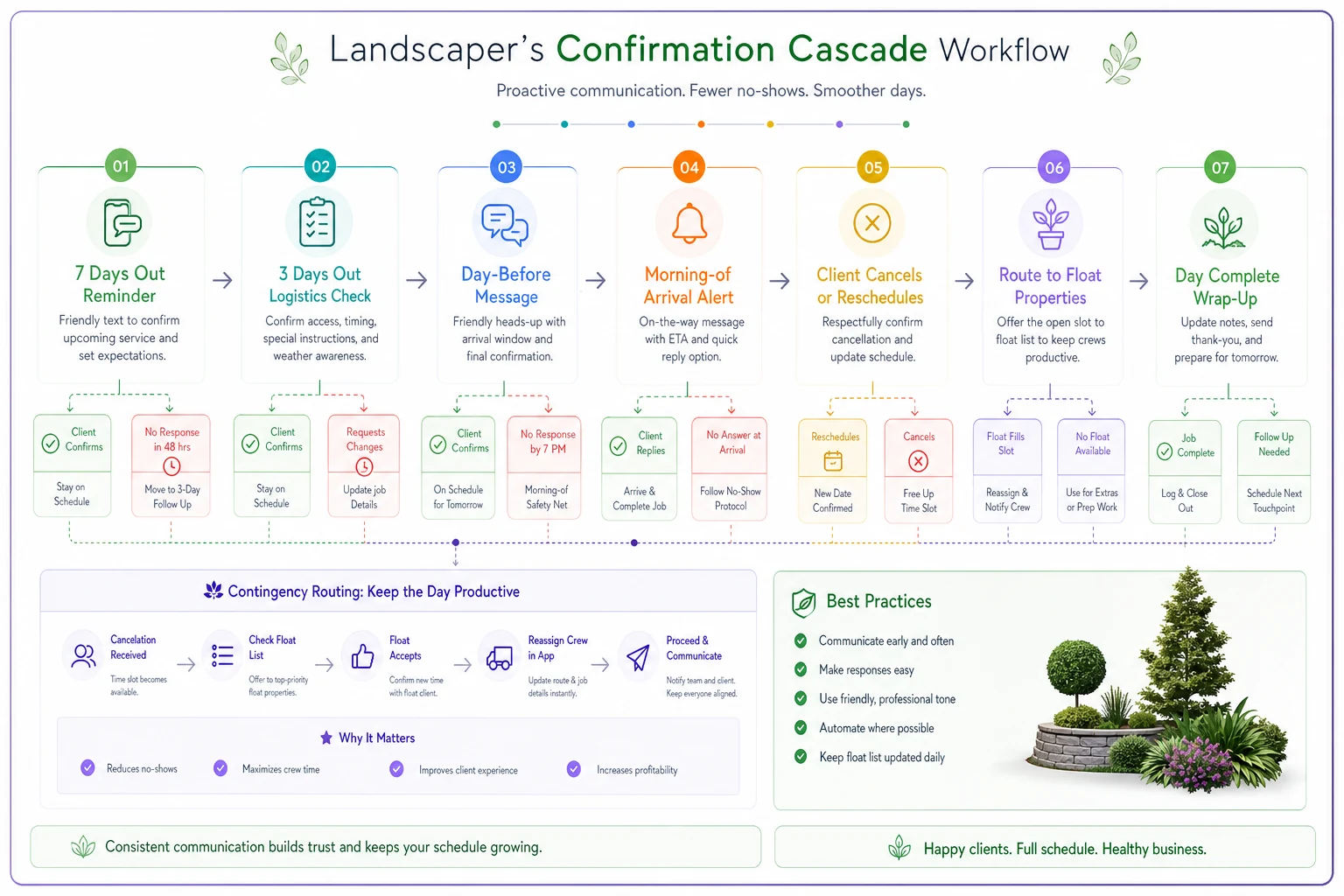
This image shows the sequence of touchpoints and the decision branches that trigger contingency routing when cancellations happen.
Scripts that reduce friction while maintaining boundaries
Confirmation frequency matters less than the wording. Wrong phrasing creates unnecessary friction or, worse, makes canceling feel like the path of least resistance.
Phone confirmations should assume the sale while allowing a graceful exit. Train your office team on something like this:
"Hi [Name], Sarah from [Company]. Calling about tomorrow's lawn service..." "[Brief pause]" "Weather's looking good, crew will be there in the morning. Anything special we should handle while we're there?"
If they hesitate or mention a conflict, pivot immediately to preservation:
"Sounds like tomorrow might be tight. Rather than skip this week and let things get overgrown, would Friday morning work? I can shift the route."
Never ask "Do you still want service tomorrow?" That question psychologically frames the service as optional. Your lawn needs cutting whether they're home or not.
For text confirmations, keep them short and action-oriented:
Three days out: "Thursday crew schedule confirmed. Gate code still 1234? Reply with any changes or concerns."
Day before: "Mowing your property tomorrow AM. Reply FRIDAY if you need us to shift one day, otherwise you're all set."
Morning of: "Crew heading your way in 30 min. Text WAIT if you need us to come back later today."
Each message offers an alternative instead of a cancellation. "FRIDAY" not "CANCEL." "WAIT" not "STOP." Small word choices that preserve the job.
The contingency routing system that saves your margins
Even a solid confirmation system won't stop every cancellation. What separates profitable landscaping companies from struggling ones is what happens in those first few minutes after the call comes in.
Build your routes with "float properties" — flexible commercial accounts or understanding residential clients who've agreed to variable scheduling. A shopping center that needs service "sometime this week" is golden when Tuesday morning falls apart. That retired client who "doesn't care when you come as long as it gets done" saves your Thursday afternoon.
Three categories of contingency work worth building out:
Instant pivots: Properties within 10 minutes of your current route that always have something to do. The office park where you can find edging work. The HOA common areas that could use detail attention. These keep crews moving without major transit time.
Upgrade opportunities: Clients already on today's route who've mentioned additional services. When the 10 AM cancellation comes through, call the 11 AM client: "We've got some extra time this morning. Want us to handle that mulch project we talked about? Can do it for 15% off since we're already there."
Maintenance banking: Clients willing to receive service earlier than scheduled. "Mr. Williams, we had a cancellation this morning. Can we knock out your Friday service today instead? You'd have a freshly cut lawn for the weekend."
Map three float properties per route ahead of time so your dispatcher can pivot instantly.
Map these before you need them. Every route should have three instant pivots identified, a couple of upgrade opportunities noted, and a handful of maintenance banking candidates within reasonable distance.
Low-friction terms that protect both parties
Your service terms shape how clients think about cancellations before any confirmation message is ever sent. Harsh fees create adversarial relationships. No policy at all trains clients to cancel freely whenever it's convenient.
Instead of punitive cancellation fees, use "rescheduling windows." Cancellations with less than 24 hours notice don't get a fee — they automatically reschedule to the next available slot, which might be 10–14 days out during peak season. Clients figure out pretty quickly that skipping at the last minute means an overgrown lawn, without you having to be the bad guy about it.
A "seasonal commitment" option adds another layer. Clients who commit to full-season service get a discount but agree to a service credit system. If they skip a week, the credit applies to fall cleanup or snow removal — they don't just get to pocket the savings. That removes the financial incentive to cancel without taking away flexibility.
For commercial properties, "weather banking" works well. If you can't service due to rain, that visit carries forward. If they cancel for their own reasons, the visit still counts against their monthly allocation. You're selling maintained properties, not individual grass-cutting events.
Technology that prevents the preventable cancellations
Manual confirmation calls and texts work, but they're inconsistent and labor-intensive. AI-powered operational software handles the entire confirmation cascade automatically while your team focuses on actually running jobs.
Better platforms track response patterns — Mrs. Henderson always replies to texts within an hour, the apartment complex only picks up the phone, the office park manager prefers email. The system adjusts confirmation method and timing based on what actually works for each client, not what you assume works.
Pattern recognition is where things get genuinely useful. When a client has cancelled twice on Thursdays, the system flags Wednesday or Friday as better scheduling options. When three properties in the same neighborhood cancel on the same day, it surfaces that as something worth looking into — maybe there's a local event you weren't aware of.
Automated contingency routing also takes pressure off your dispatcher when a cancellation hits. Instead of 20 minutes of calls and map-checking, the platform identifies nearby float properties, calculates drive time, estimates job duration, and surfaces the best pivot quickly. Rescheduling messages go out automatically with personalized options based on each client's history, so your office manager isn't rebuilding six schedules by hand.
The hidden patterns in your cancellation data
Your cancellation patterns tell a story — if you're actually tracking the right things. Most landscapers know their overall rate but miss the actionable patterns underneath.
Most landscapers know their overall rate but miss the actionable patterns underneath.
Track cancellations by:
-
Day of week
-
Time of notification
-
Client tenure
-
Service type
-
Neighborhood
-
Crew assigned
-
Weather conditions
-
Payment method
Patterns emerge quickly. Tuesday cancellations spike because that's trash day in certain neighborhoods. First-month clients cancel far more often than established ones. Properties over $75 per service rarely cancel while $35 cuts cancel constantly.
One company found their highest cancellation rate came from jobs scheduled between 2–4 PM — school pickup time. Another found that clients paying by check cancelled roughly twice as often as credit card customers. These aren't random correlations. They're operational signals that should drive scheduling decisions.
Build cancellation profiles for your client segments. High-end residential clients usually cancel for real conflicts and almost always reschedule. Rental properties sometimes cancel trying to dodge a payment. Commercial properties get unpredictable when the decision maker changes. Each segment needs a different confirmation approach and a different policy response.
| Client Segment | Cancellation Tendency | Best Confirmation Method | Policy Response |
|---|---|---|---|
| High-end residential | Low, usually reschedule | Phone or personalized text | Light touch, flexible rescheduling |
| Rental properties | Moderate, sometimes avoidant | Text with firm rescheduling window | Auto-reschedule, clear credit policy |
| Commercial (stable contact) | Low but unpredictable | Email or phone | Weather banking, monthly allocation |
| Commercial (changing contacts) | Higher risk | Phone confirmation + email follow-up | Written agreement, credit system |
| New residential clients | Highest rate | Full touch cascade | Rescheduling window, no punitive fee |
One company found their highest cancellation rate came from jobs scheduled between 2–4 PM — school pickup time. Another found that clients paying by check cancelled roughly twice as often as credit card customers. These aren't random correlations. They're operational signals that should drive scheduling decisions.
A real Thursday morning saved
Greenscape Landscaping runs four crews covering around 340 properties monthly. They were averaging 12–15 cancellations per week, creating chaos and costing somewhere around $3,200 monthly in lost revenue and idle crew time.
After implementing the touch cascade, rewriting their confirmation scripts, and setting up contingency routing, a Thursday morning that used to mean panic looked completely different.
Two cancellations came in at 7 AM — a residential client with a family emergency and a commercial property with a corporate event. The dispatcher immediately saw three float properties within eight minutes of the cancelled stops. The crew lead got updated routes on his phone. The automated system reached out to two clients about moving their Friday service to Thursday afternoon, and both said yes.
By 7:20 AM, the day was rebuilt. Crews never sat idle. Revenue for the day actually increased slightly because they upsold a mulch refresh to a client happy to get same-day service. The cancelled jobs got automatically rescheduled for the following week with confirmations already secured.
That's the difference between accepting cancellations as inevitable and building operations that absorb them without drama.
When aggressive confirmation backfires
Not every operation should run a multi-touch confirmation sequence. If you're running a smaller shop with longtime clients — especially older ones who've been with you for years — multiple touchpoints might actually damage those relationships. They hired you to handle their lawn, not manage their calendar.
High-end estate maintenance is different too. These clients expect you to show up as scheduled. Frequent confirmations can read as insecurity or unprofessionalism in that market. One confirmation to the property manager 48 hours out is usually enough.
New companies sometimes overcommunicate because they're afraid of any cancellation at all. That energy comes through in every interaction, and clients pick up on it. It can actually make them more likely to cancel, not less. Build your confirmation process from operational confidence, not anxiety.
The compound effect of consistency
Cutting cancellations isn't about one perfect system. It's about small improvements layering on top of each other. A better confirmation script shaves 2% off your cancellation rate. Contingency routing saves another 3%. Float properties recover a few more lost jobs. Suddenly you've cut your cancellation impact in half without any single dramatic change.
Most landscapers try one or two tactics and quit when nothing transforms overnight. The companies running at 2% got there by actually tracking what was working, refining timing based on real response data, testing different scripts with different client types, and building contingency options gradually as relationships developed.
Every cancelled appointment you prevent drops straight to your bottom line. Every idle crew hour you recover through smart routing adds capacity without adding cost.
The grass keeps growing whether your operations are smooth or chaotic — might as well be the company that captures that value consistently.
Ready to grow your landscaping business?
Join 2,000+ landscaping pros using Yardyly to save time, reduce task chaos, and deliver outstanding client results.