

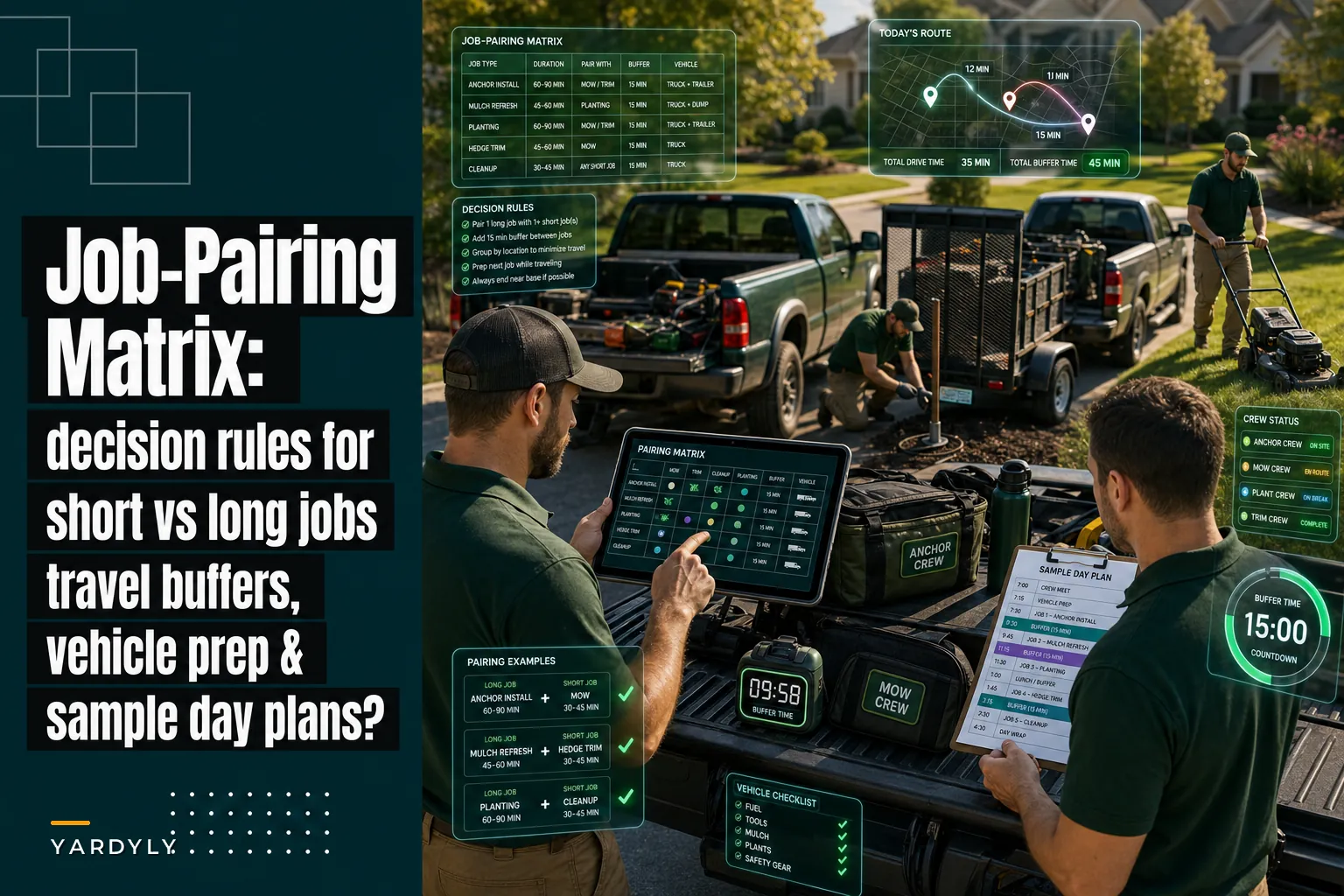

You know that feeling when you're staring at tomorrow's schedule trying to figure out if Johnson's mulch job can overlap with the Peterson weekly mow? Or whether sending half your crew to finish the Thompson edging while the other half starts at Garcia actually saves time — or just creates more headaches?
Most landscaping companies lose a couple hours every single day to poor job pairing. Not from breaks or lunch. Just from bad overlap choices that create gaps, double-backs, and crew confusion.
The real problem isn't overlapping jobs — it's doing it without clear pairing rules and travel buffers built into your schedule. Without those, you're basically gambling with your crew's productivity every single morning.
Why Traditional Block Scheduling Falls Apart
Traditional scheduling treats every job like a neat little block. Smith property: 9am–10:30am. Johnson property: 10:30am–12pm. Clean on paper. Completely unrealistic in the field.
Your crew finishes Smith at 10:10am. Now you've got 20 minutes of dead time. Or they run long and finish at 10:45am while Johnson's sitting there waiting.
The knee-jerk reaction is to start overlapping everything. Send Mike ahead to Johnson while the rest finish Smith. Sounds reasonable — until Mike realizes the blower's still at Smith, or he needs the crew leader to approve the hedge line, or any of the coordination problems that pop up when you split crews without thinking it through.
Block scheduling assumes perfect timing. Overlapping without rules assumes perfect coordination. Both fail for the same reason — they ignore how landscaping work actually flows on the ground.
The Hidden Cost of Bad Job Pairing
Picture a realistic Tuesday morning. Four-person crew, six properties. Two quick mows (25–30 minutes each), three full-service visits (mow, edge, blow — around 50 minutes), and one 2-hour mulch install.
Never miss a job detail again.
Yardyly helps you plan, confirm, and manage every landscaping project seamlessly.
- Centralized project scheduling
- Automated client updates
- Crew and resource management
No credit card required
Without pairing rules, your crew leader makes gut calls all day. Sometimes they work. Often they don't.
There was a crew running two properties on the same street — one needing just a mow, the other needing full service plus pruning. An obvious overlap opportunity. Split the crew, knock out both, move on.
Except the mow-only property had a locked side gate the homeowner forgot to leave open. Half the crew stood around for 15 minutes while someone drove back to handle it. The other half realized the pole pruner was still on the truck at the other property.
Total time lost: 35 minutes. Two jobs on the same street.
This kind of thing happens constantly without pairing protocols. The variance in landscaping work makes every overlap a potential efficiency trap. But the issue isn't the overlap itself — it's overlapping without understanding which job types actually work together and which ones create friction.
Building Your Job-Pairing Matrix
A job-pairing matrix isn't complicated. It's a compatibility chart for your common service types. But getting it right requires understanding both the work itself and the logistics around it.
Start with your service categories. Most landscaping companies run something like: quick mows (under 30 minutes, minimal equipment), full-service maintenance (45–60 minutes, standard equipment set), detail work (trimming, pruning, edging — variable time, specialized tools), installation or project work (2+ hours, heavy equipment, materials), and chemical applications (specific licensing, can't mix with other work).
| Primary Job Type | Good Pairing | Risky Pairing | Never Pair |
|---|---|---|---|
| Quick Mow | Other quick mows < 0.25 miles | Full service (only if different crew sections) | Chemical apps, irrigation repair |
| Full Service | Installation projects, quick mows | Detail work | Chemical apps |
| Detail Work | Other detail work same property | Quick mows | Installation, chemicals |
| Installation | Full service nearby | Detail work | Chemical apps |
| Chemical Apps | Only other chemical apps | Everything else | Everything else |
The matrix is just the starting framework. The real efficiency comes from understanding travel buffers and crew coordination requirements.
Travel Buffer Reality Check
Every landscaping company underestimates travel time. You think it's 5 minutes between Anderson and Baker because that's what Google Maps says. But Google Maps doesn't account for loading the last grass clippings, securing equipment, the crew stopping for water, waiting on whoever's always the last one back, a trailer getting stuck behind a school bus, or realizing you left the trimmer at the last stop.
Real transition time between jobs runs about 2.5x the actual drive time. A 5-minute drive becomes a 12-minute transition. This compounds when you're trying to overlap jobs.
Here's the framework that actually works:
Same-street overlap: Add 5 minutes buffer. Even next-door properties require crew coordination and equipment movement.
Quarter-mile radius: Add 8–10 minutes. One person driving while others finish, plus coordination time on both ends.
Half-mile to one mile: Add 15 minutes minimum. Split arrivals create real inefficiency at this distance.
Beyond a mile: Don't overlap. The coordination overhead eats whatever time you'd save.
Time real transitions between jobs for a week to set your buffer multiplier instead of assuming a fixed number.
The buffer isn't just drive time — it's the operational friction of moving a partially deployed crew and split equipment between locations.
Vehicle and Equipment Prep Protocols
This is where overlapping jobs scheduling gets genuinely tricky. When you split crews, you're also splitting equipment access. Without clear protocols, things fall apart fast.
Every overlap scenario needs a pre-flight checklist. Which truck goes where? Who has the backup trimmer? Where are the fuel cans? Who has the gate keys or codes? Is the blower charged? Who signs off on work completion?
Primary set (stays with crew leader):
-
Main mower
-
Primary trimmer/edger
-
Blower
-
Hand tools
-
First aid kit
-
Client paperwork
Satellite set (goes with split crew):
-
Backup mower or push mower
-
Secondary trimmer
-
Basic hand tools
-
Fuel can
-
Designated phone for photos/communication
The satellite set needs to be self-sufficient for the designated overlap work. It's not meant to handle everything — just the job it's assigned to.
The solution isn't duplicating all equipment — though some backup is smart. It's designating equipment sets specifically for overlap scenarios.
Sample Day Schedule with Overlap Decisions
Here's a real Tuesday schedule showing how pairing decisions actually work in practice:
Crew: 4 people, 2 trucks (one with trailer) Jobs: 7 properties, mixed service types
7:00 AM — Shop Load both trucks. Satellite truck gets push mower, backup trimmer, fuel. Review planned overlap points for the day.
7:30 AM — Depart Both trucks head to the first cluster — 3 properties within 0.3 miles of each other.
7:45 AM — Williams property (full service, 45 mins) Full crew starts together. Gate access confirmed, all equipment checked before anyone splits off.
8:15 AM — Overlap Point #1 2 crew with satellite truck to Nelson property (quick mow, 0.2 miles away). 2 crew finish Williams detail work. Decision rule triggered: properties under quarter-mile, one is a quick mow, no special requirements on either end.
8:30 AM — Regroup at Williams Nelson crew returns after roughly 15 minutes. Full crew wraps Williams and loads up.
8:45 AM — Travel to Chen property 8-minute drive, 12-minute buffer built in. Both trucks travel together — next overlap isn't until later.
9:00 AM — Chen property (installation, 2 hours) Full crew starts mulch installation. This becomes the anchor point for the next split.
9:45 AM — Overlap Point #2 2 crew take satellite truck to Ross property (full service, 0.4 miles away). 2 crew continue Chen installation. Decision rule: installation provides stable base, full service is within half-mile.
10:30 AM — Ross crew returns Installation continues with full crew. Final quality check and cleanup.
11:00 AM — Travel to afternoon cluster 15-minute drive. Lunch coordinated during travel.
11:30 AM — Mitchell & Park properties Same street, both full service. No overlap here — both properties need crew leader oversight. Done sequentially.
1:30 PM — Davis property (quick mow) Full crew, fast finish. No overlap needed at the end of the day.
2:00 PM — Return to shop
Total properties: 7. Overlap decisions made: 2. Time saved through overlaps: roughly 45 minutes. Both overlaps executed cleanly because each one followed predetermined rules.
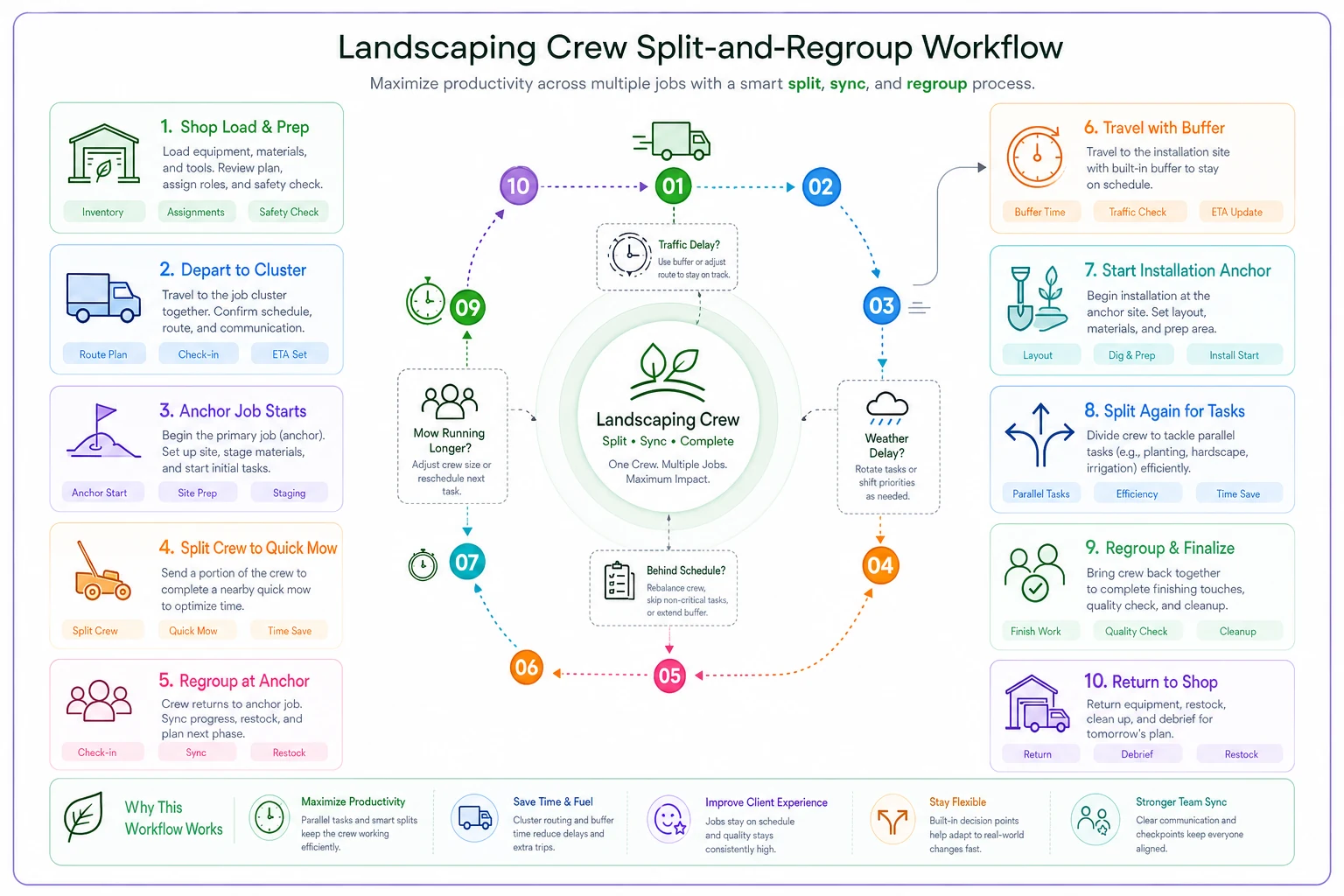
This workflow diagram shows the split-and-regroup steps used in the sample schedule.
That's the difference.
Decision Rules That Actually Work
Your crew leader shouldn't be running complex calculations at 8 AM. They need clear triggers — field-executable rules that don't require a lot of interpretation.
Rule 1: Distance Override Properties more than 0.5 miles apart don't get overlapped. Coordination cost exceeds the benefit at that distance.
Rule 2: Service Type Compatibility Only overlap combinations from the "good pairing" column of your matrix. No exceptions for "just this once."
Rule 3: Minimum Crew Size Never split below 2 people per location. Safety issue and an efficiency killer.
Rule 4: Equipment Sufficiency Both locations need to be serviceable with what's available. If crews need to share anything beyond basic hand tools, don't split.
Rule 5: Time Threshold Don't overlap jobs under 20 minutes. Setup and coordination time outweighs the work itself.
Rule 6: Communication Protocol A designated phone or radio at each location. No overlap without communication ability.
Rule 7: Weather Contingency Rain or heat advisory — no overlaps. Weather stress reduces coordination capacity across the board.
These aren't guidelines. They're guardrails that prevent the small failures that compound into lost hours by the end of the day.
Common Pairing Mistakes to Avoid
The worst pairing decisions usually seem logical at the time.
The "Same Street Means Easy" Trap Two properties on the same block doesn't automatically mean good overlap potential. If both need customer interaction, complicated access, or the same specialized equipment, you're setting yourself up for problems.
The "Quick Task" Delusion "Just run over and edge the Thompson's while we finish here" sounds simple. Until the Thompson's have that weird fence line, or their sprinklers are running, or the gate combination changed.
The End-of-Day Scramble Around 2 PM, the urge to overlap everything to finish faster gets strong. That's exactly when coordination mistakes compound. Tired crews make bad split decisions. Stick to your rules — especially in the last couple hours.
The New Property Gamble Never overlap on a property you haven't serviced before. Too many unknowns. Run it with a full crew, learn the property, then consider it for future overlaps.
When Overlapping Makes Everything Worse
Sometimes the right call is to not overlap at all.
Thursday afternoons in residential neighborhoods? Forget it. School pickup traffic turns 5-minute drives into 20-minute crawls. Carefully planned overlaps fall apart.
First service after heavy rain? Everything takes longer. Properties are muddy, equipment bogs down, grass clumps. Don't add coordination complexity to weather recovery days.
New crew members in their first few weeks? They're still learning basic workflows. Overlap coordination overwhelms them and frustrates your experienced people. Keep it simple until they're solid on fundamentals.
Properties with pets, pools, or play equipment also need full crew awareness. These are liability situations — split operations increase the chance something gets missed.
Building Your Custom Pairing System
Your operation isn't identical to anyone else's. The matrix and rules need to come from your actual data, not a template.
Track your failed overlaps for two weeks. Every time an overlap creates a problem, document what job types were involved, the distance between properties, what specifically went wrong, and how much time it cost. Patterns emerge fast. Maybe your crew handles detail work overlaps fine but struggles with split mowing routes. Maybe a quarter-mile works but anything more falls apart. Maybe certain crew combinations coordinate well and others don't.
Then calculate your buffers from real transitions. Time ten actual job transitions. Compare pure drive time to actual transition time. That ratio becomes your buffer multiplier. Most companies find their real buffer needs run 30–40% higher than estimated. Better to know the real number.
-
List your five most common job types
-
Time ten real transitions between each combination
-
Document every failed overlap for two weeks
-
Build your compatibility matrix from actual results
-
Set distance limits based on what your crew can realistically coordinate
-
Assign equipment to primary and satellite sets
-
Create a one-page rule sheet for crew leaders
-
Run a two-week pilot with your most experienced crew before rolling out to everyone
A pairing system that works for a crew in suburban Dallas might fail completely for a crew in rural Vermont — different property densities, different equipment, different dynamics. Build yours from what's actually happening in your operation.
The Technology Question
Manually planning overlapping jobs gets complex fast. You're tracking job types, distances, equipment locations, crew positions, and time buffers all at once.
This is where AI-powered operational software genuinely helps. Instead of your crew leader making gut calls at 8 AM, the system analyzes your job matrix, calculates real travel buffers, and flags optimal overlap points based on your actual operational patterns — not guesswork.
The better platforms learn from your history. That Martinez property that can never overlap on Tuesdays because of street cleaning? The system remembers. Certain crew combinations that consistently struggle with split operations? It factors that in when suggesting assignments.
Where it really earns its place is dynamic replanning. Customer cancels at 9 AM — does your planned overlap still make sense? Traffic accident blocks your afternoon route — how does that change your split strategy? A good AI-assisted scheduling platform recalculates all of that in real time instead of leaving your crew leader to figure it out on the fly.
That said, even without advanced software, implementing basic pairing rules and realistic buffer calculations makes a real difference. The key is having systematic criteria instead of winging it every morning.
Making It Stick
The best pairing matrix means nothing if your crew ignores it.
First week: Run overlaps only with your most experienced crew leader. Document everything — what worked, what didn't, what rules need adjusting. This becomes your training material.
Second week: Expand to other crews but only allow overlaps from the proven combinations with the highest success rates.
Third week: Full implementation with daily debriefs. Every overlap gets a quick 2-minute review at day's end. It builds the feedback loop that improves the system over time.
The pushback you'll hear: "We've always just figured it out as we go." True — and you've always lost hours to bad coordination too. Show them the actual time recovered from the first successful week. Real numbers land better than any policy document.
Track these weekly: jobs completed per day (before and after), overtime hours, customer complaints about timing, and crew stress levels — seriously, ask them. Most companies hit breakeven on the new system within two weeks. The ones that struggle usually tried to implement everything at once instead of rolling it out gradually.
Overlapping landscaping jobs scheduling isn't about working faster — it's about working smarter. The difference between chaos and coordination comes down to clear rules, realistic buffers, and knowing which jobs actually pair well together.
Your crew is already overlapping jobs. They're just doing it on gut feeling. Give them a framework and those random daily losses start disappearing.
Start small. Pick your two most common job types and figure out if they actually pair well. Time your real travel buffers. Build equipment sets that can operate independently. Build from what works, adjust what doesn't.
The landscaping companies doing well aren't always the ones with the fanciest equipment or the biggest crews. They're usually the ones who figured out how to get real efficiency from every hour without burning out their people. Smart overlapping is a big part of that.
Stop leaving your daily productivity to chance. Build the pairing system, implement the buffers, follow the rules. Your crew will thank you, your customers will notice, and your numbers will reflect it.
Ready to grow your landscaping business?
Join 2,000+ landscaping pros using Yardyly to save time, reduce task chaos, and deliver outstanding client results.