

Most landscaping owners don't ignore risk because they're careless. They ignore it because it's invisible until it isn't. Nothing's broken until a crew member backs a trailer into a client's garage, or a saw kickback sends someone to urgent care, or a commercial client's insurance department asks for your Certificate of Insurance and you realize your coverage lapsed two weeks ago. Compliance feels like paperwork that doesn't mow lawns, so it falls to the bottom of the pile until something forces it to the top.
The problem is that ignoring it doesn't stay cheap as you grow. A one-truck operation can get away with a handshake and a general liability policy. A six-crew operation running 40–50 properties a day has exposure stacking up in ways most owners never map out. More trucks on the road, more equipment, more subs, more client property to damage, more employees who can get hurt. Risk scales faster than revenue, and it compounds quietly.
This isn't a lecture about buying more insurance. It's a framework for building a lightweight risk and compliance system that fits a small fleet — something you can run without a safety officer, a compliance department, or a lawyer on retainer. The whole thing comes down to four pieces: a risk register, minimum insurance and contract standards, incident reporting your crews will actually use, and a quarterly audit you run yourself.
Why Risk Stays Invisible Until It Costs You
The pattern that shows up in small fleets goes something like this. The owner knows the business cold. They know which crew lead is reliable, which truck burns oil, which client is a pain about edging. All of that lives in their head. Risk management, in practice, is the owner's memory and judgment. And that works — right up until the operation gets big enough that the owner can't be everywhere.
What breaks first is usually the gap between what the owner assumes is happening and what's actually happening in the field. The owner assumes everyone wears eye protection on the trimmers. The owner assumes the new seasonal hire got briefed on the propane tank procedure. The owner assumes the sub pulling the stump job carries their own liability. None of those assumptions are written down, so none of them are verifiable, and all of them are one bad day away from becoming your problem.
A typical example: a four-crew operation lands a nice HOA contract worth around $90k a year. Six months in, a crew member hits a sprinkler head, then a buried low-voltage line, then — on a different visit — clips a resident's parked car with a mower-flung rock. Individually, small stuff. But the HOA board starts asking whether this contractor has their act together, and whether they're properly insured. Suddenly a profitable account is at risk not because of the work quality, but because there's no visible system showing the client that risk is being managed. The damage was never the real threat. The disorganization was.
For small landscapers, the biggest compliance risk usually isn't a catastrophic event. It's the slow accumulation of small, unlogged, unmanaged exposures that eventually land on a client's desk or an insurance adjuster's claim file — with no documentation to defend you.
The Risk Register: One Page That Replaces Your Memory
A risk register sounds corporate. It isn't. It's a single living document that lists the things that can go wrong, how likely they are, how bad they'd be, and who owns doing something about them. For a small fleet, this can literally be one spreadsheet tab. The point isn't to be exhaustive — it's to get risk out of your head and onto something the whole business can see.
Never miss a job detail again.
Yardyly helps you plan, confirm, and manage every landscaping project seamlessly.
- Centralized project scheduling
- Automated client updates
- Crew and resource management
No credit card required
The mistake most owners make when they first try this is treating it like a brainstorm of every possible disaster. You end up listing things so far-fetched the whole document starts feeling pointless, and then you abandon it. A useful register only tracks risks that are plausible and within your control to influence. Trailer hitch failures, yes. Act-of-God stuff, no.
Here's a realistic starting structure for a small landscaping fleet:
| Risk | Likelihood | Impact | Current Control | Owner | Review |
|---|---|---|---|---|---|
| Trailer/vehicle accident on route | Medium | High | DOT checks, driver vetting | Ops lead | Quarterly |
| Crew injury (trimmer, mower, chainsaw) | Medium | High | PPE policy, task training | Crew leads | Quarterly |
| Property damage (irrigation, cars, hardscape) | High | Medium | Pre-job walk, photo logging | Crew leads | Quarterly |
| Insurance lapse / expired COI | Low | High | Renewal calendar | Owner | Quarterly |
| Uninsured subcontractor on a job | Medium | High | Sub COI requirement | Owner | Per hire |
| Chemical/pesticide misapplication | Low | High | Applicator licensing | Owner | Annual |
| Lost or stolen equipment | Medium | Medium | Truck inventory checks | Crew leads | Monthly |
The value of this table isn't really the table. It's the "Owner" column. In most small operations, every risk silently belongs to the owner because nobody else was ever assigned. The moment you write a crew lead's name next to "property damage," the dynamic shifts — that person now has a reason to care about the pre-job walkthrough. Risk ownership is really about distributing attention, and attention is the scarce resource in a growing fleet.
One thing worth noting as you scale: the register should change as you add service lines. The day you start doing tree work, chemical applications, or hardscape installs, you've added entire new categories of exposure that your old register never accounted for. Any new service line should get a risk review before the first paid job, not after the first incident.
Minimum Insurance and Contract Standards (Keep It Boring)
Insurance is where small fleets either over-spend out of anxiety or under-cover out of denial. Neither is a system. What you want is a defined minimum standard — a baseline that every job, every sub, and every contract has to clear before work starts. Boring and consistent beats clever and inconsistent every time.
-
General Liability — the non-negotiable floor. Most commercial clients want to see $1M per occurrence / $2M aggregate. If your commercial contracts routinely ask for more, that's a signal, not an annoyance.
-
Commercial Auto — your biggest, fastest-moving risk is literally your trucks and trailers on public roads. A loaded trailer that comes loose is a catastrophic-tier event.
-
Workers' Comp — required in most states the moment you have employees, and the one most likely to get a small operation into real legal trouble if skipped.
-
Inland Marine / Equipment coverage — for the mowers, blowers, and specialty gear that live in trailers and walk off job sites.
-
Umbrella policy — once you're running multiple crews, this is cheap relative to the catastrophic scenarios it covers.
The contract side is where owners leave the most money and protection on the table. The single most common gap: no scope exclusions and no damage language. When a client claims your crew killed their prized Japanese maple that was already half-dead when you arrived, the contract is your only defense. Vague contracts turn every dispute into a judgment call, and judgment calls favor whoever's angrier.
Your minimum contract standard should spell out who's liable for pre-existing conditions, how change orders get approved, what happens with underground utilities you can't see, and your notification window for damage. None of this needs a lawyer to draft from scratch — but it does need to be consistent across every client, which is exactly where a standardized template library pays off. This ties directly into how you build your broader operational documentation, something worth tackling as part of a prioritized SOP playbook rather than as a one-off legal project.
When This Makes Sense (and When It Doesn't)
Solo operator doing residential mow-and-go? The full stack above is overkill — general liability and a clean contract template cover most of your real exposure. The moment you add a single employee, workers' comp stops being optional. The moment you take your first commercial contract, the insurance minimums stop being your choice and start being the client's requirement. And the moment you bring on a subcontractor, you inherit their risk unless your paperwork pushes it back onto them. The standards should scale with the operation, not sit at maximum from day one.
Incident Reporting Your Crews Will Actually Use
The uncomfortable truth about incident reporting in the field: if it takes more than two minutes, it won't happen. Crews are tired, it's hot, the truck's already loaded, and nobody wants to fill out a form about the sprinkler head they clipped. So they don't. And the first you hear about it is when the client calls three days later — angry — by which point you have no photos, no timeline, and no version of events except the client's.
The goal isn't a perfect report. It's any report, captured fast, at the moment it happens. What separates functional reporting systems from decorative ones is ruthless simplicity. A usable incident report for a landscaping crew needs maybe five fields:
-
What happened — one sentence, plain language.
-
Where and when — property address and time.
-
Who was involved — crew members, and whether anyone was hurt.
-
Photos — the single most valuable piece of evidence, taken immediately.
-
Immediate action taken — did they tell the homeowner, shut off water, flag the area?
That's it. Everything else is follow-up the owner or ops lead handles later. The mistake owners make is building a reporting process designed for their convenience — categorized, tagged, neatly filed — instead of the crew's. If the crew won't use it, how good the form looks doesn't matter.
There's a cultural piece here that's easy to miss. If every incident report triggers a chewing-out, you've just taught your crews that reporting equals getting yelled at, and they'll stop reporting. The near-miss — the thing that almost happened — is often more valuable than the actual incident, because it tells you where the next real one is coming from. You want crews reporting the chainsaw that kicked back but didn't connect. That only happens if reporting feels safe. The data you get from a no-blame reporting habit is worth more than the satisfaction of assigning fault.
Treat near-miss reports as talking points in your ops huddle so crews see reporting as helpful, not punitive.
Incidents and near-misses should surface in your regular team check-ins rather than disappearing into a folder. Reviewing the week's reports as a standing item in your weekly ops huddle turns isolated events into patterns you can actually act on — three sprinkler hits on the same route means that route needs a utility map, not three separate scoldings.
The Quarterly Audit You Can Actually Run
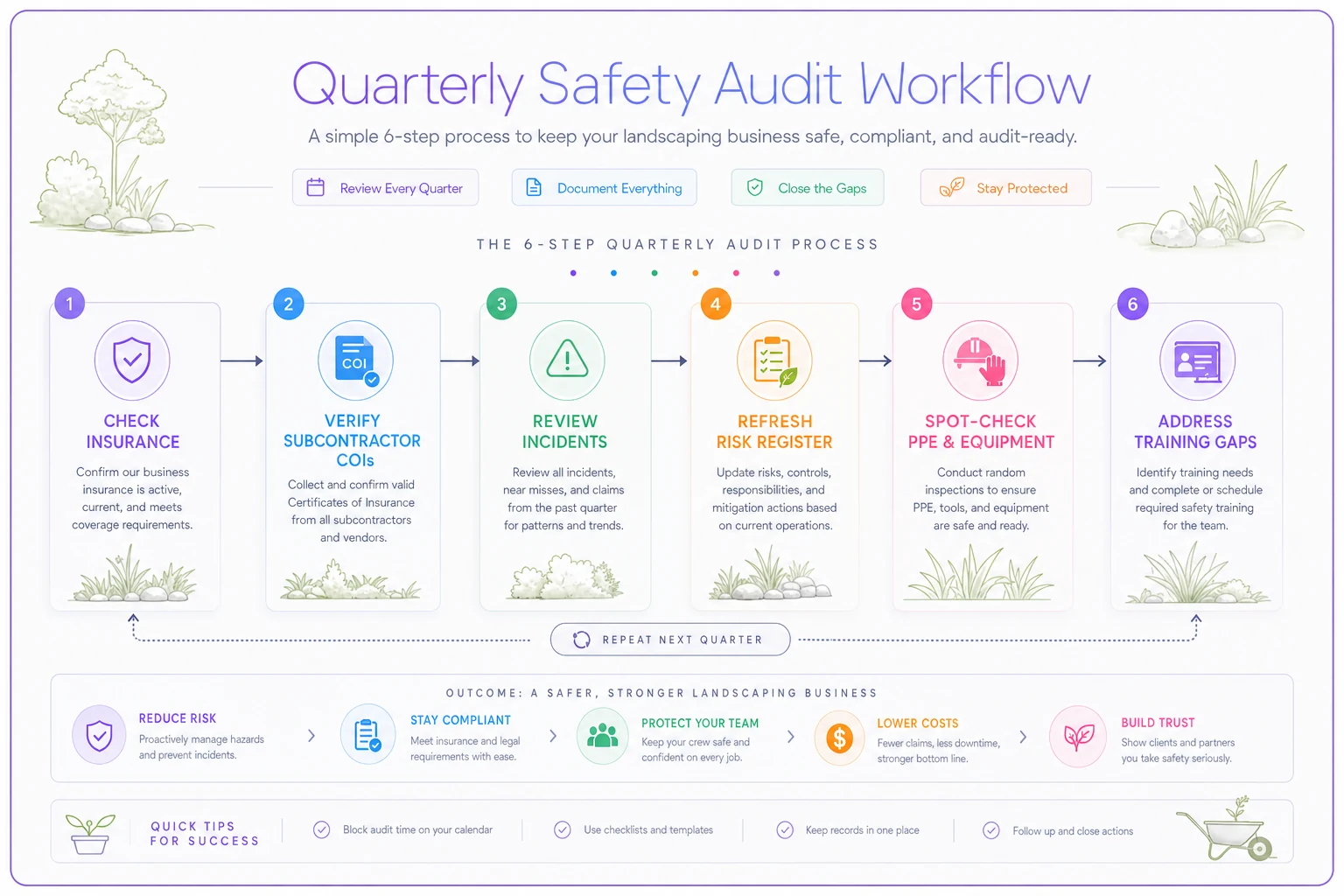
Annual compliance reviews fail small fleets because a year is long enough for everything to drift. Policies lapse, new hires never got the safety briefing, the sub's insurance expired in March and nobody noticed. A quarterly cadence is short enough to catch drift before it becomes a claim, and light enough that you'll actually do it. Four times a year, a couple hours each, run by the owner or ops lead.
-
Insurance check — pull every active policy. Confirm nothing's within 30 days of lapsing. Confirm coverage still matches what your biggest contracts require.
-
Sub and vendor COIs — every subcontractor you've used this quarter: is their insurance current and on file? Expired COIs silently transfer liability right back to you.
-
Incident review — read every incident and near-miss report from the quarter. Look for patterns: same route, same equipment, same crew, same type of damage.
-
Risk register refresh — walk the register. Did anything change in likelihood or impact? Did you add a service line? Did a control you relied on stop working?
-
PPE and equipment spot-check — are safety guards intact, fire extinguishers charged, first-aid kits stocked in every truck? This is the stuff that looks fine until the day you need it.
-
Training gaps — did every new hire this quarter get the safety basics, or did someone slip through during the busy season?
This flow visualizes the quarterly audit steps.
Quarterly Audit Checklist
-
All insurance policies current, none lapsing within 30 days
-
Coverage levels still meet active commercial contract requirements
-
Every active subcontractor's COI on file and valid
-
All incident/near-miss reports reviewed for patterns
-
Risk register reviewed and updated for new service lines or changed exposures
-
PPE present and functional in every truck
-
First-aid kits and extinguishers stocked and in-date
-
New hires confirmed to have completed safety onboarding
-
Any repeat incident locations flagged for a procedural fix
Most of what causes serious problems for small landscapers isn't the dramatic accident. It's the boring lapse — the expired policy, the uncovered sub, the safety guard someone removed because it was annoying. The quarterly audit exists to catch those before they get expensive.
A Real Scenario
A five-crew maintenance and install company running around $1.2M in annual revenue had no real risk system — just the owner's memory and a stack of PDFs buried in an email folder. Over one summer they took three property-damage hits: a cracked driveway from a skid steer, a damaged irrigation controller, and a fence post knocked loose by a crew vehicle. Total out-of-pocket to make clients whole came to somewhere around $4k–$5k, plus the softer cost of two clients who didn't renew because they'd lost confidence.
The fix wasn't dramatic. They built a one-tab risk register, set a minimum insurance and contract standard, put a five-field incident form on the crews' phones, and started running a two-hour quarterly audit. The biggest surprise came from the incident data itself — within one quarter it was obvious that two of the three summer incidents traced back to the same crew rushing to hit an unrealistic daily route. That wasn't a safety-culture problem. It was a scheduling problem showing up as property damage.
By the next season, damage claims dropped to roughly one minor incident per quarter. More valuable long-term: when a commercial prospect asked how they managed risk and liability, the owner had an actual answer. That answer helped close a contract worth more than the entire system cost to run. Compliance stopped being pure overhead and started being something they could point to.
Keeping It All Connected as You Grow
The four pieces only work because they feed each other. Incident reports populate what you learn in the quarterly audit. The audit updates the risk register. The register tells you where your insurance and contract standards have gaps. Your contracts and insurance define what the crews are responsible for reporting. Pull one piece out and the others get weaker. Run them as a loop and the whole thing gets smarter every quarter.
What changes at scale is the owner's role. In a one-truck operation, the owner is the risk system. In a six-crew operation, the owner's job is to maintain the system that manages risk without them standing on every job site. That shift — from doing the risk management to owning the system that does it — is the thing most owners delay too long. They keep trying to hold it all in their head right up until the business outgrows their memory, and that day always arrives faster than expected.
None of this requires a safety department or a compliance consultant. It requires a register you'll keep updated, standards you won't bend on, a reporting habit your crews trust, and a quarterly block on the calendar you treat as non-negotiable. Keep it boring, keep it consistent, and the risk that used to live in your head becomes something the whole operation can see, manage, and prove.
Ready to grow your landscaping business?
Join 2,000+ landscaping pros using Yardyly to save time, reduce task chaos, and deliver outstanding client results.