


Most landscaping owners who finally sit down to build SOPs make the same wrong first move — they open a blank doc and try to write down everything. Mowing patterns, edging technique, how to load the trailer, how to answer the phone, how to fold the tarps. Three weekends later they've got 40 half-finished pages, nobody's reading them, and the business runs exactly the way it did before.
The problem isn't effort. It's sequencing. When you have three or four crews and you're trying to standardize, the question that matters isn't "what should we document?" It's "which procedure, if it's inconsistent right now, is bleeding the most money, causing the most callbacks, or creating the most owner-dependency?"
That's what a prioritized SOP library actually is. Not a binder. A ranked map of where standardization pays back fastest — and a training rhythm light enough that crews actually absorb it during a busy season instead of during some fantasy off-week that never comes.
Why SOP projects stall in multi-crew operations
There's a pattern almost every landscaping business hits around three crews. When you had one crew, you were the SOP. You rode along, fixed things on the spot, and consistency came from your physical presence. The work looked the same because you were standing there.
Add a second and third crew and you physically can't be everywhere. Now the "system" is whatever each crew lead remembers from their own training — which came from their crew lead, who learned it two seasons ago and half-forgot the details. You end up with three different versions of the same job. Crew A blows out the beds first, Crew B mows first, and the property looks different depending on who showed up. The client notices. The callbacks start.
SOP projects stall not because owners don't understand the value, but because the project feels infinite — so it never gets a real start date. And when it does start, it usually starts in the wrong place. With the easy, visible stuff like how to load the trailer, instead of the expensive, invisible stuff like how to scope a job before quoting it, or how to hand off a property between crews mid-season.
Worth sitting with: the procedures that cause the most financial damage are almost never the ones that feel urgent. Nobody's yelling about your inconsistent property walkthrough. They're yelling about a broken sprinkler head. But the walkthrough is what would've caught the sprinkler head before you damaged it.
The operational priority map: what to standardize first
Before you write a single procedure, you rank them. The ranking is what turns a hopeless documentation project into a two-week sprint that actually changes how the business runs.
Never miss a job detail again.
Yardyly helps you plan, confirm, and manage every landscaping project seamlessly.
- Centralized project scheduling
- Automated client updates
- Crew and resource management
No credit card required
Score every candidate procedure on four things:
-
Cost of a mistake — What does one screw-up here actually cost? A mis-scoped install can cost thousands. A crooked mulch edge costs a re-do and some pride.
-
Frequency — How often does this task happen across all crews per week? High-frequency tasks compound tiny inconsistencies into big ones fast.
-
Owner-dependency — Does the business slow down when you aren't available to answer the question? Anything you personally get called about repeatedly is a priority.
-
Handoff risk — How many people or crews touch this? Anything that passes between people is where errors hide.
Add those up, rank them, and you get your build order. Here's how that typically shakes out for a multi-crew maintenance-and-install operation:
| Procedure | Mistake Cost | Frequency | Owner Dependency | Handoff Risk | Priority Tier |
|---|---|---|---|---|---|
| Pre-quote site scoping | High | Medium | High | Medium | Tier 1 |
| Property-to-crew handoff | Medium | High | High | High | Tier 1 |
| End-of-job quality check | Medium | High | Medium | Medium | Tier 1 |
| Equipment pre-trip inspection | High | High | Low | Low | Tier 2 |
| Client communication on scope changes | High | Low | High | Medium | Tier 2 |
| Trailer loadout / gear staging | Low | High | Low | Low | Tier 3 |
| Mowing pattern by property type | Low | High | Low | Low | Tier 3 |
This visual shows the prioritization-to-training workflow.
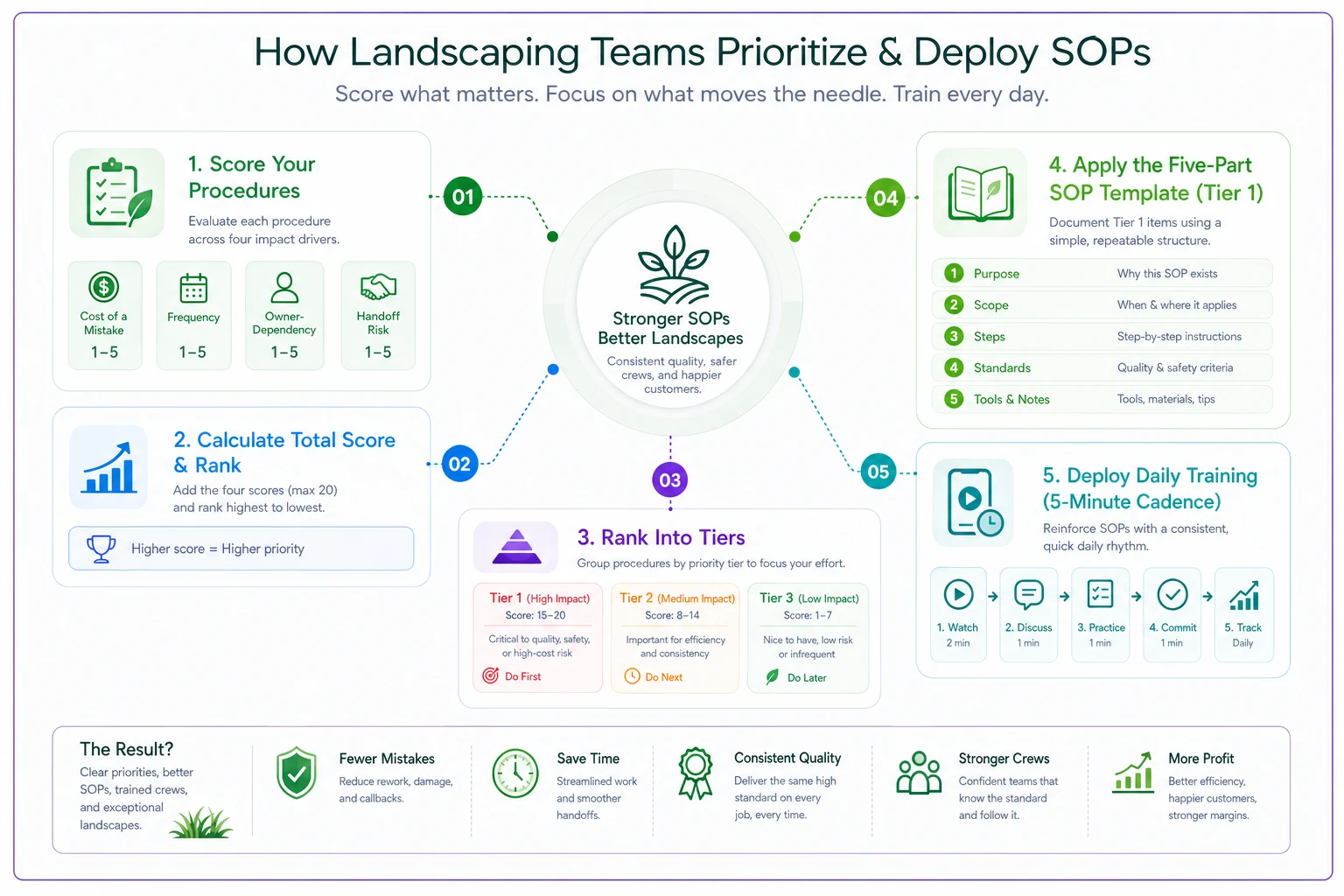
Notice what's Tier 1 and what isn't. The stuff owners feel like documenting first — loadout, mowing patterns — lands in Tier 3. High-frequency, but low mistake-cost, and it self-corrects fast because crews see the result immediately. The Tier 1 items are the quiet ones: scoping, handoffs, and the final quality check. Those are where money leaks and where you personally get pulled back into the weeds.
The three Tier 1 procedures almost every crew gets wrong
Pre-quote site scoping is Tier 1 because a bad scope poisons everything downstream. If the person quoting misses that the backyard has no gate wide enough for the mini-skid, you've priced a job you can't do efficiently and now you're eating the difference. Standardize what gets photographed, measured, and flagged before a number gets attached.
Property-to-crew handoff breaks constantly at scale. Crew A serviced a property for two months, learned where the dog gets out and which bed the client is precious about — then Crew A gets reassigned and Crew B walks in blind. The knowledge lived in someone's head, not in a record. This is the single most under-documented procedure in multi-crew shops, and it's not close.
End-of-job quality check is what stops callbacks before they start. Not a vague "make it look good" — an actual short checklist the crew lead runs before leaving. Two minutes of standardized checking saves a 40-minute return trip.
Building SOPs that crews will actually use
A procedure nobody follows is worse than no procedure, because it gives you false confidence. The failure mode here is writing SOPs like legal documents — dense paragraphs, exhaustive detail, a tone that assumes the reader has 20 minutes and a quiet room. Field crews have neither.
Good field SOPs share a few traits:
-
One screen, one task. If it doesn't fit on a phone screen, it's too long for the field.
-
Photos over prose. A picture of a correctly edged bed beats three sentences describing it.
-
Decision points, not just steps. The real value is telling crews what to do when the situation isn't standard. "If the irrigation zone won't shut off, do X and text the lead" is worth more than another step about mowing direction.
-
A clear escalation line. Every SOP should end with who to call and what to tell them when something's off.
Here's a plug-and-play structure for a field-task SOP that works across almost any procedure:
-
Trigger — When does this get done? ("Every property, before crew leaves.")
-
Who owns it — One named role, not "the crew."
-
The steps — Five to eight max, each one action.
-
The check — What does "done right" look like? Include a reference photo.
-
The exception path — What to do when something's off, and who to notify.
Keep the SOP photo and check in the same field platform so crews see it at job time.
That five-part skeleton is your template. Copy it for every Tier 1 procedure first, then work down the tiers. The consistency of the format is half the battle — crews stop having to relearn how to read each SOP every time they open one.
The low-effort training cadence
Documentation without a training rhythm just creates a graveyard of unread files. But "training" doesn't mean pulling crews off the truck for a classroom afternoon. In a real season, that afternoon never comes.
The cadence that actually sticks is small and frequent:
-
One SOP per week, five minutes at morning staging. The crew lead walks through a single procedure while gear is being loaded. That's it. Over a season you cover 20-plus procedures without losing a single billable hour.
-
A quick field confirmation. Later that same week, the lead spot-checks that the procedure got followed on an actual property. Reinforcement beats repetition.
-
Rotate, don't cram. Cover Tier 1 first, then cycle through Tier 2 and 3. Revisit Tier 1 at the start of the next season when you've got new seasonal hires coming in blind.
The mistake most owners make with training is treating it as an event instead of a drip. An event gets forgotten in a week. Five minutes at the truck, tied to something the crew already does, becomes muscle memory over a season.
This is also where keeping SOPs in a single accessible place matters more than what format they're written in. If the procedure lives in a shared doc nobody can find on a phone at 6:45am, it doesn't exist. A lot of crews now keep their SOP library inside the same field platform they use for job details and photos — open the job, the relevant procedure is right there, not buried in a folder somewhere. The point isn't the software. It's that the procedure shows up at the moment of the task, not the moment of training.
When this makes sense — and when it doesn't
When a prioritized SOP build is worth it: You're at two or more crews, you're getting callbacks you can't trace to a single person, and you personally get interrupted several times a day with questions you've already answered before. That last part is the clearest signal. Every "hey boss, quick question" is a missing SOP.
When it's a bad idea to over-invest: If you're still a solo operator or a single tight crew, don't burn weekends documenting. Your physical presence is a cheaper, faster SOP than any binder. Build the scoping and quoting procedures early because those protect margin, but hold off on documenting every field task until you actually have people to hand them to.
Who should not start here: If your business is bleeding cash from something structural — underpricing every job, or route density so bad you're losing hours in windshield time — fix that first. SOPs standardize a process; they don't fix a broken one. Standardizing an unprofitable workflow just makes you consistently unprofitable.
A real scenario
A maintenance-and-installs operation running four crews, doing somewhere around $1.4M a year, kept getting the same complaint: property quality swung depending on which crew showed. Callback rate was sitting around 9-10% of recurring visits, and the two owners were spending most of their mornings on the phone answering the same handful of crew questions.
They didn't build a binder. They ran the priority map, picked three Tier 1 procedures — pre-quote scoping, the crew-to-property handoff, and the end-of-job quality check — and wrote each one on the five-part skeleton. Then they ran the five-minute morning cadence, one procedure per week, for about six weeks.
Nothing dramatic happened in week one. By the end of the season, callbacks on recurring properties had dropped to roughly 4-5%. The bigger change was quieter: the owners stopped getting the repeat "which bed does this client care about" calls, because that knowledge now lived in the property handoff record instead of in one crew lead's memory. They estimated they got back close to an hour each morning. Not a revolution. Just the business finally running without both of them holding it together by hand every day.
The system underneath all of it
SOPs, priority mapping, and training cadence aren't three separate projects — they're one system. The priority map tells you what to build. The five-part template controls how it's written. The drip cadence controls whether it sticks. Skip any one and the other two underperform. A great SOP nobody trains on is wasted, and great training on the wrong procedures just standardizes trivia.
The real shift for a growing landscaping business isn't having documented procedures. It's moving the operation's knowledge out of your head and out of individual crew leads' heads, and into a place the whole team can reach when they need it. That's what lets you add a fifth crew without adding a fifth version of how the work gets done.
Start with the three Tier 1 procedures, keep the format boring and consistent, and let the five-minute morning habit do the heavy lifting over the season. Standardization doesn't happen in a weekend marathon — it happens in the quiet accumulation of getting the same important things right, crew after crew.
Ready to grow your landscaping business?
Join 2,000+ landscaping pros using Yardyly to save time, reduce task chaos, and deliver outstanding client results.