



The dangerous jobs aren't the small ones. Nobody goes broke waiting on a $600 mow-and-blow invoice. The jobs that quietly wreck a landscaping company are the big installs — retaining walls, paver patios, full-yard renovations, irrigation-plus-planting packages — where you've fronted $15k in materials and labor before the client has paid you a dollar past the deposit.
That gap between what you've spent and what you've collected is where most installers get burned. A homeowner disputes the plant selection halfway through. A commercial client "waits for the next AP cycle." A change order balloons the scope and suddenly the payment schedule you agreed on doesn't match the work anymore.
This post is narrowly about one thing: building payment plans for landscaping projects that protect your cash position on large installs. Deposit rules, installment templates tied to real milestones, the documentation you need before you release the next phase, and a collections escalation sequence that actually works. Not general invoicing — we've already covered invoicing mistakes that kill cash flow for smaller recurring work. This is the install-specific version, where the numbers are bigger and a single bad job can eat a whole quarter.
The core problem: your cash-out curve and your cash-in curve don't match
On an install, your spending is front-loaded. Materials get ordered and paid for early. Your best crew is on site for two weeks straight. Equipment rental, dump fees, subcontractor deposits — all of that hits in the first half of the job.
But if your payment plan is "30% deposit, 70% on completion," your cash-in is back-loaded. You've spent 60–70% of the job cost before you've collected past that first 30%. On a $40k install that means you're carrying somewhere around $18k–$24k of exposure at peak, right when you're most vulnerable to a dispute or a slow-paying client.
The fix isn't complicated, but it requires discipline: your payment schedule should roughly track your spending schedule. You want to be collecting money at roughly the same rate you're laying it out, so your exposure at any given point stays manageable. When the two curves match, a payment problem stays a small problem instead of becoming a company-threatening one.
Deposit rules that actually cover your early costs
A "standard 30% deposit" is a habit, not a rule. The right deposit number depends on your material-to-labor ratio — not on a round percentage that just sounds reasonable.
Never miss a job detail again.
Yardyly helps you plan, confirm, and manage every landscaping project seamlessly.
- Centralized project scheduling
- Automated client updates
- Crew and resource management
No credit card required
The pattern that keeps installers safe: your deposit should cover your non-refundable material costs plus mobilization, before you order anything. If a job has heavy hardscape materials — pavers, base stone, block — your material spend might be 45–55% of the total contract. A 30% deposit doesn't even cover the pallets sitting in the client's driveway.
A practical way to set the deposit:
-
Material-heavy jobs (hardscape, retaining walls, large planting) deposit = full material cost + 10% mobilization. Often lands around 40–50% of contract value.
-
Labor-heavy jobs (grading, cleanup, irrigation without major fixtures) 30–35% is usually fine because your exposure builds more gradually.
-
Custom-order or specialty items (specimen trees, imported stone, custom fabricated features): collect 100% of that specific line item up front, separate from the base deposit. Nobody eats a $2,800 special-order Japanese maple that the client walks away from.
The mistake that comes up over and over is treating the deposit as "goodwill money" instead of "cost coverage." A deposit exists to make sure that if the job collapses tomorrow, you're not out of pocket. If your deposit doesn't cover what you've already spent by the time the crew shows up, it's set too low.
Milestone installments: tie every payment to a physical, verifiable event
The best installment schedules aren't tied to dates or percentages of time elapsed. They're tied to things a client can walk outside and see. This matters because a milestone tied to visible completion is much harder to dispute than "50% due at midpoint."
Here's a sample template for a mid-sized paver patio and planting install (roughly $35k–$45k range):
| Milestone | Trigger event | % of contract | Purpose |
|---|---|---|---|
| Deposit | Contract signed, before material order | 40% | Covers materials + mobilization |
| Base complete | Excavation + base stone compacted, inspected | 25% | Covers heavy labor + equipment phase |
| Hardscape set | Pavers laid, edging installed | 20% | Covers the bulk of visible install |
| Planting + finish | Plants in, grading, cleanup done | 10% | Near-completion |
| Final | Walkthrough signed, punch list cleared | 5% | Retention/quality holdback |
Notice the small final payment. A 5% holdback is enough to motivate you to finish the punch list, but small enough that the client can't use it as leverage to withhold a large sum over a minor complaint. When your final payment is 30–40% of the job, every tiny quibble becomes a five-figure standoff. When it's 5%, the client has already paid you 95% and there's no real financial incentive to drag things out.
For larger commercial installs that run 6–10 weeks, add more milestones rather than bigger ones. Break it into 6–8 smaller draws so the exposure never gets large. This is the same milestone-terms thinking that keeps commercial bids clean — a paper trail that everyone agreed to before work started.
When milestone billing isn't worth it
Milestone schedules add admin overhead. On a two-day install under $6k, splitting into four draws isn't worth the hassle — a deposit and a completion payment is fine. Milestone billing earns its keep when a job runs long enough that your exposure would otherwise build past what you're comfortable carrying. A rough line: if peak exposure on a simple deposit/completion split would exceed around $8k–$10k, break it into milestones.
Documentation: what you need before releasing each phase
This is the part most installers skip, and it's exactly what protects you in a dispute. Each milestone payment should be paired with proof that the milestone was actually reached — not for the client's benefit, but for yours, when someone later claims the base was never compacted or the drainage wasn't installed.
Documentation checklist per milestone:
-
Dated photos of the completed phase (wide shot + close-ups of the specific work)
-
A one-line written confirmation from the client acknowledging the phase is complete (text or email is fine)
-
Copy of the milestone invoice sent, with the trigger event named on it
-
Any change orders signed before the affected milestone, not after
-
For buried work (base, drainage, irrigation lines) — photos before backfill, always
That buried-work rule is the one people learn the hard way. Once the base is covered, you cannot prove it was done right. A homeowner who gets cold feet about the final payment will absolutely claim the base wasn't put in properly. Photos with a timestamp end that argument in about ten seconds.
Always photograph buried work before backfill with a visible timestamp or reference object.
Change-order timing matters just as much. If scope grows and you don't paper it and reprice it before you do the work, you've effectively agreed to do it for free — the original payment plan doesn't cover it, and now you're asking for more money after the fact. That's the weakest possible negotiating position. Getting the takeoff right up front helps too; if your original estimate missed hidden costs that eat into install margins, there's a temptation to slip them into the job quietly rather than write a proper change order. Don't. Reprice it in writing.
The collections escalation sequence
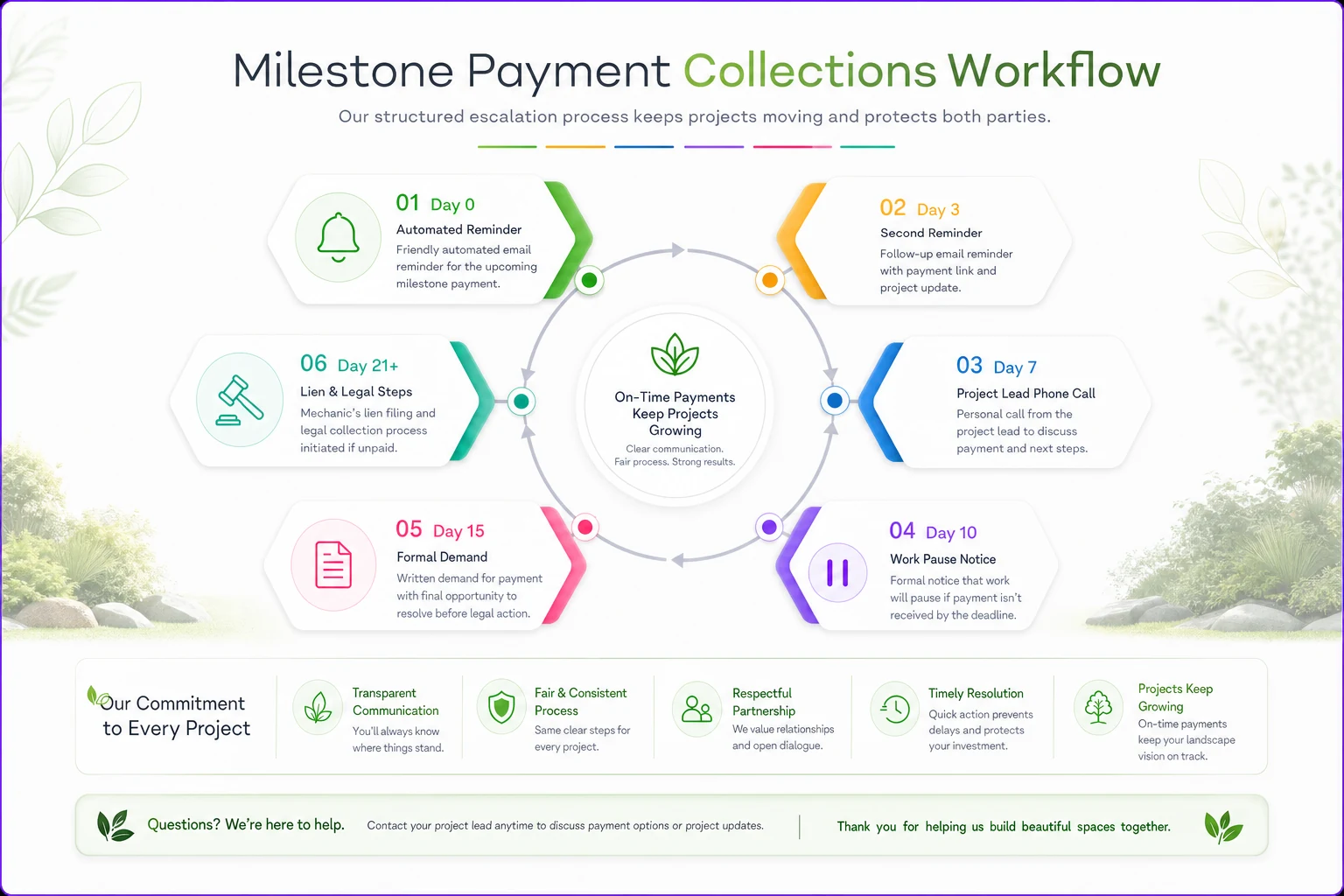
Even with good deposit rules and milestone billing, some payments will go late. The difference between installers who get paid and those who end up writing off invoices isn't luck — it's having a sequence they follow the same way every time, rather than avoiding the uncomfortable conversation until it's 60 days out.
-
Day 0 (due date) Automated reminder goes out the morning the payment is due. Friendly, factual: "Payment for [milestone] is due today, here's the link." No emotion. Most late payments are just forgetfulness.
-
Day 3 Second reminder. Slightly firmer but still administrative in tone. Reference the specific milestone and the photos/confirmation already on file.
-
Day 7 A phone call from the project lead — not an email. This is the point where you find out if it's forgetfulness or an actual problem. If there's a complaint hiding behind the non-payment, you want to surface it now, before you've done more uncollected work.
-
Day 10 Work pause notice, in writing. Per your contract, work stops when a milestone payment is 10+ days overdue. This is the single most important lever you have on an install — the client's unfinished yard is your leverage. Never keep working through a missed milestone. That's how you turn a $7k overdue draw into a $20k write-off.
-
Day 15 Formal written demand with a clear deadline and stated next step (lien filing, collections, whatever your contract and state allow).
-
Day 21+ Preliminary lien notice or mechanic's lien filing, depending on your state's deadlines. Know these deadlines before you need them — many states have a hard window (often 60–90 days from last work) after which you lose lien rights entirely.
Here's a simple visual of the collections escalation sequence.
The rule that ties this whole sequence together: work stops when payment stops. Written into the contract, explained at signing, enforced without exception. The installers who get burned are almost always the ones who kept the crew on site "to keep the client happy" while a milestone sat unpaid.
A real scenario
A hardscape-focused crew in the Midwest, doing around 25–30 large installs a year, kept getting squeezed on cash. Their standard terms were 30% down and 70% on completion. On a typical $38k patio job they were carrying around $20k of exposure at peak, and two or three times a year a final payment would drag out 45–60 days while a homeowner nitpicked the punch list.
They switched to a four-milestone schedule with a 45% deposit on material-heavy jobs and a 5% final holdback. They also added the buried-work photo rule and a hard work-pause clause at 10 days overdue.
The impact wasn't dramatic — no overnight transformation. Peak exposure on their typical job dropped to roughly $7k–$9k, and the punch-list standoffs mostly went away because the amount clients could withhold at the end was now small. They still had a couple of slow payers, but a slow payer on a 5% final balance is an annoyance, not a cash crisis. Just a business that stopped funding its clients' projects with its own money.
Where software quietly helps
None of this requires software. You can run milestone billing off a spreadsheet and a folder of dated photos. But once you're doing more than a handful of large installs at a time, tracking it all by hand gets messy — which milestone is each job at, which reminder has gone out, whether the phase photos are attached, where each unpaid draw sits in the escalation sequence.
An operational platform earns its place here. When milestone triggers, invoice reminders, and the day-0-through-day-21 collections sequence run through automated workflows, you stop relying on someone remembering to send the day-3 nudge or make the day-7 call. The system fires reminders on schedule, flags jobs where a payment is blocking the next phase, and keeps photo documentation attached to the right milestone. It doesn't collect the money for you — but it makes sure nothing slips through the cracks during the two weeks when your crew is heads-down on site and nobody's watching accounts receivable.
Pulling it together
Large installs put more of your cash at risk than any other work you do, and the payment structure is what determines whether that risk stays manageable or becomes company-threatening. Match your payment schedule to your spending schedule. Size the deposit to cover real material costs, not a habitual percentage. Tie each installment to something the client can see, document every phase before you cover it up, and enforce the work-pause clause without exception when a milestone goes unpaid.
Do that consistently and the scary jobs stop being scary — because you're never more than one small milestone away from being paid up.
Ready to grow your landscaping business?
Join 2,000+ landscaping pros using Yardyly to save time, reduce task chaos, and deliver outstanding client results.