



Cash flow crashes happen in predictable patterns for landscaping companies. The spring installation goes perfectly, the client loves everything, then three months later you're still chasing a $4,800 payment while fronting payroll for next week's jobs. Or worse — that commercial property you service twice weekly suddenly disputes six weeks of invoices because someone forgot to document a gate code change back in May.
Companies that maintain healthy cash flow don't just send invoices faster or call clients more often. They build a complete billing lifecycle that anticipates problems before money gets stuck. They structure deposits to cover real costs, trigger milestone invoices at the right operational moments, and handle disputes with specific timelines and escalation paths.
Most invoicing advice focuses on getting paid faster. Send invoices immediately. Accept credit cards. Follow up within seven days. Those basics matter, sure. But the real difference between companies with predictable cash flow and those constantly scrambling is a systematic approach to the entire field-to-office billing cycle — from initial deposit structures through dispute resolution and collections escalation.
Why Standard Billing Breaks Down in Landscaping Operations
Landscaping billing complexity goes beyond seasonal fluctuations or weather delays. The operational structure itself creates collection challenges that generic invoicing systems can't handle.
Field crews complete work across multiple properties daily, often with no client present to approve completion. Documentation happens through crew leaders who might photograph the wrong angle or miss noting a specific service adjustment. Office staff process these field reports days later, trying to piece together what actually happened at each property while the crew has already moved on to the next job.
Commercial properties add another layer — property managers who approve work but don't control payment, billing departments that require specific invoice formats, and maintenance contracts that span multiple decision-makers. One miscommunication about service scope between your crew leader and the property manager triggers a payment hold that cascades through months of invoicing.
The traditional approach — complete work, send invoice, hope for payment — leaves landscapers perpetually behind on collections. By the time you realize a client has payment issues, you've already delivered weeks or months of additional service. That $400 weekly maintenance client suddenly owes $3,200, and now they're disputing quality issues from two months ago that nobody documented at the time.
Residential clients bring different problems. They agree to projects verbally, change scope mid-job, then act surprised at the final invoice. Without deposits or milestone payments, you've funded their entire landscape transformation while hoping they'll pay when everything's done. Meanwhile, you're buying materials, paying crews, and covering equipment costs upfront.
Deposit Structures That Actually Protect Cash Flow
Deposit requirements need to match operational reality, not arbitrary percentages. The standard "50% down" rule ignores the actual cost structure of different landscaping services.
Never miss a job detail again.
Yardyly helps you plan, confirm, and manage every landscaping project seamlessly.
- Centralized project scheduling
- Automated client updates
- Crew and resource management
No credit card required
For hardscape installations, material costs often exceed 50% of the project total. A $12,000 patio installation might require $7,500 in pavers, base material, and edging — all ordered immediately after contract signing. Setting deposits at 65% for material-heavy projects ensures you're not financing the client's improvement while waiting for final payment.
Maintenance contracts require different thinking. Instead of deposits, establish prepayment cycles. New commercial clients prepay the first month, then move to net-15 terms after establishing payment history. This filters out properties with cash flow problems before you commit crew time and equipment.
Plant installation projects need tiered deposits based on plant warranty risk. Standard installations: 40% upfront. Installations involving specimen trees, rare cultivars, or plants with specific soil requirements: 60% deposits. The higher deposit covers your replacement cost risk if the client fails to maintain proper watering or disputes plant health later.
Design-build projects benefit from a three-tier deposit structure:
-
25% at contract signing (covers design time and initial planning)
-
40% at design approval (triggers material ordering)
-
25% at installation start (covers labor mobilization)
-
10% at completion (retention for punch list items)
The core idea: deposits should cover your actual exposed costs at each project phase, not follow generic formulas. Track your real cost exposure by service type, then set deposits slightly above that threshold. Protects cash flow while remaining reasonable to clients.
For recurring maintenance, consider "deposit accounts" for new clients. They fund an account equal to roughly 1.5 months of service upfront. You bill against this account monthly, and they replenish it to maintain the minimum balance. After six months of on-time replenishment, transition to standard net terms. This approach identifies payment-problematic clients early while keeping cash flow positive during the trust-building period.
Match deposit percentages to real upstream costs (materials + committed labor) rather than a flat rule for each service type.
The documentation burden feels excessive until it saves you from eating a $5,000 collection loss. One comprehensive photo set that kills a payment dispute justifies hundreds of routine documentation tasks. Consistent documentation also reveals patterns — if the same property always has "issues," you've got evidence for price adjustments or termination.
Milestone Invoicing Triggers That Prevent Scope Creep
Milestone invoicing solves two problems at once: cash flow timing and scope documentation. But most landscapers set milestones at obvious points — start, middle, end — rather than operational triggers that actually protect against disputes.
Large installation projects need milestones tied to irreversible work phases. Invoice when you've completed excavation, not just "phase one." Once you've dug out 40 cubic yards of soil, the client can't reasonably dispute that work occurred. Set the excavation milestone at around 30% of project value — enough to matter for cash flow but not so much that clients balk at paying before seeing finished hardscape.
Plant installation milestones should trigger on delivery, not planting completion. When $3,000 worth of trees arrives on-site, invoice immediately for plant materials plus 20% handling. This prevents situations where clients reject healthy plants days after installation, claiming they "don't look right" — usually buyer's remorse dressed up as a quality complaint.
For maintenance contracts with enhancement work, establish automatic milestone triggers based on cost thresholds. Any enhancement exceeding $500 triggers immediate invoicing rather than rolling into the monthly maintenance bill. This prevents sticker shock when clients see a $2,400 monthly invoice that includes tree removal they approved verbally three weeks ago and forgot about.
The milestone structure that reduces disputes most effectively:
| Project Type | Milestone | % of Project Value |
|---|---|---|
| Installation over $5,000 | Deposit | 40–65% (based on materials) |
| Installation over $5,000 | Excavation/Prep Complete | 25% |
| Installation over $5,000 | Materials Delivered/Staged | 20% |
| Installation over $5,000 | Installation 75% Complete | 10% |
| Installation over $5,000 | Final Completion | 5% |
| Enhancement $500–$5,000 | Deposit | 50% |
| Enhancement $500–$5,000 | Materials On-Site | 30% |
| Enhancement $500–$5,000 | Completion | 20% |
| Maintenance Add-On | Under $200 | Roll into monthly invoice |
| Maintenance Add-On | $200–$500 | Separate line item with photos |
| Maintenance Add-On | Over $500 | Immediate separate invoice |
Document each milestone with specific evidence. Excavation milestones need photos showing depth markers. Material delivery milestones require signed delivery receipts. Completion milestones need multiple angles showing finished work. This documentation prevents the "that's not what we agreed to" disputes that delay payment for weeks.
Dispute Triage System with Exact Resolution Timelines
Disputes multiply in landscaping because there's no systematic response process. A client emails about brown spots in their lawn, the office manager forwards it to the crew leader, who texts back that it's probably chinch bugs, then nothing happens for two weeks while the client grows increasingly frustrated and starts disputing unrelated past invoices.
Build a dispute triage system that categorizes issues immediately and assigns specific resolution timelines. Not every complaint deserves the same urgency or response depth.
Category 1: Safety/Liability Issues (Response within 2 hours)
-
Damaged irrigation causing flooding
-
Tree or branch failure risk
-
Chemical overspray claims
-
Property damage allegations
Category 2: Quality Disputes (Response within 24 hours)
-
Plant health concerns
-
Lawn condition complaints
-
Mulch or material quality issues
-
Incomplete service claims
Category 3: Billing Disputes (Response within 48 hours)
-
Invoice amount questions
-
Service verification requests
-
Contract scope clarifications
-
Payment term negotiations
Category 4: Enhancement Requests (Response within 72 hours)
-
Additional service quotes
-
Scope change requests
-
Future project planning
-
Non-urgent maintenance items
Each category needs designated responders and resolution paths. Safety issues trigger immediate crew leader notification plus office follow-up within two hours. Quality disputes require field inspection within 48 hours, documented with photos and moisture meter readings for plant issues or soil tests for lawn problems. Billing disputes get handled by office staff first, only escalating to operations if service verification is needed.
The triage system must include specific evidence requirements. Plant health disputes require photos of the entire plant, close-ups of affected areas, soil moisture readings, and irrigation coverage verification. Without complete documentation, you can't prove proper installation and maintenance — every plant replacement becomes a costly goodwill gesture.
Standard timelines for each dispute type:
Plant Health Dispute Timeline:
-
Hour 0
Client reports issue
-
Hour 2
Office acknowledges and schedules inspection
-
Hour 24
Field inspection completed with documentation
-
Hour 48
Diagnosis and resolution proposal sent
-
Hour 96
Resolution implemented or negotiation completed
Invoice Dispute Timeline:
-
Day 0
Dispute received
-
Day 1
Office reviews service records and responds
-
Day 3
Field verification if needed
-
Day 5
Final resolution or payment plan offered
-
Day 7
Escalation to collections if unresolved
The critical piece is documented resolution attempts at each stage. When you eventually need to pursue collections or cut a problem client loose, you'll have clear evidence of professional response attempts. This documentation also reveals patterns — if the same client disputes every third invoice, you can address the relationship proactively instead of reactively.
Collections Escalation That Preserves Relationships (When Possible)
Collections in landscaping requires balancing firmness with relationship preservation. The homeowner who's 60 days late might have genuine temporary cash flow issues but could be a loyal client for years. The commercial property chronically sitting at 45 days behind might be your largest account next year if you handle it professionally.
The escalation path should match payment history and account value. Long-term clients with good payment history get softer initial approaches than new clients showing immediate payment problems.
Week 1 After Due Date (All Accounts):
"Hi [Name], Quick check on invoice #[Number] for $[Amount] from [Date]. Our records show it as outstanding. If you've already sent payment, please disregard. If there's any issue with the invoice, please let me know so we can resolve it quickly. Thanks!"
Week 2 (Accounts Under $1,000):
"Hi [Name], Following up on the $[Amount] invoice from [Date]. We'll need payment by [Date+7 days] to avoid service interruption. If you need to discuss payment arrangements, please call me directly at [Phone]. We value your business and want to find a solution that works."
Week 2 (Accounts Over $1,000 or Commercial):
"[Name], Our accounting shows invoice #[Number] for $[Amount] is now 14 days past due. We need payment by [Date+7 days] to maintain your current service schedule. If there's an issue preventing payment, please contact me immediately so we can resolve it. After [Date+7 days], we'll need to pause service until the account is current."
Week 3 — Service Suspension Notice:
"[Name], Your account balance of $[Amount] is now 21 days overdue. Service will be suspended effective [Date+3 days] unless payment is received. To make a payment or discuss options, please call [Phone] immediately. We'd prefer to continue service but need to resolve the outstanding balance."
Week 4 — Final Notice Before Collections:
"FINAL NOTICE: Your account has an outstanding balance of $[Amount] from invoice(s) [Numbers] dated [Dates]. Unless payment is received by [Date+10 days], your account will be forwarded to collections, which may impact your credit. Additionally, a late fee of $[Amount] and collection costs will be added. To avoid collections, please pay immediately at [Payment Link] or call [Phone] to make arrangements."
For commercial accounts, add property management company notification at Week 3 if the property manager isn't the payment decision-maker. Sometimes the property manager can expedite payment when they realize service suspension affects the property's appearance.
The collections process must include service hold triggers. Once an account hits 30 days past due, flag it in your routing system so crews know not to perform service until the office clears the account. This stops the balance from growing while you're trying to collect.
SLA Thresholds and How to Communicate Them
Service Level Agreements in landscaping go beyond simple response times. They need to account for weather windows, seasonal constraints, and realistic crew availability. More importantly, clients need to understand these thresholds upfront — not during disputes.
Establish different SLA tiers based on service type and contract value:
| Contract Type | Emergency Response | Quality Issues | Enhancement Requests | Maintenance Window |
|---|---|---|---|---|
| Premium Commercial (over $3,000/month) | 4 hours | 24 hours | 48 hours | +/- 1 day from schedule |
| Standard Commercial (under $3,000/month) | 24 hours | 48 hours | 72 hours | +/- 2 days from schedule |
| Residential Full-Service | 48 hours | 72 hours | 5 business days | Same week as scheduled |
| Residential Basic (mow-and-go) | 1 week | Next scheduled service | Not guaranteed | Within scheduled week |
Define what actually triggers each SLA level. "Emergency" means safety hazard or property damage risk, not "the lawn looks brown." "Quality issue" means deviation from contracted service, not aesthetic preferences. Document these definitions in contracts and reference them when clients demand immediate response to non-urgent issues.
Build buffers into your actual operations. If you promise 24-hour response, your internal target should be 12 hours. This buffer accounts for weather delays, equipment problems, and crew availability issues that inevitably come up. When you consistently beat your published SLAs, clients perceive exceptional service even though you're just meeting your internal standards.
Weather exemptions need specific language. "Weather permitting" is too vague and leads to arguments. Instead: "Service may be delayed up to 72 hours due to: rainfall exceeding 0.5 inches in 24 hours, sustained winds over 25mph, or temperatures below 35°F or above 95°F." That specificity prevents disputes about whether weather actually prevented service.
Track SLA performance by client and communicate it proactively. Monthly emails to commercial clients showing "100% SLA compliance" or "Average response time: 18 hours (SLA: 24 hours)" build confidence and justify premium pricing. For key accounts, include SLA performance in monthly KPI reviews to demonstrate operational excellence.
Field Documentation Requirements That Stand Up to Payment Disputes
Payment disputes often come down to documentation quality. The crew knows they trimmed those hedges perfectly six weeks ago, but without photos and notes you're negotiating from memory against a client convinced the work wasn't done.
Standardize field documentation with specific requirements by service type. Basic lawn maintenance needs before/after photos from the same angle, focusing on areas that show clear service completion — mow lines, trimmed edges, cleaned beds. Photos from fixed reference points (front door, driveway entrance) keep things consistent across visits.
Enhancement work requires progressive documentation. Photograph the area before work begins, at meaningful completion points (excavation done, materials placed, 50% installed), and at final completion from multiple angles. Include a measuring tape or reference object for scale in renovation projects. These progress photos prevent the "that's not what we agreed to" disputes that show up weeks after the job's done.
Plant installations need thorough documentation given warranty implications. Photograph each plant's root ball before planting to document arrival condition. Capture planting depth with a measuring stick showing proper height relative to grade. Wide shots showing spacing and overall design. Document irrigation coverage with sprinklers running. This protects against claims that plants were installed incorrectly when they struggle months later.
Documentation checklists crews can quickly complete:
Basic Maintenance Documentation:
-
Front yard photo from driveway
-
Back yard photo from main viewing angle
-
Close-up of edging quality
-
Any damage or issues noted
-
Gate code or access changes recorded
Enhancement Documentation:
-
Before photos from 3 angles
-
Materials delivered (with labels visible)
-
50% completion progress shot
-
Final photos from 3 angles
-
Measuring tape showing dimensions
-
Client signature if present
Problem Documentation:
-
Wide shot showing context
-
Close-up of specific issue
-
Measuring tape or reference for scale
-
Multiple angles if structural
-
Written description of suspected cause
Time-stamp requirements matter for disputes. Phone photos automatically include date and time, but train crews to never adjust dates manually. When a client claims service wasn't performed on a specific date, accurate timestamps are your evidence. Some operational software platforms now require photo uploads before marking jobs complete, which creates an unchangeable service record tied directly to each job.
The documentation burden feels excessive until it saves you from eating a $5,000 collection loss. One comprehensive photo set that kills a payment dispute justifies hundreds of routine documentation tasks. Consistent documentation also reveals patterns — if the same property always has "issues," you've got evidence for price adjustments or termination.
When to Fire Clients (And How to Handle Final Billing)
Some clients cost more in administrative overhead and stress than they generate in profit. The homeowner who disputes every invoice, demands immediate response to non-issues, and pays 45 days late while complaining about service quality isn't worth keeping, regardless of revenue.
Identify termination triggers before emotions get involved:
-
Three disputed invoices within six months
-
Average payment exceeding 45 days over three months
-
Two safety incidents caused by client actions (unleashed dogs, blocked access)
-
Verbal abuse of crew members (once is enough)
-
Chronic Monday-morning complaints about Friday's service
-
Demands for free re-service exceeding 20% of visits
The termination process protects both final payment and reputation. Send written notice 30 days before final service date, citing specific contract terms. Include all outstanding invoices with documentation. Offer to complete any pre-paid service but decline new work. Document everything — the termination letter, their response, final service completion, and property condition at handoff.
Final billing requires extra attention. Invoice immediately after final service with comprehensive documentation — photos of property condition, inventory of any client-supplied materials returned, notes about ongoing issues. This prevents claims weeks later that you left the property in poor shape or failed to complete contracted work.
For chronically late payers, consider requiring payment before final service. "Due to account history, final month's service requires prepayment. Please remit $[Amount] by [Date] for service scheduled [Final Date]." This ensures you're not chasing payment from a client you've already decided to let go.
Sometimes partial termination makes sense. A residential client who pays slowly but reliably might lose weekly maintenance while keeping seasonal cleanups. A commercial property with one problematic building might keep the other three. Document any service reductions formally, updating contracts and expectations in writing.
Handle termination conversations professionally, even when the client doesn't. "Based on our service records, it seems we're not meeting your expectations despite our best efforts. We think you'd be better served by another company and will conclude service on [Date]." Don't list grievances or assign blame — just end it cleanly.
Building the Full Billing Lifecycle System
Creating a comprehensive billing lifecycle isn't about perfect scripts or rigid timelines. It's about building systematic responses to predictable problems while maintaining operational flexibility.
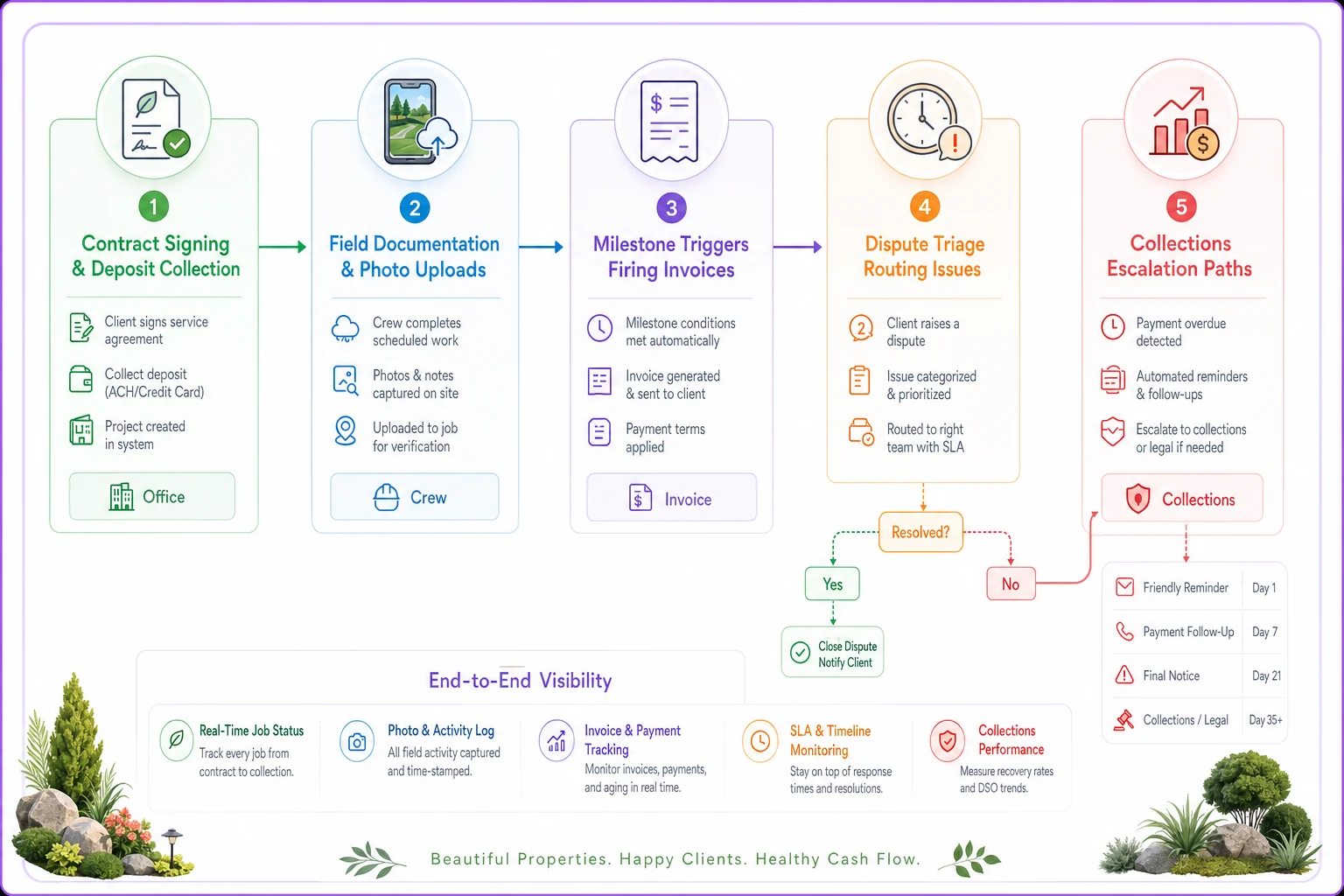
The complete system connects multiple operational checkpoints. Initial estimates based on actual property features feed into accurate proposals with appropriate deposits. Field documentation during service creates evidence for invoice accuracy. Dispute triage routes problems to proper resolution paths. Collections escalation recovers payment while preserving viable relationships.
Most landscaping companies handle billing reactively — sending invoices when they remember, following up when cash gets tight, documenting work only after disputes arise. This approach guarantees cash flow problems, especially during seasonal transitions when revenue dips but expenses continue.
A proactive billing lifecycle anticipates problems at every stage:
-
Deposits sized to cover actual cost exposure
-
Milestones triggered by operational checkpoints, not calendar dates
-
Documentation requirements that prevent disputes before they start
-
Triage systems that resolve issues before they affect payment
-
Collections processes that escalate predictably, not emotionally
You don't need to implement everything at once. Start with deposit restructuring for new contracts. Add milestone invoicing to projects over $5,000. Establish basic photo documentation requirements. Build from there as operations allow.
Technology accelerates the systematic approach. Modern operational software can trigger milestone invoices automatically when crews upload completion photos. AI-assisted platforms can flag accounts approaching payment thresholds and surface suggested collection actions before balances grow out of hand. Automated documentation requirements ensure crews capture necessary evidence before leaving job sites. But the technology only works when built on solid operational processes — deposit structures that make sense, documentation standards that prevent disputes, and collections escalation that preserves relationships while securing payment.
Here's a visual workflow that ties deposits, field documentation, milestone triggers, dispute triage, and collections escalation into a single billing lifecycle.
When cash flow is predictable, you can invest in equipment, hire quality crews, and take on larger projects. When payment is uncertain, you're constantly scrambling — turning down opportunities because you can't fund upfront costs, losing good employees who need consistent paychecks.
Build the system gradually but deliberately. Every improvement in billing operations — better deposit structures, faster dispute resolution, cleaner documentation — directly impacts your capacity to grow. The goal isn't perfection. It's a systematic approach that turns billing from a recurring headache into a predictable process.
Build the system gradually but deliberately. Every improvement in billing operations — better deposit structures, faster dispute resolution, cleaner documentation — directly impacts your capacity to grow. The goal isn't perfection. It's a systematic approach that turns billing from a recurring headache into a predictable process.
Ready to grow your landscaping business?
Join 2,000+ landscaping pros using Yardyly to save time, reduce task chaos, and deliver outstanding client results.