


Three weeks into spring rush, your best zero-turn throws a rod. The backup mower's deck spindle bearings are shot. Your newest crew's truck needs transmission work. Suddenly you're looking at $12,000 in repairs you didn't budget for, rental equipment eating your margins, and crews standing around while customers wonder why their grass isn't cut.
This happens because most operators treat equipment failures like random events. They're not. The difference between companies that scramble and those that run clean through peak season comes down to one thing: knowing your landscaping fleet equipment lifecycle thresholds before problems hit—not after.
The companies that make it past five years track specific hour and mileage triggers for every piece of equipment. They budget replacements months in advance. They build downtime buffers into their schedules. Meanwhile, everyone else reacts to breakdowns, overpays for emergency repairs, and watches their profit evaporate into shop bills.
Why Equipment Fails at Predictable Points (And Why Landscapers Miss It)
Walk into most landscaping shops in July and you'll see the same scene: three mowers torn apart, a truck on blocks, string trimmers scattered across workbenches. The owner's calling around for parts, crews are doubling up routes, and everyone's stressed about falling behind schedule.
Almost every one of those failures was predictable.
Commercial mowers hit major service points around 500, 1,000, and 2,000 hours. Truck transmissions start slipping between 140,000 and 180,000 miles if you're towing daily. Two-stroke equipment needs carburetor rebuilds every 300–400 hours of runtime. These aren't random—they're engineering realities based on wear rates, heat cycles, and material fatigue.
Yet most small landscaping operations track none of this. They run equipment until it breaks, fix whatever's obviously wrong, then act surprised when the same unit fails again two months later. The problem compounds as you scale because now you're multiplying these blind spots across multiple crews and dozens of machines.
What really kills profitability isn't the breakdown itself—it's the cascade. When that zero-turn goes down unexpectedly, you lose $400–600 per day in production. You pay overtime for other crews covering routes. Customer satisfaction drops when you reschedule. Then you overpay for rush repairs because you need the machine back immediately.
A landscaper running four crews typically loses somewhere between $18,000 and $25,000 annually just from unplanned downtime. That's pure profit gone.
The Replace vs. Repair Math Most Get Wrong
What trips up even experienced operators is holding onto equipment too long because the monthly payment feels worse than another repair bill.
Never miss a job detail again.
Yardyly helps you plan, confirm, and manage every landscaping project seamlessly.
- Centralized project scheduling
- Automated client updates
- Crew and resource management
No credit card required
Say you've got a commercial zero-turn with 1,800 hours. The engine needs a rebuild ($2,400), the hydraulic pumps are leaking ($1,600), and the deck needs welding work ($400). That's $4,400 to maybe get another season out of it. A new comparable unit runs $11,000.
The knee-jerk reaction is to repair—it's less than half the cost of new. But that ignores operational reality. That rebuilt mower will likely need another $2,000 in repairs over the next year. It'll go down more often. And when it does break, it'll happen during peak season.
A new mower under warranty eliminates surprise repairs for three years, cuts fuel consumption by around 20%, and just runs better. When you factor in reliability, productivity, and resale value, replacement often wins—but only if you run the complete numbers.
Creating Your Equipment Lifecycle Thresholds
Successful operations develop specific replacement triggers based on equipment type and usage patterns. These aren't guidelines—they're hard rules that kick off budget planning.
Commercial Mowers (Zero-Turn and Stand-On)
Hour-Based Thresholds:
-
500 hours
Major service point (usually $400–600)
-
1,000 hours
Hydraulic service, deck rebuild consideration
-
1,500 hours
Evaluate total repair history
-
2,000–2,500 hours
Replacement trigger for most operations
The window varies based on your operation. High-production crews running pristine residential lawns might push to 3,000 hours. Teams handling rough commercial properties with lots of debris typically replace closer to 1,800–2,000 hours.
Track repair costs as a percentage of replacement value. Once you've spent 50% of replacement cost in repairs, it's almost always time to sell. Most zero-turns hit this mark around 2,200 hours if properly maintained.
Trucks and Trailers
Mileage/Age Thresholds:
-
80,000 miles
Start tracking all repairs meticulously
-
120,000 miles
Transmission service is critical for towing vehicles
-
150,000 miles
Evaluate based on repair frequency
-
180,000–200,000 miles
Typical replacement for daily towing use
Trucks deteriorate faster in landscaping than almost any other industry. Daily towing, stop-and-start driving, and equipment loading create unusual wear patterns. A truck with 150,000 landscaping miles has taken more abuse than one with 250,000 highway miles.
Your replacement trigger should factor in image too. A beat-up truck might save money short-term but can cost you premium residential contracts.
Two-Stroke Equipment
Hour/Season Thresholds:
-
200–300 hours
Carburetor rebuild
-
400 hours
Full evaluation
-
500–600 hours or 3 seasons
Replacement for most handhelds
String trimmers, blowers, and edgers follow different patterns than mowers. They're relatively cheap but fail suddenly. The smarter play is often buying mid-tier commercial units and replacing on a strict schedule rather than buying top-tier and trying to extend life through repairs.
A crew running five days a week puts roughly 200 hours annually on a trimmer. Plan for two-year replacement cycles on heavy-use tools, three years for backups.
Building Preventive Maintenance Into Your Actual Schedule
Every landscaping company claims they do preventive maintenance. Most actually do reactive maintenance—they fix things when they obviously need attention. Real preventive maintenance means scheduled service regardless of how equipment seems to be running.
The challenge for small operations is fitting maintenance into a packed schedule. You can't pull equipment mid-week during peak season. This is where winter planning determines summer success.
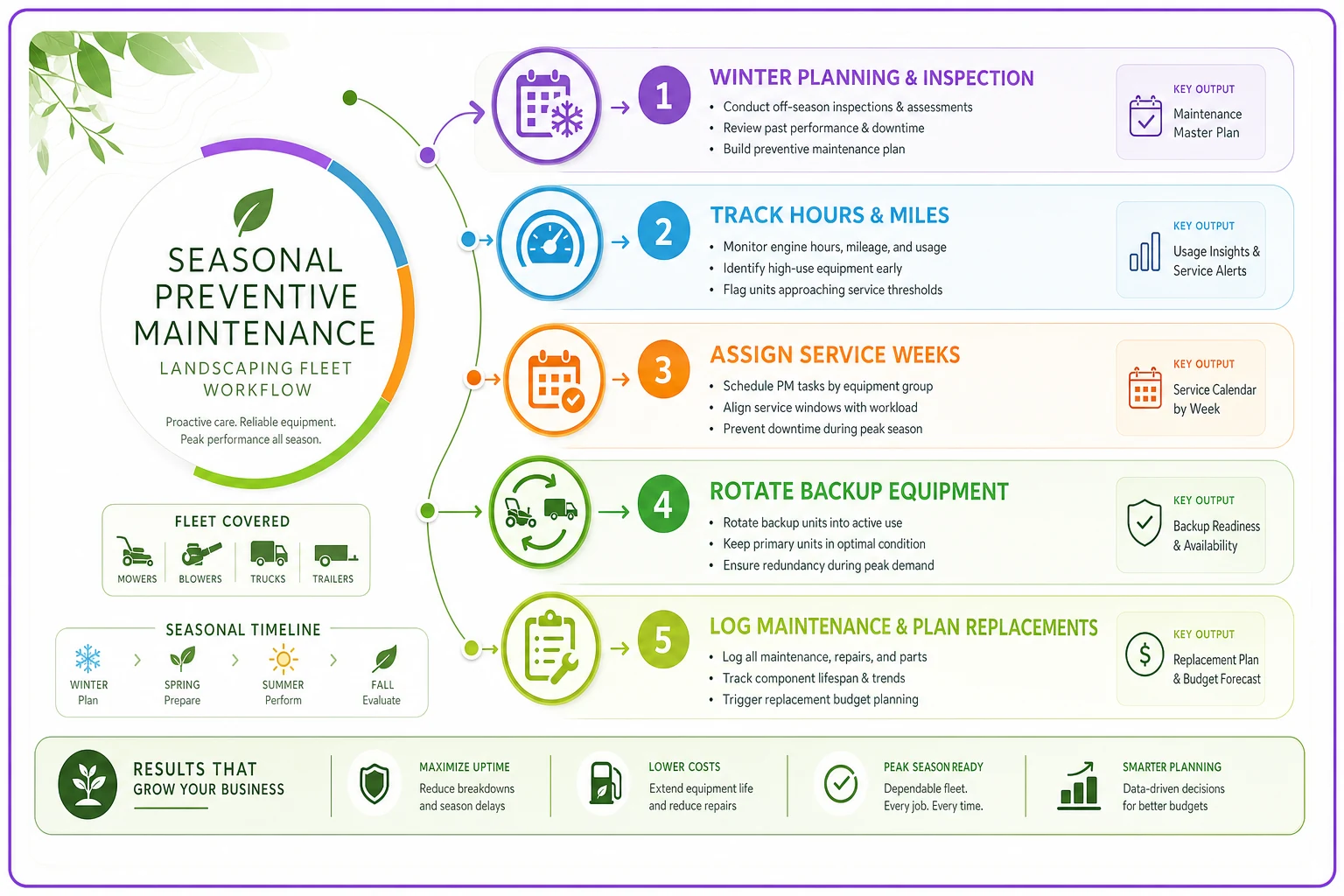
Map your maintenance calendar during slow season. Assign specific weeks for major services based on estimated hours. A zero-turn averaging 30 hours weekly needs its 500-hour service around week 17 of the season. Schedule it for week 16 before it becomes urgent.
Build redundancy into your fleet. If you run three crews, you need four mowers minimum—three working, one rotating through maintenance or available for breakdown coverage. This seems like excess until you calculate the cost of one crew standing idle half a day.
Document everything in a maintenance log: date, hours or miles, work performed, cost, and who did it. This history becomes invaluable for replacement decisions. A mower with minimal repair history might justify pushing past normal thresholds. One that's been problematic since year two gets replaced on schedule.
Check air filters weekly in dusty conditions—a clogged filter can destroy an engine in a matter of weeks.
Small details matter more than most realize. Check air filters weekly in dusty conditions—a clogged filter can destroy an engine in a matter of weeks. Grease zerks daily on zero-turns. Change hydro fluid on schedule even when it looks clean. These ten-minute habits prevent thousand-dollar repairs.
A quick visual of the maintenance scheduling workflow is helpful.
Small details matter more than most realize. Check air filters weekly in dusty conditions—a clogged filter can destroy an engine in a matter of weeks. Grease zerks daily on zero-turns. Change hydro fluid on schedule even when it looks clean. These ten-minute habits prevent thousand-dollar repairs.
Your Realistic Downtime Buffer Strategy
Even with solid maintenance, equipment fails. The operations that thrive build buffers in, assuming things will break.
For a three-crew operation, expect to lose 8–10 equipment days monthly during peak season—combinations of scheduled maintenance, unexpected repairs, and minor issues like flat tires. Schedule at 92% capacity maximum. Never book yourself so tight that one breakdown destroys the week.
Build relationships with equipment rental companies before you need them. Know their inventory, rates, and delivery options. When your mower throws a rod Tuesday morning, you want to call someone you already know.
Some dealers offer priority service contracts with 24-hour turnaround on repairs. The premium—usually 15–20% above standard rates—sounds steep until you calculate the value of getting equipment back two days faster during peak season.
Keep a breakdown kit in every truck: spare trimmer heads, spark plugs, air filters, basic tools, zip ties, spare blades. Half your so-called "breakdowns" can be fixed in five minutes if you have the right parts on hand.
The 12-Month CapEx Forecast Template
Quarter-by-Quarter Planning
Q1 (January–March): Review all equipment hours and miles from the previous season. Identify what will hit replacement thresholds in the upcoming year. This is when you lock in major purchases.
Priority purchases:
-
Mowers approaching 2,000 hours
-
Trucks over 180,000 miles
-
Major trailer repairs or replacements
Budget allocation: 40% of annual CapEx
Q2 (April–June): Peak season isn't the time for major purchases, but emergency replacements happen. Keep 20% of your CapEx budget as a buffer.
Priority purchases:
-
Emergency replacements only
-
Small tools and equipment
-
Backup inventory for high-wear items
Budget allocation: 20% of annual CapEx
Q3 (July–September): Mid-season evaluation point. Check actual hours against projections—some equipment wears faster than expected.
Priority purchases:
-
Two-stroke equipment showing wear
-
Replacement of items that can't make it through fall
-
Winter service equipment prep
Budget allocation: 25% of annual CapEx
Q4 (October–December): End-of-season dealer deals make this prime buying time for next year's needs. Dealers want to move inventory, and you have real usage data from the season.
Priority purchases:
-
Next season's major equipment
-
Trade-ins while equipment still has value
-
Snow equipment if you run winter services
Budget allocation: 15% of annual CapEx
For a $400,000 annual revenue landscaping operation:
| Category | Annual Budget | Percentage of Revenue | Notes |
|---|---|---|---|
| Mowers | $12,000–15,000 | 3–3.75% | One zero-turn replacement or two walk-behinds |
| Trucks | $8,000–10,000 | 2–2.5% | Down payment on one truck or used purchase |
| Trailers | $3,000–4,000 | 0.75–1% | One replacement every 2–3 years |
| Handhelds | $3,000–4,000 | 0.75–1% | Full crew replacement rotation |
| Small Equipment | $2,000–3,000 | 0.5–0.75% | Spreaders, wheelbarrows, etc. |
| Total | $28,000–36,000 | 7–9% | Sustainable replacement rate |
That 7–9% of revenue for equipment CapEx keeps your fleet modern without crushing cash flow. Companies spending less than 5% usually run older equipment with higher repair costs. Those spending over 12% are either scaling fast or bought too much too soon.
When Rotating Equipment Early Actually Saves Money
The counterintuitive truth: selling equipment earlier often costs less than running it to failure. A zero-turn with 1,500 hours might fetch $4,000–5,000 on the used market. The same mower with 2,500 hours and visible wear might only bring $1,500–2,000.
That $3,000 difference in resale value frequently exceeds what you'd save by delaying replacement. Factor in the repairs between 1,500 and 2,500 hours, and early replacement often wins outright.
Some operators stumbled onto this when forced to upgrade for image reasons. They replaced functional but cosmetically rough equipment to land better contracts, then found their maintenance costs dropped as a bonus.
Timing sales matters as much as timing purchases. Sell mowers in early spring when demand peaks. Sell trucks in fall when construction companies are buying. Avoid selling anything in December unless you're desperate—the market's thin and discounts are deep.
The Hidden Patterns in Your Repair Data
When you track repairs over time, clear patterns emerge that aren't obvious looking at individual repair bills.
String trimmers from the same manufacturer tend to fail in identical ways at similar hour marks. One brand's trimmer heads strip around 250 hours like clockwork. Another's throttle cables break near 300 hours. When you know these patterns ahead of time, you pre-order parts and fix issues during slow periods instead of mid-project.
Mower engines show geographic patterns too. Sandy areas mean air filter and cooling fin problems. Clay soil means deck buildup and belt wear. Humid climates bring more electrical issues. Your location affects your maintenance needs more than the manufacturer's spec sheet ever will.
The data also reveals which dealer claims don't match reality. That mower marketed as "commercial grade" might average 1,400 hours before major repairs while the genuine commercial unit consistently hits 2,200. A $2,000 price difference matters a lot less when you calculate the per-hour operating cost.
Making Equipment Decisions Based on Growth Trajectory
Your fleet strategy should match your growth plans, not just current needs. If you're adding a crew next season, start upgrading equipment now so new teams get reliable gear, not hand-me-downs.
Growing companies often buy all new equipment for new crews while existing crews run deteriorating machines. That creates morale issues and productivity gaps. A better approach: rotate equipment so experienced crews run the newest gear—they'll maintain it better—while newer crews learn on solid mid-life equipment.
For operations scaling from three to five crews over two years, front-load your CapEx spending. Buy that extra zero-turn now while you have capital, not when you're already stretching to cover new payroll. Equipment purchased ahead of need can generate rental income to offset carrying costs.
The metrics that trigger expansion decisions should factor in equipment capacity, not just revenue and customer demand. Growing into existing equipment capacity costs far less than scaling crews and equipment at the same time.
Building Your Equipment Reserve Fund
Keep a separate equipment reserve fund—distinct from operating capital. This isn't just emergency repair money. It's strategic buying power that lets you act when deals appear, not when you're desperate.
Target 3–4% of monthly revenue flowing into this reserve. For a company doing $30,000 monthly, that's $900–1,200. Seems like a lot until your transmission goes out and you have $15,000 sitting there instead of scrambling for financing.
The reserve covers multiple situations: down payments on planned purchases, unexpected major repairs that would otherwise gut your cash flow, and opportunistic buys when they come up.
When a dealer offers 20% off last year's zero-turn models in November, you can actually take advantage instead of watching the deal pass. When a competitor goes under and sells their fleet cheap, you have buying power ready.
Standardization Reduces Complexity at Scale
Once you're running more than two crews, equipment standardization becomes critical. Three different mower brands means three different parts inventories, three dealer relationships, and three sets of operating procedures.
Pick your primary brands and stick with them. You might pay 10% more for a specific trimmer model, but when every crew runs identical equipment, training simplifies, parts inventory shrinks, and crews can swap equipment without missing a beat.
Standardization extends to model years when possible. Buying three identical zero-turns in the same year means they'll need similar maintenance at similar times. You can batch services, bulk-order parts, and predict replacement timing with real accuracy.
That means passing on deals for non-standard equipment sometimes. An attractive price on a different brand becomes less attractive once you factor in the operational complexity it adds.
The Technology That Actually Helps
Equipment tracking moved from paper logs to digital systems, but most landscaping software still treats equipment as an afterthought. The genuinely useful platforms connect equipment hours to job costing, maintenance scheduling, and replacement planning automatically.
Modern operational platforms can track equipment usage per job, alert you when maintenance approaches, and calculate true per-hour operating costs including depreciation. When every crew member logs hours through their phone, you get accurate data without relying on end-of-day memory.
AI-powered systems can identify unusual wear patterns and predict failure probability based on your historical data—not generic averages. Instead of guessing when a mower might fail, you see probability-based risk indicators that actually inform decisions. These platforms also solve the coordination problem: when maintenance is due, the system notifies the crew, schedules service, and adjusts route planning automatically. No more discovering during morning dispatch that equipment needs service that should've happened last week.
Financial Strategies for Equipment Acquisition
The lease-versus-buy debate misses the bigger picture: how equipment financing affects your entire operation. Different strategies work at different growth stages.
New operations (under two years) should generally lease major equipment. Yes, you'll pay more long-term, but you preserve capital for growth and can upgrade as you figure out what actually works for your market. That stand-on mower might seem ideal until you realize your properties are too rough for it.
Established operations (three to five years) do well with a mixed approach. Buy your core fleet that you know works. Lease specialty equipment you're testing or that depreciates fast. Finance trucks and trailers at low rates when available, pay cash for handhelds.
Mature operations (five-plus years) should own most equipment outright but maintain financing relationships for strategic purchases. When rates drop or manufacturers run 0% financing, take advantage even if you have cash—that capital might generate better returns elsewhere.
Seasonal financing is worth considering too. Some lenders offer skip-payment structures where you owe nothing December through February, which matches your cash flow to your revenue cycle and reduces winter pressure.
The CapEx Forecast Spreadsheet Setup
You don't need complex software for a good CapEx forecast, but you need more than back-of-napkin math. A clean spreadsheet with the right structure beats fancy software nobody uses.
Track these core metrics for every piece of equipment:
-
Purchase date and price
-
Current hours/miles
-
Monthly usage rate
-
Repair history total
-
Estimated replacement date
-
Projected resale value
From that data, calculate monthly depreciation, repair cost per hour, and months until replacement. Sum these across all equipment for total CapEx needs.
Update it monthly, not annually. Equipment breaks faster than expected. Markets shift. Deals show up. Monthly updates keep your forecast relevant.
Include soft costs in your planning: sales tax, delivery fees, setup costs, initial service packages. That $11,000 zero-turn realistically costs $12,500 by the time it's running. Budget for reality, not sticker prices.
Moving from Reactive to Predictive
The shift from reactive repairs to predictive replacement changes more than maintenance costs. It changes how you price jobs, how you schedule, and how you grow—with actual confidence in your capacity.
Operations running predictive equipment management typically report 30–40% lower total equipment costs over five years compared to reactive approaches. That's not just repair savings—it's better productivity, higher employee satisfaction, and stronger customer retention from consistent service delivery.
If overhauling everything at once feels overwhelming, start with one category. Pick mowers, get lifecycle tracking dialed in there, then expand. The discipline carries over into other parts of the business naturally.
Your equipment should serve your growth, not constrain it. When you know exactly when each piece needs replacing, what it'll cost, and how it affects operations, fleet decisions become strategic advantages rather than reactive scrambles.
Ready to grow your landscaping business?
Join 2,000+ landscaping pros using Yardyly to save time, reduce task chaos, and deliver outstanding client results.