



Most landscaping companies track labor costs down to the minute but have no real idea what they're spending on green waste disposal per job. You quote a cleanup at $450, the crew finishes in three hours, looks profitable on paper. Then the truck makes two trips to the transfer station at $85 each plus an hour of drive time each way. That healthy margin just became breakeven work.
It gets worse during peak season. Transfer stations change hours, add scheduling requirements, raise fees without notice. Your crew shows up with a full truck and finds the green waste section closed for maintenance. Now they're burning diesel circling back or hunting for an alternate site that charges 40% more.
Operating without disposal cost controls means unpredictable margins. One week you're profitable, the next week the same job types barely cover expenses because disposal ate the difference. The variance shows up months later when you're wondering why certain services never generate the returns you expected.
Why Disposal Costs Spiral Out of Control
Green waste disposal operates differently than standard commercial waste. Transfer stations treat landscapers as high-volume commercial users — different fee structures, access restrictions, scheduling requirements. A homeowner can roll up with a pickup bed of branches anytime. Your crew with a loaded dump trailer might need an appointment, gets charged commercial rates, and faces rejection if the load has the wrong material mix.
The complexity multiplies across job types. Tree trimming generates dense wood waste some facilities won't accept without chipping first. Sod removal creates heavy loads that trigger weight-based fees instead of volume pricing. Spring cleanups mix leaves, branches, and debris that might need separation depending on the facility. Each job type carries different disposal requirements and costs, but most companies quote them using the same rough estimate.
Crew behavior compounds everything. Without clear guidelines, crews make disposal decisions based on convenience rather than cost. They'll drive past a cheaper municipal site to hit the closer commercial one. They'll make multiple partial-load trips instead of consolidating. They'll include disposal time in their lunch break to avoid logging it as job hours. These shortcuts hide the true disposal cost while quietly killing job profitability.
Small operators might lose $20–40 per job to untracked disposal. At 15 jobs a week, that's roughly $2,400 monthly in missing margin — enough across a season to fund equipment upgrades or add a crew member.
Building Your Per-Job Disposal Tracking System
Effective disposal tracking starts before crews load the truck. Each job needs a disposal estimate built into the quote — not a generic line item, but a real number based on service type and property characteristics.
Never miss a job detail again.
Yardyly helps you plan, confirm, and manage every landscaping project seamlessly.
- Centralized project scheduling
- Automated client updates
- Crew and resource management
No credit card required
Create disposal categories for your common job types:
Basic Maintenance:
-
Standard mow/blow/edge
No disposal cost
-
With bag collection
$15–25 depending on property size
-
Hedge trimming added
$35–45 for a typical suburban lot
-
Full service with weeding
$45–60 disposal allowance
Cleanup Projects:
-
Spring cleanup (leaves/light debris)
$8–12 per cubic yard
-
Storm cleanup (branches/heavy debris)
$15–20 per cubic yard
-
Overgrowth clearing
$25–35 per cubic yard plus potential equipment rental
-
Construction debris mixed
$40–50 per cubic yard at specialized facilities
Specialty Disposal:
-
Sod removal
$180–220 per ton at most facilities
-
Stump grindings
Often rejected, needs a special disposal site
-
Treated lumber/railroad ties
Hazardous waste protocols, $300+ per load
-
Soil/rocks
Usually rejected at green waste, needs construction disposal
Track actual costs against these estimates for every job. The variance tells you whether your pricing model holds up or needs adjustment.
Dump Fee Triggers and Decision Rules
Smart disposal decisions happen at specific trigger points during the workday. Rather than leaving it to crew judgment, give them clear rules they can follow without calling the office.
Here's how a typical decision flow should work during a shift: crew documents load percentage in the morning, works through jobs applying the thresholds below, and only contacts dispatch if something falls outside the normal range.
Load percentage determines most of it:
-
Under 40% full — continue to next job unless ending shift
-
40–70% full — dump if the next job will push you over capacity
-
Over 70% full — dump before starting anything debris-heavy
-
95% full — dump immediately, no exceptions
Time of day matters too, because transfer station congestion is predictable:
-
Before 10am — use municipal sites, usually far less crowded
-
10am–2pm — avoid transfer stations during the commercial rush
-
2pm–4pm — solid window at most facilities
-
After 4pm — confirm closing times before committing, have a backup ready
And when fees cross certain thresholds, the math changes on where to go:
-
Under $40 disposal — use the most convenient site
-
$40–80 disposal — worth driving an extra 15 minutes for a cheaper facility
-
Over $80 disposal — calculate fuel and labor cost before deciding
-
Over $120 disposal — seriously consider renting equipment to reduce volume first
Print this as a simple decision chart crews can keep in the truck. No complex math, just clear if-then rules.
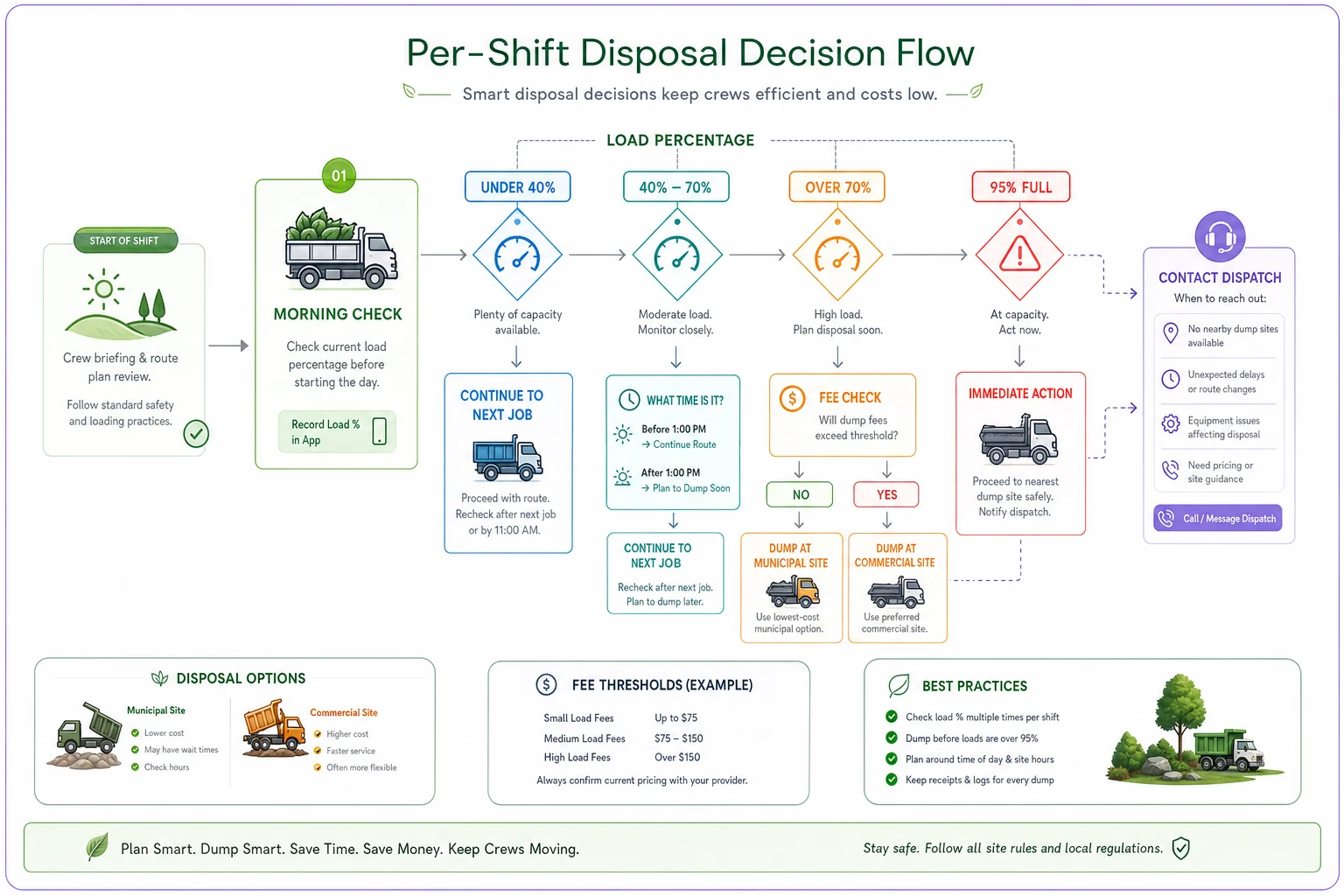
Simple enough to actually stick.
Transfer Station Scheduling and Access Rules
Every transfer station operates differently, and those differences cost money when crews don't plan ahead. Municipal facilities often restrict commercial access to certain hours or days. Private transfer stations might require accounts, pre-scheduling, or specific payment methods.
Map out your disposal options with complete operational details:
| Facility Name | Hours | Commercial Window | Scheduling Required | Green Waste Rate | Mixed Load Rate | Payment Methods | Special Restrictions |
|---|---|---|---|---|---|---|---|
| County Transfer | 7am–4pm M–F | All hours | No | $42/ton | $65/ton | Cash/Check | No palm fronds |
| Green Recycling Inc | 6am–6pm Daily | 6am–10am only | Yes (online) | $38/ton | Not accepted | Account only | Must separate wood |
| Municipal Compost | 8am–3pm M–Sat | Residents only | N/A | N/A | N/A | N/A | No commercial access |
| Regional Landfill | 24/7 gate access | Anytime | No | $58/ton | $58/ton | All methods | 20% contamination limit |
Update this grid monthly. Facilities change rules seasonally, especially during peak green waste periods in spring and fall. The "cheap" site might implement commercial restrictions during busy periods, pushing you to the expensive alternative with no warning. Create contingency routes for each zone your crews work. When the primary site is closed or restricted, crews should know exactly where to divert without calling the office. Include drive times and adjusted fees in these backup plans.
Client Communication Scripts for Disposal Charges
Disposal costs turn into client disputes when they're not addressed upfront. Customers assume hauling is included in labor, then push back on charges for something they think they already paid for. Clear communication prevents these situations while justifying your pricing structure.
Initial Estimate Language:
"This estimate includes removal and legal disposal of all green waste generated. Current transfer station rates are $X per load, and this job will likely generate Y loads based on the debris volume. If actual disposal differs significantly from the estimate, we'll notify you before proceeding."
Pre-Service Confirmation:
"Tomorrow's service includes hauling approximately [volume] of green waste. Our disposal estimate assumed normal plant material. If we encounter concrete, dirt, or construction debris mixed in, disposal fees increase by roughly $40 per cubic yard. Should we proceed with the quoted scope?"
Overage Notification:
"Hi [Name], the crew leader reported more debris than anticipated at your property. The original estimate included one disposal run at $75. Actual cleanup will require two runs totaling $150. Would you like us to complete everything today, or handle the extra debris on a separate visit?"
Invoice Explanation:
"Disposal fee breakdown: 1.5 tons of mixed green waste at County Transfer Station. Receipt #4892 attached. This represents actual weight-based fees plus 30 minutes transport time at standard hourly rate."
Train office staff and crew leaders on these scripts. Consistency prevents clients from shopping for the answer they want to hear.
Sample Per-Job Calculations
Real numbers show how disposal costs impact different job types. Here's how actual costs break down across common services:
Scenario 1: Spring Cleanup — 3,500 sq ft property
-
Labor
2 crew × 2.5 hours @ $35/hour = $175
-
Equipment
Blower/mower/tools = $25
-
Disposal estimate
1 load @ $65 = $65
-
Margin target
35%
-
Quote price
$408
-
Labor
2 crew × 3 hours @ $35/hour = $210 (rain delay)
-
Equipment
$25
-
Disposal
1.5 loads @ $65 + 1 hour drive time @ $70 = $167.50
-
Actual cost
$402.50
-
Margin achieved
1.4%
One extra half load wiped out the entire job margin. With better disposal tracking, the crew could have compressed material more efficiently or made a single trip to a volume-based facility instead of multiple load-based runs.
Scenario 2: Commercial Hedge Trimming — 200 linear feet
-
Labor
2 crew × 1.5 hours @ $35/hour = $105
-
Equipment
Hedge trimmers/ladder = $15
-
Disposal estimate
Light load @ $35 = $35
-
Margin target
40%
-
Quote price
$258
-
Labor
2 crew × 1.5 hours @ $35/hour = $105
-
Equipment
$15
-
Disposal
Combined with another job, allocated cost = $12
-
Actual cost
$132
-
Margin achieved
48.8%
Combining loads saved $23 in disposal and pushed margin above target. That only happens when crews track what's on the truck and plan disposal runs together.
Scenario 3: Estate Overgrowth Clearing — Full day job
-
Labor
3 crew × 8 hours @ $35/hour = $840
-
Equipment
Chipper rental + tools = $275
-
Disposal estimate
3 loads @ $95 = $285
-
Margin target
35%
-
Quote price
$2,154
-
Labor
3 crew × 9 hours @ $35/hour = $945
-
Equipment
$275
-
Disposal
2 loads chipped material @ $45 = $90
-
Actual cost
$1,310
-
Margin achieved
39.2%
Chipping on-site cut disposal volume by around 70%, saving $195 in fees despite the extra labor hour. The project takeoff checklist would have flagged this opportunity during estimation.
Creating Accountability Without Micromanaging
Disposal tracking fails when it becomes paperwork that crews ignore in the field. The system needs to capture essential information without disrupting how jobs actually get done.
Keep the morning dispatch note short:
-
Current truck load percentage
-
Planned disposal site
-
Estimated disposal time window
Then at the end of the day:
-
Actual disposal site used
-
Receipt number or weight ticket
-
Time spent at facility
-
Next-day load status
Thirty seconds to complete, but enough data to spot patterns over time. After a month, you'll see which crews consistently overfill trucks, which sites offer real value, and which job types generate surprising disposal costs.
Build disposal efficiency into crew incentives. If one crew averages $50 per job in disposal while another doing similar work averages $35, there's a real conversation to have. Reward crews who find legitimate ways to reduce disposal costs without cutting corners on service quality.
Some operational software platforms can automate parts of this tracking by connecting disposal receipts directly to job records. When crews photograph weight tickets, the system pulls out the cost and assigns it to the right job — no manual data entry, no end-of-month guesswork.
Photograph weight tickets and attach them to the job record to speed reconciliation.
It also flags when disposal costs run over the estimate, so you catch it the same day instead of during a quarterly review.
Seasonal Disposal Planning
Disposal costs shift predictably through the year, but most companies react to changes instead of planning for them. Spring green waste floods transfer stations, driving up wait times and fees. Fall leaf disposal can trigger volume restrictions. Winter brings reduced facility hours right when storm cleanup generates unexpected debris.
March–April: Spring cleanup surge
-
Book facility appointments in advance
-
Consider equipment rental for volume reduction
-
Budget 20% higher disposal costs
-
Add a disposal surcharge to spring cleanup quotes
May–September: Steady maintenance period
-
Optimize routes for combined loads
-
Negotiate volume rates with facilities
-
Track per-job costs for next year's pricing
October–November: Leaf season
-
Pre-arrange municipality partnerships
-
Research composting alternatives
-
Consider dedicated disposal runs
-
Adjust crew schedules to account for disposal time
December–February: Storm and weather response
-
Identify 24/7 facilities in your area
-
Build an emergency disposal fund
-
Create rapid response protocols
-
Maintain backup site relationships
When you know October brings 40% higher disposal costs, you can adjust quotes going into fall rather than eating the margin hit after it happens.
The Real Cost of Hidden Disposal Expenses
Beyond direct dump fees, disposal creates hidden costs throughout your operation. Drive time burns fuel and labor hours. Heavy loads accelerate wear on trucks and trailers. Crews rushing through transfer station protocols increase liability. These indirect costs often equal or exceed the actual disposal fees.
A typical 10-mile round trip to a transfer station costs roughly:
-
Fuel
$8–12 depending on vehicle
-
Labor
$35–50 for driver time
-
Vehicle wear
$5–8 per trip (distributed maintenance cost)
-
Opportunity cost
One less billable job that hour
Total real cost: $85–95 per disposal run before paying any dump fees.
That math changes how you think about disposal planning. Suddenly the "free" municipal compost site 20 miles away costs more than the commercial facility charging $45 just five miles off your route. The crew making three partial-load trips per week wastes roughly $500 in operational costs on top of actual disposal fees.
Smart operators minimize trips through planning. They invest in larger trailers or dump trucks to reduce run frequency. They rent compaction equipment for big jobs. They negotiate annual contracts for better rates and priority access. Every one of those decisions comes from understanding real disposal costs — not just the fee printed on the receipt.
Turning Disposal from Cost Center to Competitive Advantage
Companies that get disposal cost management right gain pricing advantages over competitors still working off rough estimates. When you know actual disposal costs by job type, you can quote aggressively on low-disposal work while protecting margins on debris-heavy projects.
That precision opens up real decisions. Maybe you stop accepting job types that consistently lose money on disposal. Maybe you invest in equipment that reduces disposal volume. Maybe you partner with another company to share disposal runs. These opportunities only become visible when you're tracking real numbers.
The compound effect builds over time. Better disposal tracking leads to more accurate quotes. More accurate quotes improve win rates on profitable work. Better margins fund better equipment. Better equipment reduces disposal costs. The cycle builds on itself, creating operational advantages that competitors can't easily match.
Green waste disposal is one of the last uncontrolled cost centers for most landscape operators. While companies obsess over labor efficiency and equipment utilization, disposal costs quietly erode margins job by job. The damage stays hidden until year-end analysis reveals entire service categories running at breakeven or worse.
Taking control requires systematic tracking, clear decision rules, and consistent execution. The per-job disposal checklist forces cost visibility. Dump fee triggers prevent expensive convenience decisions. Transfer station scheduling rules avoid costly delays and access surprises. Client communication scripts prevent payment disputes. Together, these tools turn disposal from a random expense into a managed cost.
The results tend to show up quickly. Disposal costs drop just from awareness and better decision-making. Margins improve on debris-heavy jobs. Cash flow becomes more predictable when disposal charges actually match real costs. More importantly, the business gains pricing confidence because every cost component is tracked and controlled.
Start with simple tracking this week. Note disposal costs for every job. Compare actual expenses to what you quoted. Find the patterns. Build your facility assessment grid and crew decision rules. Within a month you'll have a clearer picture than most competitors ever will. Within a season, disposal management stops being an operational burden and starts being an advantage.
Ready to grow your landscaping business?
Join 2,000+ landscaping pros using Yardyly to save time, reduce task chaos, and deliver outstanding client results.