
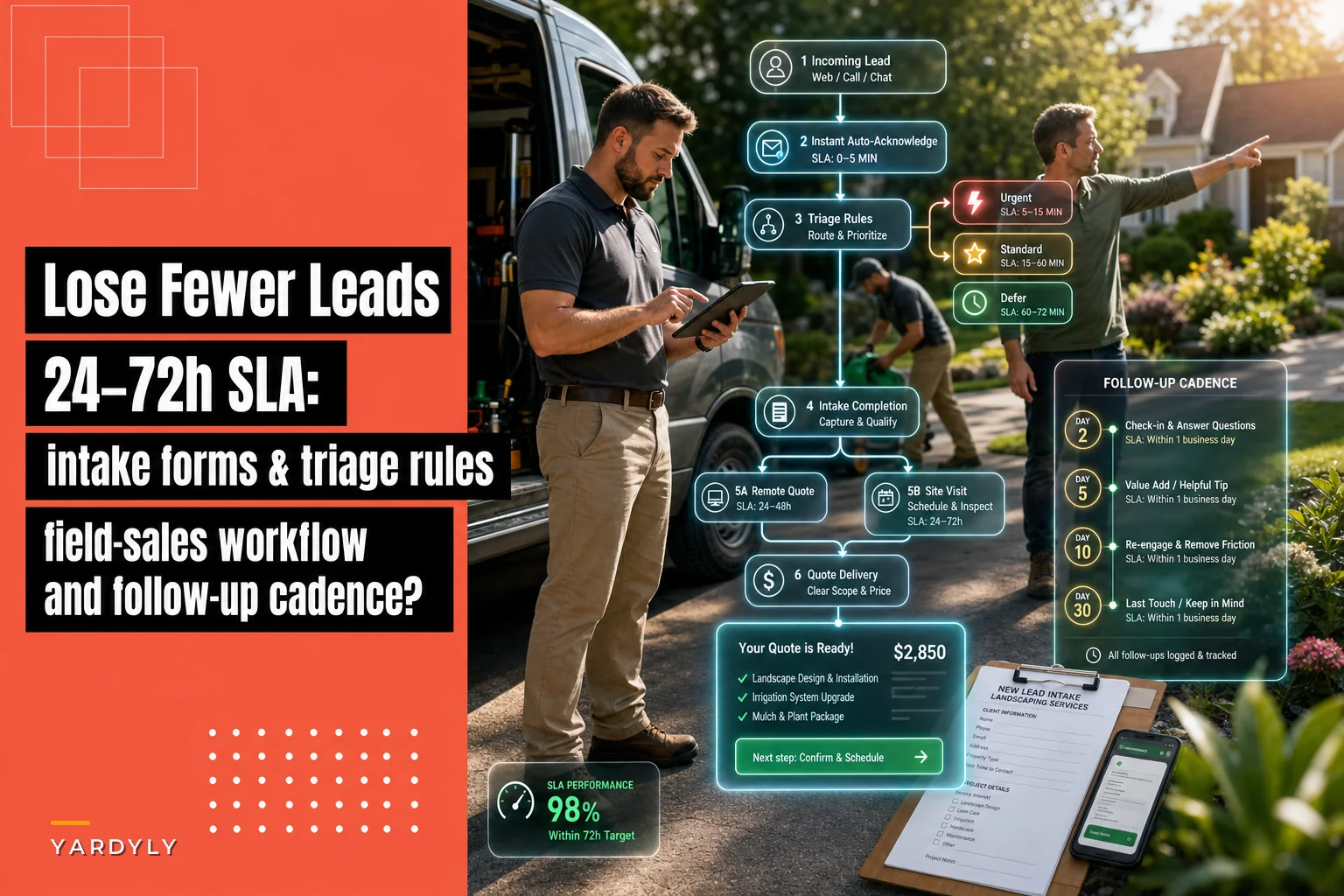

The quote that shows up four days late almost never wins. By then the homeowner has two other estimates on the kitchen counter and a neighbor's recommendation in their back pocket. You're not competing on price at that point—you're competing on who bothered to show up first.
Most landscaping companies don't lose leads because their pricing is off. They lose them because the lead sat in somebody's truck console, a text thread, and a voicemail for three days before anyone acted on it. The job eventually gets quoted, but the window already closed.
A landscaping quote SLA—a written commitment about how fast every lead gets a response and a quote—fixes most of this. Not because speed magically wins jobs, but because an SLA forces you to build the plumbing underneath it: a real intake form, triage rules so urgent jobs don't wait behind driveway edging requests, and a follow-up cadence that doesn't depend on anyone remembering to call back.
This is about one thing: getting from "lead came in" to "quote in their hands" inside 24–72 hours, consistently, without heroics.
The real reason quotes go out late
It's rarely laziness. The breakdown is almost always structural, and it looks the same across small and mid-sized operations.
The owner or lead salesperson is the bottleneck. They're the only one who can price a retaining wall or a full re-sod, and they're on a mower or at a job site most of the day. Leads pile up until evening, and by evening they're drained, so pricing waits for "tomorrow morning when I'm fresh." Tomorrow morning there's a crew callout, so it waits again.
The second problem is incomplete intake. A lead calls, somebody scribbles "Mrs. Patterson, backyard thing, call back" on a notepad. When the estimator finally gets to it, they can't quote anything—no square footage, no access info, no clue what Mrs. Patterson actually wants. So now there's a second round of phone tag before a quote can even start.
Third, nothing separates the hot lead from the cold one. A commercial property manager who needs a bid by Friday sits in the same undifferentiated pile as a homeowner just getting a few prices for spring. Without triage, the urgent job waits as long as the tire-kicker.
This almost always comes down to an intake process that lives entirely in people's heads and a quote process that depends on one overloaded person having a free hour. Fix those two things and the SLA becomes achievable instead of just aspirational.
What a 24–72 hour SLA actually means
The mistake people make is treating "24–72 hours" as one vague promise. It's actually three different commitments, and spelling them out is what makes the system work.
Never miss a job detail again.
Yardyly helps you plan, confirm, and manage every landscaping project seamlessly.
- Centralized project scheduling
- Automated client updates
- Crew and resource management
No credit card required
| Stage | What happens | Target time |
|---|---|---|
| First contact | Someone acknowledges the lead—text, call, or email. Not a quote, just "we got it and here's what's next." | Within 1–2 business hours |
| Qualification | Intake form completed, job triaged (urgent / standard / low-priority), site visit booked if needed | Within 24 hours |
| Quote delivered | Written quote in the client's hands, with a clear number | 24–72 hours depending on job complexity |
The first-contact window is the one most crews ignore, and it's the cheapest to fix. A lead that hears anything back within the first hour feels completely different from one that hears nothing until day two—even if the actual quote takes the same amount of time either way. That early acknowledgment buys patience.
The 72-hour ceiling should be reserved for genuinely complex work—multi-phase installs, anything requiring a takeoff, jobs where you need a supplier price first. Simple maintenance quotes and small projects should land comfortably inside 24 hours. If your "complex" bucket is catching 70% of leads, your intake form isn't collecting enough up front.
Build the intake form around what blocks a quote
An intake form isn't a contact form. A contact form collects a name and "what can we help with?" An intake form collects everything that would otherwise require a callback before you can price the job.
-
Service type — maintenance, install, cleanup, irrigation, hardscape, other (drives the triage path)
-
Property address — so you can pull it up on satellite before you even call
-
Approximate scope — a few checkboxes or a short description
"front + back lawn, roughly quarter acre"
-
Timeline / urgency — "need it this week," "within a month," "just pricing for now"
-
Access notes — gate width, dogs, locked backyard, street parking only
-
Budget range (optional) — even a rough band tells you whether it's worth sending a crew out
-
Photos — strongly encourage 3–5 phone photos; they cut site-visit time enormously
-
How they found you — feeds your marketing, not the quote, but cheap to capture here
The highest-leverage field is the photo upload. For smaller jobs, a decent set of phone photos plus a satellite measurement often means you can skip the site visit entirely and quote remotely—which is the single biggest speed unlock most crews have available. If you've already got standards for mandatory field photo sets, point your intake form at the same standard.
Make photo uploads easy on mobile—show example shots so customers send usable images.
One thing worth flagging: companies that make every field mandatory see form completion rates crater. Make the quote-blocking fields required and everything else optional. A half-filled form you can follow up on beats a perfect form nobody submits.
Triage rules: who jumps the line
Triage is where the SLA actually earns its keep. The whole point is that not every lead deserves the same clock.
Tier 1 — Urgent (quote within 24 hours, same-day contact). Storm damage, safety hazards (a leaning tree over a driveway), commercial bids with a stated deadline, and any existing client with an add-on request. Existing clients belong here because the cost of winning them is near zero and the cost of ignoring them is losing the whole account.
Tier 2 — Standard (quote within 48–72 hours). Most residential installs, seasonal cleanups, new maintenance accounts with a normal timeline. This is the bulk of your volume and the SLA's default lane.
Tier 3 — Low-priority (acknowledge fast, quote when capacity allows). "Just getting prices," jobs well outside your service area, scopes you don't really want. Still acknowledge them within the day—reputation matters—but they don't get to push a paying urgent job back.
The mistake most owners make is running triage in their head instead of on paper. When it lives in your head, the loudest lead wins, not the most valuable one. A written rule—"commercial deadline bids and existing-client add-ons always go Tier 1"—means whoever handles intake makes the right call without needing you in the loop.
A small but real insight: urgency and value aren't the same thing. A homeowner frantically calling about a dead patch of grass can be low-value; a calm property manager emailing a bid request can be a $40k annual contract. Triage on value plus deadline, not on how stressed the caller sounds.
The follow-up cadence most crews skip entirely
Sending the quote isn't the finish line—it's the halfway point. The number of quotes that die simply because nobody followed up is staggering, and it's pure waste. You already did the hard work of pricing the job.
-
Day 0 — Quote delivered, with one clear sentence on what happens next: "Happy to walk through any of this—want me to pencil you in for the week of the 14th?"
-
Day 2 — Short check-in. "Just making sure the quote came through okay—any questions on the scope?"
-
Day 5 — Value nudge, not a price nudge. Mention a scheduling window filling up or offer to tweak scope to fit a budget.
-
Day 10 — Last direct touch. "Want to keep your spot on the spring schedule or should I close this out for now?"
-
Day 30 — Soft re-engagement if still nothing. Moves them to a longer nurture list.
The "keep your spot" line at Day 10 is one of the better-performing nudges in the trades because it's true—your calendar genuinely does fill—and it gives the client a real reason to decide instead of just drifting indefinitely.
Keep the cadence to texts and quick calls, not long emails. And give each follow-up a different angle. Three identical "just checking in" messages read as nagging; a scheduling nudge, a scope-flexibility nudge, and a deadline nudge read as helpful.
A sample intake‑to‑quote workflow for field salespeople
``
[Lead Arrives] → [Auto-Acknowledge < 1 hr] → [Triage T1/T2/T3]
       ↓                                              ↓
[Complete Intake]                        [T1: Same-day call]
       ↓                                 [T2: Book within 24hr]
[Remote Quote or Site Visit]             [T3: Acknowledge, hold]
       ↓
[Deliver Quote + Next Step]
       ↓
[Follow-up Cadence: Day 2 → 5 → 10 → 30]
``
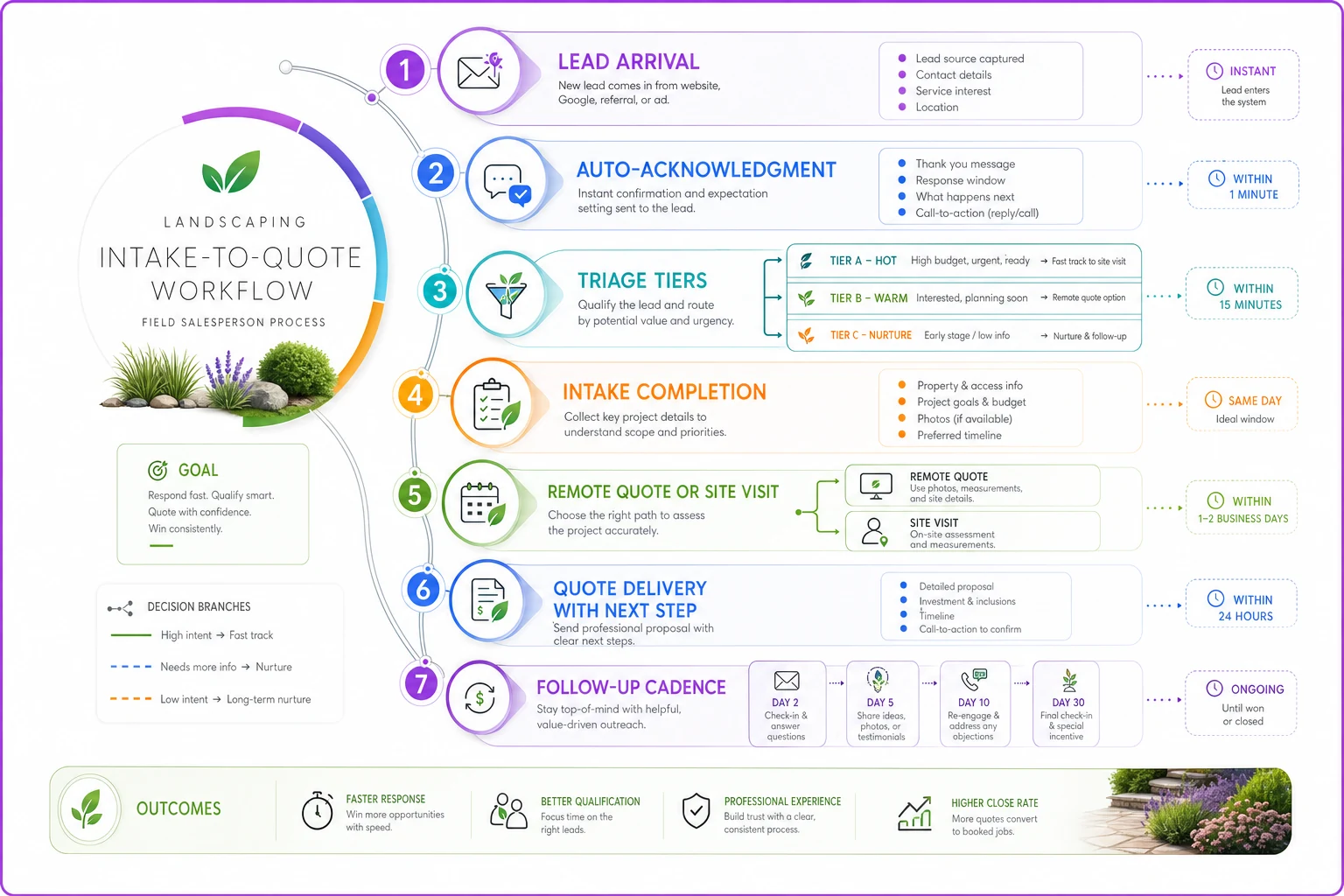
This flow shows the intake-to-quote steps field salespeople follow and where timing matters.
Step 1 — Lead lands (any source). Web form, phone call, referral, Google Business message. Everything routes into one place. The person taking a phone lead fills the same intake form the website uses—no exceptions. One intake, one destination. That discipline matters more than any tool you pick.
Step 2 — Auto-acknowledge within the hour. A templated text goes out: "Thanks for reaching out to [Company]—we've got your request and someone will be in touch today to confirm details." This holds the lead's patience while you're still on a job.
Step 3 — Triage at the next break. Between jobs or at lunch, the salesperson reviews new leads and tags each Tier 1/2/3. Tier 1 gets a call before the day ends. Takes maybe five minutes.
Step 4 — Complete the intake. For jobs you can quote remotely—using photos and satellite measurements—finish the intake right there. For jobs needing a site visit, get it booked inside the 24-hour window.
Step 5 — Price it. Remote-quotable small jobs get priced from the truck using a standard line-item sheet. A reliable per-feature time model makes this fast and consistent—the same logic behind estimating mowing time by yard features works for quick-turn quotes, and a clean small-project takeoff checklist keeps you from missing hidden costs like disposal or access.
Step 6 — Deliver with a next step. Quote goes out with a specific call to action, not just a number. "Approve this and I'll get you on the schedule for the week of the 21st."
Step 7 — Run the cadence. Follow-ups fire on Day 2, 5, 10. Whoever owns the lead owns the cadence.
The quiet advantage of writing this down is that it survives your absence. When you're out dealing with a sick crew member, leads still get acknowledged, triaged, and followed up—because the process doesn't live in one head anymore.
Where tools help without taking over
You can run this entire system on a spreadsheet, a shared inbox, and phone reminders. Plenty of small crews do, and it beats chaos. The friction shows up as you scale: more leads than one person can triage, follow-ups falling through because nobody's watching the calendar, intake details scattered across texts and sticky notes.
That's where an operational platform starts to earn its place—one shared intake form feeding one lead list, automatic acknowledgments so the first-contact clock is never missed, SLA timers that flag any lead approaching its deadline, and follow-up reminders that don't depend on memory. The value isn't the technology itself; it's that the SLA stops leaking when volume climbs. The system enforces the discipline so your people don't have to carry it in their heads.
Start manual. Add tooling when the manual version starts cracking under volume—not before.
When a strict SLA is the wrong move
A 24-hour quote promise is a bad idea if you can't actually deliver it. Promising speed you don't have is worse than making no promise at all, because now you've set an expectation and missed it.
It's also a poor fit for highly custom, design-heavy work—large hardscape projects or full landscape designs—where a rushed quote is a mispriced quote. For that work, the SLA should cover acknowledgment and a site-visit booking within 24–72 hours, with the actual quote following on a realistic timeline you state clearly up front.
And if you're a solo operator genuinely at capacity, don't build a system to chase leads you can't service. Triage ruthlessly, quote only the work you actually want, and pass on the rest—fast.
A quick real-world picture
A two-crew residential outfit was averaging around five to six days from lead to quote during spring rush, closing maybe a third of what came in. The bottleneck was obvious once they mapped it: every lead waited for the owner to find a free evening, and roughly half required a callback because intake was incomplete.
They put in a real intake form with required photo uploads, a three-tier triage rule, and a Day 2 / Day 5 / Day 10 follow-up cadence. Quotes started going out inside 48 hours for standard jobs, and small jobs got priced remotely from photos with no site visit at all. Close rate moved into the mid-40s over the next couple of months, and the owner stopped burning evenings on pricing because most of it happened in daytime pockets between jobs.
Nothing fancy changed about their pricing or their crews. They just stopped letting leads rot.
The takeaway
Speed alone doesn't win jobs—but a credible, repeatable quote SLA forces you to build the intake, triage, and follow-up machinery that does. Most lost leads aren't lost to competitors with better prices. They're lost to a notepad, a busy week, and a quote that showed up after the client already made up their mind.
Write the SLA down. Build the intake form around what actually blocks a quote. Triage on value and deadline, not on who's loudest. Then follow up like the job is worth winning—because it is.
Write the SLA down. Build the intake form around what actually blocks a quote. Triage on value and deadline, not on who's loudest. Then follow up like the job is worth winning—because it is.
Ready to grow your landscaping business?
Join 2,000+ landscaping pros using Yardyly to save time, reduce task chaos, and deliver outstanding client results.