

Most landscaping companies don't lose their playbook because they never wrote one. They lose it because the playbook lives in four places at once: a half‑finished Google Doc from 2022, a laminated card in the foreman's truck, a voice memo someone sent during a storm, and the head of a crew lead who's about to retire or quit.
That fragmentation is the real knowledge problem. Not the absence of SOPs — the drift. Procedures exist, but nobody knows which version is current, where to find them in under thirty seconds, or whether the irrigation startup steps in the binder match what the crew actually does on site. By the time you scale past two or three crews, this quietly becomes one of the most expensive things in your business, and it never shows up as a line item.
Treat knowledge management landscaping the way you'd treat your equipment fleet: as a system with maintenance schedules, ownership, and a way to know when something's broken.
The real failure isn't missing SOPs — it's untracked drift
This pattern shows up constantly once a company has more than one crew. The office writes a procedure. A crew lead finds a faster way to do it. A client complains about something, so the owner tweaks the process verbally in a morning huddle. Three months later, you have three versions of "how we edge beds" and no idea which one is official.
-
Two crews do the same service two different ways, and your quality audits swing wildly between them
-
New hires get trained on whatever the person next to them happens to remember
-
A client escalation reveals that "the SOP" everyone referenced hasn't been updated since you changed chemical suppliers
-
Nobody can tell you the last time a given procedure was reviewed
Across a lot of multi‑crew operations, the document count keeps growing while the usefulness drops. More SOPs, less trust in any of them. Crews stop checking the library entirely because last time they looked, the information was wrong — and being wrong on a job costs them more than just guessing.
An SOP library nobody trusts is worse than no library, because it creates false confidence. Someone follows an outdated spray procedure and now you've got a compliance issue instead of a knowledge gap.
Why this breaks specifically as you grow
With one crew and an owner who's on every job, knowledge lives in proximity. You correct things in real time. The "system" is you standing there.
Never miss a job detail again.
Yardyly helps you plan, confirm, and manage every landscaping project seamlessly.
- Centralized project scheduling
- Automated client updates
- Crew and resource management
No credit card required
| Stage | What knowledge looks like | Where it breaks |
|---|---|---|
| 1 crew | Owner's head + a few docs | Nothing yet — proximity covers it |
| 2–3 crews | Shared drive, some SOPs | Version confusion, inconsistent quality |
| 4–6 crews | "Official" library exists | Nobody knows what's current; training drifts per crew |
| 7+ crews / multi‑location | Multiple sub‑libraries | Conflicting procedures, compliance gaps, slow onboarding |
The mistake owners make here is reacting to each breakpoint by writing more documentation. But volume was never the issue. The issue is that there's no mechanism to tell current from outdated, no owner for each piece of content, and no cadence to refresh it. You're adding pages to a book nobody can navigate.
What a real knowledge system actually needs
A functional library has four jobs, and most landscaping companies only do the first one.
-
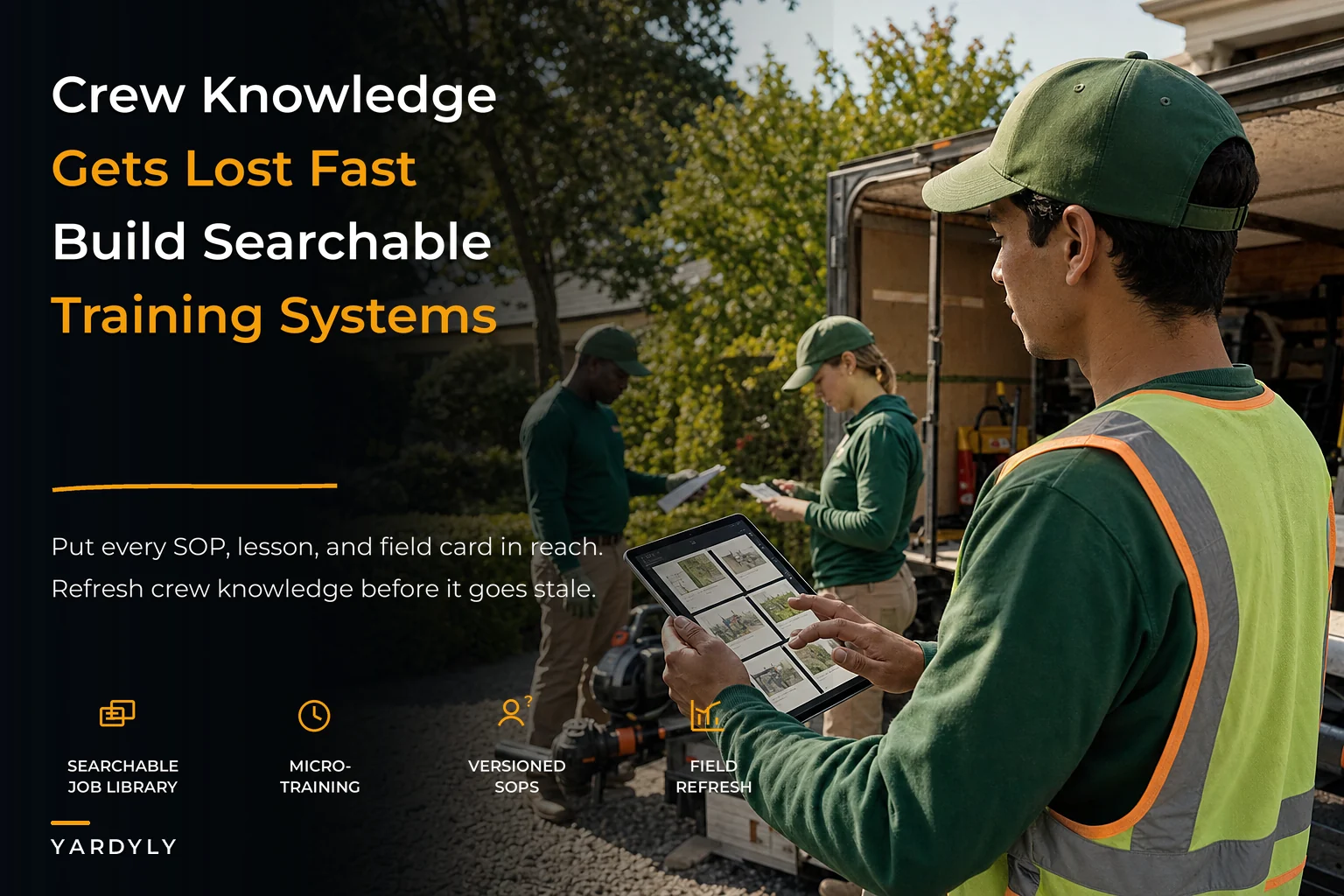
1. Version control. Every procedure needs a version number, a "last reviewed" date, and a single source of truth. When a crew opens the bed‑edging SOP, they should see v3.2, updated in March, owned by the operations lead — not a mystery doc with no history. This alone kills most of the "which version is real" confusion.
-
2. On‑demand micro‑training. Full training binders don't get used mid‑season. What crews actually need is a two‑minute module on one task, available when they hit it. This connects directly to the micro‑certification approach covered in the 7‑Day Field‑Ready Onboarding for Seasonal Crew — short, verifiable, task‑specific chunks instead of a day‑long firehose nobody retains.
-
3. Quick‑reference field cards. Not the full SOP — the stripped‑down version a crew member checks on their phone while standing in a bed. Tolerances, torque specs, dilution ratios, the three photos required before and after. The field card is the SOP's working surface.
-
4. A refresh cadence. Content that never gets reviewed rots. Every piece of the library needs a scheduled review — quarterly for high‑change items like chemicals and pricing, annually for stable stuff like equipment startup.
Miss any one of these and the whole thing degrades. Version control without a refresh cadence just means your outdated doc has a tidy version number. Micro‑training without field cards means people learn something once and have nothing to reference later.
Surface the "last reviewed" date in search results so crews can see currency before opening a doc.
Version control without a refresh cadence just means your outdated doc has a tidy version number. Micro‑training without field cards means people learn something once and have nothing to reference later.
Building the library taxonomy (the part everyone skips)
Before you write or migrate a single procedure, decide how the library is organized. This is the step that determines whether anyone can find anything, and it's almost always rushed.
-
1. Service category — Maintenance, Install, Irrigation, Chemical/Turf, Cleanup
-
2. Procedure type within that — Setup, Execution, Quality Check, Teardown, Safety
-
3. Asset level — the document itself, with its version, owner, and review date
-
4. Reference layer — the field card and micro‑cert module attached to that procedure
So a crew member looking for how to winterize irrigation navigates: Irrigation → Teardown → Winterization SOP (v2.1) → and sees the field card and the two‑minute cert module right there, attached.
Naming conventions matter more than they seem. Pick one and never break it:
-
Every document starts with its category code (IRR‑, MNT‑, CHM‑)
-
Version format stays consistent (v2.1 means minor update to major version 2)
-
"Last reviewed" date is mandatory and visible before the content opens
-
Each document names exactly one owner — not a department, a person
When libraries fail an audit, it's almost never because content was missing. It's because content existed but couldn't be found, or two documents claimed to be authoritative and nobody could tell which won. Taxonomy fixes both. This pairs well with deciding what to document first — the Prioritized SOP Playbook for Multi‑Crew Landscaping is a good companion for sequencing that.
Versioning rules that keep content honest
Versioning sounds bureaucratic until the first time an outdated procedure costs you a client or a compliance headache. Then it feels like insurance you wish you'd bought sooner.
-
Major version bump (v2 → v3) the procedure fundamentally changed — new chemical, new equipment, new client requirement
-
Minor version bump (v2.1 → v2.2) a clarification, a corrected step, a tightened tolerance
-
Change log entry required for every bump one line — what changed, who changed it, why
-
Old versions archived, not deleted so when a dispute references "what we did in April," you can actually check
The change log is the piece people resist and the piece that saves them. When a crew lead says "the SOP never said to do that," you open the log and settle it in ten seconds instead of relitigating it in a meeting.
One practical rule: a version bump should trigger a review of the attached field card and micro‑cert module. If the SOP changed but the field card still shows the old dilution ratio, you've just created the exact drift the whole system exists to prevent. Keep the three in sync or they'll undercut each other.
Where the right tools quietly earn their keep
You can run this on a shared drive and a spreadsheet, and plenty of two‑crew shops do. But the maintenance burden grows fast. Around four crews, keeping versions synced, field cards aligned, and review dates tracked by hand becomes its own part‑time job — usually dumped on whoever's already overloaded.
That's where operational software with AI‑assisted workflows starts to matter, not as a gimmick but as a way to remove the manual bookkeeping. A good platform makes the library searchable in plain language ("how do we blow out irrigation lines?" instead of hunting through folders), flags documents whose review date has passed, and surfaces the right field card based on the job type a crew is dispatched to. AI automation can also draft change‑log summaries and catch where a field card no longer matches its parent SOP — the kind of drift a human reviewer misses because there's simply too much to cross‑check manually.
Here’s a simple workflow showing how the library, field cards, micro‑training, review cadence, and automation connect.
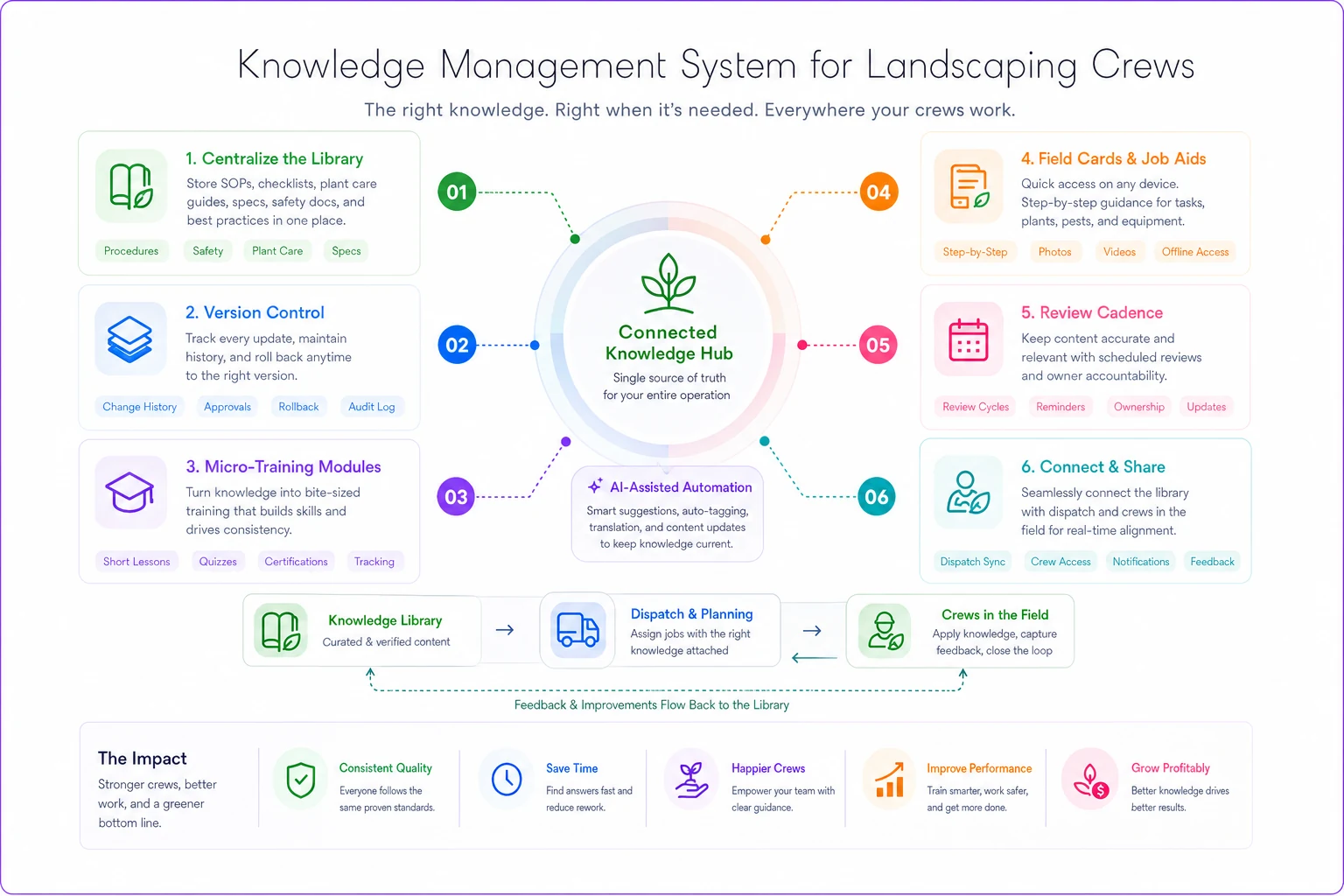
The point isn't to automate judgment. Someone still owns each procedure and decides what's correct. The automation handles the tedious part — tracking, flagging, matching, reminding — so the knowledge system doesn't quietly rot the moment everyone gets busy, which is exactly when it always does.
A real scenario
A six‑crew maintenance and install company kept losing time to the same issue: new seasonal hires and existing crews doing identical services differently, which showed up as inconsistent quality scores and client callbacks.
Their "library" was a shared drive with around 40 documents, maybe half of them current, none version‑tracked. Onboarding a seasonal hire took close to two weeks before they were reliably field‑ready, mostly because training depended on whichever lead had time that day.
They rebuilt it over a slow off‑season. Taxonomy first, then version numbers and owners on every document, then a review cadence — quarterly for chemical and pricing, annual for equipment. They attached a short field card and a two‑minute cert module to the highest‑traffic procedures.
The changes weren't dramatic on paper but they stacked up. Field‑ready onboarding dropped to roughly nine or ten days because new hires could work through the micro modules instead of waiting for a lead. Callbacks on the services they'd standardized dropped noticeably the following season. The arguments about "which way is right" mostly stopped, because the change log answered it. Nothing miraculous — just a system that held its shape under pressure instead of drifting apart every spring.
When this is worth it — and when it isn't
When it makes sense: You're running three or more crews, onboarding seasonal labor every year, or seeing quality that swings by crew. Those are signs that knowledge is fragmenting faster than you can patch it by hand. The payoff is real at that stage.
When it's overkill: A solo operator or a tight two‑person outfit where the owner is on every job doesn't need version control and a taxonomy yet. Proximity is still doing the work. Building a formal system now is effort spent on a problem you don't have — though keeping a handful of clean, dated SOPs makes the eventual transition a lot smoother.
Who should NOT start here: If your core services aren't defined yet — if you're still figuring out how you want work done — don't formalize the chaos. Standardize the handful of procedures you're confident in first, document those properly, and expand the library as your methods settle. Locking in a bad procedure with a tidy version number just makes the wrong thing official.
The deeper you get into skills tracking and pay, the more this ties into career progression too — the Technician Skills Matrix & Career Ladder approach uses the same micro‑cert building blocks, so a well‑built library feeds directly into how you promote and pay people.
The through‑line
Knowledge management isn't a documentation project you finish. It's a maintenance habit, like sharpening blades or rotating tires. The companies that stay consistent across crews aren't the ones with the most SOPs — they're the ones whose library people actually trust, because it's current, findable, and owned.
Get the four pieces working together — versioning, micro‑training, field cards, and a refresh cadence — and the tribal knowledge in your best crew lead's head stops being a single point of failure. It becomes something the whole operation can run on, even on the day that lead doesn't show up.
Get the four pieces working together — versioning, micro‑training, field cards, and a refresh cadence — and the tribal knowledge in your best crew lead's head stops being a single point of failure. It becomes something the whole operation can run on, even on the day that lead doesn't show up.
Ready to grow your landscaping business?
Join 2,000+ landscaping pros using Yardyly to save time, reduce task chaos, and deliver outstanding client results.