

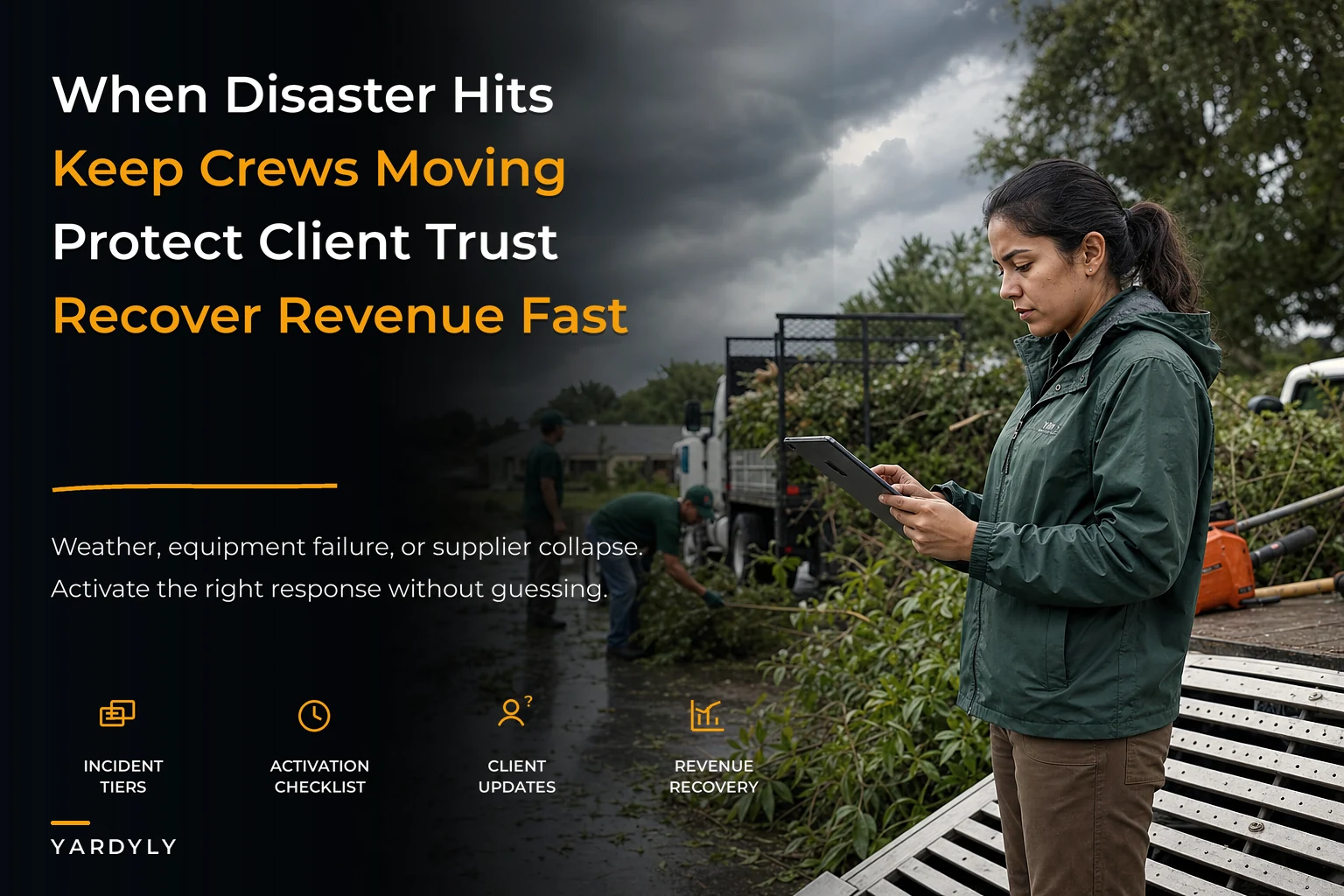

Most landscaping businesses don't fail during a disaster. They fail in the three days after it, when the phone won't stop ringing, half the crew is stuck, one truck is dead, and nobody knows what to do first. The event itself is short. The scramble is long, and that's where you bleed money, clients, and crew trust.
Business continuity for landscapers isn't one plan — it's three or four completely different failure types that happen to share a filing cabinet. A derecho that snaps trees across your whole route is nothing like your primary mower dealer going out of business, which is nothing like a mulch supplier that suddenly can't fill orders in peak season. Each one breaks a different part of your operation. Build a single "emergency plan" that treats them the same and you'll grab the wrong checklist at the worst possible moment.
This article is less about disaster prep in the abstract and more about how the whole system holds together — or falls apart — when one piece gets yanked out. We'll cover the three disaster types that actually hit small crews, how they cascade through the business, and how to build tiered plans you can activate in minutes instead of hours.
Why "we'll figure it out" stops working past two crews
A solo operator or a one-crew shop can improvise through a disaster. The owner knows every client, every job's priority, where every piece of equipment is, and which supplier owes them a favor. That works because all the knowledge lives in one head.
That model quietly dies somewhere around the second or third crew. Now the owner is across town when the storm hits, the office person doesn't know which commercial accounts have contractual response windows, and two crew leads are making independent calls about which jobs to abandon. Everybody's working hard. Nobody's coordinated. That's the real failure mode — not the disaster itself, but the collapse of a single decision-maker who could see the whole board.
The businesses that recover fast aren't the ones with the most equipment or the deepest cash reserves. They're the ones where a crew lead can pull up a laminated card or a phone screen and know exactly what tier they're in, who to call, and what to do first. The decision was made before the chaos. During the chaos, they're just executing.
What breaks at scale isn't your ability to work hard. It's your ability to make fast, consistent decisions across people who can't all talk to each other in real time. Continuity planning is really just pre-deciding those calls.
The three disaster types and how each one cascades
Weather is a demand and supply shock at once. A big storm can wipe out access to jobs while simultaneously flooding you with cleanup and emergency requests. Your existing schedule becomes worthless in an afternoon, and you're suddenly triaging a pile of new work with a crew that may itself be dealing with damage at home. We've covered the day-of decision logic in our service-type by storm-severity decision matrix — continuity planning picks up where that leaves off, covering the multi-day recovery after the storm passes.
Never miss a job detail again.
Yardyly helps you plan, confirm, and manage every landscaping project seamlessly.
- Centralized project scheduling
- Automated client updates
- Crew and resource management
No credit card required
Major equipment failure is a slow-motion capacity leak. When your primary zero-turn or only skid steer dies in June, you don't lose everything at once — you lose maybe 30–40% of your daily throughput, and it compounds every day the machine sits down. This is the disaster people prepare for least because it doesn't feel like an emergency at first. It feels like an inconvenience, right up until you're four days behind and clients are canceling. If you don't already have replacement thresholds mapped out, our piece on equipment lifecycle thresholds and CapEx forecasting is worth reading alongside this one.
Supplier collapse is the sneakiest. Your mulch, sod, plant, or hardscape supplier goes dark — maybe they're out of stock for weeks, maybe they close entirely. There's no dramatic moment. You just quietly can't fulfill installs you've already sold, sometimes ones with signed contracts and collected deposits. This one damages your reputation before you even realize you're in a crisis, because the client's expecting a Tuesday install and you're on the phone begging three other yards for pallets.
The mistake almost everyone makes is preparing only for the loud disaster (weather) and getting blindsided by the quiet ones. Equipment failure and supplier issues happen more often and cost more over a full season.
Building tiered plans instead of one big binder
A single all-purpose emergency plan is too heavy to actually use. What works is tiering by severity, so activation is a quick judgment call rather than a research project.
| Tier | Trigger | Operational impact | Who activates |
|---|---|---|---|
| Tier 1 – Disruption | 1 day of lost capacity, single machine down, one supplier delayed | Reshuffle within the week, no client impact yet | Crew lead |
| Tier 2 – Serious | 2–4 days lost, multiple jobs affected, deposits at risk | Reprioritize whole schedule, proactive client calls | Ops manager / owner |
| Tier 3 – Critical | Week+ recovery, contractual SLAs at risk, revenue threat | Full recovery mode, cash and vendor decisions | Owner only |
The value of tiering is speed. When something breaks, the first question isn't "what do we do?" — it's "what tier is this?" That single question routes the right people to the right checklist and stops crew leads from either panicking over a Tier 1 or shrugging off a Tier 3.
Worth noting: most shops set their tier thresholds too high. They treat a machine down for two days as no big deal. But in peak season, two days of lost mowing capacity across a full route is easily $2k–$3k in delayed revenue, plus the goodwill cost of reschedules. Set your triggers based on how your season actually feels, not how it feels in April when you still have slack.
Quick activation checklists that work under stress
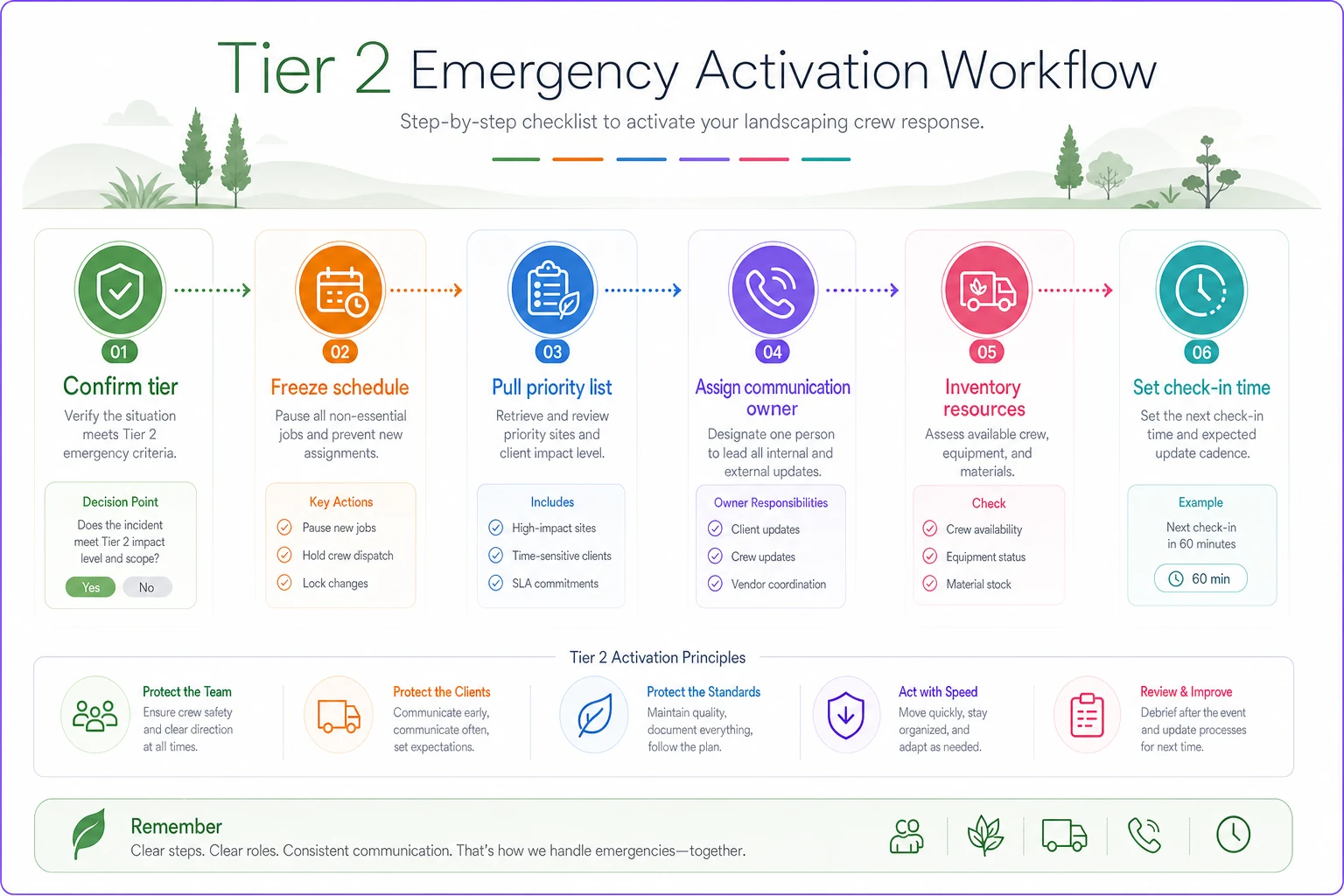
A checklist you're using during a crisis has to be short enough to run from a truck cab. If it's a two-page document, nobody reads it. The goal is the first 30 minutes — not the whole recovery.
-
Confirm the tier out loud. One person names it so everyone's working from the same severity level.
-
Freeze the current schedule. Stop crews from starting new work until things get reprioritized — otherwise you burn hours on low-priority jobs while urgent ones slip.
-
Pull the priority list. Which clients have contractual response windows, medical or safety needs, or time-sensitive events? These go first, always.
-
Assign one communication owner. A single person handles client messaging so you're not sending mixed signals from three different phones.
-
Inventory what you actually have. Working equipment, available crew, accessible supplies. Not what you should have — what's real right now.
-
Set a check-in time. Everyone reconvenes — call or text — at a fixed hour so the plan can adjust as new information comes in.
Notice what's not on there: solving the whole problem. The activation checklist just gets you organized and stops the bleeding. Recovery sequencing is a slower, more deliberate process that comes next.
A quick visual of the activation workflow can help crew leads run the checklist from a truck cab.
Notice what's not on there: solving the whole problem. The activation checklist just gets you organized and stops the bleeding. Recovery sequencing is a slower, more deliberate process that comes next.
Prioritized recovery sequencing: what order to dig out
Once you're stabilized, the order you rebuild in determines how much you lose. A lot of crews go wrong here — they work in the order clients yell loudest, not the order that actually protects the business.
-
Contractual and safety-critical work first. Commercial accounts with SLAs, anything that's a liability if left undone — blocked access, hazard trees, drainage issues. These carry penalties or legal risk.
-
High-value recurring clients. The accounts that make up a big chunk of your monthly revenue. Losing one of these to a competitor during recovery costs far more than one missed job.
-
Deposits already collected. Jobs where the client has paid and is waiting. Protecting these protects your cash position and your reviews.
-
Standard recurring maintenance. The bread-and-butter mowing and upkeep — important, but it can flex a few days without turning into a real problem.
-
New leads and one-off work. Painful to defer, but these haven't been promised anything yet, so they cost the least to push.
"First come, first served" is a trap during recovery. The client who calls first is rarely the one who costs you the most to disappoint. Map your sequence before the disaster so you're not making these calls emotionally at 6 a.m. with an angry voicemail in your ear.
For equipment failure specifically, the sequence shifts slightly. You're not choosing which clients to serve — you're choosing which jobs match your reduced capacity. A dead mower means you route the smaller, faster properties to your remaining machine and push the big estates that would eat your whole day.
Client communication templates that hold trust together
Silence is what actually loses clients during a disaster — not the delay itself. The shops that keep clients through a rough week are the ones that got ahead of the message before the client had to chase them down.
Three templates cover most situations. Keep them saved and ready, because writing them thoughtfully at hour zero of a crisis never actually happens.
Weather / proactive delay: "Hi [Name], the storm this week has affected access across our routes. Your service is currently rescheduled for [date]. Safety-critical and contracted work is being handled first, and we'll confirm your exact window by [day]. Thanks for your patience — we'll keep you posted."
Equipment failure (focus on the impact, not the internal problem): "Hi [Name], we're running behind on your area this week due to an operational issue on our end. We expect to be back to your property by [date]. If anything's time-sensitive, reply here and we'll prioritize."
Supplier issue on a promised install: "Hi [Name], we've hit a materials delay from our supplier that affects your install date. We're sourcing an alternative and expect to confirm a new date within [X days]. Your deposit is secure and nothing changes on your end — we just want to be upfront early."
The pattern across all three: name the impact, give a date even if it's rough, state what's being protected, and commit to a next update. Vague reassurance does more damage than an honest delay.
Where information falls apart — and how to keep it from doing so
During a disaster, the knowledge you need is scattered. Client priority lists are in the owner's head. Supplier backup contacts are in someone's phone. Which properties have gate codes or hazard notes is in a paper folder in a truck that's stuck across town.
This is the real argument for keeping operational data centralized — not because software saves you during a disaster (it doesn't, people do), but because when a crew lead can pull up a property's priority level, contract terms, hazard notes, and contact preferences from a phone, the tier system actually works. When that information lives in five places, your carefully built recovery sequence collapses into guesswork.
Store a client priority ranking, backup supplier contacts, and per-property notes somewhere every crew lead can reach.
AI-powered operational platforms can help here in a real way — not by making decisions during a crisis, but by keeping client priorities, supplier contacts, and per-property notes organized and accessible before one ever happens. The businesses that recover cleanly tend to have three things stored somewhere every crew lead can reach: a client priority ranking, backup supplier contacts, and per-property notes. Whether that's a shared software platform or a well-maintained set of records, decisions made in advance are useless if the person making the call can't see them.
A real scenario: when the primary dealer folded mid-season
A three-crew maintenance and install shop in the Midwest had built their whole operation around one equipment dealer — sales, service, and warranty all through one relationship. In late June that dealer abruptly closed. Two mowers were mid-repair and stuck in a locked shop, and their next machine order evaporated.
For about a week and a half, they were running three crews' worth of work on essentially two crews' worth of functioning equipment. The first few days were pure chaos — jobs slipping, crews idle waiting on machines that weren't coming, and nobody sure which accounts to protect. They estimated losses somewhere in the range of $4k–$6k in delayed and canceled work during that stretch.
What turned it around wasn't heroics. The owner built a rough tier system on the fly: contracted commercial accounts and deposit-paid installs got the working equipment, standard mowing got pushed with proactive texts, and new leads got a two-week hold. They rented a mower to bridge capacity and lined up two backup dealers before the month ended. The following season, backup supplier contacts were documented and a one-page recovery sequence was taped inside every truck. When a smaller equipment breakdown hit that August, they were back on schedule in under two days with almost no client fallout.
The lesson wasn't "have more equipment." It was "have the plan written down before you need it."
When heavy continuity planning makes sense — and when it doesn't
If you're a solo operator or running a single crew, you don't need a three-tier binder system. You need backup supplier contacts, a rented-equipment plan, and a savings buffer. Improvisation still works at that size, and over-engineering a plan you'll never open is just busywork.
The tier system starts earning its keep at two-plus crews, when no single person can see the whole operation during a crisis. That's the inflection point where pre-made decisions and accessible records stop being nice-to-have and start being the difference between a bad week and a lost month.
One more thing worth saying: if your regular week is already firefighting, a disaster plan won't save you — it'll just be another document nobody opens. Get the daily operation stable first, then build the continuity layer on top of that.
Pulling it together
Business continuity for landscapers isn't about predicting disasters. It's about pre-deciding the calls you'd otherwise make badly under pressure — which jobs come first, who talks to clients, when you spend money on rentals or backup suppliers, and what tier of response a given failure deserves.
The three disaster types each break your operation differently. Weather overwhelms you with simultaneous demand and access problems. Equipment failure slowly drains your capacity in a way that's easy to underestimate until you're buried. Supplier collapse quietly torpedoes work you've already sold. A single generic plan can't handle all three well, which is why tiering by severity and keeping short activation checklists beats one heavy binder every time.
Build the priority ranking, the backup contacts, and the communication templates while things are calm. Store them somewhere every crew lead can actually reach. Then when the storm hits or the mower dies or the mulch never shows up, your team isn't inventing a response — they're just running the one you already made.
Business continuity for landscapers isn't about predicting disasters. It's about pre-deciding the calls you'd otherwise make badly under pressure — which jobs come first, who talks to clients, when you spend money on rentals or backup suppliers, and what tier of response a given failure deserves.
Build the priority ranking, the backup contacts, and the communication templates while things are calm. Store them somewhere every crew lead can actually reach. Then when the storm hits or the mower dies or the mulch never shows up, your team isn't inventing a response — they're just running the one you already made.
Ready to grow your landscaping business?
Join 2,000+ landscaping pros using Yardyly to save time, reduce task chaos, and deliver outstanding client results.