


Weather decisions in landscaping aren't just about checking if it's raining. A light drizzle during spring mulch installation means nothing, but that same drizzle during fungicide application ruins the entire treatment. Meanwhile, your fertilization crew sits idle because you canceled based on morning radar, only to watch perfect conditions roll in by 10am.
The real problem isn't weather itself—it's inconsistent calls that confuse crews, frustrate clients, and leave money on the table. You need a weather policy your teams can actually follow, not vague "use your judgment" guidelines that produce different decisions from different crew leaders every single week.
Why Standard Weather Policies Fail in Landscaping
Most landscaping companies run on informal weather rules. The owner checks radar in the morning, crews text photos of conditions, and everyone hopes for the best. This breaks down fast when you're managing multiple service types across different zones.
A hardscaping crew working paver installation needs completely different thresholds than a maintenance crew doing weekly mows. Chemical applications have regulatory restrictions baked in. Design installations have material considerations. Each service type responds differently to weather, yet most companies apply one blanket policy across all of them.
The financial hit compounds quickly. Cancel too early and you're paying crews to sit home during workable conditions. Push too hard and you're dealing with callbacks from damaged turf, unsafe conditions, or chemical treatments that didn't take. One landscaper running five crews tracked weather-related decisions for a month and found roughly $14,000 in lost billable hours from overcautious cancellations—while still getting complaints about working in marginal conditions.
Building Your Service-Type Weather Matrix
Different services need different thresholds. Here's a working matrix based on what actually happens in the field:
Never miss a job detail again.
Yardyly helps you plan, confirm, and manage every landscaping project seamlessly.
- Centralized project scheduling
- Automated client updates
- Crew and resource management
No credit card required
Mowing and Maintenance Services
| Condition | Decision | Modifications | Notes |
|---|---|---|---|
| Light Rain (< 0.1"/hr) | Continue service | Skip bagging; inform client about clumping | Monitor slopes for slick surfaces |
| Moderate Rain (0.1"–0.25"/hr) | Case by case | Depends on slope and soil saturation | Notify client about potential cut quality |
| Heavy Rain (> 0.25"/hr) | Suspend service | Redeploy to shop maintenance | Low reschedule priority—weekly service has flexibility |
| Wind 15–25 mph | Continue | Monitor debris | — |
| Wind 25–35 mph | Suspend trimming near structures | — | — |
| Wind 35+ mph | Full suspension | — | — |
Chemical Applications
| Condition | Rule |
|---|---|
| Herbicides | 2-hour dry window required post-application |
| Fungicides | 4-hour dry window minimum |
| Granular fertilizer | Can apply if rain expected within 24 hours |
| Liquid fertilizer | Requires 6-hour dry window |
| Above 85°F | No broadleaf herbicide applications |
| Below 50°F | Most post-emergent herbicides are ineffective |
| Below 40°F | Suspend all chemical applications |
| Wind 10+ mph | No spray applications (regulatory requirement in most states) |
| Wind 5–10 mph | Use drift reduction nozzles; increase droplet size |
| Wind under 5 mph | Check for inversions—early morning risk |
Hardscaping and Installation
| Service | Weather Rule |
|---|---|
| Concrete/mortar work | No work if rain expected within 24 hours; temp must stay above 40°F for 48 hours post-pour |
| Paver base prep | No work during any precipitation |
| Setting pavers | Light rain acceptable |
| Polymeric sand | Requires 24-hour dry forecast |
| Planting operations | Light rain is ideal; heavy rain causes soil compaction; frozen ground = full stop |
The decision flow below distills these thresholds into a quick field workflow.
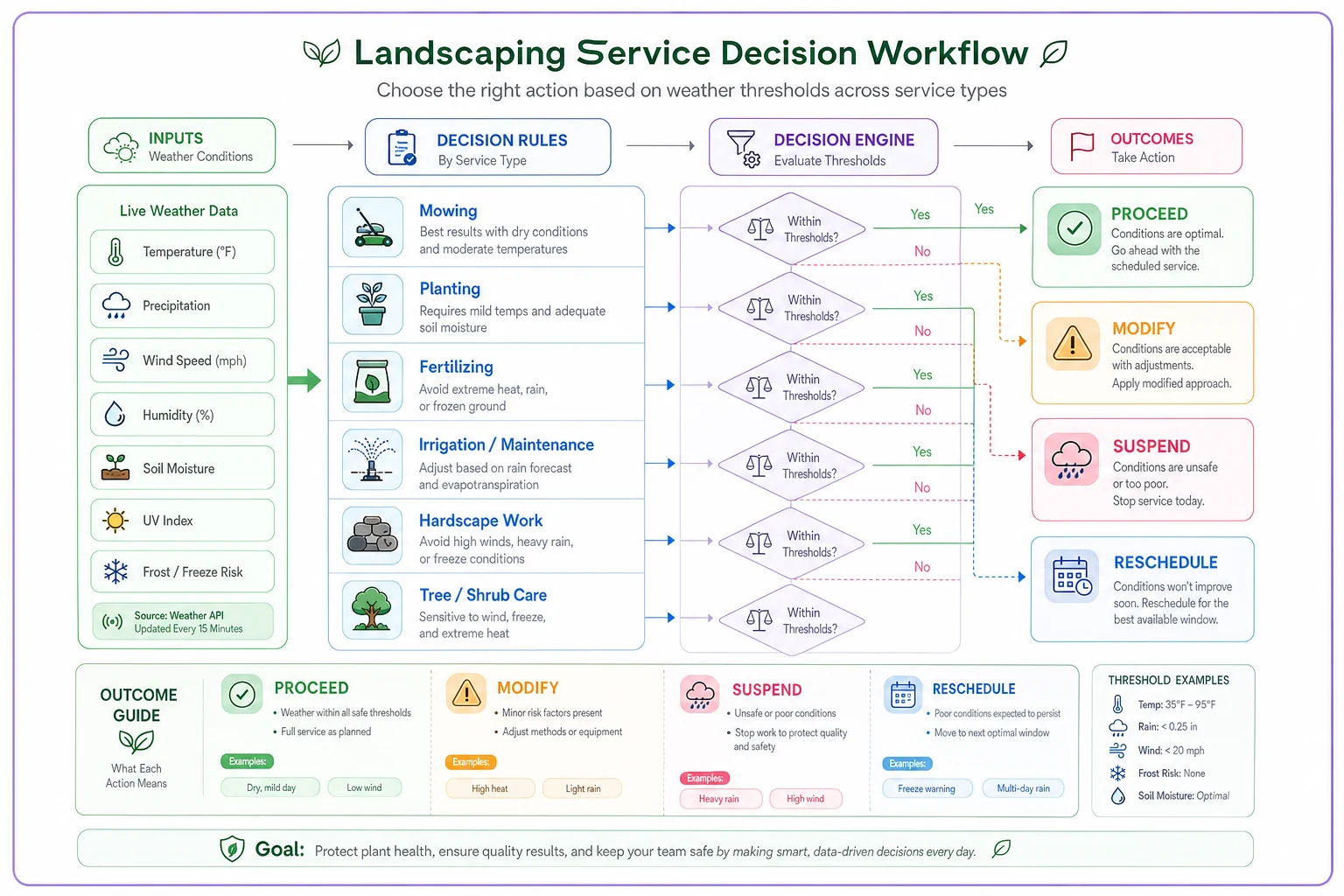
Use this workflow for morning calls and deployment planning.
Customer Communication Templates That Actually Work
Clear communication prevents most weather-related conflicts. Generic messages—the ones that just say "due to weather, we're rescheduling"—create more confusion than they resolve. Your notices need to set expectations while still leaving room for field decisions.
Night-Before Notice (High Probability) "Tomorrow's forecast shows [specific condition] starting around [time]. Your [service type] is tentatively rescheduled to [date]. We'll confirm by 7am if conditions improve. This ensures the best results for your property and crew safety."
Morning Confirmation "Weather update: We're proceeding with modified service today. [Specific modification, e.g., 'We'll mow but skip bagging due to wet conditions']. This prevents turf damage while maintaining your property's appearance."
Post-Service Weather Note "Service completed despite challenging conditions. You may notice [specific issue, e.g., 'minor track marks in softer areas']. These will self-correct within [timeframe]. Contact us if you have concerns."
The difference from standard templates is specificity—name exactly what changes and why. Clients accept weather delays when they understand the reasoning. Vague messages trigger complaints. Specific ones don't.
Rescheduling Priority Rules That Balance Revenue and Relationships
Not all postponements are equal. Your rescheduling matrix needs to account for service windows, client flexibility, and revenue protection.
Priority Level 1: Time-Sensitive Services These can't wait. Pre-emergent applications have narrow windows. Event prep for weddings and parties has a hard deadline. Commercial properties often have contractual requirements. New installations with live plant material have even less margin for error. Reschedule within 48 hours, overtime authorized if needed.
Priority Level 2: Regular Maintenance with Flexibility Weekly mowing can push one to two days. Bi-weekly maintenance, pruning without specific deadlines, and mulch installation all fall here. Reschedule within standard rotation and compress routes if possible.
Priority Level 3: Non-Urgent Services Fall cleanups, dormant pruning, soil amendments, design consultations—these have wide windows. Push to next available opening and communicate an extended timeline up front.
The real challenge comes when everything backs up. After three straight rain days, you might have 200 properties needing service. Without clear priorities, crews start cherry-picking easy jobs or nearby properties, leaving time-sensitive work sitting undone.
Capacity Rules: When to Call It vs. Push Through
The hardest decisions happen in marginal conditions. It's 6am, radar shows scattered showers, and five crews are waiting for direction. A structured decision framework cuts down those gray-area calls.
The 60/40 Rule If conditions allow 60% productivity for more than 40% of the day, deploy crews with modified service plans. This prevents the all-or-nothing mentality that kills profitability.
Example: Light morning showers clearing by 10am. Instead of canceling, start crews at 10am with adjusted routes. You'll complete 60–70% of normal capacity versus zero if everyone stays home.
Partial Crew Deployment
-
Chemical crews — hold if any precipitation is present
-
Mowing crews — deploy to properties with good drainage
-
Installation crews — shift to shop prep, material runs, equipment maintenance
-
Design team — use the time for site visits, estimates, planning work
The Two-Hour Window Make initial calls based on two-hour forecast windows, not full-day predictions. Weather changes fast, and afternoon conditions often look nothing like what the morning radar suggested.
-
5
30am: Initial assessment
-
7
30am: Deployment confirmation
-
10
00am: Afternoon adjustment
-
2
00pm: Next-day planning
Running this cycle keeps decisions tighter and reduces the "we canceled for nothing" situations that quietly kill morale.
Real Numbers from Weather Decision Tracking
A mid-sized maintenance company with six crews tracked every weather decision through the 2024 season. Their data revealed patterns most companies never bother looking for.
| Category | Result |
|---|---|
| Over-cancellation cost | $47,000 in lost billable hours |
| Under-cancellation impact | 14 damage claims totaling ~$8,400 |
| Year-two improvement | ~65% reduction in weather-related losses |
The biggest finding wasn't about the decisions themselves—it was communication. Clients who received specific updates with clear reasoning rarely complained, even through multiple reschedules. Generic messages triggered roughly three times more follow-up calls and complaints.
Who Should NOT Use This System
This structured approach doesn't work for everyone.
Skip it if you run a single crew doing one service type, your entire client base is within a five-mile radius, you only do project work with flexible timelines, or your market rarely sees meaningful weather disruptions.
For solo operators or single-service companies, complex matrices create unnecessary overhead. Basic thresholds and straightforward client communication will serve you better.
Implementing Without Overwhelming Your Team
Rolling this out takes gradual steps, not a full system launch on day one. Start with your biggest pain point—usually chemical applications or morning mowing decisions.
-
Weeks 1–2
Introduce service-type thresholds for your primary service
-
Weeks 3–4
Add customer communication templates
-
Weeks 5–6
Implement rescheduling priorities
-
Weeks 7–8
Roll out the full system across all service types
Train crew leaders to make decisions within the framework without waiting for owner approval. That 6am bottleneck—where everyone's texting the owner for direction—breaks the whole system. Crew leaders need clear authority to call off specific services based on defined thresholds, not gut feel.
Document decisions and outcomes for the first month. You'll quickly see which thresholds need adjustment for your market. Mountain properties need different wind thresholds than coastal areas. Clay soil regions need different rain delays than sandy soils.
Technology Integration for Consistency
Manual weather monitoring creates natural inconsistencies. One person's "light rain" is another's "moderate shower." Operational software with integrated weather monitoring helps close that gap.
Modern platforms can pull local weather data directly into your scheduling system, automatically flagging services that hit threshold conditions. Instead of checking multiple apps and making gut calls, you get consistent recommendations tied to your predetermined matrix.
Automate customer notices to send the exact template tied to each threshold so clients get clear, consistent reasons for changes.
The automation extends to customer communication too. When weather triggers service modifications, the system can automatically send appropriate client notices using your templates. Crews get updated routes that reflect weather-appropriate services. Rescheduling follows priority rules, not whoever calls the office first.
For multi-location operations, this consistency becomes critical. Your north-side crews might face entirely different conditions than south-side teams. Centralized weather monitoring with location-specific thresholds keeps everyone working from the same playbook while still accounting for microclimate differences.
Seasonal Adjustments and Pattern Recognition
Weather policies need seasonal calibration. Spring's saturated soil requires different thresholds than summer's dry conditions. Fall leaf removal has different wind tolerances than summer mowing.
Spring Adjustments
-
Lower rain thresholds due to already-saturated soil
-
Extended chemical application windows
-
Tighter scheduling for pre-emergent windows
Summer Modifications
-
Higher heat thresholds push start times earlier
-
Afternoon storm patterns influence morning loading decisions
-
Irrigation coordination becomes more critical
Fall Considerations
-
Wind thresholds increase for leaf cleanup operations
-
Shorter daylight limits makeup capacity
-
Freeze warnings create installation rushes that need to be anticipated
Companies that adjust thresholds seasonally report better crew buy-in and fewer weather-related conflicts. Static year-round policies ignore operational reality.
Beyond Basic Weather: Secondary Factors
Raw weather data only tells part of the story. Previous conditions matter just as much as current ones.
Soil Saturation Index Three days after heavy rain, soil might still be too soft for mowing even under clear skies. Track cumulative precipitation over 72 hours, not just what's happening right now.
Dew Point Delays Morning dew can delay mowing operations by two to three hours even in otherwise perfect weather. Properties with heavy shade or poor air circulation need later start times built into the schedule.
Sequential Service Impacts If you aerated yesterday and rain is forecast tomorrow, today's fertilizer application becomes critical to get right. Your weather matrix needs to account for service sequences, not just individual treatments in isolation.
Equipment Limitations Zero-turn mowers handle wet conditions differently than walk-behinds. Your fleet composition directly influences your thresholds. Companies running all stand-on mowers can work in conditions that would sideline traditional riders.
The Competitive Advantage of Clear Weather Policies
While competitors make random weather calls that frustrate clients and crew leaders alike, a systematic approach creates predictable operations. Clients learn to trust your judgment when decisions follow consistent logic. Crews stop second-guessing morning calls when they understand the reasoning behind them.
You also capture revenue others leave behind. When competitors blindly cancel for "rain in the forecast," you're selectively deploying crews to weather-appropriate services. Those 60% productivity days add up over a full season.
Companies with documented weather policies report roughly 20% more billable hours during marginal weather periods compared to those making ad-hoc decisions. For a typical five-crew operation, that's somewhere in the $30,000–$50,000 range in additional annual revenue.
Your weather policy also becomes a selling point during estimates. Commercial clients especially value operational maturity—the ability to explain exactly how you handle weather decisions rather than shrugging and saying "it depends."
Weather will always create challenges in landscaping. But the difference between profitable companies and those scraping by often comes down to making consistent, defensible decisions when conditions get marginal. Build your matrix, train your team, communicate clearly with clients, and weather goes from your biggest operational headache to a manageable variable.
Ready to grow your landscaping business?
Join 2,000+ landscaping pros using Yardyly to save time, reduce task chaos, and deliver outstanding client results.