


Your best landscaping client just texted their neighbor your number. That referral will probably close at three times the rate of a cold lead and spend more annually. But most landscaping companies have zero process for making that happen consistently.
The customer lifecycle in landscaping isn't just about getting jobs done. It's about building an operational machine that systematically transforms one-time mowing customers into clients paying for weekly maintenance, seasonal cleanups, hardscaping projects — and sending you their entire street.
Companies that document their handoff points between sales, service, and renewal generate significantly more revenue per client over two years. Not because they're better at landscaping. Because they're better at operational continuity.
The Four Critical Handoff Points That Make or Break Client Value
Most landscaping businesses treat each customer interaction as a separate event. Sales closes a deal, crews show up, someone sends an invoice, maybe you follow up next season. Each part of the business operates in its own bubble.
What actually drives customer lifetime value is the quality of information moving between those touchpoints. A sales rep promises bi-weekly edging but doesn't write it down. The crew chief doesn't know Mrs. Johnson's dog needs to be inside before leaf blowing starts. Nobody captures that the client mentioned interest in a paver patio "maybe next year."
These aren't just missed opportunities — they're operational failures that compound. When your spring cleanup crew doesn't know a client complained about fall cleanup pricing, you lose the renewal. When nobody tells sales that a maintenance client asked about landscape lighting, you miss the upsell.
The fix isn't complicated, but it requires discipline. You need one-page SOPs that define exactly what information moves forward at each handoff, who owns that transfer, and how you verify it happened. Think of it like a relay race where dropping the baton costs you $4,000 in annual contract value.
Sales to Onboarding: The First 48 Hours Set the Tone
Here's what typically happens after a sale closes: sales celebrates, adds it to the schedule, maybe sends a confirmation email. The crew shows up whenever they can fit it in, often without knowing what was actually sold or promised.
Never miss a job detail again.
Yardyly helps you plan, confirm, and manage every landscaping project seamlessly.
- Centralized project scheduling
- Automated client updates
- Crew and resource management
No credit card required
The gap between what sales sells and what operations delivers kills more landscaping businesses than weather. Sales promises "weekly touch-ups of flower beds" but ops thinks it's just mowing. Sales quotes "haul-away included" but the crew leaves clippings. These disconnects happen because there's no formal handoff process.
Your sales-to-onboarding SOP should capture:
Information Transfer Requirements:
-
Exact services sold with frequencies
-
Special requests or restrictions documented
-
Gate codes, pet warnings, parking instructions
-
Preferred communication method
-
Budget discussions or future project interests
-
Any verbal promises or clarifications made
Measurable Handoff Criteria:
-
Property walkthrough completed with photos
-
Service checklist reviewed with client
-
First service date confirmed 24 hours prior
-
Crew briefed on special requirements
-
Welcome packet sent with service calendar
The key is making this transfer systematic, not relying on sales reps to remember details or crews to ask the right questions. One landscaping company in Virginia started using a simple Google Form that sales completes during the final conversation. Takes about three minutes and prevents the majority of first-service issues.
Service to Service: Maintaining Operational Memory
The biggest profit leaks happen during the service phase — not because of bad work, but because of information loss. Your crew notices drainage issues that would be perfect for French drain work, but nobody tells sales. A client mentions they're thinking about outdoor lighting, but it never makes it past the crew truck.
Most companies run on crew chief memory. Tony remembers the Smiths want the back gate kept closed. Maria knows to skip the side yard when it's wet. But when Tony's out sick or Maria switches routes, that institutional knowledge disappears with them.
This is where establishing clear communication protocols becomes important. Every service visit should generate a simple record:
Per-Visit Documentation:
-
Service completed checklist
-
Issues noticed (irrigation leaks, pest damage, thin turf)
-
Client interactions or requests
-
Upsell opportunities identified
-
Equipment or access problems
If you make this complicated, crews won't do it. The most effective system is a laminated card with checkboxes, or a phone app that takes 30 seconds to fill out. Crew chiefs snap a photo after each property. That's it.
Service to Renewal: Converting Satisfaction into Commitment
Renewal doesn't start when the contract ends. It starts with every service interaction, every problem resolution, every bit of unexpected value you deliver throughout the season. Companies hitting 85%+ renewal rates treat renewal as an operational process, not a sales event.
Most landscapers wait until March to think about renewals for April. By then, three competitors have already quoted your clients and you're playing defense. The customer lifecycle for landscaping requires you to start renewal conversations 60 to 90 days out — but more importantly, to have been building toward that renewal all season.
The 60-Day Renewal Sequence:
Day 60 before contract end:
-
Send service history summary showing all work completed
-
Include before/after photos from the season
-
Note any additional services provided at no charge
Day 45:
-
Call to discuss next season's needs
-
Present renewal pricing with any adjustments
-
Offer early renewal incentive (lock in current pricing, priority scheduling)
Day 30:
-
Send formal renewal agreement
-
Include service calendar for next season
-
Reference specific property improvements made
Day 15:
-
Follow-up call if not renewed
-
Address any concerns or budget issues
-
Offer modified service package if needed
Day 7:
-
Final renewal notice
-
Transition plan if not renewing
-
Request for feedback regardless of decision
The critical piece is defining measurable criteria for each stage. If a client hasn't responded by day 45, what triggers the next action? Who owns that follow-up? What's the escalation path? Without answers to those questions, the sequence falls apart.
Building Your One-Page SOPs
Complicated SOPs don't get followed. The landscaping companies that actually implement lifecycle management keep each SOP to a single page with three sections: triggers, actions, and verification.
Sales to Onboarding SOP Example:
Triggers:
-
Contract signed
-
Deposit received
-
Start date selected
Actions:
-
Sales completes client intake form (3 min)
-
Operations receives intake within 2 hours
-
Ops assigns crew and route within 24 hours
-
Welcome call made within 48 hours
-
First service reminder sent 24 hours prior
Verification:
-
Intake form timestamp
-
Crew assignment logged
-
Call log entry completed
-
SMS confirmation received
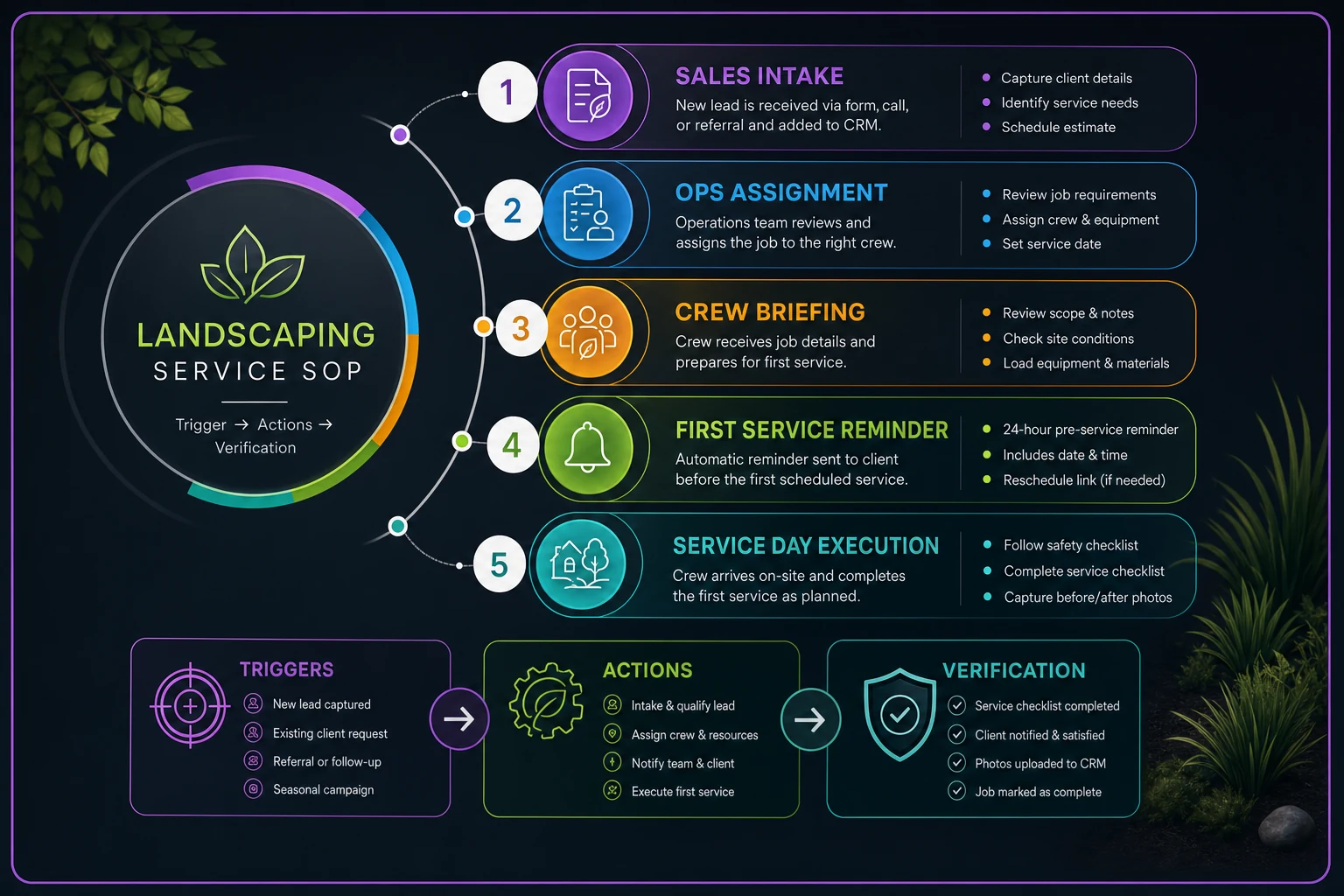
Use this quick visual to get the team aligned on the one-page SOP flow.
Keep language simple. Use checkboxes. Make it scannable. If someone needs more than 30 seconds to understand what to do, it's too complicated.
NPS and Follow-Up Templates That Actually Work
Net Promoter Score sounds corporate, but for landscaping it basically means: would you recommend us to your neighbor? Companies consistently growing through referrals ask this question systematically, not randomly.
Most get it wrong by sending generic surveys that feel like spam. "On a scale of 1-10..." Delete. Tie your follow-ups to specific service milestones instead:
After First Service:
"Hi [Name], wanted to make sure your first service went smoothly yesterday. Any issues we should know about? Just reply with a quick note."
Mid-Season Check:
"Hey [Name], we're halfway through the season. Your property is looking great, especially the front beds. Anything you'd like us to adjust for the second half?"
Post-Project:
"[Name], your patio project is complete! Would love to know how the experience was. Also, if any neighbors ask about it, happy to give them a similar deal."
End of Season:
"Thanks for trusting us this season, [Name]. If you had to describe our service to a neighbor in one sentence, what would you say?"
These feel like genuine check-ins rather than corporate surveys. They generate real responses that either surface problems to fix or open referral conversations naturally.
What Implementation Actually Looks Like
A landscape company in Atlanta implemented this lifecycle system a few years back — around $1.2M annually, mostly residential maintenance with some installation work. Pretty typical operation. Owner selling, two crew chiefs, seasonal labor, constant firefighting.
The first month was rough. Sales pushed back on intake forms ("I've been selling for 15 years, I know what information we need"). Crews ignored service documentation ("We don't have time for paperwork"). The owner almost scrapped the whole thing.
By month three, patterns started showing up. The intake form caught a gate code issue that would've meant a missed first service. Service documentation identified four irrigation repair opportunities worth over $3,000. The renewal sequence converted a dozen clients who were already planning to switch providers.
Year-end: revenue per client up around 28%, renewal rate climbed from 67% to 81%, referrals increased noticeably. But the real change was operational — instead of the owner handling every renewal personally, the process ran itself.
Where Operational Software Fits
When you have clear handoffs, documented interactions, and systematic follow-ups, every part of your operation improves. But managing all these touchpoints manually gets impossible as you scale past a certain point.
AI-powered operational software changes that equation. Instead of hoping your sales rep remembers to complete the intake form, the system prompts them automatically after marking a deal closed. Rather than crew chiefs filling out paperwork at the end of a long day, they voice-note observations that get transcribed and routed to the right person. The renewal sequence triggers automatically based on contract dates, with messages pulled from actual service history.
The intelligence layer means the system learns from patterns over time — noticing that properties with irrigation systems renew at higher rates when you do mid-summer system checks, or that clients who receive photo updates are far more likely to refer. Your ops meetings become strategic instead of just putting out fires.
This isn't about replacing human judgment. It's about making sure that judgment gets captured and acted on consistently. Your experienced crew chief still spots the drainage problem — but now that observation reliably reaches the person who can do something about it.
Common Lifecycle Breaks and Their Fixes
Common Lifecycle Breaks and Their Fixes
| Problem | Root Cause | Fix |
|---|---|---|
| Oversell Problem | Sales promises what ops can't consistently deliver | Monthly sales ride-alongs; ops input on service packages before client presentation |
| Memory Gap | Information lives in people's heads, not systems | Simple documentation requirements at each touchpoint, enforced through workflow tools |
| Renewal Scramble | Starting renewal conversations too late | Automated triggers based on contract dates, not calendar reminders |
| Silent Client | Not knowing a client is unhappy until they cancel | Proactive check-ins tied to service milestones, not random quarterly surveys |
| Missed Upsell | Crews see opportunities but don't communicate them | Simple opportunity flag system with commission sharing so there's actual incentive to report |
Use this quick reference during ops reviews to map fixes to the right handoff.
Making It Stick
Creating SOPs is easy. Getting them followed is the hard part.
The landscaping companies that successfully implement customer lifecycle management share three characteristics. They start small — pick one handoff point, usually sales to operations, and get that working before adding complexity. Quick wins buy the buy-in you need from the team.
They measure compliance, not just outcomes. Track whether intake forms are completed, not just whether first services go smoothly. Monitor renewal sequence execution, not just renewal rates. What gets measured gets managed.
Track intake form completion weekly to catch drops early.
They also iterate based on frontline feedback. Crews and sales reps will tell you what's broken — but only if you're actually listening and willing to adjust. The best SOPs are living documents, not laminated binders gathering dust on a shelf.
The Competitive Reality
Landscaping companies will eventually fall into two categories: those with systematic customer lifecycle management and those competing on price. The systematic operators charge more, retain clients longer, and grow through referrals. The price competitors chase new leads every season, deal with constant turnover, and struggle to understand why they can't scale.
The customer lifecycle for landscaping isn't just about keeping clients happy — it's about building operational infrastructure that compounds value over time. Every documented handoff, every captured insight, every systematic follow-up adds to an operational asset that makes your business harder to compete with.
Start with one handoff point. Document it. Measure it. Improve it. Then move to the next. The compound effect takes time, but the operational advantage it builds is durable.
Start with one handoff point. Document it. Measure it. Improve it. Then move to the next. The compound effect takes time, but the operational advantage it builds is durable.
Ready to grow your landscaping business?
Join 2,000+ landscaping pros using Yardyly to save time, reduce task chaos, and deliver outstanding client results.