



If you had a loader, a couple of mowers, or a truck on your 2027 purchase list — or if you were planning to buy out a competitor's maintenance book this winter — the ground just shifted under your financing plan. The SBA's SOP 50 10 8.1 went into effect October 1, 2026, and it quietly rewrote the math lenders use to say yes or no on 7(a) and 504 loans.
This isn't a "read it later" update. It changes how much you can borrow, how long approval takes, and how clean your books need to be before anyone cuts a check. For most landscaping owners, the practical fallout is straightforward: the money is slower and smaller than it was six months ago. The question is what you do about it in the next 30 days.
The short version of what changed
The official SBA information notice announcing SOP 50 10 8.1 lays out the full structure, but the parts that actually hit landscaping borrowers are these:
-
Higher DSCR floors. Debt service coverage ratio requirements went up. Lenders want to see more cushion between what you earn and what you'd owe.
-
Independent valuations and Quality‑of‑Earnings reviews on larger deals. If you're acquiring a business or doing a bigger equipment-plus-goodwill financing, expect a third party digging through your numbers.
-
Tighter equity source rules. Some of the creative ways people stacked their down payment or injected equity are now capped or disallowed.
-
Stricter change-of-ownership lending. Buying or selling a landscaping company through SBA financing now carries more diligence and tighter add-back rules.
A summary from Lenders Cooperative on what lenders are implementing makes the timing point clearly: banks are already adjusting their pipelines, so even if your deal looked fine in August, it may get re-scoped under the new standards.
None of this kills deals outright. It raises the bar on preparation — and that's where most small landscaping firms get caught off guard.
Why this lands harder on landscaping than most industries
Landscaping has a financing profile that's almost built to struggle under tighter underwriting. Three reasons.
Never miss a job detail again.
Yardyly helps you plan, confirm, and manage every landscaping project seamlessly.
- Centralized project scheduling
- Automated client updates
- Crew and resource management
No credit card required
Seasonal revenue wrecks DSCR math. A DSCR floor assumes relatively steady earnings. Your December looks nothing like your June. If a lender runs coverage on trailing twelve months and your winter months drag the average down, your ratio looks weaker than your actual summer cash position. Higher floors mean that seasonal dip now matters more than it used to.
Equipment-heavy balance sheets, thin margins. You're buying depreciating iron with slim net margins. When the valuation requirement kicks in, a used skid steer or a three-year-old mowing fleet gets appraised conservatively — often below what you think it's worth. That gap has to come from somewhere, usually your own cash.
Owner-operator books are messy. This is the big one. A lot of landscaping P&Ls are run to minimize taxes, not to impress a lender. Personal truck expenses, cash tips to day labor, owner's comp bundled oddly, equipment bought through a side entity. Under the old rules you could explain some of that away. Under Quality‑of‑Earnings scrutiny, every add-back has to survive a stranger's review.
The Cantrell Firm's breakdown of the acquisition changes makes a useful point for anyone buying or selling: add-backs that used to get waved through now need documentation. "We added back the owner's wife's salary because she didn't really work here" is the kind of claim that now gets challenged. If it doesn't hold, your valuation drops and so does your loan.
The deeper problem this exposes
What the new SOP really surfaces has nothing to do with the SBA: most landscaping firms don't have a CapEx plan, they have a CapEx reaction.
The typical pattern goes like this. A mower throws a rod in peak season. The owner scrambles, finds financing in a week, buys a replacement, moves on. It works — until underwriting gets slower and stricter. When your financing timeline stretches from one week to four or six because of valuations and QoE reviews, the "just react to it" model breaks. You can't park a crew for a month waiting on a loan while your competitor keeps mowing.
The firms that come through the next two years fine aren't the ones with the cleanest trucks. They're the ones who already treat equipment replacement as a scheduled, forecasted expense instead of an emergency. If you already know your 2019 stand-on mowers hit replacement thresholds next spring, you can start the financing conversation in January instead of June. That timing difference is the whole game now.
This is exactly why equipment lifecycle thresholds and a 12‑month CapEx forecast stopped being optional. Under the old financing environment, sloppy CapEx planning cost you a little margin. Under SOP 50 10 8.1, it can cost you the loan entirely — or push you into a worse one.
Your 30‑day response plan
You don't need to panic. You need to move methodically. Here's the sequence that actually protects your capital plans.
-
Pull a clean 24-month financial package (Days 1–5). Profit & loss, balance sheet, tax returns, and a debt schedule. Not the version you hand your accountant in April — the version a stranger could read without you in the room explaining it. If your bookkeeper categorizes things inconsistently month to month, fix that now.
-
Build your real add-back list (Days 3–8). Write down every expense you'd claim as a true add-back and attach proof to each one. Owner comp, one-time repairs, personal vehicle use. If you can't document it, assume a lender won't credit it.
-
Run your own DSCR at the new floor (Days 5–10). Take your trailing twelve months, model the new debt payment, and calculate coverage. If you're under the floor, you now know you need either a bigger down payment, a smaller purchase, or a cash deal. Better to know this before the lender tells you.
-
Inventory your equipment against replacement thresholds (Days 7–14). Hours, repair cost trends, downtime days. Flag anything that'll need replacing in the next 12–18 months so you can get ahead of the financing timeline.
-
Talk to two lenders and one alternative source (Days 10–20). One SBA-preferred lender, one bank, and one equipment-specific financier or leasing company. Ask each how SOP 50 10 8.1 changed their process and timeline. The answers will vary more than you'd expect.
-
Re-sequence your CapEx calendar (Days 20–30). With real timelines in hand, decide what gets financed, what gets paid in cash, what gets leased, and what gets pushed to next year.
This visual walks the 30-day sequence step-by-step.
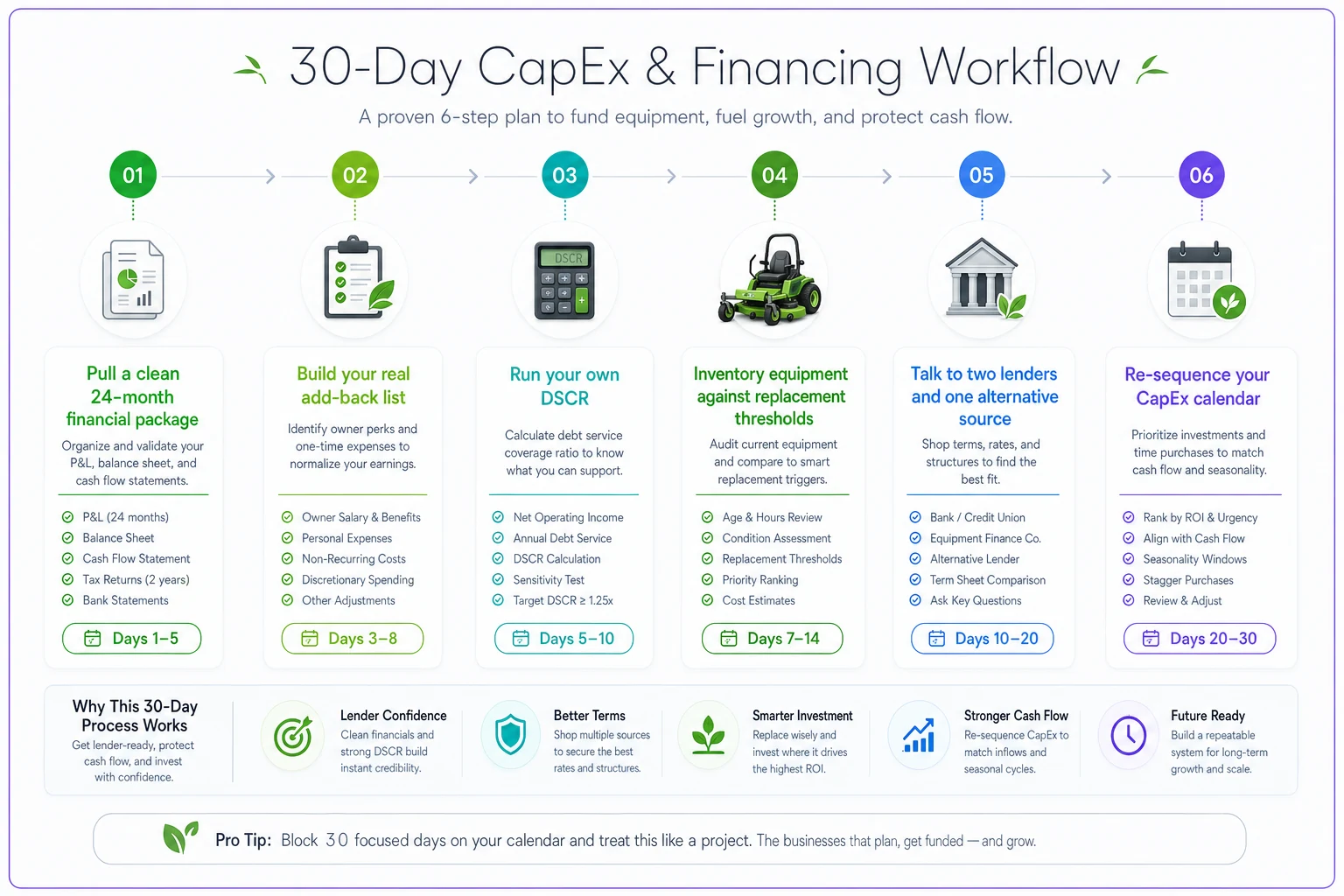
Run your DSCR calculation early so you can adjust financing choices instead of scrambling.
Re-sequence your CapEx calendar (Days 20–30). With real timelines in hand, decide what gets financed, what gets paid in cash, what gets leased, and what gets pushed to next year.
Finance, lease, or pay cash: how to decide now
The new rules make some purchase methods more attractive than they were. Here's a rough decision frame.
| Situation | Best path under SOP 50 10 8.1 | Why |
|---|---|---|
| Single mower or small tool, under ~$15k | Cash or vendor financing | Not worth the slower SBA diligence; preserve borrowing capacity for bigger needs |
| Truck or skid steer replacement, known in advance | Equipment lease or non-SBA equipment loan | Faster approval, avoids tying up SBA eligibility |
| Fleet expansion tied to new contracts | SBA 7(a), but start 60+ days early | Bigger ticket justifies the diligence, but timeline is now the risk |
| Acquiring a competitor's book | SBA with full QoE prep | Valuation and add-back scrutiny is unavoidable; prep decides the outcome |
| Emergency mid-season breakdown | Cash reserve or pre-approved line of credit | You cannot wait weeks for underwriting in July |
The theme running through that table: keep your SBA capacity for the deals that genuinely need it, and solve smaller needs faster and cheaper. A lot of owners burn their borrowing power on equipment that could've been leased, then come up short when the real opportunity — an acquisition or a big fleet move — shows up.
When financing through SBA still makes sense
Despite the tighter rules, 7(a) and 504 are still the right call in specific cases:
-
You're buying a business and the goodwill or intangibles make equipment-only financing impossible.
-
The purchase is large enough that the lower SBA rates meaningfully beat equipment financing over the term.
-
You have clean books and real DSCR cushion, so the new floors aren't actually a barrier.
-
You're planning far enough ahead that a 45–60 day timeline doesn't jam your operations.
You're buying a business and the goodwill or intangibles make equipment-only financing impossible.
When it's now a bad idea
You need the equipment in under three weeks. The diligence window alone can exceed that.
-
You need the equipment in under three weeks. The diligence window alone can exceed that.
-
Your DSCR barely cleared the old floor. You're likely under the new one.
-
Your books rely on add-backs you can't document. QoE will strip them out and your deal shrinks.
-
The purchase is small enough that leasing or vendor terms get you there faster with less paperwork.
The purchase is small enough that leasing or vendor terms get you there faster with less paperwork.
A real scenario
Consider a mid-sized maintenance firm running around eight crews, roughly $2.6M in annual revenue. They'd planned a fleet refresh — three new stand-on mowers and a dump truck, somewhere in the $140k–$160k range — financed through an SBA loan they assumed would close in a couple weeks, same as their last one did in 2024.
When they finally sat down with their lender in October, the deal got re-scoped. The new DSCR floor, applied against trailing twelve months that included a soft winter, put them right at the edge. The lender asked for a larger equity injection and a cleaner breakdown of owner's comp. Timeline stretched from "a week or two" to about six weeks.
The fix wasn't dramatic, but it mattered. They split the purchase: the dump truck went onto a four-year equipment lease that closed in under two weeks, keeping a crew productive. The three mowers went through a smaller, well-documented SBA request where the lower ticket cleared the DSCR floor without issue. They got the equipment on roughly the original timeline, preserved most of their borrowing capacity, and avoided a spring scramble.
The difference wasn't luck — they'd modeled the new floor themselves before the lender did, and already had their equipment replacement schedule mapped out.
What this really comes down to
The firms that struggle under SOP 50 10 8.1 won't struggle because the rules are unfair. They'll struggle because they treated financing as something you figure out when the mower dies. The rules just made that approach expensive.
Clean books, a documented add-back list, a real DSCR you've run yourself, and an equipment replacement calendar that looks 12 months ahead — that's the entire defense. None of it is complicated. It just has to exist before you need the money, not after. Start the 30-day sequence now, keep your SBA capacity for the deals that earn it, and you'll find the new underwriting environment a lot less intimidating when you're the prepared one in the room.
The firms that struggle under SOP 50 10 8.1 won't struggle because the rules are unfair. They'll struggle because they treated financing as something you figure out when the mower dies. The rules just made that approach expensive.
Clean books, a documented add-back list, a real DSCR you've run yourself, and an equipment replacement calendar that looks 12 months ahead — that's the entire defense. None of it is complicated. It just has to exist before you need the money, not after. Start the 30-day sequence now, keep your SBA capacity for the deals that earn it, and you'll find the new underwriting environment a lot less intimidating when you're the prepared one in the room.
Ready to grow your landscaping business?
Join 2,000+ landscaping pros using Yardyly to save time, reduce task chaos, and deliver outstanding client results.