


Most landscaping referral programs don't fail because the offer was bad. They fail because nobody could actually run them without the owner personally remembering who referred whom, when the reward was owed, and whether the new customer ever paid.
That's the real killer. Not the incentive. The admin overhead.
A referral program that requires you to keep a mental tally, dig through text messages to figure out who sent you the Hendersons, and then remember three weeks later to mail a gift card — that program is dead on arrival. It just takes a couple months to notice it stopped working.
This article is narrow on purpose. We're going to break down the specific mistakes that make referral programs collapse under their own weight, and how to build one that runs with almost no tracking effort. The kind of thing a crew lead or office admin can operate without you hovering.
Mistake #1: Rewarding the referral instead of the deliverable
The most common structure landscapers use is "refer a friend, get $50." Sounds fine. It's actually the root of most of the problems.
"Refer a friend" is vague. Does the friend just have to call? Get an estimate? Sign a contract? Pay the first invoice? Nobody defines it, so what happens in real operations is this: someone gives your number to a neighbor, the neighbor calls, gets a quote, and never books. Now your customer is texting you asking where their $50 is, and you're stuck either eating the cost for a non-customer or looking cheap for saying no.
Multiply that by 15 referrals a season and you've got a bunch of awkward conversations and a program that feels like a liability instead of a growth channel.
The fix is deliverable-based incentives. You tie the reward to a specific, verifiable milestone — almost always the new customer's first completed and paid job. Not the call. Not the estimate. The paid work.
This does two things. It protects your margin, because you only pay out when you've actually earned revenue. And it removes ambiguity, because "paid invoice" is a clear line in your system that anyone can check.
A reasonable structure looks like this:
| Referral outcome | What you pay | Why |
|---|---|---|
| New lead calls / requests quote | $0 | No revenue yet, too easy to game |
| New customer signs but hasn't paid | $0 | Cancellations happen; don't pay early |
| New customer's first job completed + paid | Reward triggers | Real revenue, verifiable milestone |
| New customer becomes recurring (maintenance) | Optional bonus | Rewards your highest-value referrals |
That last row matters more than people think. A one-time cleanup referral is worth a lot less than someone who signs a weekly mow contract. If your reward is flat, you're overpaying for low-value referrals and underpaying for the ones that actually build your book.
Mistake #2: The reward that costs you cash instead of margin
Cash and gift cards feel clean, but they hit you at your worst possible rate — full dollar value, straight out of pocket. If you're paying out $50 cash on a $340 first job, that's a meaningful chunk of an already thin first-job margin.
Never miss a job detail again.
Yardyly helps you plan, confirm, and manage every landscaping project seamlessly.
- Centralized project scheduling
- Automated client updates
- Crew and resource management
No credit card required
A smarter move for a lot of landscapers is to reward with your own services where possible. A free add-on, an account credit toward next season, a service upgrade. Your cost is your internal cost, not retail. A "free mulch top-off on your next visit" might cost you $18 in material and 20 minutes of labor you're already routing to that property, but it feels like a $75–$90 value to the customer.
This isn't about being cheap. It's about the reward costing you margin dollars instead of cash dollars, and keeping the customer engaged with your service instead of just handing them money.
That said — some customers genuinely prefer cash or a gift card, and forcing service credit on someone who referred you three great clients is a bad look. A simple approach: offer service credit as the default, cash as the "big referrer" option once someone's sent you two or more paying customers.
Mistake #3: No script, so nobody actually asks
Owners set up a referral program, put a line about it on the invoice, and then wonder why referrals don't go up. The program exists on paper. It never enters an actual conversation.
Referrals happen at emotional peaks — right after a customer sees a finished job they love, or right after you've handled a problem well. That's the window. If your crew doesn't say anything in that window, the moment passes.
Field crew script (job completion): > "Glad you're happy with how it turned out. Quick thing — if you know a neighbor who could use us, we take care of the person who sends them your way. I'll leave a card, your name's already on our list." No pitch. No pressure. It plants the seed and links the referral to them specifically.
Office/follow-up script (used in your post-job message or call): > "Thanks again for your business this season. If you refer someone and they book a job with us, we'll credit your account $[X] once their first job wraps up. Just have them mention your name when they call." Notice the office script says the exact trigger out loud — "once their first job wraps up." You're setting the timing expectation upfront so there's no confusion about when the reward lands. That one sentence prevents most of the "where's my reward" friction.
Mistake #4: Timing that creates disputes and admin work
This is the part almost nobody plans for, and it's where programs generate the most headaches.
You need explicit timing and fulfillment rules that everyone can follow without asking you. Otherwise every referral becomes a one-off judgment call, and judgment calls are exactly the admin overhead that kills the program.
-
Attribution window. A referral only counts if the new customer mentions the referrer at first contact or within their first quote. This stops the after-the-fact "oh actually so-and-so sent me" claims that create disputes.
-
Trigger event. Reward is earned the day the new customer's first job is marked paid. Not before.
-
Fulfillment timing. Reward goes out within a set window after the trigger — say, on the next billing cycle or within two weeks. Pick one and never deviate.
-
Expiration. Referrer has to redeem service credit within 12 months. Keeps liabilities from stacking up. Cap or tier. Decide upfront whether there's a limit, or whether high-volume referrers unlock a better tier. Ambiguity here always favors the customer and against your margin.
The point of writing these down isn't bureaucracy. It's that once the rules exist, anyone can run the program by following them. The decision has already been made. Your admin just checks the box when the trigger fires.
The low-admin tracking system that actually holds up
Most landscapers try to track referrals in their head or in scattered notes, and that's why it becomes a burden. The fix is embarrassingly simple, and it works whether you're on a spreadsheet or a full field-service platform.
You need one thing above all: a lead-source field on every new customer record.
Every new lead gets tagged with where they came from. When it's a referral, you tag it "Referral" and record the referrer's name in the same record. That's the whole trick. The referral tracking isn't a separate system — it's just a field on the customer you're already creating anyway.
Then a simple tracking sheet, tied to those lead-source fields, gives you everything:
-
Referrer name — who sent them
-
New customer name — who was referred
-
Date referred / first contact — for the attribution window
-
First job status — quoted / booked / completed / paid
-
Reward type — service credit or cash
-
Reward status — pending / earned / fulfilled
-
Fulfillment date — when it actually went out
Column four ("first job status") is already something you track for billing. You're not doing new work — you're reading a field you already maintain. When a referred customer's first job flips to "paid," that's your trigger. The reward moves from "pending" to "earned," and your fulfillment rule tells you exactly when to send it.
How this runs in practice
Say a maintenance customer refers her neighbor. Your admin creates the neighbor's record, tags the lead source "Referral — Janet R." The neighbor books a fall cleanup. When that cleanup gets invoiced and paid, the status field updates. On your weekly review, you filter the sheet for "first job = paid" and "reward status = pending." Those are your payouts for the week. You fulfill them, mark them "fulfilled," done.
That entire loop takes maybe five minutes a week for a small operation. No memory required. No digging through texts. If you already run tight numbers on your operation — and if you've built out something like decision‑mapped KPIs that trigger hiring, pricing, and routing — you can fold referral conversion right into that same review rhythm instead of treating it as a separate chore.
Here's a simple diagram of the workflow.
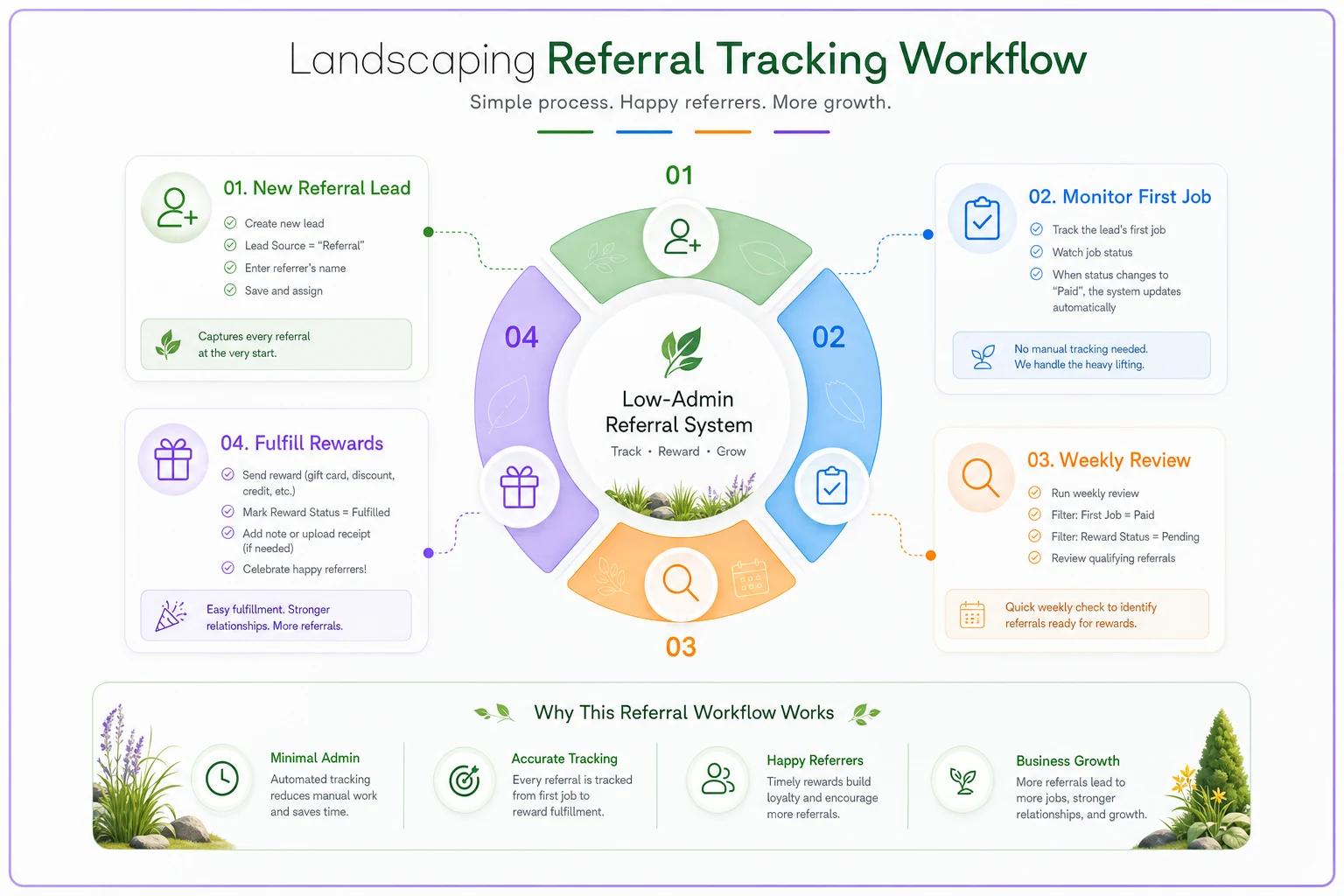
Make the lead-source field required on new customer forms so referrals can't be missed.
If you already run tight numbers on your operation — and if you've built out something like decision‑mapped KPIs that trigger hiring, pricing, and routing — you can fold referral conversion right into that same review rhythm instead of treating it as a separate chore.
A real scenario: how this looks before and after
A two-crew residential landscaper running mostly maintenance and seasonal cleanups had a "refer a friend, get $50" program. On paper it existed. In reality, over a full season they'd paid out maybe six or seven times — half of those to people whose "referral" never actually became a paying customer. The owner tracked it in his head and a notes app, and he admitted he'd probably forgotten to pay a few people who did send real business, which is its own kind of damage.
They switched to a deliverable-based model: reward triggers only on the referred customer's first paid job, service credit as the default, cash tier for repeat referrers, and a lead-source field on every new record feeding a one-page tracking sheet.
Over the next season, trackable referrals that turned into paying customers went from a handful to somewhere around 18–22. Because rewards only paid on paid jobs, the owner stopped bleeding cash on tire-kickers. And the weekly five-minute check replaced the "wait, did I ever pay the Hendersons" anxiety entirely. Nothing explosive — just a program that finally ran on its own and quietly added a steady trickle of new maintenance accounts.
When this is worth building — and when it isn't
When it makes sense: You have a base of happy recurring customers (maintenance clients especially), your crews interact with clients directly, and you have some way to record a lead source and job payment status. If you already invoice and track paid status, you already have 80% of what you need.
When it's a bad idea: If your customer base is almost entirely one-off, low-margin jobs with no repeat relationship, referrals will be thin and the reward economics get shaky. And if you genuinely can't commit to a consistent weekly review, don't launch it — an inconsistently-run referral program that forgets to pay people is worse than none at all. It damages the exact relationships you're trying to leverage.
Who should hold off: Solo operators drowning in fieldwork with zero admin bandwidth. Build the lead-source habit first, get comfortable with it, then layer the referral logic on once you're not the bottleneck for everything.
The takeaway that actually matters
A referral program isn't a marketing tactic you announce. It's an operational system with three moving parts: a reward tied to a real deliverable, timing rules that remove every judgment call, and a lead-source field that turns tracking into something you read instead of something you build.
Get those three right and the program mostly runs itself. Get any one of them wrong — vague reward, fuzzy timing, or no tracking field — and it'll quietly stall out around month three, right when you finally needed it to work.
Ready to grow your landscaping business?
Join 2,000+ landscaping pros using Yardyly to save time, reduce task chaos, and deliver outstanding client results.