

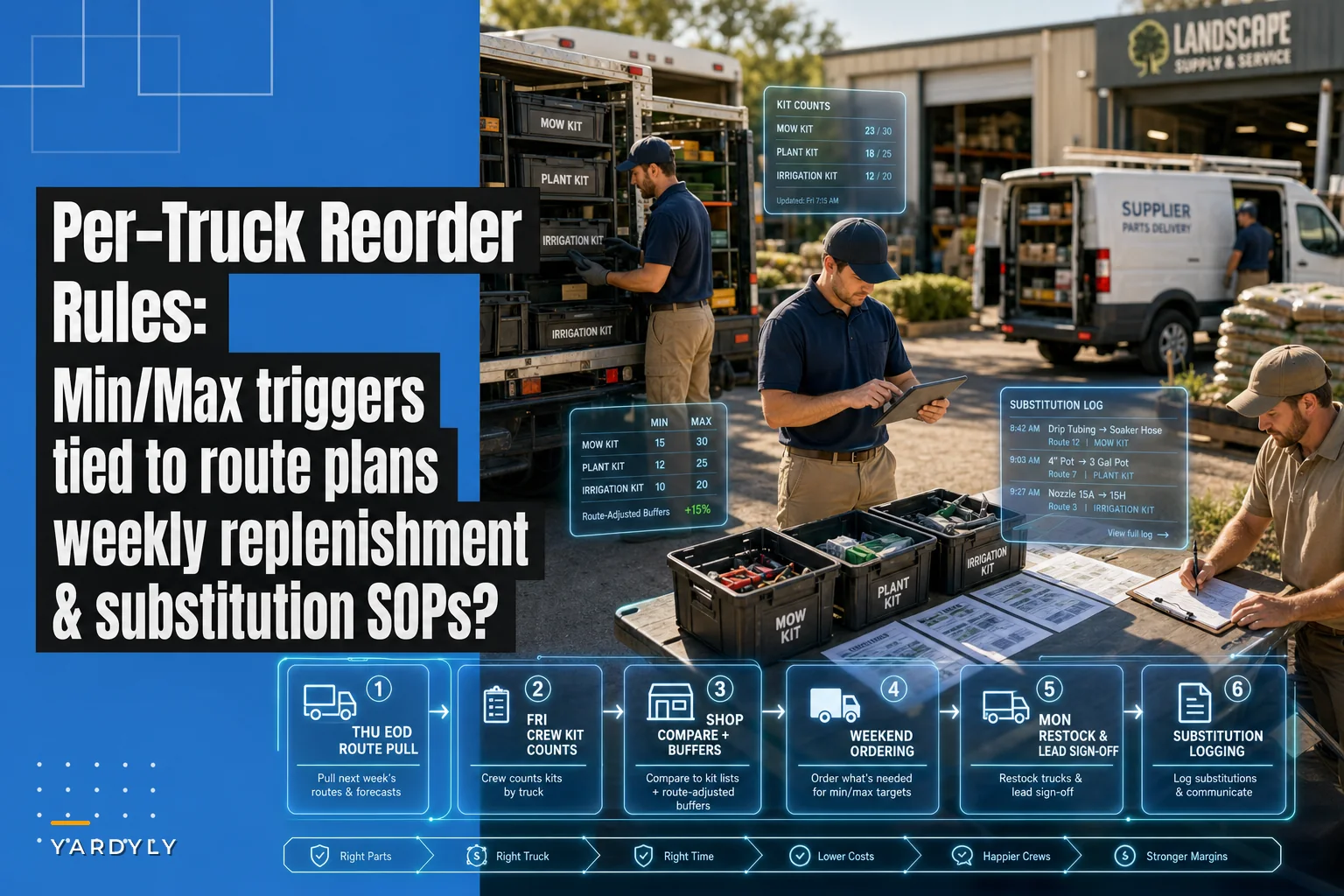

The problem with most landscaping inventory systems isn't that nobody tracks parts. It's that the tracking lives in a spreadsheet at the shop while the shortage happens 22 miles away at a job site. A crew lead opens the trailer at 9:40 AM, finds two trimmer heads instead of four, and now the second property on the route is either skipped, half-finished, or done poorly with the wrong line gauge.
Reorder rules for landscaping parts only work when they're attached to the truck, not the warehouse. That's the whole game. Below is a practical system for building per‑truck kit lists, setting min/max triggers that actually reflect next week's work, and writing substitution rules so a missing part doesn't kill a billable hour.
Start With the Truck, Not the Stockroom
Most shortage problems trace back to one decision: inventory is managed at the central level, but consumption happens at the truck level. These are two different inventory systems pretending to be one.
A central stockroom tells you how many 0.095 trimmer lines you own. It tells you nothing about whether Truck 3 — the one running six mow-and-trim properties tomorrow — actually has enough on board. Those are separate questions, and the second one is the only one that matters when a crew is standing in a client's driveway.
The fix starts by defining a standard kit list per truck, tied to what that truck actually does. A dedicated mowing crew doesn't need the same kit as an install truck or a cleanup crew. One of the most common patterns in small fleets is that owners build one generic kit list, copy it to every vehicle, and then wonder why the mow trucks always run dry on line while the install truck hoards fittings nobody touches.
Here's a simplified version of how the kits diverge:
| Item | Mow/Trim Truck | Install Truck | Cleanup Truck |
|---|---|---|---|
| Trimmer line (0.095) | 6 spools | 1 spool | 3 spools |
| Blade sets | 4 | 1 | 2 |
| Blower parts (filters, plugs) | 2 each | 1 each | 4 each |
| Irrigation fittings | 0 | 20+ assorted | 2 emergency |
| Zip ties / flagging | 1 pack | 3 packs | 2 packs |
| Fuel mix cans | 2 | 1 | 2 |
| Spare pull cords | 2 | 1 | 2 |
The exact numbers matter less than the principle: the kit reflects the work pattern of that specific truck. Once you've got that, the min/max triggers have something real to attach to.
Min/Max Triggers That Read the Route Plan
Static min/max levels are better than nothing, but they're blind to what's coming. A trigger that says "reorder trimmer line when it drops below 2 spools" assumes every week looks the same. It doesn't.
Never miss a job detail again.
Yardyly helps you plan, confirm, and manage every landscaping project seamlessly.
- Centralized project scheduling
- Automated client updates
- Crew and resource management
No credit card required
The upgrade is tying the minimum to upcoming route volume. If next week's route plan for Truck 3 has 14 trim-heavy properties instead of the usual 8, your minimum should float up for that truck, for that week. In practice, this usually surfaces when a big commercial account cycles into the rotation or a storm cleanup week stacks extra brush work onto the normal schedule.
Two numbers working together:
-
Baseline min/max — your normal reorder points for a typical week.
-
Route-adjusted buffer — extra stock added when the upcoming plan shows above-average consumption for a given part.
A typical example: Truck 2's baseline for blades is a minimum of 2 sets. But Thursday's route includes three overgrown foreclosure properties that chew blades. The route-adjusted trigger bumps the minimum to 4 for that run. The crew lead sees it on the kit sheet, the shop pre-stages two extra sets, and nobody's limping through tall fescue with a dull blade.
Consumption isn't flat, so your triggers shouldn't be either. Most owners set min/max once in spring and never touch it again, then spend all summer firefighting shortages that the route plan predicted days in advance.
How to calculate a usable buffer
-
Pick a high-consumption part (trimmer line is the usual suspect).
-
Estimate average use per property type — say, a quarter spool per standard trim property, a full spool per heavy-overgrowth property.
-
Multiply by the properties on the upcoming route.
-
Add a 15–20% cushion for breakage and waste.
-
Compare that total to what's on the truck. If the truck can't cover it, that's your reorder quantity.
Run this once and you'll immediately see which trucks are chronically under-stocked for the work they're assigned.
The Weekly Replenishment SOP
Reorder triggers are useless without a fixed moment where someone actually acts on them. The missing piece in most fleets is a recurring replenishment window — a standing time each week where trucks get restocked against their kit lists and the next week's route-adjusted buffers.
The best slot tends to be late Friday afternoon or early Monday morning, before trucks roll. Friday has the advantage that any ordering can happen over the weekend; Monday has the advantage that you already know the finalized route. Pick one and make it non-negotiable.
A clean weekly replenishment SOP:
-
Thursday EOD — Pull next week's route plan per truck. Flag any high-consumption properties.
-
Friday AM — Each crew lead submits a kit count. Actual on-truck quantities, not guesses.
-
Friday midday — Shop compares counts against kit list + route buffer. Anything under min goes on the order.
-
Friday PM / weekend — Place supplier orders. Note lead times on anything that can't arrive by Monday.
-
Monday AM — Restock trucks to full kit before departure. Crew lead signs off on the count.
-
Monday — Log any substitutions made (more on this below) so the pattern gets visible.
The step people skip is #2 — the honest count. Crew leads eyeball the trailer and say "we're good." Then Tuesday the truck's dry. A two-minute physical count on Friday prevents the Tuesday scramble. Make it a checklist item, not a verbal check-in.
Make the Friday two-minute physical kit count a mandatory checklist item.
This is also where keeping a simple centralized record pays off. When kit counts, route plans, and reorder points all live in one place instead of three spreadsheets and a group text, the Friday comparison takes ten minutes instead of an hour. The same discipline applies to tracking machine wear — the kind of thresholds covered in Reduce Downtime and CapEx Surprises: Equipment Lifecycle Thresholds and a 12‑Month CapEx Forecast for Landscapers — because a worn deck burns through blades faster and quietly breaks your consumption math.
Visual workflow: weekly replenishment steps from route pull to restock.
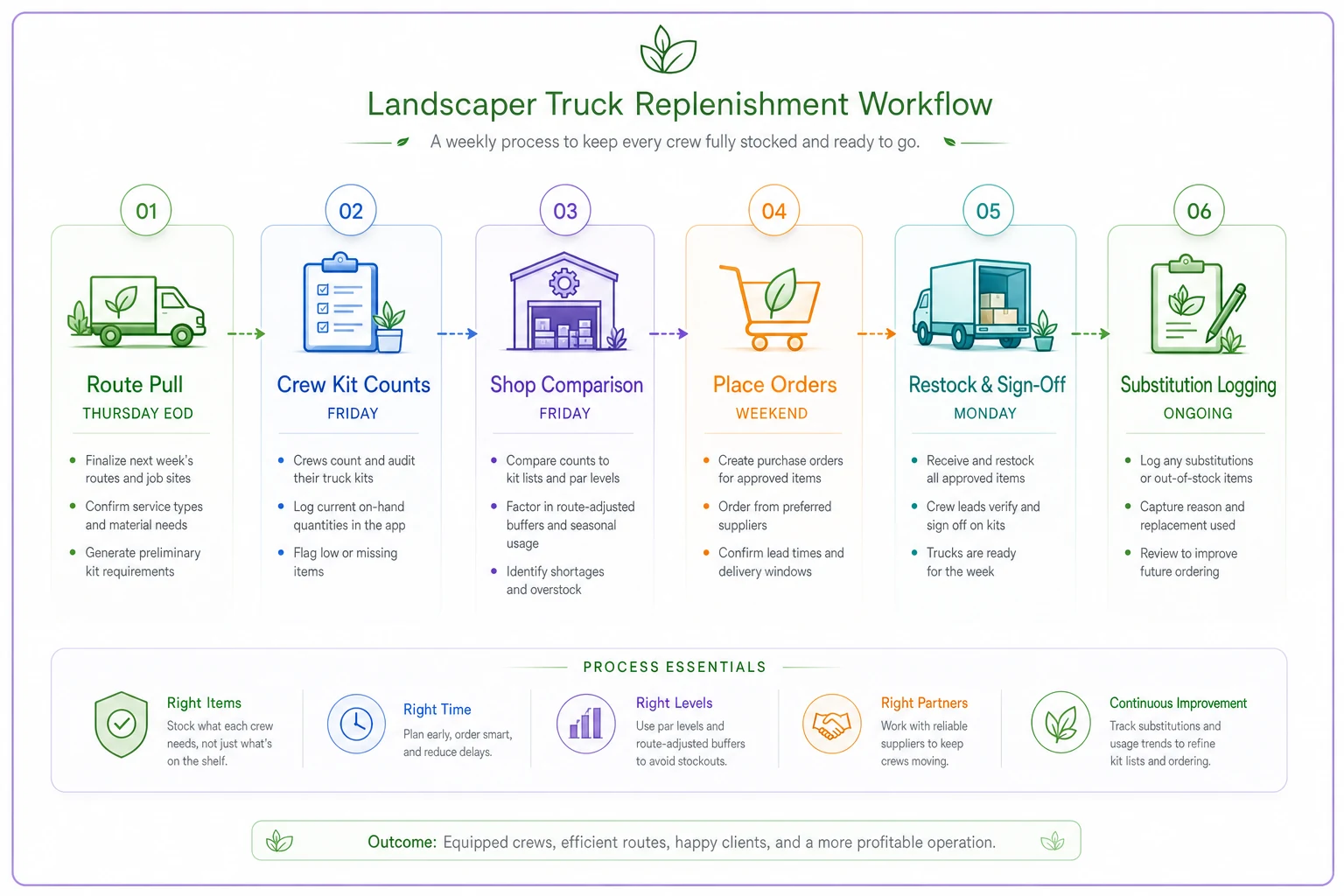
When this ritual is non-negotiable, reorder triggers actually result in stocked trucks instead of ignored alerts.
Substitution Rules So a Shortage Doesn't Stop the Shift
Even with good triggers, you'll run short sometimes. A supplier backorders, a crew burns through double the expected line, something breaks. The question isn't whether it happens — it's whether the crew knows what to do in the next 90 seconds without calling the shop.
That's what a substitution SOP solves. It's a pre-approved list of acceptable swaps so a crew lead can keep working instead of standing around waiting for a dispatch decision.
A workable substitution sheet:
-
Out of 0.095 trimmer line? → Use 0.105 for the rest of the day. Acceptable for heavy properties, slightly higher fuel burn. Not for fine edging.
-
Out of the correct mower blade? → Use the universal high-lift set from the spare bin. Log it; order the correct set.
-
Out of the right irrigation fitting? → Use a compression coupling as a temporary fix, flag the property for a proper repair within 48 hours.
-
Out of fuel mix? → Pull from the backup can, never run straight gas. If backup's empty, nearest station, keep the receipt.
-
Out of flagging/paint? → Chalk or temporary marker, re-flag on next visit.
The rule that makes this work: every substitution gets logged. Not to punish anyone — to see the pattern. If Truck 4 is substituting trimmer line every other week, the problem isn't the swap. It's that the kit list or the route buffer is wrong for that truck, and you just found it.
What to never substitute
-
Don't substitute safety gear (eye pro, chaps, hearing protection). Short on it, the crew doesn't run that machine.
-
Don't substitute blade types that don't fit the deck spindle — you'll damage the mower and blow past your equipment lifecycle thresholds early.
-
Don't improvise electrical or fuel-line fixes in the field. That's a shop job.
A substitution SOP is permission to keep working on the small stuff and a hard stop on the stuff that creates bigger problems.
When This System Actually Makes Sense — and When It Doesn't
This level of structure pays off once you're running three or more trucks, or two trucks with genuinely different service lines. At that scale, informal "grab what you need" inventory starts losing you billable hours in ways you can't easily track.
Single-truck operation? Honestly, you don't need route-adjusted buffers and a formal substitution sheet. A good kit list and a Sunday-night restock habit covers you. Building heavy SOPs around a one-truck operation is overhead you'll quietly abandon by July.
Who should not do this: owners who haven't yet standardized their kit lists. You can't set min/max triggers on an undefined kit. Get the per-truck kits right first, run them for a few weeks, then layer on the triggers and substitution rules once you know your real consumption.
A Real Scenario: Three-Truck Maintenance Crew
A maintenance-focused outfit running three trucks, roughly 130 recurring properties a week. Their recurring issue: mid-shift trimmer line and blade shortages about twice a week, each one costing part of a property — either a skipped trim or a return trip.
Before fixing it, they estimated 3–4 return trips a month tied purely to missing parts. At roughly $40–$60 of crew time and fuel per return, that's somewhere around $150–$220 a month leaking out, plus the softer cost of clients noticing uneven work.
They did three things. Built distinct kit lists per truck instead of one generic list. Added a Friday count-and-route-check to the weekly routine. Wrote a one-page substitution sheet and taped it inside each trailer.
Within about six weeks, mid-shift shortages dropped to roughly one every couple of weeks, and most of those got handled on the spot with an approved substitution instead of a return trip. The return trips tied to parts basically stopped. Nothing dramatic on paper — but the crews stopped losing afternoons to the shop run, and the Friday count surfaced that one truck was chronically short on blades because it kept drawing the overgrown rental properties. That truck's buffer got adjusted, and the pattern went away.
Pulling It Together
Reorder rules for landscaping parts fail when they're built around the stockroom and run on gut feel. They work when the kit lives on the truck, the triggers read next week's route, the replenishment happens on a fixed schedule, and the crew has pre-approved swaps for the moments something still slips through.
The real win isn't fewer shortages — it's that your crews stop losing billable hours to problems you could see coming. Start with clean per-truck kits, add route-aware buffers on your highest-consumption parts, lock in one weekly replenishment window, and give your crew leads the authority to substitute smart and keep the shift moving.
Reorder rules for landscaping parts fail when they're built around the stockroom and run on gut feel. They work when the kit lives on the truck, the triggers read next week's route, the replenishment happens on a fixed schedule, and the crew has pre-approved swaps for the moments something still slips through.
Ready to grow your landscaping business?
Join 2,000+ landscaping pros using Yardyly to save time, reduce task chaos, and deliver outstanding client results.