



Most mulch problems don't show up in the estimate. They show up three days later when a client texts you a photo of dyed mulch bleeding onto their new driveway, or your crew arrives to spread and realizes the "10 yards" you sold barely covers half the beds. By then you're eating the cost, arguing over a redo, or sending a second truck across town for free.
Mulch feels simple. Buy by the yard, sell by the yard, mark it up, spread it. But the margin lives in the parts nobody prices carefully — the drop location, the coverage math, the acceptance moment, the inspection that either happened or didn't. Get those wrong and a job that looked like 35% margin turns into a break-even redelivery.
This is a tight breakdown of where mulch pricing and delivery actually go sideways, and the specific rules, scripts, and checklists that stop it.
The Four Places Mulch Jobs Bleed Money
When you look at mulch jobs that turned into complaints or free redos, almost all of them trace back to one of four failures:
| Failure point | What it looks like | Who eats the cost |
|---|---|---|
| Coverage math | Sold 8 yards, needed 12; or sold 12, spread 8 and client thinks you shorted them | Usually you |
| Drop location | Pile dumped on the wrong side, on grass, or blocking a garage | You (rework) or client (angry) |
| Product mismatch | Client wanted brown, got black; wanted hardwood, got dyed | You (full replacement) |
| Acceptance gap | No one confirmed the amount or condition at drop | Whoever has less proof — usually you |
None of these are exotic. They're boring, avoidable process gaps. But they compound — a busy mulch season might run 40–60 deliveries, and even a 10% dispute rate means five or six jobs where you're giving away product and truck time.
Coverage Math: The Mistake That Starts in the Estimate
The most expensive mulch mistake happens before a truck ever moves. Someone eyeballs the beds, says "looks like 10 yards," and quotes it.
Never miss a job detail again.
Yardyly helps you plan, confirm, and manage every landscaping project seamlessly.
- Centralized project scheduling
- Automated client updates
- Crew and resource management
No credit card required
Here's the math that gets skipped. One cubic yard covers roughly 100 square feet at 3 inches deep, or about 160 square feet at 2 inches. That "roughly" is doing a lot of work, and the depth assumption is where estimates fall apart. A client who wanted a rich 3-inch layer for weed suppression, quoted at a 2-inch coverage rate, will look at the finished job and feel shorted — even though you delivered exactly what you priced.
-
Measure actual bed square footage. Don't guess. Even a rough measuring wheel or phone app beats a windshield estimate.
-
Lock the depth in writing — a 2-inch refresh and a 3-inch full install are different jobs at different prices.
-
Calculate yards
square footage ÷ coverage rate for that depth. -
Add a waste and settling factor of about 5–10% for irregular beds, slopes, and spillage.
-
Round up to the nearest half-yard, and tell the client you did.
A typical example: 640 square feet of beds at 3-inch depth. At roughly 100 sq ft per yard, that's 6.4 yards. Add 8% for waste and you're at about 6.9 — round to 7 yards. If you'd eyeballed "6 yards" you'd have come up short, sent a crew back for one more yard, and burned a half day of labor plus a second delivery fee on a $400 job.
Being short is far more expensive than being slightly over. An extra half-yard costs you maybe $20–$40 in product. A shortage costs you a return trip, crew idle time, and a client who now thinks you either can't measure or tried to skimp.
Building a Per-Yard Price That Doesn't Quietly Lose Money
Per-yard pricing goes wrong when owners build off product cost plus a flat markup and forget everything else a yard of mulch drags along with it.
-
Product cost (bulk price per yard from your supplier)
-
Delivery and hauling cost allocated per yard
-
Spreading labor (this is the big one)
-
Bed prep — edging, weeding, old mulch removal
-
Disposal if you're hauling out old material
-
Overhead and margin
Spreading labor is where thin quotes come from. A crew spreads roughly 4–6 yards per person per hour on open, accessible beds — but that drops hard on tight beds, backyard-only access with a wheelbarrow, or slopes. If you priced spreading at open-bed speed and the job turns out to be a wheelbarrow-across-the-lawn situation, your labor cost per yard can easily double.
A sample per-yard build-up for a mid-range install:
-
Product
~$32/yard (bulk hardwood)
-
Delivery allocation
~$12/yard
-
Spreading labor
~$28/yard (accessible) up to ~$50/yard (difficult access)
-
Bed prep
quoted separately as a line item, not baked into the yard price
-
Target margin
30–40%
Break out bed prep as a separate line item so you can price messy beds fairly without inflating your basic yard rate.
Bed prep being broken out matters. When you bury prep inside the per-yard price, two things happen: your yard price looks scary-high next to competitors, and you lose the ability to charge fairly for the messy beds that actually take the time. Keep the yard price clean and itemize prep and access difficulty separately.
If old material is coming out, the hauling and dump cost is its own trap. The disposal margin breakdown in this post on dump fees and per-job disposal math gets into exactly how fast that adds up on mulch removal jobs.
Drop Policies: The Two-Minute Conversation That Prevents Redeliveries
A large share of mulch complaints aren't about the mulch at all — they're about where the pile ended up.
Drop policy rules worth enforcing:
-
Every mulch delivery gets a confirmed drop location before the truck leaves the yard — not decided on-site.
-
Drop location is documented with a note or a marked photo of the client's property.
-
Default rule
never dump on grass unless the client explicitly accepts lawn damage risk in writing.
-
If the client won't be home, the drop spot must be pre-marked (cone, chalk, flag) or pre-agreed with a photo.
-
If access is tight and the truck can't reach the preferred spot, the driver stops and calls — does not improvise.
The pattern is simple: the drop decision should never be made by whoever happens to be standing there at 7 a.m. It should be made ahead of time, written down, and confirmed. Improvised drops are where the redelivery and lawn-repair costs come from.
Client-Acceptance Scripts (Drop and Spread)
This is the part most crews skip, and it's the cheapest insurance you'll find. A 30-second acceptance script at drop and at completion kills most disputes before they start, because you've created a shared, agreed record.
At drop (delivery-only or before spreading):
> "Hi, dropping your mulch now. You ordered 7 yards of brown hardwood — that's what's on the truck. I'm placing it here [point], off the grass, clear of the garage. Does this spot work for you? Great — I'll snap a photo of the pile and placement for our records."
At completion (after spreading):
> "We finished spreading all 7 yards at the depth we quoted across the front and side beds. Take a walk with me? I want you to check the edges and coverage before we pack up. If anything looks thin, tell me now and we'll adjust while we're still here."
That last line — tell me now while we're still here — is the whole game. The dispute you settle on-site costs nothing. The same dispute over text three days later costs a return trip.
What the acceptance moment should capture:
-
Amount delivered (yards, confirmed out loud)
-
Product type and color (confirmed against the order)
-
Drop location and condition (photo)
-
Completion walkthrough acknowledged
-
Any client-requested changes noted
Capture those five things and most disputes evaporate because you've created a mutually acknowledged record at the moment that matters.
The Inspection Checklist That Ends "You Shorted Me" Arguments
Coverage disputes are almost always winnable with photos — if you took them. Without them it's your word against theirs, and the client is holding the money.
Run this at completion, every mulch job, no exceptions:
-
- [ ] Photo of empty truck bed or delivery ticket showing yardage delivered
-
- [ ] Wide photo of each mulched area showing full coverage
-
- [ ] Close photo showing depth at bed edge (a ruler or your boot for scale helps)
-
- [ ] Photo of clean edges and transitions to lawn and hardscape
-
- [ ] Photo confirming no product on driveway, walkways, or stone
-
- [ ] Note of product type and color matching the order
-
- [ ] Client walkthrough completed (name and time noted)
Depth is the metric clients complain about most, but almost nobody photographs it. A single edge photo showing 3 inches of mulch settles the "it looks thin" argument instantly. Inconsistent photo sets are the reason so many disputes turn into he-said-she-said — this checklist closes that gap.
Running the checklist also forces a natural quality scan of the job before the crew drives off. Easier to fix a thin corner on-site than schedule a callback for it.
Real Scenario: A 4-Crew Maintenance Company Cleaning Up Mulch Season
A landscaping company running four crews was doing somewhere around 50–55 mulch jobs a spring, mostly residential refreshes in the $350–$900 range. Their mulch season was profitable on paper but kept leaking:
-
About 6–7 jobs a season needed a return trip for shortage (bad coverage math)
-
Two or three lawn-damage complaints from piles left on grass
-
A handful of "it looks thin" disputes with no photos to counter them
-
One full color-mismatch replacement (black delivered, brown ordered)
Rough cost of the leaks: redelivery trips running $120–$180 each in truck and labor, plus the color replacement around $400, plus goodwill discounts handed out to quiet complaints. Somewhere in the $2,500–$3,500 range for the season — most of it invisible because it was spread across a lot of small write-offs nobody was tracking as a group.
The fixes weren't complicated. They started measuring beds instead of eyeballing, locked depth in the quote, added a rounding-up rule, required a confirmed drop location before trucks left, and made the completion walkthrough and photo checklist mandatory. The following season, return trips dropped to one or two, the lawn complaints basically stopped, and the "it looks thin" arguments ended because crews could pull up a depth photo on the spot.
The dollar recovery mattered, but the bigger change was that mulch stopped being the service line generating the most annoying phone calls.
When Tighter Drop and Inspection Rules Aren't Worth It
Not every job needs the full process.
When it makes sense: residential jobs where the client is present or particular, higher-value installs, anything with tricky access, and any client who's disputed before. This is where documentation pays for itself many times over.
When it's overkill: a bulk delivery-only drop to a contractor or a repeat commercial account with a standing spot and no spreading involved. A confirmed location and one photo is plenty — you don't need a completion walkthrough on a pile you're not spreading.
Who should not skip it: any crew running high mulch volume in spring. At 40+ jobs, even a small dispute rate turns into real money and real weekend phone calls. The process costs 60–90 seconds per job. The dispute costs a half-day.
Where Software Quietly Helps
None of this requires software to work — the rules above run fine on a clipboard and a phone. But once you're doing 40 or 50 mulch jobs in a compressed spring window, coordination gets messy fast. Which drops are confirmed, which spots are marked, which jobs still need completion photos, who followed up on which complaint.
This is where an operational platform earns its keep — not by doing anything clever, but by making the coverage calculation, the confirmed-drop field, the acceptance note, and the photo checklist required steps rather than things a busy crew hopes to remember. When the depth is locked in the quote, the drop location is confirmed before dispatch, and completion photos are required before a job closes out, the disputes mostly stop because the process didn't leave room for them.
The tools matter less than the discipline. But when volume is high and memory is unreliable, having the checklist built into the workflow beats trusting everyone to run it perfectly on a 90-degree Saturday.
Bringing It Together
Mulch is a low-drama service line right up until it isn't. Jobs that go bad almost never fail because the mulch was bad — they fail because coverage was guessed, the drop was improvised, or nobody documented the amount and depth at the moment it would have mattered.
Fix the four leak points — measure and lock depth, price the yard honestly with prep broken out, confirm every drop before the truck moves, and run a 60-second acceptance and photo check at completion — and mulch season shifts from your biggest source of annoying callbacks to one of your cleaner margins. The whole system costs a couple of minutes per job and saves you the return trips, the giveaways, and the arguments you can't win without proof.
Here's a simple workflow to enforce those steps on every job.
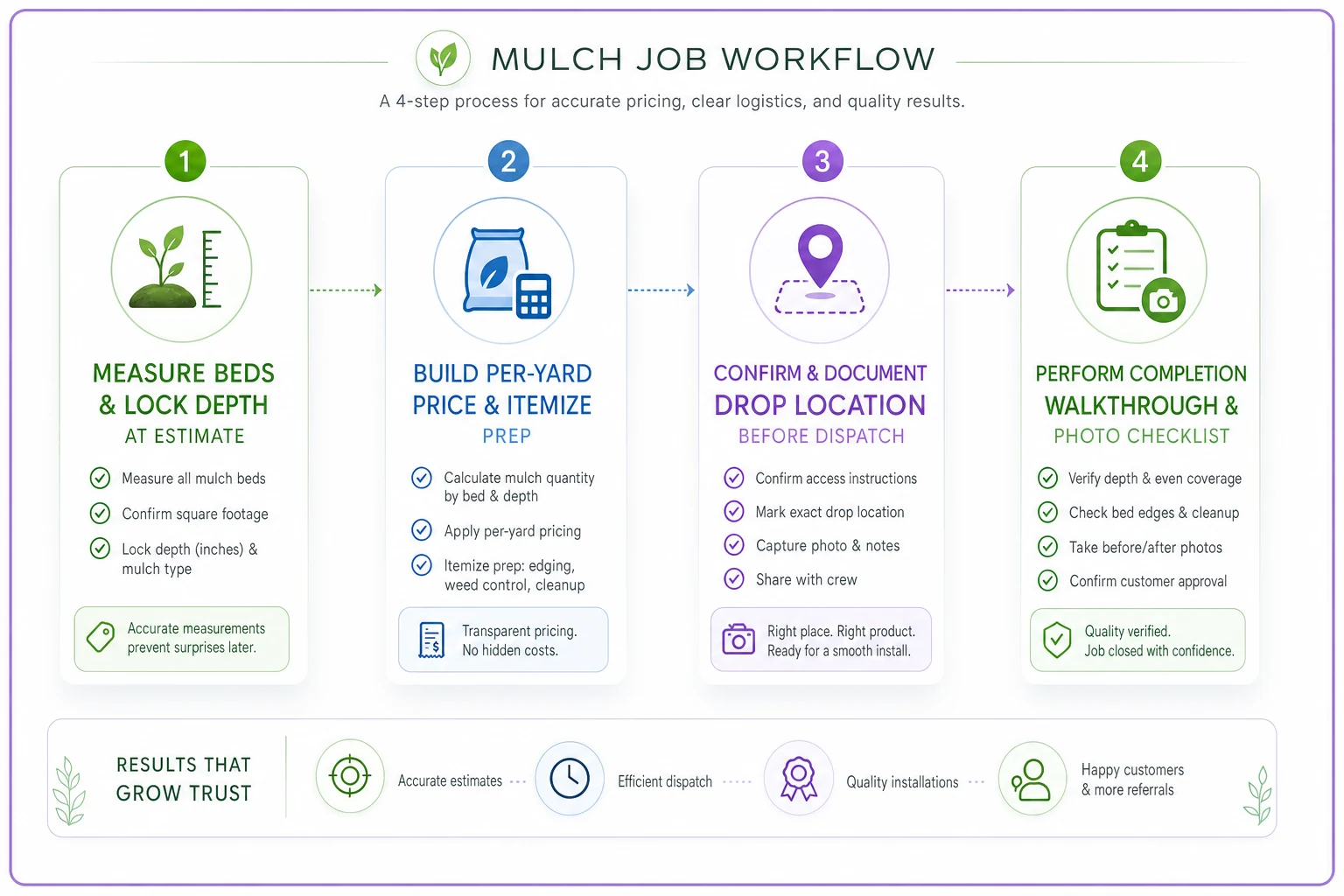
A visual checklist like this keeps the team aligned: estimate, price, drop, inspect.
Mulch is a low-drama service line right up until it isn't. Jobs that go bad almost never fail because the mulch was bad — they fail because coverage was guessed, the drop was improvised, or nobody documented the amount and depth at the moment it would have mattered.
Ready to grow your landscaping business?
Join 2,000+ landscaping pros using Yardyly to save time, reduce task chaos, and deliver outstanding client results.