

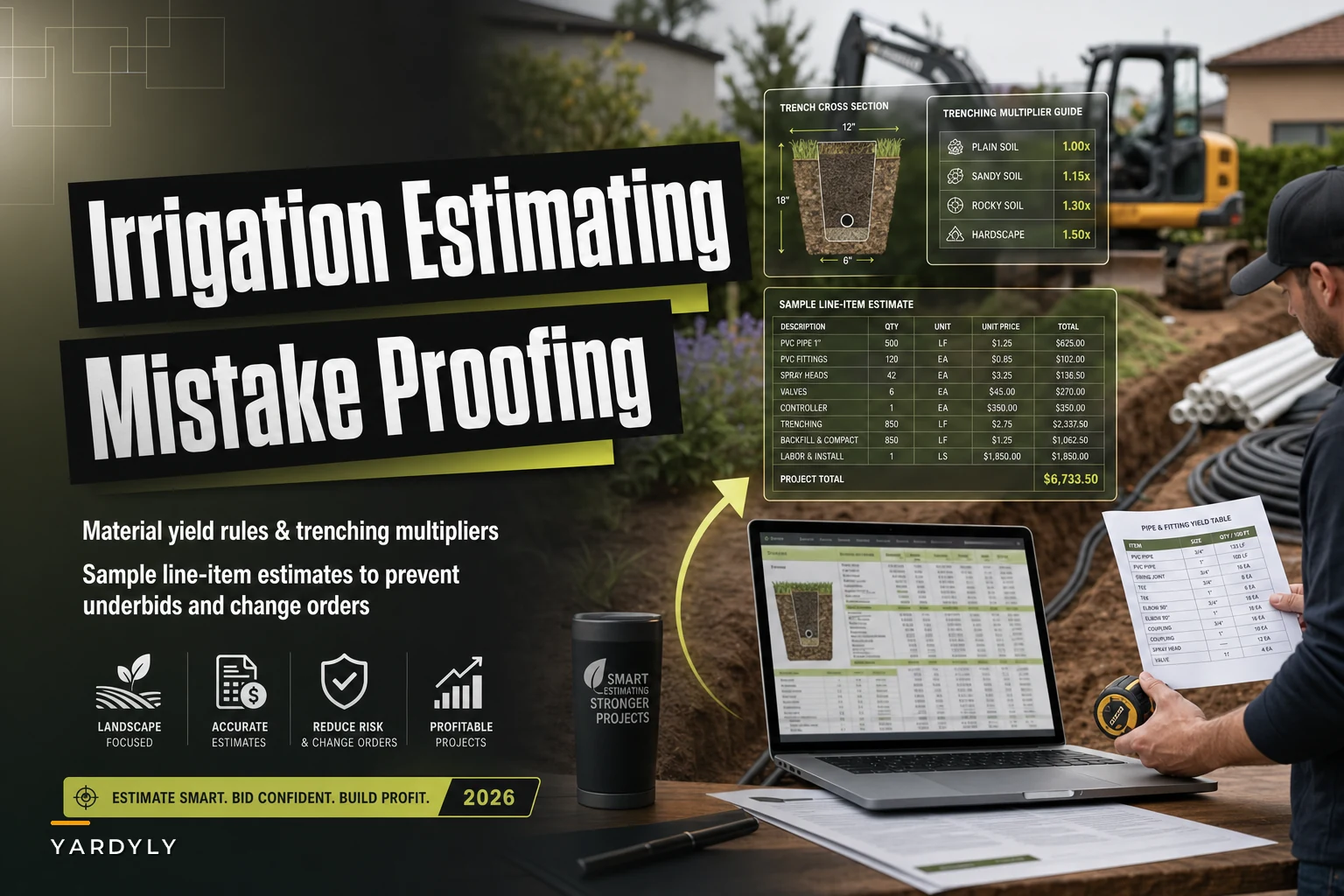

Most irrigation underbids don't come from lazy math. They come from crews and estimators trusting round numbers that felt right two years ago. A guy quotes "about 200 feet of pipe" for a zone, orders exactly 200 feet, and then loses a Saturday because the actual run needed 240 after accounting for swing joints, sweeps, and the fact that trenches never go in a straight line. Multiply that across six zones and a couple of change orders, and the "clean" $8,400 residential system quietly turns into a $7,100 profit job.
This piece is narrow on purpose. It's about the estimating layer specifically — how to build per-component rules, yield tables, and trenching multipliers so your number holds up when the crew hits real dirt. If you want the broader takeoff view, the Small Project Takeoff Checklist for Landscapers covers hidden costs across job types. Here we're going deep on irrigation alone.
The three estimating gaps that cause almost every underbid
Before the tables, it helps to name where the money actually disappears. Across residential and light-commercial irrigation work, underbids cluster in three spots:
-
Material yield assumptions — estimating pipe, wire, and fittings off linear zone length instead of installed reality.
-
Trenching labor — pricing all digging at one flat rate regardless of soil, depth, or obstacles.
-
The "invisible" components — fittings, glue, primer, swing joints, valve boxes, wire splices, and the small stuff that never makes the customer-facing quote but always hits the truck order.
The first two are estimating discipline. The third is a checklist problem. All three are fixable without turning your quotes into a research project.
Material yield: stop estimating off zone length
The core mistake: someone measures a zone at 180 feet head-to-head and orders 180 feet of poly or PVC. But installed pipe never equals measured distance. You lose length to:
Never miss a job detail again.
Yardyly helps you plan, confirm, and manage every landscaping project seamlessly.
- Centralized project scheduling
- Automated client updates
- Crew and resource management
No credit card required
-
Trench meander (real trenches curve around roots, rocks, and hardscape)
-
Depth transitions and sweeps at every turn
-
Swing joints at each head
-
Cut waste and coupling overlap
-
The tail you leave for future tie-ins
A practical rule that's held up well: add a yield factor on top of measured length, and the factor changes by pipe type and site complexity.
Material yield reference table
| Component | Base estimate method | Yield / waste factor | Notes |
|---|---|---|---|
| Lateral poly pipe | Measured zone length | +12–18% | Higher end on rooty or rocky sites |
| Mainline PVC | Measured run | +8–12% | Straighter runs, less meander |
| Funny pipe / swing joints | Per head | 2.5–3.5 ft per head | Don't estimate as continuous run |
| Low-voltage wire | Longest zone run + return | +20–25% | Wire follows trench + slack loops |
| Fittings (ells, tees, couplings) | Per head + per turn | 1.3–1.6 fittings per head | Round up, always |
| PVC glue / primer | Per 100 fittings | 1 pint glue / 1 pint primer | Buy ahead, cheap insurance |
| Valve box | Per valve manifold | 1 per manifold + 1 spare | Spare covers field regrouping |
The wire number surprises people the most. Estimators price wire like it's a straight shot from the controller to the far valve. In reality it snakes through the trench, loops at every valve for service slack, and most crews run a spare conductor or two anyway. A zone that's 160 feet on paper often eats 200+ feet of wire once you count slack loops and the return path.
The pattern worth internalizing: measure once, then apply the factor. Estimating "eyeballed with buffer built in" produces inconsistent numbers because the buffer lives in someone's head and changes depending on how slammed they are that week.
Trenching labor: one flat rate is why you keep eating hours
Trenching is where labor estimates fall apart fastest. Crews price digging at a single production rate — something like "we trench about 300 feet a day" — and then get destroyed by clay, tree roots, or a site that turns out to be half rock.
The fix is a trenching labor multiplier applied against a clean baseline. Start with your true baseline production rate in easy conditions (loamy soil, open yard, standard depth). Then multiply up from there.
Trenching multiplier framework
| Condition | Multiplier on baseline hours | Real-world trigger |
|---|---|---|
| Easy soil, open area | 1.0x | Standard turf, no obstacles |
| Compacted / dry clay | 1.4–1.6x | Trencher stalls, slower passes |
| Rocky soil | 1.8–2.3x | Hand work, bar and pick sections |
| Heavy root zones | 1.5–2.0x | Mature trees within trench path |
| Under/around hardscape | 2.0–3.0x | Boring, hand tunneling, cut-and-patch |
| Wet / saturated ground | 1.3–1.7x | Trench collapse, pump-out time |
If your baseline is 4 hours to trench a zone in easy soil, that same zone in dry clay with a few mature trees isn't 4 hours — it's closer to 6.5–8 depending on how the conditions stack. That gap, unaccounted for, either hits your margin directly or turns into a change-order argument with a homeowner who didn't see it coming.
Use a standard site-condition checkbox on walkthrough notes to automatically apply the appropriate trenching multiplier when building the quote.
Most estimators know the site is rocky when they walk it. They just don't have a rule that forces the multiplier into the number. A simple field note — "clay, 2 mature oaks in trench path" — should automatically trigger the right adjustment when you build the quote, not get lost somewhere between the walkthrough and the spreadsheet.
A sample line-item estimate that actually holds
Generic quotes read like "Irrigation system — $8,400." That number is a change-order magnet because there's nothing to point at when scope shifts. Here's what a defensible residential line-item estimate looks like — a 5-zone system, roughly average suburban lot, mixed soil with two trees.
Sample: 5-zone residential system
| Line item | Qty / basis | Unit assumption | Line total |
|---|---|---|---|
| Lateral poly pipe | 720 ft (measured 620 + 16% yield) | $0.42/ft | ~$302 |
| Mainline PVC | 140 ft (+10%) | $0.68/ft | ~$95 |
| Spray heads | 22 | $8.50 ea | ~$187 |
| Rotor heads | 8 | $14 ea | ~$112 |
| Swing joints / funny pipe | 30 heads × 3 ft | $0.35/ft | ~$32 |
| Zone valves | 5 | $22 ea | ~$110 |
| Valve boxes | 3 (2 manifold + 1 spare) | $18 ea | ~$54 |
| Controller (smart, 6-zone) | 1 | $185 | ~$185 |
| Low-voltage wire | 380 ft (+22%) | $0.28/ft | ~$106 |
| Fittings / glue / primer | lot | est. | ~$140 |
| Materials subtotal | ~$1,423 | ||
| Trenching labor | 5 zones, clay + roots (1.5x) | 26 hrs @ $55 | ~$1,430 |
| Assembly / head install labor | 22 hrs @ $55 | ~$1,210 | |
| Controller + wiring labor | 6 hrs @ $55 | ~$330 | |
| Commissioning / testing | 3 hrs @ $55 | ~$165 | |
| Labor subtotal | ~$3,135 | ||
| Overhead + margin | applied | (your %) |
The point isn't the exact dollars — your pricing varies by region and supplier. The point is every number traces back to a rule. When the homeowner adds a sixth zone mid-job, you're not renegotiating a lump sum. You're adding lines: X feet of pipe at the yield factor, Y trenching hours at the site multiplier, Z heads. The change order writes itself and nobody feels cheated.
The invisible-component checklist
This is the stuff that never makes the customer quote but always shows up on the material run. Missing it is death by a thousand cuts — a $9 trip to the supply house four times a week adds up to real money and lost crew hours.
-
[ ] Swing joints counted per head (not as continuous pipe)
-
[ ] Fittings estimated per head and per directional turn
-
[ ] PVC glue + primer in the order
-
[ ] Wire slack loops at each valve counted
-
[ ] Spare wire conductor(s) included
-
[ ] Waterproof wire connectors — one per splice plus spares
-
[ ] Valve box spare for field regrouping
-
[ ] Backfill / cleanup labor line
-
[ ] Trench depth verified against local frost / code
-
[ ] Trenching multiplier applied per site condition
-
[ ] Boring/tunneling flagged for any hardscape crossing
-
[ ] Rain sensor / flow sensor if the system spec calls for it
Most of these are cheap individually. The cost isn't the part — it's the stopped crew and the trust you burn when a "finished" job needs one more supply run.
Building your own numbers: a 5-step process
Don't borrow these multipliers blindly. Your soil, crew speed, and supplier prices are different. Here's how to build your own defensible set in a few weeks:
-
Track three real jobs in detail. Log measured length vs. actual material used, and estimated trench hours vs. actual. Just three honest jobs reveals your real yield gap.
-
Calculate your true easy-soil baseline. Find the job that dug clean and use that as your 1.0x reference for trenching.
-
Back into your yield factors. If you measured 600 ft and used 700 ft of pipe, that's your ~16% factor — right there, no guessing.
-
Write the multipliers down where estimates get built. A rule that lives only in your head doesn't survive a busy week. It needs to be in the same place you build the quote.
-
Re-check quarterly. Supplier prices move, crews get faster, and a new trencher changes your baseline. Stale numbers underbid just as reliably as no numbers.
When flat-rate estimating is actually fine
Not every job needs this level of rigor. High-volume, near-identical small repairs — a head swap, a single-zone add-on in familiar soil — a flat rate is faster and accurate enough. The multiplier system earns its keep on new installs, mixed-condition sites, and anything over a couple grand. Forcing full line-item discipline onto a $180 repair just slows you down for no real gain.
When this saves your season
Where it really matters: larger residential installs and light-commercial work where a single bad soil assumption swings the job by 8–12 hours. That's the zone where one underbid can erase the margin from two good jobs. If most of your revenue lives there, the estimating rules aren't optional.
Here's a quick workflow visualization.
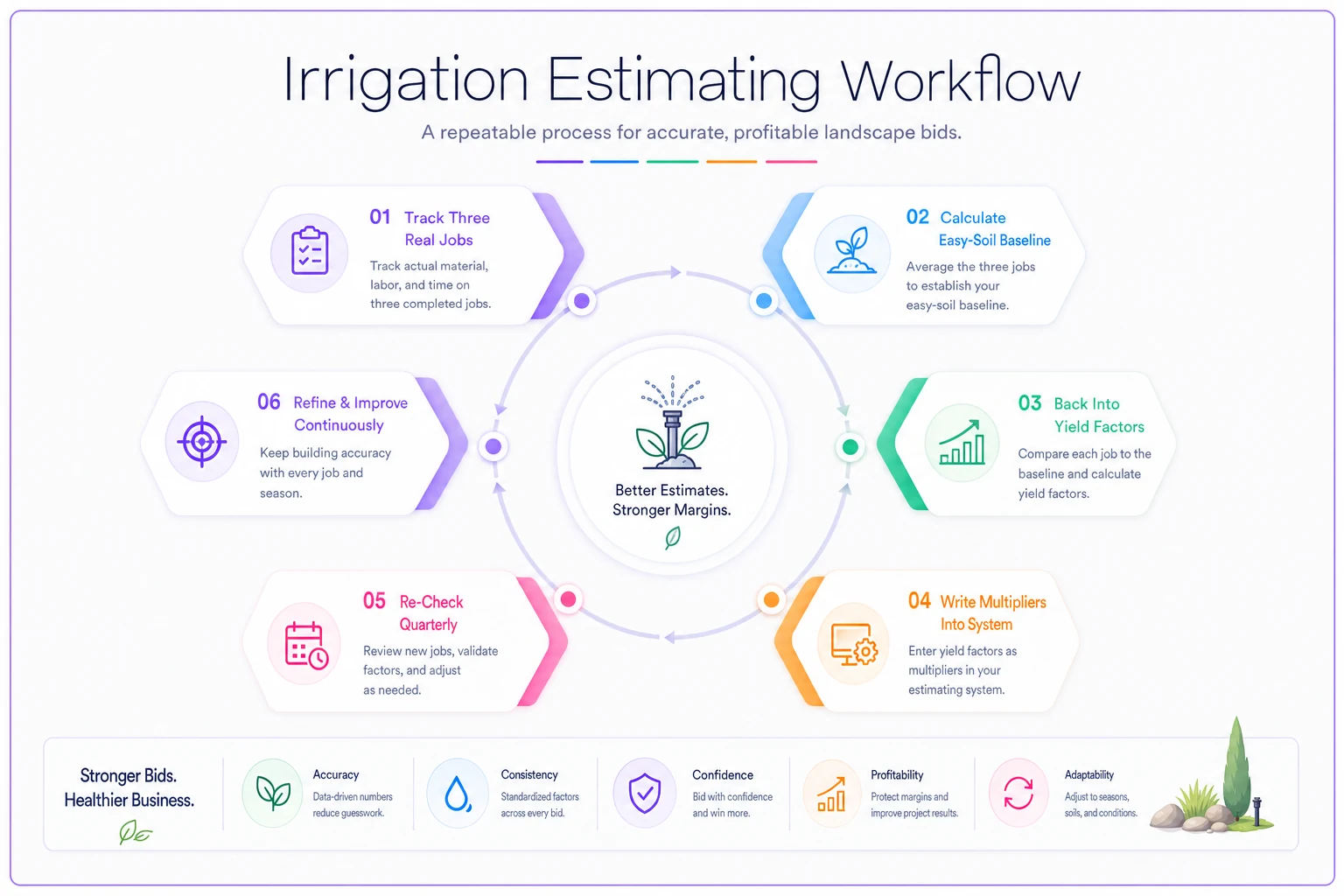
Use it to train estimators and standardize quote rules.
A quick real-world scenario
A small irrigation-and-landscape outfit — two crews, mostly residential installs — kept finishing jobs "on time but somehow flat." Their quotes looked healthy on paper, somewhere around 22–25% margin, but actuals kept landing closer to 12–15%.
Two things were bleeding them. First, they estimated pipe and wire off measured zone length with no yield factor, so nearly every job needed a mid-week supply run — call it $30–$40 in parts but an hour of a two-person crew standing around, repeatedly. Second, they priced all trenching at one rate despite working a lot of clay-heavy lots with mature trees.
They didn't do anything complicated. They logged four jobs, built a yield table and a rough trenching multiplier, and started quoting line-item. Within a couple months the mid-week supply runs mostly stopped, and their quoted-vs-actual gap tightened to a few points instead of ten. Change-order disputes dropped too — because when scope grew, the added lines were obvious and the customer could see exactly what changed.
Where a system helps (without overthinking it)
None of this requires software to work. Plenty of shops run it off a well-built spreadsheet. But the failure mode is consistency — the rules get skipped when someone's slammed, or the multiplier that lived on one estimator's laptop never makes it to the new hire.
That's the practical case for keeping your yield factors and trenching multipliers inside whatever estimating or job-management platform your team already uses. When a field note says "rocky" or "clay," the right adjustment is already there. The invisible-component checklist doesn't get skipped. Every quote traces back to the same logic regardless of who built it. The value isn't automation for its own sake — it's that your best estimating knowledge stops depending on one person remembering to apply it on the right day.
Bottom line
Irrigation underbids are almost never a math failure. They're a rules failure — trusting round numbers, pricing all dirt the same, and forgetting the small parts that stop a crew cold.
Build your yield table, set your trenching multipliers off real jobs, quote line-item so change orders are obvious, and run the invisible-component checklist before every send. Do that, and the number you quote is the number you actually keep.
Irrigation underbids are almost never a math failure. They're a rules failure — trusting round numbers, pricing all dirt the same, and forgetting the small parts that stop a crew cold.
Build your yield table, set your trenching multipliers off real jobs, quote line-item so change orders are obvious, and run the invisible-component checklist before every send. Do that, and the number you quote is the number you actually keep.
Ready to grow your landscaping business?
Join 2,000+ landscaping pros using Yardyly to save time, reduce task chaos, and deliver outstanding client results.