

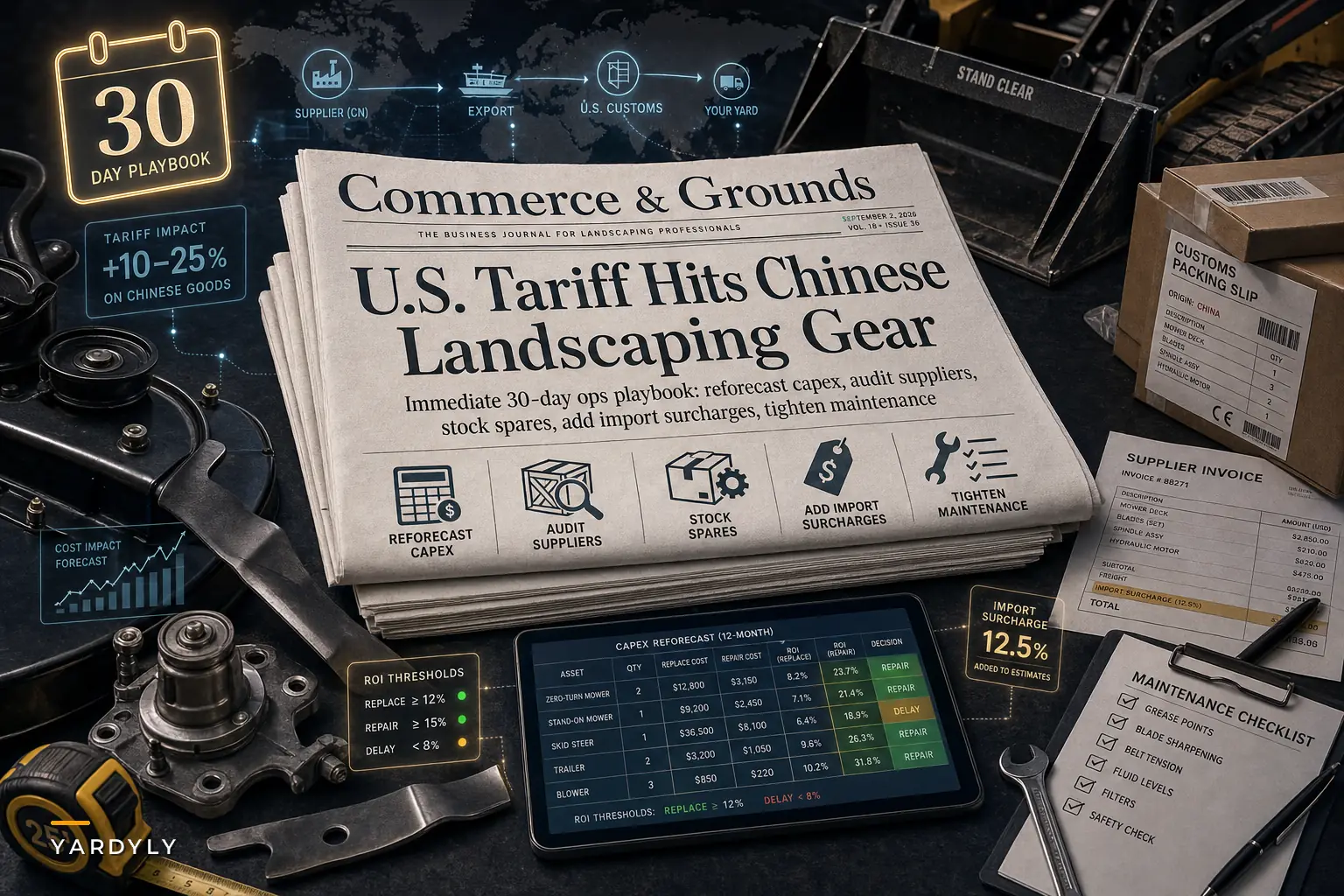

The news itself is simple enough. According to a recent Reuters report, the U.S. is preparing a roughly 7.5% "overcapacity" tariff on a broad set of Chinese goods ahead of an upcoming summit. Whether it lands at exactly 7.5% or gets negotiated down doesn't really change how you should be planning right now. What matters is that a big chunk of what a landscaping operation buys — string trimmers, blowers, mower parts, hydraulic fittings, blades, batteries, hand tools, irrigation components — either comes directly from China or contains parts that do.
So the useful question isn't "will prices go up." It's "which of my line items are exposed, and what do I change in the next 30 days before it hits my margins."
That's what this checklist is for. Not a policy explainer. A tariff is really just a stress test on how sloppy or tight your sourcing and bidding already are. Firms with clean supplier records and disciplined bid math barely feel a 7.5% bump. Firms flying blind eat it quietly for two seasons before they notice their equipment line doubled.
First, understand what actually moves — and what doesn't
A tariff percentage is a headline number, not what you'll pay. The real pass-through depends on where the item sits in the supply chain and how much pricing power your supplier has.
The pattern worth knowing: finished imported equipment usually passes through most of the tariff fast, because the importer has thin margins and no real reason to absorb it. Parts and consumables are messier — some distributors sit on inventory bought at old prices, so you get a lag of a few weeks to a couple months before increases show up. Domestic-branded gear that quietly uses Chinese components? That creeps up slowest, but it does creep.
| Category | Typical exposure | How fast it hits | What to do first |
|---|---|---|---|
| Imported handheld power equipment (trimmers, blowers) | High | Fast (weeks) | Pre-buy known replacements |
| Mower blades, filters, belts, spark plugs | Medium–High | Lagged (1–2 months) | Stockpile fast-movers |
| Hydraulic fittings, bearings, small parts | High | Lagged | Identify domestic alternates |
| Batteries / battery platforms | High | Fast | Lock platform now, avoid switching |
| Irrigation heads, valves, fittings | Medium | Lagged | Confirm project pricing validity |
| Domestic-brand equipment w/ imported parts | Low–Medium | Slow creep | Renegotiate service contracts |
| Hand tools, PPE | Low–Medium | Slow | Bulk buy at current price |
The mistake most crews make is treating "prices are going up" as one event. It's not. It's a rolling series of small increases across different categories on different timelines — which is exactly why it's easy to miss until it's already baked into your P&L.
Week 1: Audit what you actually buy and where it comes from
You can't hedge exposure you haven't measured. Most small landscaping firms don't have a real supplier list — they have a pile of receipts and a few phone numbers stored in someone's head.
Never miss a job detail again.
Yardyly helps you plan, confirm, and manage every landscaping project seamlessly.
- Centralized project scheduling
- Automated client updates
- Crew and resource management
No credit card required
Pull your last 12 months of equipment and parts spend and sort it into three buckets:
-
Critical + exposed — items you can't operate without that are likely tariff-affected (blades, filters, trimmer line, common repair parts, replacement handhelds)
-
Critical + safe — must-haves that are domestically sourced or already stockpiled
-
Discretionary — nice-to-haves you can delay or skip if costs jump
The point of this sort isn't to be perfect. It's to find the handful of SKUs that make up most of your risk. In real operations, the 80/20 shows up hard here — maybe 15 to 20 part numbers account for the bulk of your recurring parts spend, and those are the only ones worth thinking carefully about.
While you're at it, write down which supplier each critical item comes from and whether you actually have a backup. A surprising number of firms discover they're single-sourced on a part their whole fleet depends on. That's the real vulnerability a tariff exposes — not price, but concentration.
Week 2: Fix your bids before the increases catch you
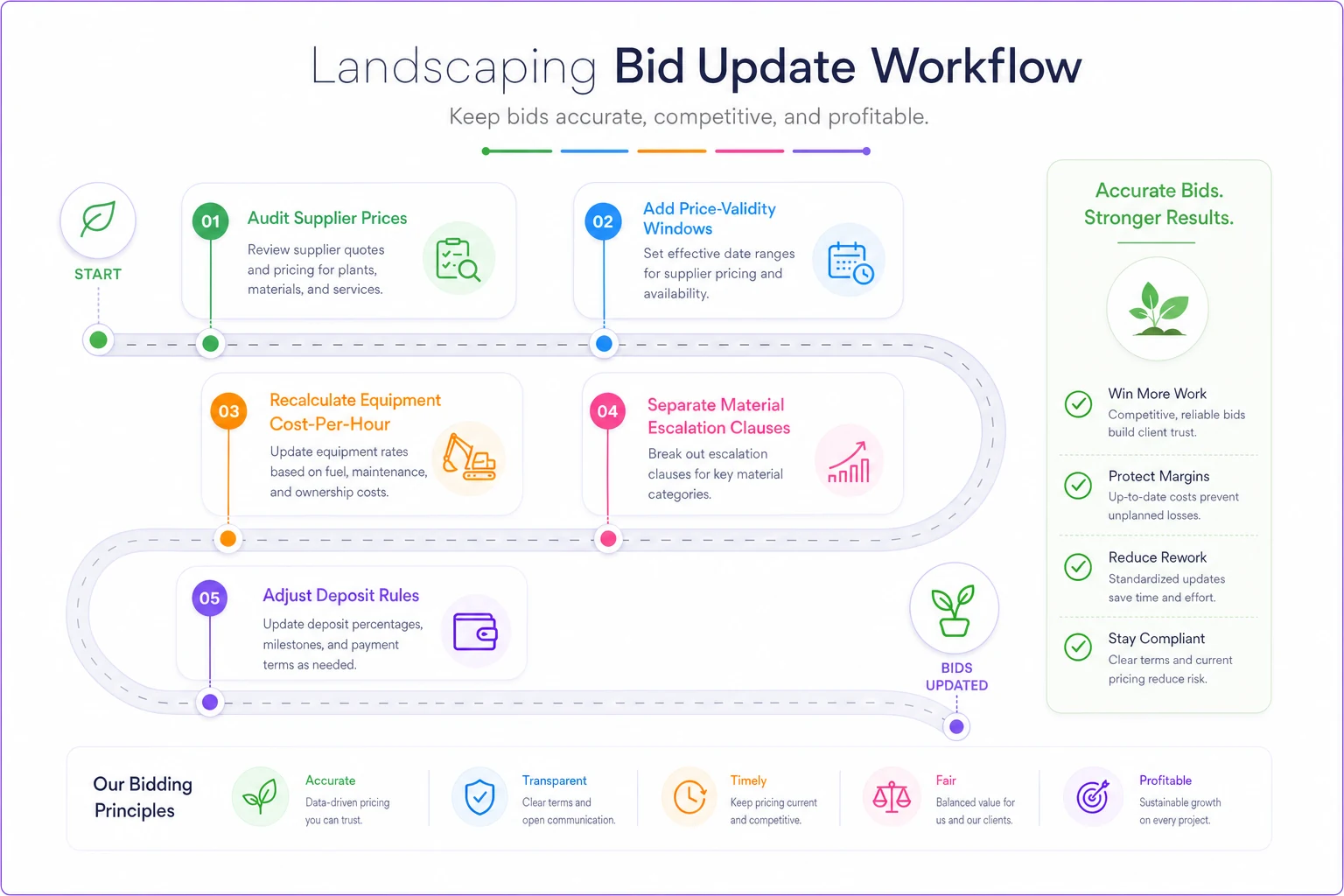
This is where money leaks quietly. If you're bidding project work — installs, irrigation, hardscape-adjacent jobs with material components — with pricing you built in spring, some of those numbers are already stale.
-
Add a price-validity window to every quote. "Pricing valid 30 days" is standard in construction and almost nonexistent in landscaping bids. Put it on everything. It's the single cheapest protection against a supplier increase landing between your quote and the client's signature.
-
Rebuild your equipment cost-per-hour. If a trimmer that cost $340 now costs $370, and you burn through a couple a season, your true equipment overhead per billable hour shifts. Small, but it stacks across a fleet.
-
Separate material escalation from labor. On larger installs, add a clause that ties material pricing to a named supplier quote with an expiration. That way if a valve box or fitting jumps 8%, you're passing through a documented number, not eating it or getting into a scope dispute.
-
Recheck your deposit rules on projects with long lead times. If lead times stretch because suppliers reroute away from China, you may be fronting material cost weeks earlier. Bigger deposits protect your cash position.
Here's a quick visual of the bid-update workflow.
The firms that handle cost shocks well aren't the ones with the lowest costs — they're the ones whose bids reprice fast. A 7.5% input increase quietly absorbed across a season can be the difference between an okay year and a break-even one, and almost nobody notices it happening in real time.
Week 3: Make the repair-vs-replace call deliberately
When new equipment gets more expensive, the math on repairing older gear shifts. Suddenly that mower you were going to retire is worth keeping one more season — but only if parts availability holds and the repair cost stays reasonable.
This is exactly where equipment lifecycle thresholds earn their keep. If you don't already have clear rules for when a machine gets repaired versus replaced, a tariff is a good forcing function to build them. We wrote a full breakdown on this in Reduce Downtime and CapEx Surprises: Equipment Lifecycle Thresholds and a 12‑Month CapEx Forecast for Landscapers — the same framework applies here, you're just recalculating the replace side of the equation with higher numbers.
A quick decision guide for the next 90 days:
-
Accelerate a planned purchase if the item is high-exposure, you were going to buy it this year anyway, and current inventory is still priced at pre-tariff levels. Buying a couple months early to dodge a 7.5% increase on a $6k machine is a clean call.
-
Delay a purchase if it's discretionary, if switching now locks you into a more expensive battery or parts ecosystem, or if you'd be buying on credit at rates that outweigh the tariff savings.
-
Repair instead if parts are still available and the machine has real life left — the replacement just got more expensive relative to the fix.
When accelerating capex is a bad idea: if it strains cash going into your slow season, or if you're pre-buying gear you don't actually have a confirmed need for. Buying three extra trimmers to "beat the tariff" and then watching them sit in a shed is just tying up cash to avoid a $75 increase. Don't let a headline number push you into bad inventory decisions.
Week 4: Stockpile the right spares and renegotiate terms
Stockpiling gets misunderstood. The goal isn't to hoard — it's to buy a buffer on the handful of fast-moving, high-exposure consumables you identified in Week 1, at today's price, before the lagged increase shows up.
Think blades, filters, belts, common fittings, trimmer line. Stuff that doesn't expire, that you'll definitely use, and that's cheap to store. Buying a season's worth of blades now is smart. Buying a year of specialty parts for one aging machine is not.
Your Week 4 checklist:
-
[ ] Order 3–6 months of your top fast-moving consumables at current pricing
-
[ ] Confirm which critical parts have a second supplier lined up
-
[ ] Ask your main distributors directly whether tariff increases are coming and when
-
[ ] Lock any annual pricing agreements before they reset
-
[ ] Identify one domestic or non-China-sourced alternate for your two or three most critical parts
-
[ ] Update your reorder points to reflect longer possible lead times
Ask your distributor "what's changing on your end and when" — it can get you weeks of lead time to plan around.
That distributor conversation matters more than people expect. Suppliers often know their increase timelines before customers do, and a simple "what's changing on your end and when" can get you weeks of lead time to plan around. The firms that get blindsided are usually the ones who never asked.
A real scenario
A midsize maintenance and install firm running four crews pulled their parts and equipment spend from the prior year — roughly $80k across gear and consumables — and did the three-bucket sort. Turned out about 60% of that spend was tariff-exposed, but the genuinely critical, hard-to-swap items were a much smaller slice, somewhere around $18k–$22k.
Instead of panic-buying, they pre-purchased a season of blades, filters, and trimmer line at current prices, added a 30-day validity line to every project quote, and moved up the replacement of two trimmers they'd already budgeted for. They also found a domestic alternate for one hydraulic fitting they'd been single-sourced on for years.
Where good records quietly do the heavy lifting
None of this works if your sourcing lives in someone's memory and your bid costs live in a spreadsheet nobody's updated since March. The firms that respond to cost shocks fast are the ones who already had their supplier list, per-item costs, and equipment history somewhere they could actually pull up.
That's the real lesson underneath the tariff. A solid business management setup — where equipment costs, parts usage, supplier records, and job pricing connect — turns a "we should probably look into that" into a same-week decision. When your quoting reflects current costs and your reorder points flag longer lead times before you run dry, a 7.5% input increase becomes a line item you manage instead of a surprise you absorb.
Firms still piecing this together across paper receipts and gut feel are the ones who'll be wondering in six months where their margin went. The operational advantage isn't complicated — it's just having the information in one place when you need it.
The bottom line for the next month
A tariff is a deadline, not a disaster. The 30 days ahead of you are worth more than the exact percentage that eventually lands, because most of the protection comes from moves you should've made anyway — knowing your suppliers, repricing bids on a real schedule, having clear repair-vs-replace rules, and stocking the few consumables that actually matter.
Do the audit. Fix the quotes. Buy the buffer on your top movers. Have the supplier conversation. Firms that treat this as a forcing function to tighten their sourcing come out with better records and steadier margins regardless of where trade policy lands next. The ones that wait for increases to show up on invoices will spend next spring trying to figure out why the equipment line got so heavy — and by then, the window to do anything about it will already be closed.
Ready to grow your landscaping business?
Join 2,000+ landscaping pros using Yardyly to save time, reduce task chaos, and deliver outstanding client results.