



The heat dome parked over most of the U.S. since early July isn't just uncomfortable—it's operationally breaking landscaping businesses. According to AP reporting, we're seeing record-breaking temperatures with overnight lows barely dropping below 80°F in many regions. Crews are starting shifts already dehydrated, and the usual "work through lunch to beat the afternoon heat" strategy falls apart completely when morning temps hit 95° by 8:30 AM.
This heat wave is different. The duration is what kills you operationally. A three-day spike? You push through it, maybe lose a day of productivity. Two weeks in with no real break in sight changes everything. Crews are exhausted, equipment is failing at triple the normal rate, and customers are simultaneously demanding more watering services while complaining about crews showing up at 6 AM.
The cascade failure nobody talks about
Most heat wave scheduling advice focuses on the obvious—start earlier, take more breaks, provide water. The real operational nightmare happens in week two when everything starts compounding.
Your lead mower operator calls out Thursday because he's been getting up at 4 AM for ten straight days and his body finally gave out. Now you're shuffling crews, which means the new guy on the commercial property doesn't know about the irrigation head buried under the mulch. He hits it, floods the parking lot. The property manager, already stressed because their HVAC is struggling, threatens to cancel the contract.
Meanwhile your afternoon installation crew can't start until 5 PM to avoid peak heat. That means working until dark, making quality control nearly impossible. The paver edges aren't quite right, but nobody notices until the client calls furious the next morning. You promise to fix it—but when? Morning crews are already behind from shorter shifts, and afternoon slots are reserved for heat-sensitive work only.
This cascading schedule compression is what actually destroys margins during extended heat events. Not the overtime pay or the extra water bottles. It's the inefficiency tax of constantly shuffling jobs, redoing work done in bad conditions, and managing client relationships strained by repeated last-minute changes.
The four-window system that actually works
Companies that maintain both safety and productivity during heat waves tend to use a four-window rotation instead of the traditional two-shift model.
Never miss a job detail again.
Yardyly helps you plan, confirm, and manage every landscaping project seamlessly.
- Centralized project scheduling
- Automated client updates
- Crew and resource management
No credit card required
Window 1: Dawn patrol (5:00 AM – 8:30 AM) Highest-skilled crew handles noise-sensitive residential properties. Mowing, edging, detail work while temps are still in the 70s or low 80s. No lengthy equipment repairs, no extended homeowner consultations—just efficient, quiet work.
Window 2: Commercial hustle (6:30 AM – 10:00 AM) Commercial properties don't care about noise, so you can run multiple mowers and move fast. The overlap with Window 1 gives you some flexibility if someone calls out.
Window 3: Shade and service (10:00 AM – 2:00 PM) Most companies shut down completely here. But you can keep limited operations going with the right work selection—tree work, shaded property maintenance, irrigation repairs, equipment maintenance back at the shop. You're not pushing hard, but you're not burning four hours of potential revenue either.
Window 4: Recovery sprint (5:00 PM – 8:30 PM) Afternoon window for installations, make-up mowing, and properties with flexible schedules. Not a full crew—maybe 40% of your workforce—but it lets you catch up on delayed work without destroying your team.
No single employee works more than two windows per day, and you rotate who gets dawn patrol versus the evening shift. That rotation is what prevents the cumulative exhaustion that causes injuries and mistakes by week two.
Rotate who gets dawn patrol weekly to prevent cumulative exhaustion.
The diagram below shows how these windows connect across a typical heat wave day:
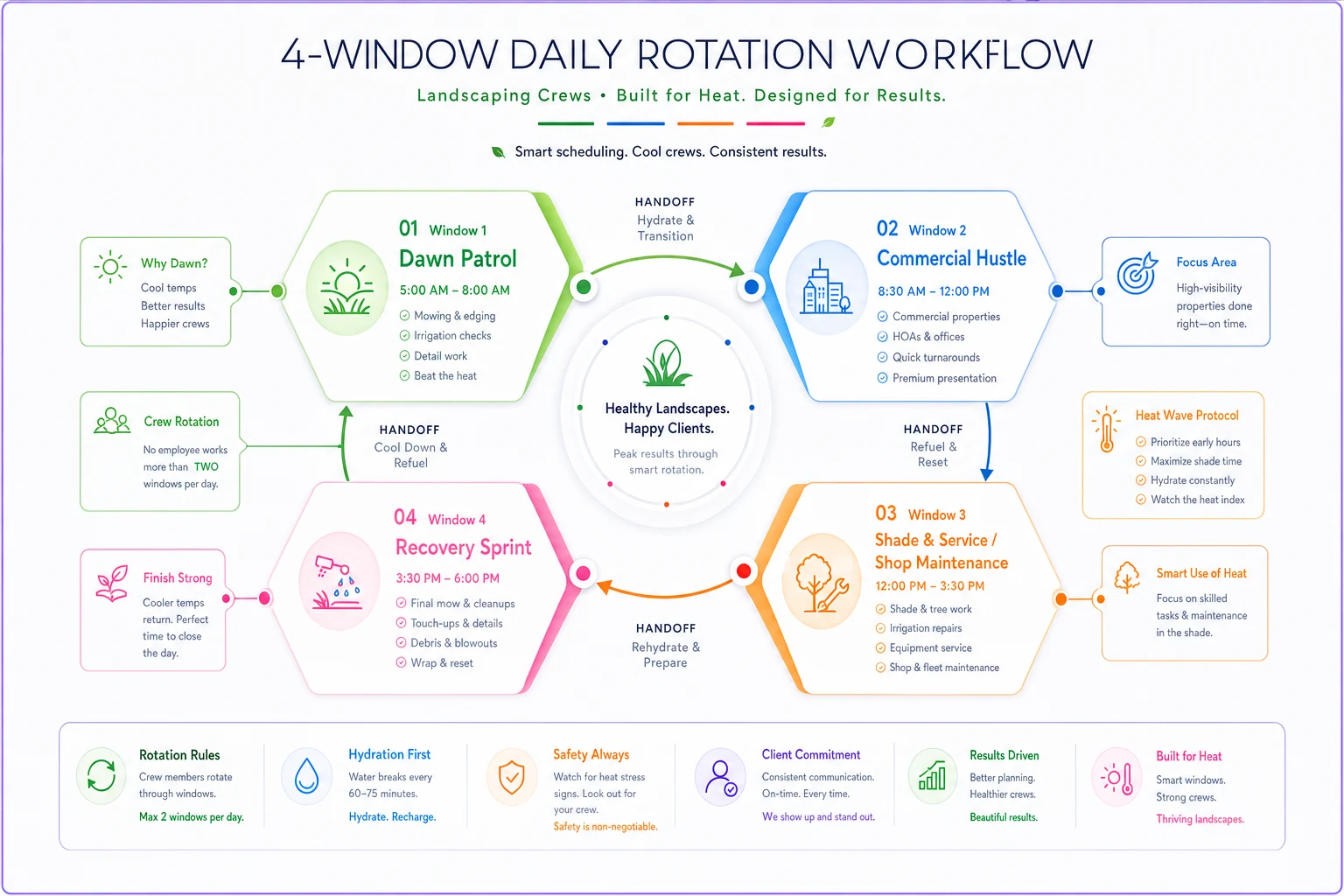
Use this flow to plan handoffs and crew rotations during heat events.
Preemptive client communication that prevents meltdowns
The worst thing you can do is notify clients the morning of a service change. By then they've arranged their entire day around your arrival, and a last-minute adjustment creates frustration that compounds with every subsequent heat-related change.
Start a tiered notification process five days before forecast extreme heat. A brief message to all clients in affected windows: "Extended extreme heat is forecast for next week. Your service may shift 2–3 hours earlier for crew safety. We'll confirm exact timing 48 hours before service."
-
Send initial notice five days out with forecast context
-
Confirm adjusted timing at 48 hours with exact window
-
Send day-before reminder with crew arrival time
-
Follow up post-service if any work was modified or deferred
Commercial property managers especially respond well to this. They care more about predictability than specific timing. If they know every time it's forecast above 95°F your crew arrives at 6:30 AM instead of 9:00 AM, they can plan around it without the constant back-and-forth.
The equipment failure multiplier nobody budgets for
CNBC's recent coverage focused on power grid strain, but that same heat is destroying landscaping equipment at rates most operators haven't accounted for. Hydraulic systems overheating on zero-turns, trimmer engines seizing, commercial-grade mowers failing after just three hours of operation.
A typical landscaping company with eight zero-turns might see one major repair per month during normal summer ops. During this heat dome, some are seeing one or two failures per week. That's not just repair costs—it's a scheduling cascade. Your 60" mower goes down and now you're trying to cut the same property with a 48" backup.
The costs multiply fast. A hydraulic pump failure on a commercial mower runs $1,200–1,800 in parts plus labor. But the real hit is losing that mower for three to five days during peak season—either renting equipment at roughly $400/day or losing around $800/day in productivity from that crew.
Smarter operators are running equipment on 20-hour maintenance intervals instead of the standard 50 hours during this stretch. Yes, you're tripling maintenance supply costs. But you're preventing the $2,000+ catastrophic failures and, more practically, you're building those maintenance windows into the 10 AM–2 PM block when crews can't be doing heavy field work anyway.
Micro-scheduling adjustments that preserve margins
The typical heat wave response—start earlier, end earlier—works for about three days. After that, you need adjustments that account for job-specific heat exposure rather than treating every property the same.
A property with zero shade needs to move to the earliest morning slots or evening only. But that corner commercial property with mature oaks providing 60% shade? That can still run at 11 AM with proper crew rotation. Treating all properties the same is where you lose recoverable productivity.
| Shade Coverage | Safe Working Window | Notes |
|---|---|---|
| Full sun (0–30%) | Dawn or dusk only | Reschedule before 8 AM or after 5 PM |
| Partial shade (30–50%) | Can extend to 10 AM | Monitor crew closely, limit shifts |
| Mostly shaded (50%+) | Can work until noon | Mandatory breaks every 45 min |
| Indoor or covered work | Normal hours | Standard hydration protocols apply |
Rating each property this way takes maybe an hour the first time. After that it's just maintenance. A crew can knock out three partially-shaded residential properties between 10 AM and noon, generating $400–500 in revenue during what would otherwise be dead time. Not massive, but across a two-week event it adds up.
The hydration math that keeps crews functional
Everyone knows to provide water. The quantity is where operators consistently underestimate.
A crew member working a dawn patrol from 5 AM to 8:30 AM needs roughly 84 ounces minimum—more than half a gallon just for one shift. Add an evening window and you're looking at close to a gallon per person per day, not counting what they need before and after shifts. For a six-person crew, that's 6+ gallons per day minimum. Crews staying functional through extended heat waves are closer to 1.5 gallons per person per day. That's 50+ gallons per week for a small operation.
What actually matters most is pre-shift hydration. Crew members showing up already dehydrated from the day before never fully recover during the shift. Some companies now provide take-home electrolyte packs specifically for evening consumption so crews start the next morning in better shape. It sounds like a small thing. The difference in crew output by day ten of a heat wave is not small.
Technology fixes for heat-scrambled operations
When you're reshuffling schedules daily based on temperature forecasts and crew availability, manual scheduling becomes a losing battle. This is where AI-powered operational software becomes genuinely useful for heat wave scheduling.
A single heat-related schedule adjustment can affect eight to twelve other jobs once you account for route optimization and crew reassignments. Doing that manually means your office manager rebuilds the next day's schedule for two to three hours every evening—and that's if nothing else goes wrong.
Scheduling platforms with AI automation handle the reshuffling automatically. Input your heat exposure ratings, set temperature thresholds, and the system generates optimized schedules when forecasts exceed safe working conditions—then sends client notifications, updates crew routes on their phones, and tracks which properties got bumped so nothing falls through the cracks.
The longer-term value is pattern recognition. After a few heat events, the system starts identifying which clients are flexible about timing versus those who need rigid scheduling, and which crew members hold up better on early morning shifts versus evening work. That institutional knowledge doesn't evaporate when the heat breaks—it just sits there ready for the next event.
The profit recovery timeline most companies miss
A two-week heat wave creates six to eight weeks of operational impact. Weeks one and two are obvious—you're managing safety and schedule chaos. But weeks three through six are where companies either recover profitably or slide into deeper problems.
Week three, the heat breaks but your crews are exhausted. Productivity stays suppressed even though conditions improved. You're also dealing with accumulated equipment repairs, heat-stressed lawns and plants that need extra attention, and relationship repair with clients who had repeated schedule changes.
Weeks four through six are the make-or-break recovery period. Companies that planned ahead—kept some budget reserve for overtime, pre-scheduled equipment maintenance, had client retention communication ready—bounce back to normal margins relatively quickly. Those that assumed everything snaps back to normal when temperatures drop find themselves in a profit hole that drags into September.
Budget for roughly 20% increased labor costs spread across two months, not two weeks. Plan for an equipment maintenance surge in week three. Pre-write client communication templates for when you're catching up on delayed enhancement work. That eight-week view changes how you allocate resources during the event itself.
Beyond surviving to systematic resilience
The July 2026 heat dome won't be the last extreme weather event to break landscaping operations. These events are becoming more frequent, which means heat wave response has to become a core operational capability—not an emergency exception you figure out from scratch every time.
The companies holding up best through this aren't just the ones with the most water coolers or the earliest start times. They built systematic responses: four-window scheduling, property-specific heat ratings, preemptive client communication protocols, and platforms that handle the constant reshuffling without burning out office staff.
More importantly, they're documenting what's working and what isn't during this event. Every heat wave teaches you something about your operational limits, your crew's actual capacity, and which clients give you flexibility when you need it. The question is whether you capture those lessons in repeatable processes or lose them to the chaos of the moment.
Next week, when forecasts show continued extreme temperatures across much of the country, you'll either be running systematic adjustments or scrambling through another day of reactive changes. That difference doesn't come from working harder—it comes from building operations that don't require heroics every time the thermometer spikes.
Ready to grow your landscaping business?
Join 2,000+ landscaping pros using Yardyly to save time, reduce task chaos, and deliver outstanding client results.