

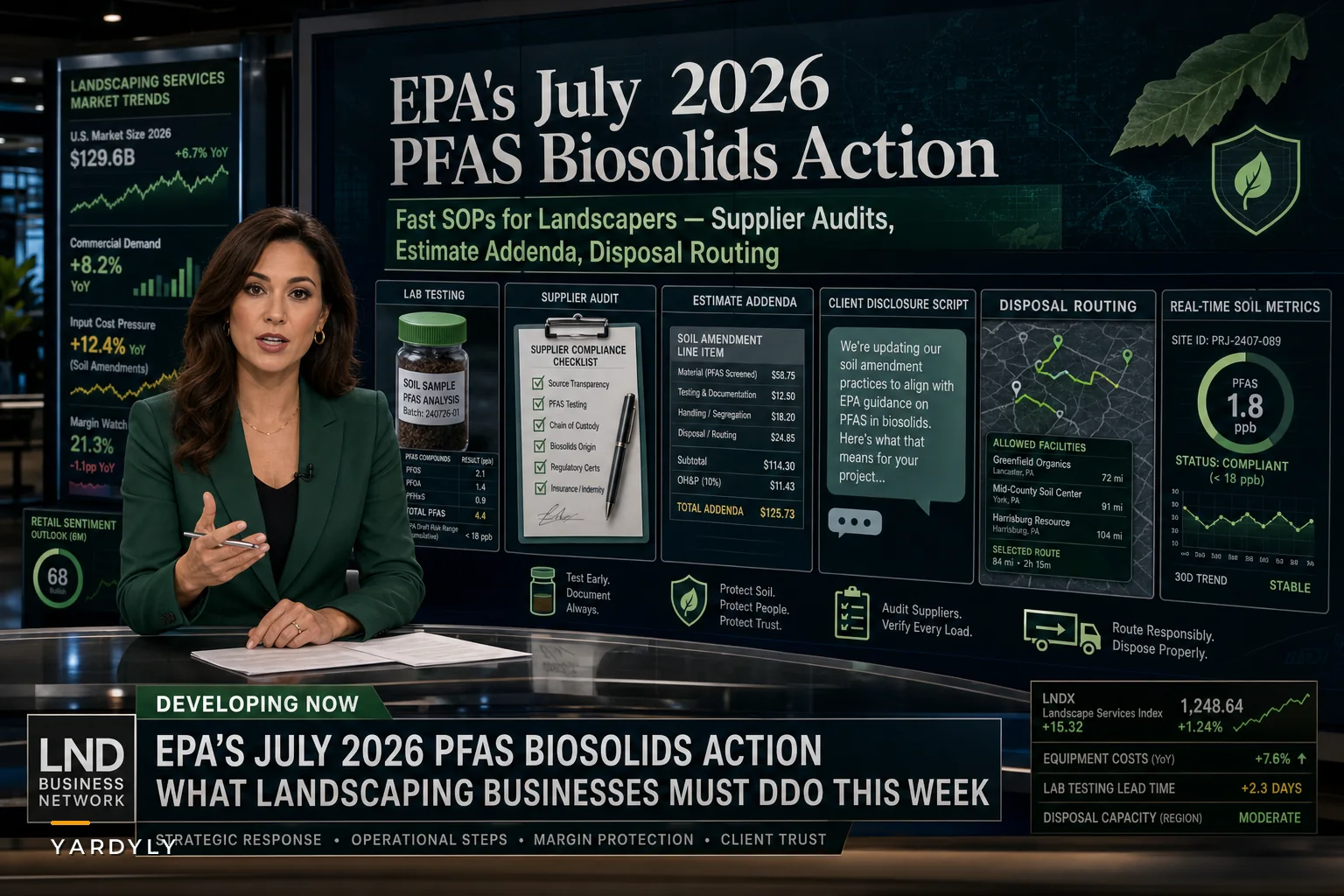

At a supplier meeting in Raleigh recently, every soil amendment vendor in the room was talking about the same thing. The EPA dropped new draft guidance on PFAS in biosolids while simultaneously proposing to rescind several drinking water PFAS rules. The conversation shifted from bulk pricing to alternative sourcing in about twenty minutes flat.
If you're buying compost, topsoil blends, or any organic amendments for landscaping projects, this affects your business now. Not in some distant regulatory future — suppliers are already adjusting product lines and pricing structures for next season.
The Supply Chain Shock Nobody Prepared For
The EPA's July actions around PFAS biosolids landscaping regulations create real uncertainty for anyone using biosolid-derived materials. What seemed like cheap, sustainable soil amendments suddenly carries liability questions that nobody has clear answers to yet.
Most landscapers don't realize how much of their standard amendment mix contains biosolid-derived products. That "premium organic blend" from your bulk supplier? There's a decent chance it includes processed sewage sludge that municipalities have been selling as fertilizer for decades. The black gold compost you've been getting at $28 per yard? Same story.
The operational mess hits on multiple fronts at once. Amendment costs might jump 15–30% as suppliers shift to non-biosolid sources. Some products will simply disappear. Municipalities that were practically giving away biosolid compost are now sitting on material nobody wants to touch. Meanwhile, you've got estimates out there based on pricing that's about to change.
Audit Your Amendment Chain Right Now
Start with a supplier inventory that most landscapers never bother creating. List every soil amendment product you've purchased in the last 12 months — not just what you regularly buy, but everything. The specialty blend from the botanical garden job, the mushroom compost from the farm supply place, even the bagged products you grab when you're short on bulk delivery.
Never miss a job detail again.
Yardyly helps you plan, confirm, and manage every landscaping project seamlessly.
- Centralized project scheduling
- Automated client updates
- Crew and resource management
No credit card required
Contact each supplier and ask three specific questions: Does this product contain biosolids or biosolid-derived materials? What percentage? Are you planning formula changes for the 2027 season?
Document their responses in writing. Not "Joe said it's probably fine" in your notes app — get emails or texts that create a paper trail. When a client asks about soil safety six months from now, you need documentation that shows you did your homework.
The tricky part is that many suppliers genuinely don't know their own full supply chain. That regional compost facility might be mixing municipal biosolids with yard waste and agricultural byproducts. Your supplier's supplier might change formulas without notification. This lack of transparency has always existed — PFAS just exposed it.
Recalculating Project Costs Without Panicking
Pull your last 20 estimates that included soil amendments and calculate what percentage of total project cost went to amendment materials. For typical residential landscaping, it runs anywhere from 8% on basic mulch-and-plant jobs to around 25% on full lawn renovations with heavy topdressing.
Run scenarios. If amendment costs increase 20%, how much does that shift your margin? At 30%? Can you absorb a 2–3% margin hit on existing estimates, or do you need to issue revised quotes?
Companies doing high-volume maintenance work barely feel the impact — amendments are a small slice of operational cost. But landscapers specializing in organic lawn care or soil restoration see their entire pricing model disrupted. One organic-focused company in Virginia saw their standard lawn renovation package jump from $3,200 to $3,850 when they switched to certified PFAS-free amendments. That's not something you quietly absorb.
The pricing conversation gets complicated because you can't pass costs through uniformly. Commercial clients with sustainability requirements might actually prefer paying more for documented PFAS-free materials. Residential customers focused on curb appeal won't understand why their fall overseeding quote jumped $400. You need different messaging for different clients, and you need to figure out that segmentation before the phone starts ringing.
Creating Your Client Communication Strategy
The worst thing you can do is wait for clients to find out through news coverage. You need to get ahead of it before misinformation spreads through neighborhood Facebook groups.
-
Tier 1
Existing clients with organic/sustainability focus
These clients chose you specifically for environmental reasons. They need detailed information about your amendment sourcing changes, even if it means price increases. Send a formal letter or email explaining your shift to verified PFAS-free products, include links to EPA guidance, and frame it as proactive quality control — because it is. -
Tier 2
Active project clients
Anyone with a project scheduled in the next 90 days needs to know about potential cost adjustments. Keep it straightforward: "Following new EPA guidance on soil amendments, we're updating our sourcing to ensure the highest quality materials for your project." -
Tier 3
General customer base
A simple newsletter or website update covers everyone else. Focus on your commitment to safe, quality materials without diving into technical details that create unnecessary concern.
Timing matters as much as the content itself. Tell clients after you've secured new suppliers but before work starts. Nothing damages trust like a surprise change order because you didn't plan ahead.
Tell clients after you've secured new suppliers but before work starts. Nothing damages trust like a surprise change order because you didn't plan ahead.
Building Your Amendment Testing Protocol
Testing sounds expensive and complicated, but a basic protocol protects your business without breaking the budget. You don't need to test every bag of topsoil — you need a systematic approach that documents due diligence.
-
New supplier relationship — test their primary products before committing
-
Switching product lines — test before bulk orders
-
Client specifically requests PFAS-free materials — test and document
-
State or municipal regulations change — test your standard amendments
-
Annual review of existing approved suppliers
Budget roughly $300–500 per test for basic PFAS panels. That seems steep until you compare it to losing a $50,000 commercial maintenance contract because you couldn't document soil safety. One mid-sized company in Maryland spent around $2,200 on testing last quarter and used those results to win three organic-focused commercial properties worth $180,000 annually.
Create a simple tracking system for each tested product:
| Field | Details |
|---|---|
| Product name | Full product name and SKU |
| Supplier | Company name and contact |
| Test date | Date sample was collected |
| Results | Pass/fail and PFAS levels |
| Expiration | Typically 12 months from test |
| Certificate location | File path or folder reference |
This isn't bureaucracy. When a concerned HOA board member waves a news article about PFAS contamination at you, you pull up test results and end the conversation in two minutes.
Operational Adjustments That Actually Work
Inventory management needs immediate adjustment. Ordering whatever's cheapest from whoever delivers fastest isn't a sourcing strategy anymore. You need preferred supplier relationships with documented sourcing standards.
Start batching amendment orders by source verification level. Keep PFAS-tested products separate from untested materials. Use tested amendments for sensitive projects — schools, daycares, food gardens — and standard materials for less critical applications like commercial mulching or non-food landscaping. This segmentation lets you manage costs while protecting yourself where it matters most.
Adjust your storage and handling too. Mark amendment piles or bins clearly with source documentation dates. Train crews on which materials go where — you don't want someone grabbing untested compost for the elementary school garden because it was sitting closer to the loader.
Documentation becomes part of daily operations. Every amendment delivery needs a receipt showing product source. Every application needs basic job notes about what went where. When integrated into your existing workflow, this adds maybe 30 seconds per job. Add two fields to the job tickets you're already creating and you're done. When you're already tracking hidden costs in your takeoff checklist, adding amendment documentation fields takes about ten minutes of setup.
The Small Details That Prevent Big Problems
Update your estimate templates to include amendment source disclosure. A simple line — "Project includes EPA-compliant soil amendments from verified sources" — provides legal protection while building client confidence. For higher-end projects, list specific product names and certifications.
Review your contracts for material substitution clauses. You need flexibility to switch products if your preferred amendment becomes unavailable or problematic. Standard language: "Contractor reserves the right to substitute equivalent or superior materials based on availability and regulatory compliance."
Update supplier agreements to include PFAS disclosure requirements. If they can't or won't provide sourcing documentation, find suppliers who will. This isn't being difficult — it's basic supply chain management when the regulatory landscape shifts.
A simple one-page client handout about soil amendments and PFAS goes a long way. Not a scientific paper, just a plain FAQ explaining what you're doing to ensure safe materials. Post it on your website, include it in proposals, keep copies in the trucks.
Pricing Strategies That Preserve Margins
The knee-jerk reaction is to universally raise prices to cover higher amendment costs. Smarter strategies preserve margins without pushing away price-sensitive customers.
-
Basic standard materials meeting minimum requirements
-
Premium tested, certified PFAS-free products
-
Organic Plus specialized amendments from verified organic sources
This gives clients a choice while protecting your margins on jobs that justify higher material costs.
Bundle amendment costs into project phases rather than itemizing them. Instead of showing "$400 for PFAS-free compost," include it in "Phase 2: Soil Preparation and Amendment — $1,850." Clients see the value in the complete service, not sticker shock from individual line items.
For maintenance contracts, build in quarterly price adjustment provisions tied to amendment costs. Something like "Prices subject to quarterly adjustment based on material cost index" gives you flexibility without constant renegotiation.
Making This Systematic, Not Chaotic
The businesses handling this well aren't just reacting to each new development. They're building workflows that turn regulatory uncertainty into a competitive edge.
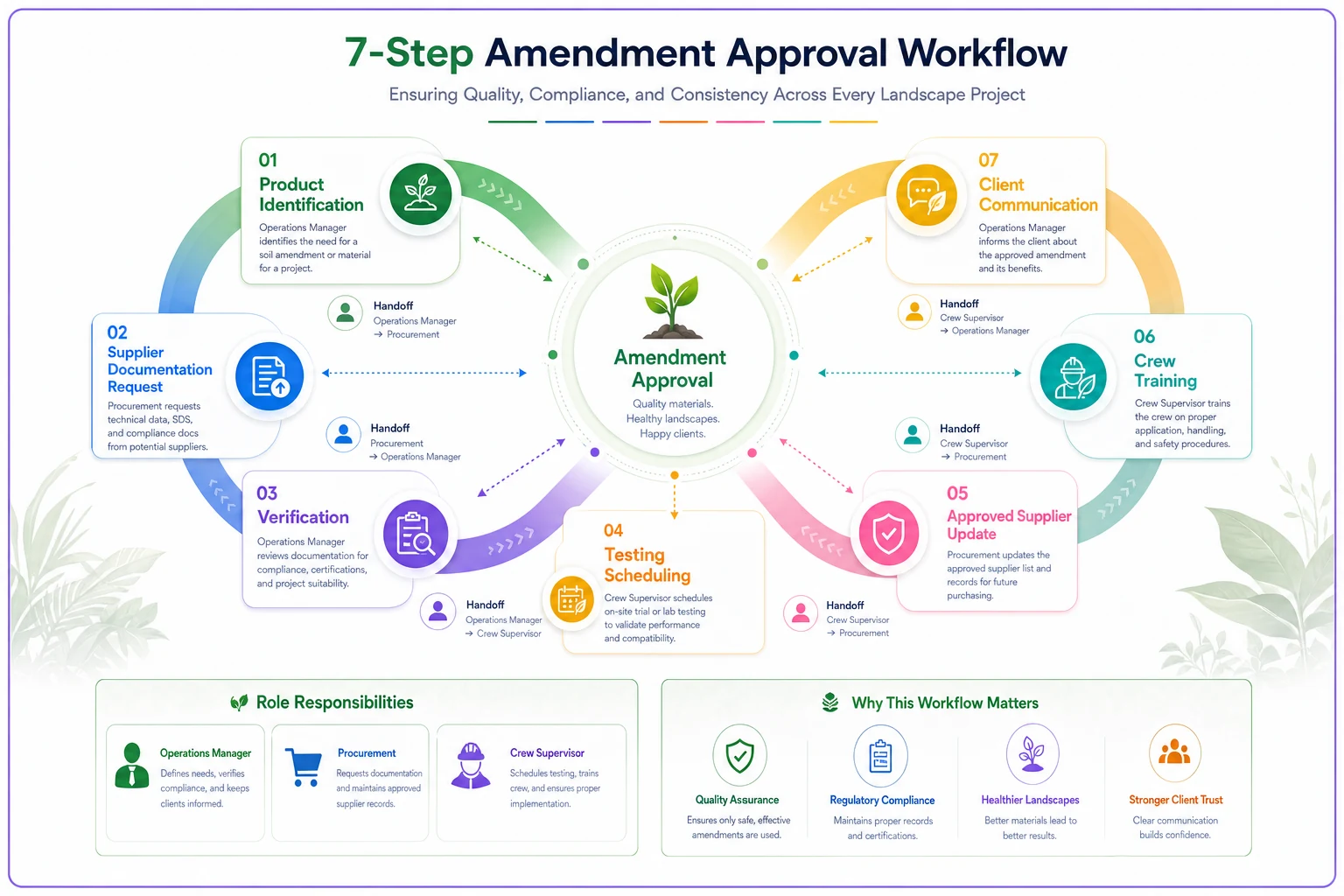
A simple amendment approval process helps here:
-
New product identified
-
Supplier documentation requested
-
Claims verified against documentation
-
Testing scheduled if necessary
-
Approved supplier list updated
-
Crew training on new product
-
Client communication issued if relevant
That sequence takes a confusing situation and breaks it into manageable steps. It also makes it easier to delegate — your operations manager or lead crew supervisor can run steps two through six without you involved in every decision.
Set up quarterly amendment reviews. First Monday of each quarter, spend an hour reviewing your approved supplier list, checking for regulatory updates, and adjusting procedures. This prevents the scramble that comes from sudden changes while keeping you ahead of competitors who are still using "whatever's available."
Operational software you might already use for job tracking can handle amendment documentation without adding new systems. Add custom fields for amendment source, test dates, and certification numbers to your existing job records. Most platforms support this kind of customization, and once the fields are there, crews fill them in as part of normal job closeout — no extra workflow required.
A Real Transition That Worked
Greenscape Solutions in North Carolina faced this exact situation in early July. About 40% of their amendment supply was coming from municipal biosolid compost at $22 per yard. When the EPA guidance dropped, their supplier immediately stopped deliveries pending clarification.
Rather than scramble, they ran a three-phase transition:
-
Phase one identified alternative suppliers within two days, even at higher costs
-
Phase two communicated proactively with their 180 active clients about temporary material changes
-
Phase three negotiated bulk pricing with new suppliers and got costs down to only 18% above original
The key wasn't finding perfect solutions immediately. It was having a plan that kept operations running while they figured out longer-term adjustments. They lost roughly $3,400 in margin during the transition month but retained every single client by being upfront about what was happening.
By September, they'd grown their business by marketing a "Certified Clean Soil Promise" to environmentally conscious neighborhoods. What started as a supply chain crisis became a differentiator because they handled it systematically instead of reactively. That's not a fluke — it's what happens when you treat operational problems like operational problems instead of hoping they go away.
Moving Forward Without Perfect Information
Nobody has complete answers about PFAS biosolids regulations yet. The EPA guidance remains in draft form. State regulations vary widely. Municipal rules are shifting. Waiting for perfect clarity means paralysis while competitors adapt.
What you can control is your operational response. Document what you're using. Build supplier relationships based on transparency. Adjust pricing to maintain margins. Communicate with clients before they get nervous. These actions protect your business regardless of how regulations finally settle.
The companies struggling right now are the ones pretending nothing changed — still buying whatever's cheapest, hoping clients won't ask questions, assuming this will blow over. When a competitor shows up with documented PFAS-free materials and clear communication about soil safety, it's not a close call on who wins the contract.
Public awareness of PFAS is growing, regulations are tightening, and client expectations are shifting. Landscaping businesses that build systematic approaches to amendment sourcing and documentation don't just survive this transition — they use it to establish professional credibility that separates them from competitors still operating like it's 2019.
Take the weekend to audit your amendment sources. By Monday, you'll know exactly what you're putting in client properties.
From there, building a response plan becomes just another operational adjustment — challenging but manageable, like everything else in running a landscaping business.
Ready to grow your landscaping business?
Join 2,000+ landscaping pros using Yardyly to save time, reduce task chaos, and deliver outstanding client results.