



Spring hits landscaping companies like a freight train every single year, and most owners still scramble through the same exact chaos. Your regular eight-crew operation that runs clean in October suddenly needs to handle triple the volume in April. The phone rings nonstop, crews get double-booked, and profitable jobs slip through because nobody can figure out who's available when.
A proper landscaping scheduling system isn't about fancy software or complex spreadsheets. It's about having clear rules that everyone follows when demand spikes. The difference between companies that thrive during peak season and those that barely survive comes down to decision frameworks—specific triggers that tell you when to add capacity, how to escalate problems, and which jobs to prioritize.
Why Traditional Scheduling Falls Apart During Peak Season
Most landscaping businesses build their scheduling around normal capacity. Regular crews, standard routes, everyone knows their role. That works fine when you're handling 40 weekly maintenance accounts and maybe 10 installation projects.
Then March arrives. Suddenly you're fielding 200 quote requests, your maintenance list balloons to 120 properties, and everyone wants their spring cleanup done yesterday. Whatever passed for a scheduling system immediately breaks down.
The real problem isn't the volume itself. It's that your scheduling operates on assumptions that stop being true during peak season. Your crew leader who normally handles scheduling for his team is now in the field 12 hours a day. Your office manager who coordinates jobs is drowning in phone calls. The owner who usually makes tough priority calls is out giving estimates morning to night.
What follows is pretty predictable. Jobs get scheduled without checking equipment availability. New clients get promised unrealistic start dates. Maintenance accounts get shuffled so much that crews show up to the wrong properties. Rain delays create a domino effect that takes weeks to untangle.
The financial damage hits harder than most owners expect. Not just from obvious stuff like overtime costs or rushed hiring. The real damage comes from quality issues when tired crews cut corners, from losing reliable clients who get bumped one too many times, and from burning out your best people.
Building Capacity Buffers That Actually Work
Capacity buffers in landscaping aren't about having extra crews sitting around waiting. They're about structured flexibility that kicks in automatically when certain thresholds are hit.
Never miss a job detail again.
Yardyly helps you plan, confirm, and manage every landscaping project seamlessly.
- Centralized project scheduling
- Automated client updates
- Crew and resource management
No credit card required
The most practical buffer system starts with defining your capacity zones. Normal capacity might be your eight crews handling 35 stops per day total. Stretched capacity pushes that to 42 stops by extending routes slightly. Emergency capacity means pulling your installation crew into maintenance for a couple days or calling in your trusted subcontractor.
Green Zone (Normal Operations)
-
80% or less of crew hours committed
-
All equipment has 20% downtime buffer
-
Office can return calls same day
-
Estimates scheduled within 5 days
Yellow Zone (Stretched Capacity)
-
80-95% of crew hours committed
-
Equipment scheduled back-to-back
-
Callbacks within 24 hours
-
Estimates pushed to 7-10 days
Red Zone (Emergency Mode)
-
Over 95% capacity
-
Saturday crews activated
-
Non-critical work postponed
-
Estimates only for large projects
The triggers between zones need to be specific. When you hit 32 maintenance stops scheduled for tomorrow and have more than five installations pending, you're automatically in yellow zone. No discussion, no owner approval needed. Your scheduler knows to activate the Saturday crew and push non-essential trimming to next week.
Equipment buffers mean keeping one extra mower maintained and ready during peak season, even if it sits idle some days.
These buffers extend beyond just crew time. Equipment buffers mean keeping one extra mower maintained and ready during peak season, even if it sits idle some days. Supply buffers mean ordering around 20% more mulch than calculated, because running out mid-job costs more than the excess inventory ever would.
Escalation Paths That Prevent Bottlenecks
Not every scheduling conflict needs owner involvement, but your team needs clear rules for when it does. The biggest scheduling failures happen when problems sit unresolved because nobody knows who can actually make the call.
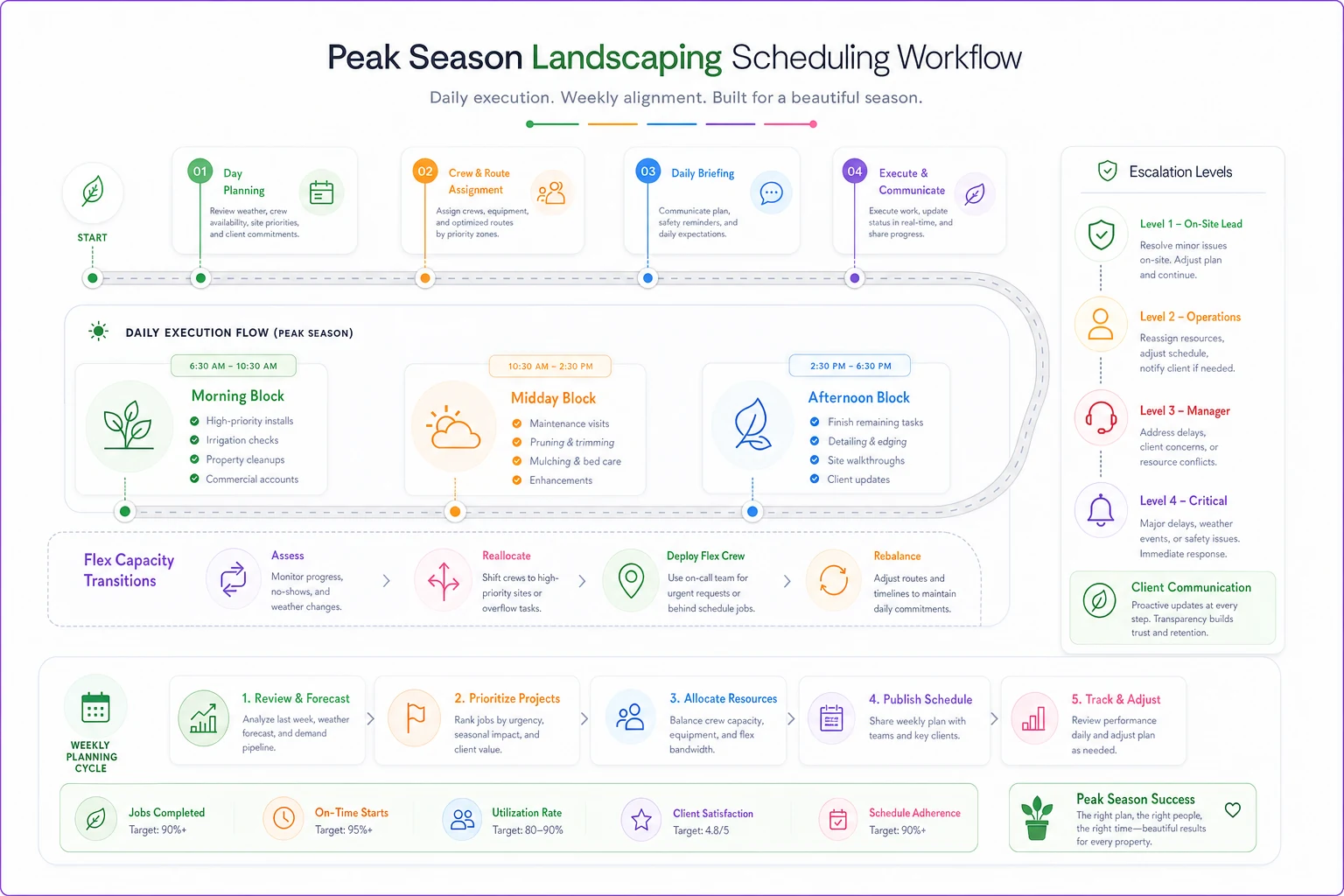
Level 1: Crew Leader Authority
-
Swapping job order within the same day
-
Adding 30 minutes to a job that's running long
-
Skipping a property due to weather or access issues
-
Moving tomorrow's first stop to today if finishing early
Level 2: Operations Manager Decisions
-
Moving jobs between crews
-
Authorizing overtime for specific jobs
-
Pulling equipment from one crew to another
-
Rescheduling this week's work to next week
-
Bringing in the backup crew for a specific day
Level 3: Owner/GM Required
-
Turning down new business due to capacity
-
Hiring additional seasonal crews
-
Major schedule restructuring affecting multiple weeks
-
Disputes with high-value clients about scheduling
-
Subcontracting work that's normally done in-house
The key is that each level has specific, measurable triggers. Not "call the operations manager when things get complicated." More like: "call the operations manager when a job will run more than 2 hours over estimate" or "when weather will affect more than 3 scheduled stops."
One landscape company I worked with had their best crew leader quit mid-season because he was constantly being second-guessed on field decisions. Once they established clear escalation levels, their next crew leader stayed five years. The difference was knowing exactly what he could decide himself versus what needed approval.
Daily and Weekly Templates That Scale
Templates in landscaping scheduling aren't about rigid adherence to a plan. They're about having a starting point that everyone understands. During peak season, you need structure that can flex without breaking.
A daily template for peak season looks different from your regular season schedule. Instead of fixed routes, you work in blocks:
Peak Season Daily Template
Morning Block (7:00-11:00)
-
2 crews on commercial maintenance
-
3 crews on residential route work
-
2 crews on installations
-
1 crew on priority fixes/callbacks
Midday Transition (11:00-12:00)
-
All crews check in via scheduling app
-
Afternoon adjustments made based on morning progress
-
Equipment swaps if needed
Afternoon Block (12:00-5:00)
-
Commercial crews move to residential
-
Installation crews continue or assist maintenance if ahead
-
One crew designated for same-day emergency calls
This block structure means you can shift resources without blowing up the entire day's plan. If installation finishes early, they know to check in for maintenance support. If morning routes run long due to overgrown properties, afternoon blocks adjust without drama.
Here's a simple visual of how the daily and weekly templates flow during peak season.
Weekly templates during peak season need even more structure. Here's what actually works:
| Day | Primary Focus | Secondary | Flex Capacity |
|---|---|---|---|
| Monday | Commercial properties | Quote follow-ups | Installation overflow |
| Tuesday | Residential Route A | Small installs | Emergency calls |
| Wednesday | Residential Route B | Commercial catch-up | Equipment maintenance |
| Thursday | Installations | Route overflow | New client starts |
| Friday | Weekly completion | Next week prep | Cleanup/organization |
| Saturday | Overflow only | Large installs | None |
The flex capacity column is where the system earns its keep. These are your release valves when things get tight. Thursday's installation focus can absorb route overflow from earlier in the week. Friday's completion push keeps problems from carrying into next week.
Codifying Decision Rules for Common Scenarios
The difference between controlled busy and outright chaos comes down to having actual rules for common scheduling decisions. Not guidelines or suggestions—rules that anyone can follow without needing to track down a manager.
Weather Delay Rules:
-
Light rain (under 0.25")
Only chemical applications postponed
-
Moderate rain (0.25-0.5")
Mowing pushed back 24 hours minimum
-
Heavy rain (over 0.5")
All work except emergencies pushed 48 hours
-
Crew reassignment
Automatically moves to garage organization, equipment maintenance, or training
Double-Booking Resolution:
-
Check job types
Installation always takes priority over maintenance
-
Compare client history
2+ year clients prioritized over first-year
-
Evaluate drive time
Job with less travel gets scheduled first
-
Financial impact
Higher-margin job takes precedence if all else equal
New Request Insertion:
-
Emergency (safety/damage)
Same day, bump non-critical maintenance
-
High-value client urgent
Within 48 hours, adjust routes
-
Standard new request
Next available slot, minimum 5 days out
-
Low-priority add-on
Scheduled for next month's route
These rules remove the emotional component from scheduling decisions. Your scheduler doesn't have to feel bad about bumping Mrs. Johnson's lawn because the rules clearly state that property damage repair takes precedence.
Technology Integration Without Losing Control
The best landscaping scheduling systems combine human judgment with operational software that handles the repetitive parts. Not letting an algorithm run your business—using AI-powered tools to enforce rules you've already established.
Modern scheduling platforms can automatically apply your capacity buffers, alerting schedulers when they're approaching yellow or red zones. Instead of manually checking crew hours, the system flags when you're at 85% capacity for tomorrow. Instead of calling each crew leader about equipment, the platform tracks what's assigned where.
Where it gets genuinely useful is pattern recognition. AI-powered operational software can identify that every third Tuesday in April you get slammed with calls because that's when HOAs typically approve spring budgets. It notices that jobs in certain neighborhoods consistently run longer due to terrain. Those insights let you adjust templates before problems hit rather than reacting after the fact.
What makes this different from basic scheduling software is the decision-assistance layer. When your scheduler needs to reorganize jobs after a rain delay, the system suggests optimal options based on your coded rules—factoring in drive time, client priority, crew capabilities, and equipment availability. Stuff that takes a person hours to work through manually.
This isn't about replacing human judgment. Your experienced scheduler still makes the final call, but now they're choosing between pre-validated options instead of starting from scratch. The automation handles the conflict-checking grunt work, while your team focuses on client relationships and quality.
Measuring What Actually Matters
Most landscaping companies track the wrong metrics during peak season. They focus on total jobs completed or revenue per day, and miss the indicators that actually predict whether the scheduling system is working.
Schedule Adherence Rate: Not whether jobs got done, but whether they got done when originally scheduled. If you're constantly reshuffling, the system has fundamental problems. Target: 75% or higher during peak season.
Escalation Frequency: How often Level 2 and 3 decisions are needed. High escalation frequency means your Level 1 rules need adjustment. Target: Fewer than 3 Level 3 escalations per week.
Capacity Zone Time: What percentage of time you spend in each zone. Living in red zone burns out crews and creates quality issues. Target: roughly 60% green, 30% yellow, 10% red maximum.
Client Touch Ratio: How many times you contact a client about the same job. Multiple calls about scheduling the same job suggests a systemic problem. Target: 1.5 or less average touches per job.
Same-Day Completion Rate: Percentage of daily schedules completed without carrying work forward. Constant spillover compounds into bigger scheduling problems fast. Target: 85% or higher.
These metrics reveal whether your scheduling system actually works or just moves problems around. A company completing 200 jobs per week at 60% schedule adherence is in worse shape than one doing 150 jobs at 85% adherence.
Learning from Peak Season Failures
Every landscaping company has scheduling horror stories from peak season, but few actually analyze them in any systematic way. The ones that improve year over year document what broke and adjust their rules accordingly.
A few failure patterns that show up repeatedly:
The expertise assumption failure happens when you assume every crew can handle every job type during busy periods. A new crew might be solid at mowing but disasters at bed edging. Building crew capability matrices prevents this—a simple grid showing which crews can handle which job types at what efficiency levels.
The sequential scheduling trap occurs when jobs must happen in a specific order but nobody tracks the dependencies. Fertilization before mowing, debris removal before mulching, irrigation repair before sod installation. Missing these relationships causes cascade failures where one delay wrecks multiple days.
Commitment creep usually starts innocently. Sales promises a slightly optimistic timeline to land a big job. Operations agrees to squeeze it in. Before long, you're committed to 110% capacity before accounting for any equipment breakdowns or weather delays. Hard capacity caps prevent this—actually refusing new work when at 95% capacity, no exceptions.
The emergency override spiral begins when every client's urgency becomes your emergency. True emergencies like safety hazards or property damage need immediate response. But "emergency" lawn service because relatives are visiting doesn't warrant destroying your entire schedule. Clear emergency definitions stop this from becoming a habit.
Building Your Scheduling System Incrementally
You can't drop a complete scheduling system into the middle of peak season. The smart approach builds incrementally, adding components as your team adapts.
Start with capacity zones. Simply tracking whether you're in green, yellow, or red helps everyone understand the current pressure level. Add basic triggers—workable thresholds, not perfect calculations.
Next, establish Level 1 escalation rules. Give crew leaders clear authority for specific decisions. This immediately reduces bottlenecks and builds trust in the system. Add Level 2 and 3 rules once Level 1 becomes routine.
Daily templates come third. Don't try to optimize from day one—just create basic morning and afternoon blocks that provide structure. Refine them based on what actually happens in the field, not theoretical efficiency.
Only after the basics are working should you add technology automation. The platform should codify rules you've already tested, not create new processes in the middle of busy season. Start with simple schedule visualization, then add conflict checking, then route optimization.
Companies that successfully implement scheduling systems during peak season typically do it over 6-8 weeks, not as a single big overhaul. Each week, add one new component and adjust based on actual results.
Landscaping companies still doing $2 million after ten years often share one frustrating trait—their scheduling falls apart every peak season. They can't scale because they can't reliably deliver what they promise when volume increases.
Companies that build proper scheduling systems grow more consistently because they can handle peak season without sacrificing quality or grinding down their teams. Seasonal spikes stop being survival challenges and start being profit opportunities.
The framework here—capacity buffers, escalation paths, daily templates—isn't complicated. But it requires discipline to implement and stick to. The payoff comes when April arrives and instead of panic, your team shifts into yellow zone operations. Schedulers follow escalation rules instead of calling you for every decision. Crews work from templates that flex without breaking.
More than anything, a proper landscaping scheduling system means you stop dreading peak season. You know tomorrow's schedule will happen roughly as planned, that problems will get resolved at the right level, and that your business can handle whatever spring throws at it.
The choice is straightforward: another season of chaos, or build the system that finally handles it. The framework is here. The only question is whether you'll implement it before next spring arrives.
Ready to grow your landscaping business?
Join 2,000+ landscaping pros using Yardyly to save time, reduce task chaos, and deliver outstanding client results.